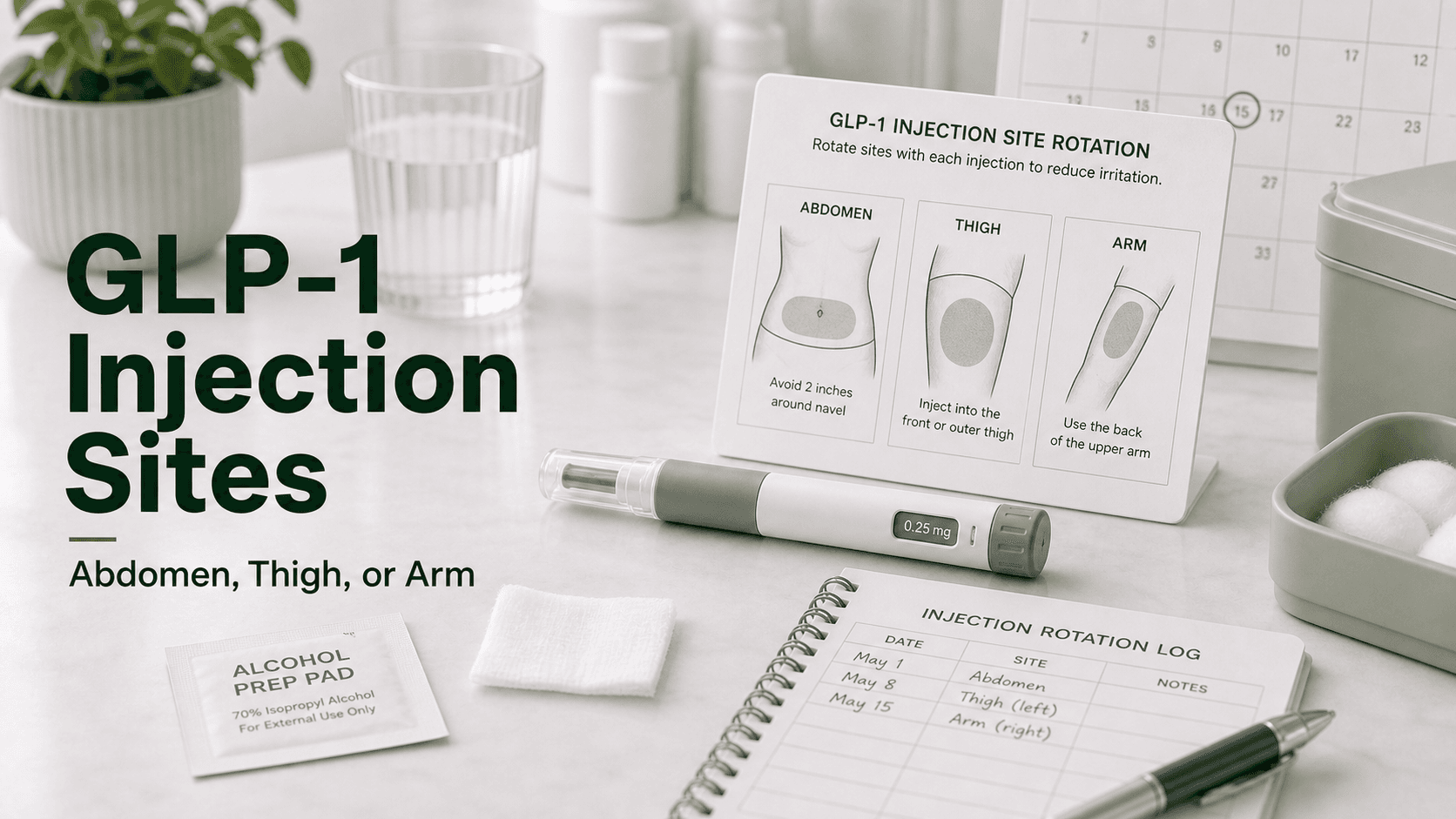
GLP-1 medications like Ozempic, Wegovy, Mounjaro, and Zepbound are subcutaneous injections — they go just under the skin into the fat layer, not into muscle. Three body areas are FDA-approved: abdomen, front-outer thigh, and back of the upper arm. Absorption is close enough to identical that the labels treat the three as interchangeable: both the semaglutide and the tirzepatide prescribing information state that similar exposure is achieved in the abdomen, thigh, or upper arm. The real variable is rotation: as many as two-thirds of patients who inject regularly develop lipohypertrophy (palpable fatty lumps) at some point, which slows absorption and dents the consistency of dosing.
If you are choosing a delivery device, our guide to the GLP-1 injection pen explains how the prefilled pens work.
Direct answer: Inject subcutaneously into the abdomen (stomach, at least 2 inches / two finger-widths from the belly button), the front or outer-front of the thigh between knee and hip, or the back of the upper arm. For semaglutide and tirzepatide the FDA labels report similar exposure from all three, so the best location is simply the one you can see, pinch, and rotate. Rotate every dose — either between body areas or shift at least 1 inch within the same area, keeping any single spot a 4–6 week break between reuses. Pinch a fold of skin, insert at 90° (or 45° if very lean), hold 5 seconds, withdraw, don't rub, dispose in a sharps container.
GLP-1 Injection Site Chart: Where to Inject on Your Body
There is no photograph on this page — here is the same information as a text chart you can follow with the pen already in your hand. Three areas of the body are in play, and nothing else is approved:
ABDOMEN / STOMACH  - front, easiest to reach on your own
+--------------------+--------------------+
|   1  upper left    |   2  upper right   |
|              (o) <-- navel              |
|   4  lower left    |   3  lower right   |
+--------------------+--------------------+
 stay 2 in (5 cm) clear of the navel, below the ribs,
 above the pubic bone, out to wherever you can pinch a fold

THIGH  - front and outer face, middle third only
 hip |=========[ ####### ]=========| knee
 never the inner thigh - vessels and nerves sit shallow there

UPPER ARM  - back and outer, over the triceps
 shoulder |======[ ##### ]======| elbow
 the loose fold at the back of the arm, not the shoulder muscle
The numbers in the abdomen grid are a working rotation order: quadrant 1 this week, 2 next, then 3, then 4, then back to 1 offset by an inch.
| Zone | Where exactly | Solo? | Notes |
|---|---|---|---|
| Abdomen (stomach) | Anywhere on the belly you can pinch a fold, at least 2 inches from the navel, below the rib line, out of the waistband crease | Yes — the easiest site | Largest surface, so the most room to rotate |
| Thigh, front-outer | Middle third of the leg between hip and knee, front or outer face | Yes | Tighter skin — pinch harder and go slower |
| Upper arm, back-outer | Midway between shoulder and elbow, the fleshy back of the arm over the triceps | Realistically no | Mounjaro and Zepbound labels say another person should inject here |
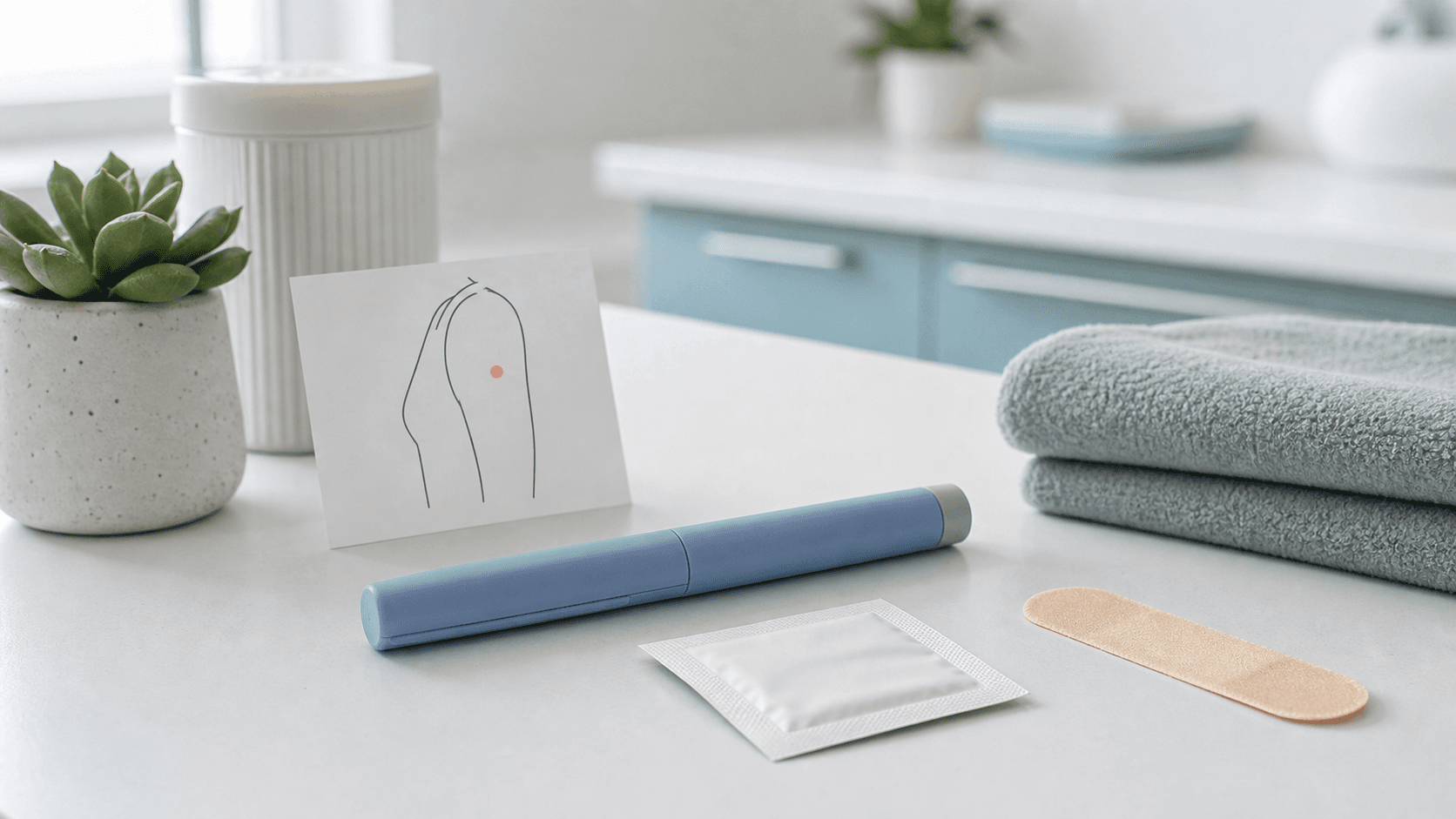
Every pen also ships with an illustrated Instructions for Use leaflet that shades these same zones on a body diagram, and the manufacturers publish the identical diagrams on their patient sites. The picture is worth a look once; after that, the rotation order is what matters.
Thigh and Arm Tips
- Thigh: use the middle third only. The knee end thins out and the hip end runs up toward the groin.
- Thigh: stay off the inner thigh entirely — vessels and nerves sit closer to the surface there.
- Thigh: alternate legs weekly. Left thigh and right thigh count as two separate sites.
- Arm: aim for the loose fold you can pinch at the back of the arm, not the deltoid at the top of the shoulder, which is muscle rather than fat.
- Arm: hand the pen to someone else. Both tirzepatide labels assume a second person for this site.
- Both: do not rub afterward. Zepbound's instructions say to press lightly with gauze or a cotton ball if you see blood, and not to rub the site.
The Three FDA-Approved Sites
| Site | Pros | Cons | Best for |
|---|---|---|---|
| Abdomen (stomach) | Largest area; easiest to self-inject solo; thickest and most consistent fat layer | Lumps appear faster if not rotated | Most people, weekly dosing |
| Thigh (front-outer) | Easy to see and reach sitting down; ample subQ fat in most adults; same labelled exposure as the abdomen | Tighter skin can sting more; harder for very lean people | Backup/second weekly site |
| Upper arm (back, outer — the triceps area) | Discreet; untouched tissue if your belly is over-used | Hard to self-inject solo; the Mounjaro and Zepbound labels say another person should give the arm shot | When abdomen and thigh need a break |
Abdomen
The default for most people on a weekly GLP-1 shot, and the area the patient leaflets call your "stomach":
- Stay at least 2 inches (about two finger-widths) from the belly button
- Use a roughly half-moon shape around the navel, excluding scars, stretch marks, and skin folds
- Skip the immediate waistband area where pants press
Thigh
- Use the front or outer front of the thigh, never the inner thigh (vessels and nerves)
- Halfway between hip and knee
- Pinch generously — thigh skin is tighter than abdominal skin
- Sit down and let the leg go slack before you pinch — a tensed quad is hard to grab
- Semaglutide and tirzepatide labels report similar exposure from thigh and abdomen, and no dose adjustment is needed when you switch a shot from one to the other
Upper Arm
- The fleshy outer back of the upper arm — the loose skin over the triceps, halfway between shoulder and elbow, not the rounded shoulder muscle
- Hard to do solo; ask a partner or skip this site if injecting alone. The Mounjaro and Zepbound labels go further and state that another person should inject the back of the upper arm; the Ozempic and Wegovy labels list the upper arm without that restriction
- Whoever injects should pinch the fold — you cannot reliably pinch your own arm one-handed
- Lean arms may not have enough subcutaneous fat — switch to a shorter needle or 45° angle
Does the Injection Site Change Absorption? Thigh vs Abdomen
For the two drug families almost everyone is on, the answer in the prescribing information is no.
| Drug | Absolute bioavailability | What the FDA label says about the site |
|---|---|---|
| Ozempic, Wegovy (semaglutide) | 89% | "Similar exposure is achieved with subcutaneous administration of semaglutide in the abdomen, thigh, or upper arm." Wegovy adds that the injection site can be changed without dose adjustment. |
| Mounjaro, Zepbound (tirzepatide) | 80% | "Similar exposure was achieved with subcutaneous administration of tirzepatide in the abdomen, thigh, or upper arm." |
| Victoza (liraglutide, daily) | ~55% | The Victoza label reports AUC equivalent between upper arm and abdomen and between upper arm and thigh, with thigh AUC 22% lower than abdomen — yet concludes that "liraglutide exposures were considered comparable among these three subcutaneous injection sites." No dose adjustment for changing site. |
So a real, measured thigh-versus-abdomen gap exists for daily liraglutide and does not exist for the weekly drugs — and even for liraglutide the label calls the three sites comparable.
Which tissue you inject into matters far more than which zone it sits in. Injecting into lipohypertrophy — the thickened, rubbery tissue that builds up where you inject over and over — is the variable that actually moves absorption: in insulin injection-technique research, drug delivered into those areas showed 3 to 5 times more variability than the same dose into normal tissue. A well-rotated thigh beats an over-used abdomen every week of the year.
Why Rotation Matters
Injecting repeatedly in the exact same spot leads to:
- Lipohypertrophy — palpable lumps of thickened fatty tissue, which can "reduce or limit absorption, and may remain for weeks or months." Up to two-thirds of regular injectors develop this at some point.
- Lipoatrophy — pits or depressions where the fat layer thins out instead of thickening. In the insulin literature it is treated as an immune-mediated reaction and has "virtually disappeared" since recombinant human insulin replaced animal-derived preparations
- Slowed or erratic absorption through changed tissue, leading to inconsistent dose response
- Itching, redness, bruising that lingers longer than usual
What the labels themselves say about moving the site:
| Drug | Label wording |
|---|---|
| Ozempic (semaglutide) | "Instruct patients to use a different injection site each week when injecting in the same body region." |
| Wegovy (semaglutide) | "The time of day and the injection site can be changed without dose adjustment." |
| Mounjaro, Zepbound (tirzepatide) | "Rotate injection sites with each dose." |
| Victoza (liraglutide) | "No dosage adjustment is needed if changing the injection site and/or timing." |
Novo Nordisk's pen instructions add the same thing in plain language: change the injection site with each injection, do not use the same site every time, and always use a new needle. Needle reuse is one of the two factors most consistently linked to lipohypertrophy in the injection-technique literature — poor rotation is the other.
Injection-technique guidance developed for insulin puts a floor on the spacing: divide each area into quadrants (halves for the thighs), use one quadrant per week, move in a consistent direction such as clockwise, and keep individual injections at least 1 cm — roughly an adult finger's width — apart. A weekly GLP-1 gives you far more room than a daily insulin regimen, so round that up.
The rule of thumb: keep any specific spot on a 4–6 week break before reusing it.
Two Rotation Patterns That Work
Pattern 1 — Rotate Between Areas
Easiest to remember:
- Week 1: abdomen (left side)
- Week 2: thigh (left)
- Week 3: thigh (right)
- Week 4: abdomen (right side)
- Week 5: upper arm (if available) or back to abdomen
Pattern 2 — Stay in One Area, Shift Position
Pick the abdomen (or thigh), divide mentally into a 2x2 or clock pattern, and move 1+ inch each week:
- Week 1: upper left abdomen
- Week 2: upper right abdomen
- Week 3: lower right abdomen
- Week 4: lower left abdomen
- Week 5: cycle back, but offset slightly
Either approach works. Consistency matters more than the specific pattern.
Technique Step-by-Step
- Wash hands.
- Take the pen out of the fridge 15–30 minutes before — cold injection stings more.
- Choose a site and rotate from last week.
- Clean the skin with an alcohol swab; let it dry. Wet alcohol stings.
- Inspect the medication — clear, colorless, no particles. If cloudy, do not inject.
- Prepare the pen or syringe per the device instructions; remove the cap.
- Pinch a 1–2 inch fold of skin between thumb and index finger.
- Insert at 90° (straight in) for adults of normal weight; consider 45° if very lean.
- Press the button or plunger slowly all the way down.
- Hold for 5–10 seconds to ensure full dose delivery (per pen instructions).
- Withdraw the needle straight out.
- Don't rub — a gentle press with gauze is fine.
- Dispose of the needle in a sharps container, never a regular trash can.
What If Something Goes Wrong
| Issue | What it means | What to do |
|---|---|---|
| Slight bleeding | Nicked a small capillary | Press gently 1 minute. No further action needed. |
| Larger bruise | Hit a deeper vessel | Apply cold pack; resolves in days. |
| Sharp pain into muscle | Needle went too deep | Continue the dose; effect is still therapeutic. Switch to 45° next time. |
| Drop of medication leaks out | Needle came out too fast or pinch released early | Do not redose; small loss does not change response meaningfully. |
| Lump that lasts weeks | Lipohypertrophy | Rotate aggressively away from that spot for 4–8 weeks. |
| Persistent redness > 48 hours | Possible infection or allergic reaction | Contact prescriber. |
Common Mistakes
- Injecting cold medication. Take the pen out of the fridge 15–30 minutes early.
- Reusing needles. Use a new needle every dose. Reusing dulls the tip and increases lump risk.
- Skipping the hold time. Pulling the needle out too fast wastes drug.
- Injecting through clothing. Don't. Skin needs to be clean and visible.
- Using the same spot every time. Even if it feels easier, lipohypertrophy will catch up.
- Aspirating before injection. Not necessary with short subcutaneous needles.
- Injecting into a stretch mark or scar. Absorption is unreliable.
Special Cases
- Pregnant abdomen — switch to thighs or upper arms during pregnancy (though most GLP-1s are contraindicated in pregnancy regardless).
- Visible bruising or skin condition in your usual area — pick a different site that week.
- Recent abdominal surgery — wait until the surgeon clears the area; use thigh in the meantime.
- Very lean body — pinch carefully, consider a 4–6 mm needle, and use a 45° angle to stay in subcutaneous fat.
Storage Right Before Injection
- Refrigerated until first use: standard for sealed pens
- Room temperature is OK for in-use pens for 28–56 days depending on the product
- Take pen out 15–30 minutes before injecting to reduce stinging
- Never inject frozen medication — discard and contact pharmacy
Frequently Asked Questions
Where is the best place to inject a GLP-1? Any of the three FDA-approved sites: abdomen (at least 2 inches from navel), front of thigh, or back of upper arm. Most people choose abdomen because it's easiest.
Does the injection site affect how the drug works? Barely. The semaglutide and tirzepatide labels both report similar exposure from the abdomen, thigh, and upper arm, and no dose adjustment when you switch. The one measured gap is on daily liraglutide, where thigh AUC runs 22% below the abdomen — and even there the label calls the three sites comparable. Tissue quality is the real variable: injecting into lipohypertrophy made absorption 3 to 5 times more variable in insulin studies.
Should I inject in muscle or fat? Always subcutaneous fat. GLP-1 medications are not approved or studied for intramuscular injection.
How often should I rotate sites? Every dose. Keep any specific spot on a 4–6 week break before reusing it. Up to two-thirds of patients develop lipohypertrophy without good rotation.
Is bleeding after injection normal? A drop is normal. Larger bruises resolve on their own. Persistent redness over 48 hours warrants a call to the prescriber.
Can I inject myself in the upper arm? Technically yes, but it's awkward without help, and most people who use the arm have a partner administer it. The Mounjaro and Zepbound labels assume exactly that: they specify that another person injects the back of the upper arm.
Does cold medication hurt more? Yes. Take the pen out of the fridge 15–30 minutes before injecting to reduce stinging.
Can I inject my GLP-1 shot into my thigh? Yes. The Ozempic, Wegovy, Mounjaro, Zepbound, and Victoza labels all name the thigh alongside the abdomen and upper arm, and none of them ranks it lower. Use the middle third of the leg between hip and knee, on the front or outer face — never the inner thigh. Sit down, let the muscle relax, pinch a firm fold, and alternate legs week to week. No dose adjustment is needed when you move a shot from your stomach to your thigh.
Can I shoot a GLP-1 into my arm, and where in the arm exactly? The spot is the fleshy back of the upper arm — the triceps area, roughly midway between shoulder and elbow — not the rounded shoulder muscle. The Mounjaro and Zepbound labels state that another person should give the injection in the back of the upper arm; the Ozempic and Wegovy labels list the upper arm without that restriction. Either way you cannot pinch your own arm properly one-handed, so this location realistically needs a second pair of hands.
Where is the best spot to inject Ozempic? Ozempic's label names the abdomen, thigh, and upper arm and reports similar exposure from all three, so the best location is whichever you can see, pinch, and rotate reliably. The label adds one specific instruction: use a different injection site each week when you keep injecting in the same body region. Novo Nordisk's pen instructions also say to count 6 seconds with the dose button still pressed after the counter reaches 0 — pull out early and a stream of medication can escape from the needle tip.
Is there a picture, diagram, or chart of GLP-1 injection sites? The text chart above maps all three areas with their boundaries, including a four-quadrant abdomen grid you can use as a rotation order. Every pen also ships with an illustrated Instructions for Use leaflet that shades the approved zones on a body diagram, and the manufacturers post the same illustrations on their patient sites. If you want something to stick on the fridge, sketch the four abdomen quadrants and number the weeks — the numbering does more work than the picture.
What is lipoatrophy, and can a GLP-1 cause it? Lipoatrophy is the opposite of a lump: the subcutaneous fat under a repeatedly used site thins out and leaves a dent or hollow. The insulin literature describes it as an immune-mediated reaction and notes it has virtually disappeared since recombinant human insulin replaced animal-derived preparations. There is no published prevalence figure for GLP-1 pens, and the injection-site change reported with regular injectors is lipohypertrophy — raised, rubbery lumps — rather than lipoatrophy. Management is identical either way: stop injecting into the affected area, rotate elsewhere, and let it recover.
Last reviewed: May 13, 2026
Sources
- Best Injection Sites for Semaglutide / GLP-1 Guide — InjectCo
- How to Inject Semaglutide for Weight Loss — Mayo Clinic Diet
- GLP-1 Injection Sites: Where and How to Inject — Family Tree Primary Care
- Advanced Guide to Semaglutide Injection Sites & Rotation Strategy — Skinny Rx
References
- OZEMPIC (semaglutide) injection — Prescribing Information (subcutaneous administration sites), U.S. FDA
- Insulin lipodystrophy and lipohypertrophy (PMC, NIH)
- The Injection Technique Factor: site rotation, lipohypertrophy and absorption (PMC, NIH)
- OZEMPIC (semaglutide) injection — full prescribing information, DailyMed/NIH
- WEGOVY (semaglutide) injection — full prescribing information, DailyMed/NIH
- MOUNJARO (tirzepatide) injection — full prescribing information, DailyMed/NIH
- ZEPBOUND (tirzepatide) injection — full prescribing information, DailyMed/NIH
- VICTOZA (liraglutide) injection — full prescribing information, DailyMed/NIH
- Ozempic Pen administration instructions — NovoMedLink (Novo Nordisk)
- How to use the Zepbound single-dose pen — Eli Lilly