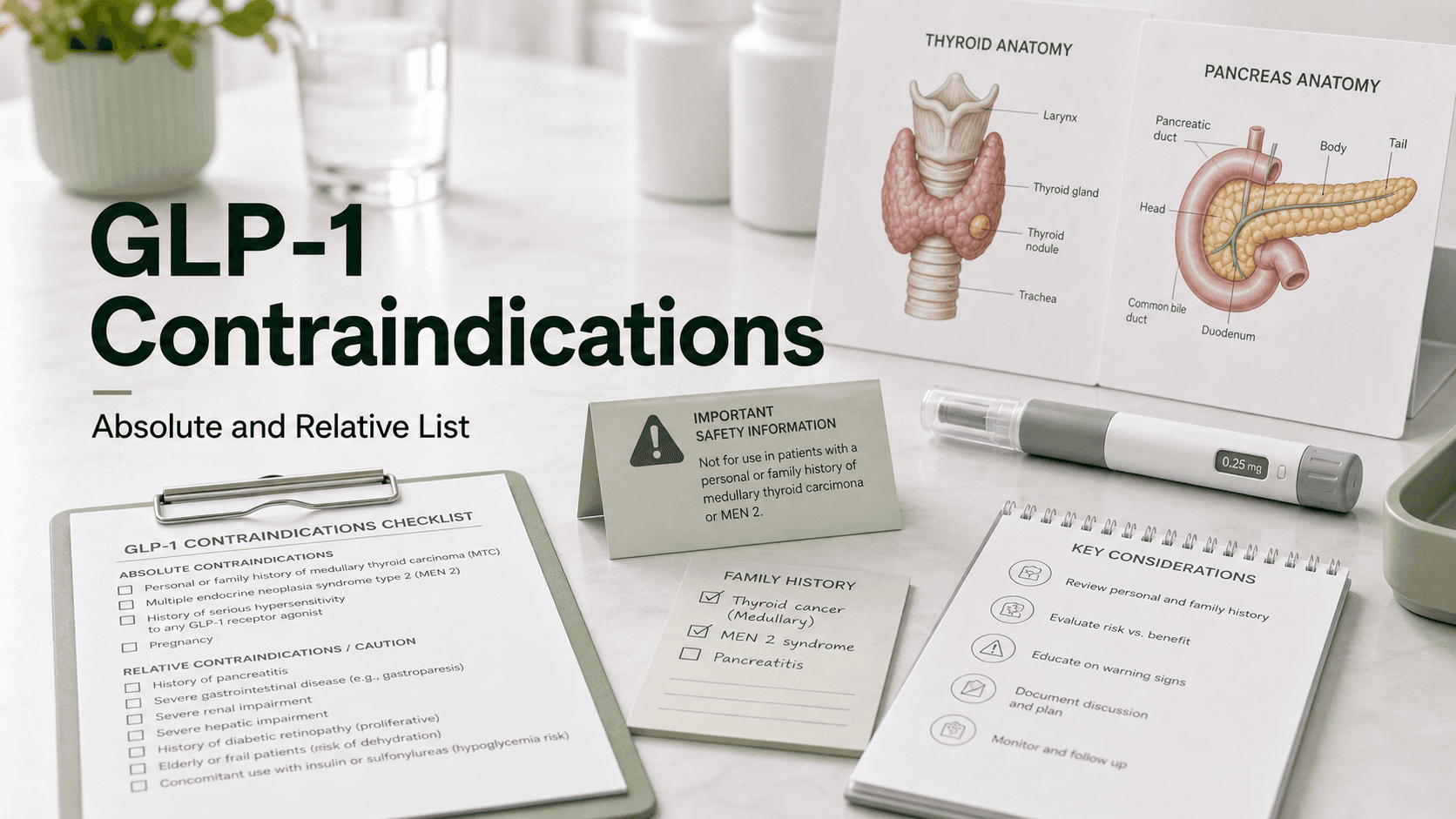
GLP-1 Contraindications: The Complete Absolute and Relative List
The GLP-1 receptor agonist class — written GLP-1 RA in clinical shorthand — carries an FDA boxed warning, the most serious labeling category, for thyroid C-cell tumor risk. Every GLP-1 RA sold in the US carries it except twice-daily exenatide (Byetta), whose label has no boxed warning at all. Beyond that, a small list of conditions absolutely rules out treatment, and a longer list requires explicit risk-benefit conversation, monitoring, or specialty input. Confusing "absolute" with "relative" contraindications leads either to patients taking a drug they shouldn't, or avoiding one they would have done well on.
If a medication is not a fit for you, it helps to weigh GLP-1 therapy versus bariatric surgery.
Direct answer: Absolute contraindications to all FDA-approved GLP-1 receptor agonists (Ozempic, Wegovy, Mounjaro, Zepbound, Rybelsus, Foundayo, Saxenda) are: personal or family history of medullary thyroid carcinoma (MTC), multiple endocrine neoplasia type 2 (MEN2), serious prior hypersensitivity to a GLP-1 (anaphylaxis or angioedema of the face/tongue/throat), pregnancy, and active breastfeeding. Relative contraindications — "discuss explicitly, often proceed with monitoring" — include history of pancreatitis, severe gastroparesis, active gallbladder disease, type 1 diabetes (off-label only), severe inflammatory bowel disease, active diabetic retinopathy, history of suicidal ideation, and certain bariatric surgery contexts.
One precision point, because it decides arguments: only two of those absolute items — MTC/MEN2 history and serious hypersensitivity — are actually printed under Contraindications (Section 4) of the current US labels. Pregnancy and breastfeeding live in Section 8, where the labels tell you to stop the drug when a pregnancy is recognized rather than listing pregnancy in Section 4. Saxenda carried a Section 4 pregnancy contraindication until FDA removed it in May 2025. The practical answer for a pregnant patient is unchanged — do not use it — but the label category is different, and the lookup table further down tracks that difference condition by condition.
Absolute Contraindications
These mean: do not start the drug.
Medullary Thyroid Carcinoma (MTC) and MEN2
The black-box warning. In rodents, GLP-1 receptor agonists caused thyroid C-cell tumors, and the class is contraindicated in patients with a personal or family history of medullary thyroid carcinoma or MEN2. Human data has not confirmed this signal, but given MTC's severity and rarity, the FDA contraindicates GLP-1 use in:
- Personal history of medullary thyroid carcinoma
- Family history of MTC (any degree of relation)
- Multiple endocrine neoplasia type 2 (MEN2)
- C-cell hyperplasia (pre-cancerous condition)
A simple, benign thyroid nodule on its own is not a contraindication. Only the cancer or syndromic forms are.
Note: GLP-1 medications mildly increase calcitonin levels — a marker for MTC. This is one reason MTC families are excluded. The labels are blunt about what to do with that number: routine calcitonin testing or thyroid ultrasound is "of uncertain value for early detection of MTC" and may drive unnecessary procedures, because calcitonin has low test specificity. In the Saxenda trials, 1.2% of treated patients finished with calcitonin at or above twice the upper limit of normal; patients who actually have MTC usually run above 50 ng/L.
Serious Hypersensitivity Reaction
A previous anaphylaxis or angioedema (sudden swelling of the lips, face, tongue, or throat) to a GLP-1 means no GLP-1 of any kind. Cross-reactivity within the class is real, so a serious reaction to one GLP-1 disqualifies you from all of them.
Pregnancy
Animal data show fetal harm. Guidelines:
- Stop a GLP-1 at least 2 months before trying to conceive (semaglutide has a ~1-week half-life and remains active in the body for ~5 weeks after the final dose)
- Discontinue immediately if pregnancy occurs unexpectedly
- Do not initiate in anyone pregnant
Label status: pregnancy is not a Section 4 contraindication on any current US GLP-1 label. The weight-management labels (Wegovy, Zepbound, Saxenda, Foundayo) say "weight loss offers no benefit to a pregnant patient and may cause fetal harm" and instruct discontinuation when a pregnancy is recognized. The diabetes labels use the older formula — use during pregnancy only if the potential benefit justifies the potential risk. The 2-month rule is explicit on the semaglutide labels: discontinue "at least 2 months before" a planned pregnancy, because of the long washout.
Breastfeeding
Insufficient human data on transmission through breast milk, and the labels split by formulation rather than by drug. The oral semaglutide tablets — Rybelsus, Ozempic tablets and Wegovy tablets — say breastfeeding is not recommended, and the reason is the SNAC absorption enhancer, not the semaglutide: SNAC and its metabolites are present in human milk, infants clear it more slowly than adults, and non-SNAC formulations exist. The injectables carry standard benefit-versus-risk language, not a prohibition. Neither is a Section 4 contraindication, so treat this as a strong steer rather than a hard bar, and one worth settling with the prescriber before the first dose.
Relative Contraindications
These mean: discuss explicitly; sometimes proceed with monitoring.
History of Pancreatitis
GLP-1 agonists should not be prescribed in patients with a history of pancreatitis and should be discontinued in anyone who develops it. The data is mixed on whether risk meaningfully rises in patients with prior pancreatitis. Most prescribers will:
- Avoid initiating within 6–12 months of an episode
- Consider cautiously in remote, single-episode cases
- Educate patients on red-flag symptoms (severe upper abdominal pain radiating to the back, vomiting)
What the labels say is softer than that StatPearls line. Acute pancreatitis sits in Section 5 as a warning on every label — 5.2 on Ozempic, 5.5 on Zepbound — with the instruction to discontinue if it is suspected. On prior episodes, Victoza states only that "it is unknown if patients with a history of pancreatitis are at higher risk," and Trulicity carries a Limitation of Use: "Has not been studied in patients with a history of pancreatitis. Consider other antidiabetic therapies in these patients." No US label bars a prior episode outright.
Rapid weight loss on a GLP-1 also increases gallstone risk — and gallstones are themselves a pancreatitis trigger.
Severe Gastroparesis
GLP-1s slow gastric emptying. In patients with significant gastroparesis, this can:
- Worsen symptoms — nausea, fullness, vomiting
- Cause severe constipation
- Raise aspiration risk during anesthesia
- Make symptoms permanent in a small subset of patients
Severe symptomatic gastroparesis is essentially absolute. Mild delayed gastric emptying is a relative contraindication that often requires a GI evaluation first.
This is one of the few relative items with identical wording across the class. Ozempic, Wegovy, the semaglutide tablets, Mounjaro, Zepbound, Saxenda, Byetta and Foundayo all carry the same sentence in Section 5: not recommended in patients with severe gastroparesis. "Not recommended" is a warning, not a contraindication — which is exactly why prescribers differ on it.
Severe Inflammatory Bowel Disease
Crohn's or ulcerative colitis flares can be hard to distinguish from GLP-1-driven GI side effects. Active severe IBD is a relative contraindication; stable, treated IBD is usually fine.
Active Gallbladder Disease
Modest increases in gallstones and cholecystitis observed in trials, especially with rapid weight loss. Active inflammation or obstruction requires medical evaluation before treatment; stable, asymptomatic disease may still be treatable.
Active Diabetic Retinopathy
SUSTAIN-6 showed a small uptick in retinopathy progression with semaglutide, likely tied to rapid A1C reduction. The Ozempic label puts numbers on it: over 2 years in patients with type 2 diabetes and high cardiovascular risk, retinopathy complications occurred in 3.0% on semaglutide versus 1.8% on placebo, and patients with a history of diabetic retinopathy should be monitored. Zepbound's label takes the other approach and simply flags the untested ground — it "has not been studied in patients with non-proliferative diabetic retinopathy requiring acute therapy, proliferative diabetic retinopathy, or diabetic macular edema." Patients with active proliferative diabetic retinopathy should have eye stabilization first.
History of Suicidal Ideation or Self-Harm
FDA and EMA have been evaluating reports of suicidal thoughts in GLP-1 users since 2023. As of April 2026, no causal link has been confirmed in trial data — but:
- Patients with active or recent suicidal ideation need close monitoring
- Mental health screening before starting is increasingly common
- Family and prescriber should be informed of any worsening mood
Label update: FDA has since removed the Suicidal Behavior and Ideation subsection from these labels — from Wegovy in January 2026, and from Zepbound and Saxenda in February 2026, each recorded in the label's Recent Major Changes box. It is no longer a labeled warning on those products, and it was never a contraindication on any of them. Monitoring someone with active ideation still makes sense; a psychiatric history on its own does not block treatment.
Type 1 Diabetes
GLP-1s are not FDA-approved for T1D. Off-label use is sometimes considered as adjunct therapy, but:
- The boxed warnings still apply
- Insulin management becomes more complex (hypoglycemia risk)
- DKA risk can be elevated with significant calorie reduction in T1D
No label lists type 1 diabetes as a contraindication; it is an absent indication. Victoza and Trulicity spell it out in Limitations of Use — "not for treatment of type 1 diabetes mellitus" — while the newer labels simply restrict the indication to adults with type 2.
Chronic Kidney Disease
Most GLP-1s do not require dose adjustment for kidney function. Semaglutide is FDA approved to slow CKD progression in T2D. Caveats:
- Severe GI side effects can cause dehydration and acute kidney injury — monitor in patients with low baseline kidney function
- Exenatide (Byetta) is not recommended in end-stage renal disease or severe renal impairment, defined on the label as creatinine clearance below 30 mL/min, and is to be used with caution after renal transplantation — that is a Section 8.6 statement, not a contraindication. The rest of the class is generally OK
- Ozempic goes further than "allowed": it is indicated to reduce the risk of sustained eGFR decline, end-stage kidney disease and cardiovascular death in adults with type 2 diabetes and CKD
Severe Hepatic Impairment
Most GLP-1s are eliminated by enzymatic degradation, not the liver. Severe liver disease is not a contraindication for most patients, and the semaglutide label backs that up: no clinically significant difference in exposure across mild, moderate and severe hepatic impairment (Child-Pugh Class A through C). Wegovy injection now carries an accelerated-approval indication for noncirrhotic MASH with moderate to advanced fibrosis (F2 to F3) in adults — note the word noncirrhotic. Practical advice: avoid in decompensated cirrhosis until specialist guidance.
Older Adults
Not a contraindication, but increased risk of lean muscle mass loss during weight loss in patients already at risk for sarcopenia. Mitigated with:
- Adequate protein (1.2–1.6 g/kg body weight per day)
- Resistance training 2–3× weekly
- Slower titration
Children Under 12
Age limits are per drug and per indication, and they do not all land at 12. The diabetes drugs reach younger patients than the weight drugs:
| Drug | Youngest labeled age | Indication at that age |
|---|---|---|
| Victoza (liraglutide) | 10 | Type 2 diabetes |
| Trulicity (dulaglutide) | 10 | Type 2 diabetes |
| Mounjaro (tirzepatide) | 10 | Type 2 diabetes |
| Saxenda (liraglutide) | 12, and body weight above 60 kg | Chronic weight management |
| Wegovy injection (semaglutide) | 12 | Obesity |
| Ozempic, Rybelsus, Ozempic tablets, Wegovy tablets | Adults only | Safety and effectiveness not established in pediatric patients |
| Zepbound, Foundayo, Byetta | Adults only | Safety and effectiveness not established in pediatric patients |
Being under the labeled age is not a contraindication in the Section 4 sense — it is untested ground, which is why the label says "have not been established" rather than "contraindicated." The boxed warning and every Section 4 item still apply at any age. Always check the indication for the specific drug.
Bariatric Surgery History
Compatibility depends on the type:
| Surgery | Compatibility with GLP-1 |
|---|---|
| Gastric sleeve | Usually compatible; often used to maintain or accelerate loss |
| Gastric bypass | Compatible, but altered absorption affects oral formulations |
| Duodenal switch | Caution — significant motility changes |
| Adjustable gastric band | Compatible, common combination |
Talk with the bariatric surgeon, especially in the first 12 months post-op.
Contraindication Lookup: Condition, Label Category, Which Drugs
"Contraindication" gets used loosely. On an FDA label it means one specific thing: an item printed under Section 4, Contraindications. Everything else sits in a weaker category — the boxed warning at the top, a Warning and Precaution (Section 5), a Limitation of Use (Section 1), or a note in Use in Specific Populations (Section 8). Prescribers argue about the Section 5 items; almost nobody argues about Section 4. This table is checked line by line against the current US prescribing information for each drug.
| Condition | Label category | Which drugs | What the label actually says |
|---|---|---|---|
| Personal or family history of MTC | Contraindication (Section 4) + boxed warning | Semaglutide (Ozempic, Wegovy, Rybelsus), tirzepatide (Mounjaro, Zepbound), liraglutide (Saxenda, Victoza), dulaglutide (Trulicity), orforglipron (Foundayo) — every one except Byetta | "Contraindicated in patients with a personal or family history of medullary thyroid carcinoma" |
| MEN2 | Contraindication (Section 4) + boxed warning | Same list | Named in the same sentence as MTC |
| Prior serious hypersensitivity (anaphylaxis, angioedema) | Contraindication (Section 4) | Every GLP-1 RA, Byetta included | "Known serious hypersensitivity to [drug] or any of the excipients" |
| Prior immune-mediated thrombocytopenia from exenatide | Contraindication (Section 4) | Byetta only | "History of drug-induced immune-mediated thrombocytopenia from exenatide products" — serious, sometimes fatal bleeding |
| Pregnancy | Not Section 4 on any current label; Section 8.1 instruction | Class-wide, with different wording for weight vs diabetes labels | "Weight loss offers no benefit to a pregnant patient and may cause fetal harm... discontinue when a pregnancy is recognized." Saxenda's Section 4 pregnancy contraindication was removed in May 2025 |
| Breastfeeding | Not Section 4; Section 8.2 | Tablets: Rybelsus, Ozempic tablets, Wegovy tablets | "Breastfeeding is not recommended" for the SNAC-containing tablets; injectables get benefit-versus-risk language instead |
| Severe gastroparesis | Warning (Section 5) | Ozempic, Wegovy, semaglutide tablets, Mounjaro, Zepbound, Saxenda, Byetta, Foundayo | "[Drug] is not recommended in patients with severe gastroparesis" |
| History of pancreatitis | Not a contraindication anywhere | Trulicity carries the strongest wording | "Has not been studied in patients with a history of pancreatitis. Consider other antidiabetic therapies in these patients" (Trulicity, Limitations of Use) |
| Acute pancreatitis while on treatment | Warning (Section 5) | Class-wide | "If pancreatitis is suspected, discontinue [drug] and initiate appropriate management" |
| Active gallbladder disease | Warning (Section 5) | Semaglutide and tirzepatide labels | "If cholelithiasis or cholecystitis are suspected, gallbladder studies are indicated" |
| Diabetic retinopathy | Warning (Section 5) | Ozempic, Wegovy, Mounjaro, Zepbound, Trulicity, Foundayo | Ozempic: 3.0% vs 1.8% retinopathy complications over 2 years. Zepbound: "has not been studied in patients with... proliferative diabetic retinopathy, or diabetic macular edema" |
| General anesthesia or deep sedation | Warning (Section 5) | Added class-wide | "Rare postmarketing reports of pulmonary aspiration... who had residual gastric contents despite reported adherence to preoperative fasting recommendations" |
| Type 1 diabetes | Not a contraindication; an absent indication | Victoza and Trulicity say it outright | "Not for treatment of type 1 diabetes mellitus" |
| Severe renal impairment or ESRD | Not a contraindication | Byetta specifically | "Not recommended for use in patients with end-stage renal disease or severe renal impairment (creatinine clearance <30 mL/min)." Ozempic is indicated in type 2 diabetes with CKD |
| Severe hepatic impairment | Not a contraindication | Semaglutide studied across Child-Pugh A to C | No clinically significant difference in semaglutide exposure by hepatic impairment |
| Resting heart rate increase | Warning (Section 5.5) | Saxenda only | "Monitor heart rate at regular intervals" — mean rise 2 to 3 bpm, tachycardia reported in 0.6% |
| Below the labeled age | Not a contraindication; untested | See the pediatric table above | "Safety and effectiveness have not been established in pediatric patients" |
| Thyroid nodules, papillary or follicular thyroid cancer | Not on any label | — | Only MTC and MEN2 appear anywhere in Section 4 |
Items That Are Drug-Specific, Not Class-Wide
Most "GLP-1 contraindication" lists online flatten the class into one set of rules. These six do not generalize:
| Item | Drug | Detail |
|---|---|---|
| No boxed warning, no MTC contraindication | Byetta (exenatide twice daily) | The only GLP-1 RA on the US market whose label carries neither |
| Boxed warning despite negative rodent data | Foundayo (orforglipron) | The label states orforglipron "is not pharmacologically active in rats or mice and did not produce tumors in rodents" — the class warning and the MTC contraindication are applied anyway |
| Thrombocytopenia contraindication | Byetta | Drug-induced immune-mediated thrombocytopenia from any exenatide product rules out Byetta permanently |
| Oral contraceptive backup | Mounjaro, Zepbound | Switch to a non-oral method or add a barrier method for 4 weeks after starting and 4 weeks after every dose escalation |
| Heart-rate monitoring instruction | Saxenda | The only GLP-1 label that tells the prescriber to monitor heart rate at regular intervals |
| CYP3A4 and simvastatin limits | Foundayo | Max 9 mg daily alongside a strong CYP3A4 inhibitor, avoid strong inducers, and do not exceed simvastatin 20 mg daily |
Conditions That Are NOT Contraindications (Despite Common Confusion)
- Simple benign thyroid nodules — only MTC and MEN2 are contraindications
- Other thyroid cancers (papillary, follicular) — not contraindicated by current labeling
- Mild GERD — often improves on GLP-1, though can worsen for some
- Gallstones in remission — caution, but not a hard contraindication
- Hypertension — improves with weight loss
- Mild-to-moderate kidney disease — usually fine; semaglutide is approved for CKD in diabetes
- Most autoimmune conditions — not contraindicated unless GI involvement is severe
- Most other diabetes medications — usually compatible (insulin and sulfonylureas need dose adjustment to avoid hypoglycemia)
- Atrial fibrillation and other irregular heart rhythms — no GLP-1 label names arrhythmia, AFib or palpitations in Section 4 or Section 5; the labeled cardiac finding is a 1 to 3 bpm rise in resting heart rate
- Iron deficiency and anemia — neither appears in the contraindications or warnings of any GLP-1 label; iron status is a monitoring question during rapid weight loss, not a bar to starting
- Systemic vasculitis, lupus, rheumatoid arthritis and psoriasis — none are named on any GLP-1 label; the only autoimmune overlap that matters clinically is severe active bowel inflammation, because a flare and the drug's own GI effects look alike
- Hiatal hernia, or a prior fundoplication or hernia repair — not named on any label; the labeled GI limit is severe gastroparesis, so what a prescriber works from is how your stomach empties now, not the operation on your chart
- A psychiatric diagnosis — depression, anxiety, bipolar disorder and ADHD are not named on any label, and the suicidality warning was removed from the Wegovy, Zepbound and Saxenda labels in early 2026
- MRI, CT and other imaging — no GLP-1 label mentions any imaging study; sedation, not the scan, is the labeled issue
Drug Interactions to Discuss
GLP-1s don't have many serious drug interactions, but several are worth specific attention:
| Class / Drug | Issue | Action |
|---|---|---|
| Insulin and sulfonylureas | Hypoglycemia risk | Usually need dose reduction |
| Oral contraceptives | Tirzepatide may reduce their efficacy through delayed gastric emptying; the delay is largest after the first dose | Labeled instruction for Mounjaro and Zepbound: switch to a non-oral method, or add a barrier method, for 4 weeks after initiation and 4 weeks after each dose escalation. Non-oral hormonal contraceptives are unaffected |
| Warfarin | Named on the labels as the example of a narrow-therapeutic-index oral drug; Byetta has postmarketing reports of raised INR, sometimes with bleeding | Mounjaro, Zepbound and Trulicity: monitor drug levels. Byetta: monitor INR frequently until stable when starting or changing the dose |
| Levothyroxine | Levothyroxine exposure rose 33% when given with oral semaglutide in a drug-interaction study — an increase, not the reduction most people assume | Consider extra clinical or laboratory monitoring; also coordinate around the tablets' empty-stomach dosing rule |
| Antibiotics with absorption rate considerations | May see slowed onset | Adjust as needed |
| Digoxin | Liraglutide cut digoxin AUC by 16% and Cmax by 31%; exenatide cut Cmax by 17% and delayed Tmax by about 2.5 hours. These are pharmacokinetic findings, not labeled dose changes | Monitor if you sit near the therapeutic edge |
| Strong CYP3A4 inhibitors and inducers | Foundayo (orforglipron) only — it is a small molecule, so unlike the peptides it is metabolized through CYP3A4 | Cap Foundayo at 9 mg daily with a strong inhibitor, avoid strong inducers, and avoid inhibitors that also block OATP1B |
| Simvastatin | Foundayo raises simvastatin exposure | Do not exceed simvastatin 20 mg once daily |
| Other GI motility drugs | Compounded slowing effects | Discuss explicitly |
Pre-Surgical Guidelines
Many surgical societies have issued GLP-1 protocols since 2023 due to aspiration risk from delayed gastric emptying during anesthesia. Common guidance:
- Pause weekly GLP-1s for 7+ days before elective surgery
- Pause daily GLP-1s for 24 hours before elective surgery
- Pre-op clear liquid diet for 24 hours if anesthesia is planned
- Coordinate with anesthesia team for any procedure with sedation
Emergency surgery on a GLP-1 patient is treated as "full stomach" for aspiration precautions.
What the labels say is narrower than what the societies advise, and the gap is worth knowing before an argument with a scheduler. Every current US label carries the same Section 5 wording: rare postmarketing reports of pulmonary aspiration in patients on a GLP-1 RA undergoing elective surgery or a procedure requiring general anesthesia or deep sedation, who had residual gastric contents "despite reported adherence to preoperative fasting recommendations." Then the labels say plainly that "available data are insufficient to inform recommendations to mitigate the risk," including whether holding the drug or changing the fasting rules would help. The only instruction to the prescriber is to tell patients to disclose planned procedures.
The 2024 multisociety guidance (American Gastroenterological Association, ASMBS, ISPCOP and SAGES, affirmed by the American Society of Anesthesiologists) fills that gap with shared decision-making rather than a blanket hold:
- Timing: the original ASA schedule stands — hold the day of surgery for daily formulations, one week before for weekly formulations
- Diet: a liquid diet for at least 24 hours, as used before colonoscopy and bariatric surgery, when there is clinical concern about delayed emptying
- Assessment: point-of-care gastric ultrasound to check for retained contents where the equipment and expertise exist
- Airway: weigh rapid sequence induction against cancelling the case, rather than defaulting to cancellation
Side Effect Rate Context
For context on what "common" looks like at therapeutic doses:
- Nausea occurs in roughly 44% of semaglutide trial participants during titration
- Effects typically improve within 2–4 weeks at stable dose
- Discontinuation due to side effects: 3–10% depending on drug and dose
What People Get Wrong About Contraindications
- "I have a thyroid nodule, so I cannot take a GLP-1." Only MTC, MEN2, or C-cell hyperplasia are contraindications. Most thyroid nodules are not relevant.
- "My kidney disease means I cannot have one." Semaglutide is actually approved to slow CKD progression in T2D.
- "One episode of pancreatitis ten years ago disqualifies me forever." Remote, single episodes are usually a discussion, not a hard no.
- "I can stay on it through pregnancy." No. Stop two months before conception.
- "My doctor said I shouldn't have surgery on GLP-1." Many can have surgery — they just need to pause the drug for 7+ days (weekly) or 24 hours (daily) and coordinate with anesthesia.
- "It conflicts with my birth control forever." Not forever, but longer than most people are told: the Mounjaro and Zepbound labels ask for a non-oral or barrier method for 4 weeks after starting and for 4 weeks after each dose increase. On a slow titration that is several separate windows, not one. Non-oral hormonal contraceptives are not affected, and the semaglutide labels carry no contraceptive instruction at all.
Frequently Asked Questions
Who absolutely cannot take a GLP-1? Anyone with personal or family history of medullary thyroid carcinoma, MEN2, C-cell hyperplasia, prior serious hypersensitivity (anaphylaxis or angioedema), pregnancy, or active breastfeeding.
What is a contraindication for GLP-1 RA use? Two things, on the current US labels: a personal or family history of medullary thyroid carcinoma or MEN2, and a prior serious hypersensitivity reaction — anaphylaxis or angioedema — to the drug or any of its excipients. Those are the only items printed under Section 4 for semaglutide, tirzepatide, liraglutide, dulaglutide and orforglipron. Byetta (exenatide) is the exception in both directions: no thyroid contraindication, and its own Section 4 entry for prior drug-induced immune-mediated thrombocytopenia from exenatide. Everything else you have read about — pancreatitis history, severe gastroparesis, gallbladder disease, retinopathy — is a Section 5 warning, not a contraindication.
Can I take a GLP-1 if I had pancreatitis years ago? Possibly, with a careful discussion. Recent episodes are usually a reason to avoid; remote single episodes are case-by-case.
Is gastroparesis a contraindication? Severe symptomatic gastroparesis effectively is. Mild delayed gastric emptying is a relative contraindication that usually requires GI evaluation first.
Can I take a GLP-1 if I have kidney disease? Often yes. Semaglutide is FDA approved to slow CKD progression in T2D.
Are there contraindications specific to Mounjaro vs Wegovy? The class-wide contraindications apply to both. Tirzepatide has the additional 4-week oral contraceptive precaution during titration. Specific package inserts include drug-specific cautions.
What about surgery? Most surgical societies recommend pausing weekly GLP-1s for 7+ days before elective surgery, daily GLP-1s for 24 hours, to reduce aspiration risk from delayed gastric emptying.
How long after stopping a GLP-1 is it safe to get pregnant? At least 2 months. Semaglutide's long half-life means it stays active in the body for ~5 weeks after the final dose.
Is it safe to have an MRI while taking a GLP-1? No GLP-1 label names MRI, CT, or contrast dye as a contraindication or a precaution. The drug is not an implant, so there is nothing in your body for the magnet to act on, and an awake scan needs no change to your dosing. The one procedure-related warning on these labels is pulmonary aspiration during general anesthesia or deep sedation — so the question only becomes real if your scan is being done under sedation, which happens with claustrophobia, long cardiac studies and young children. Tell the sedation team you are on a GLP-1. Leave the pen and needles with your belongings rather than carrying them in: loose metal stays out of the scanner room, which is a standard MRI screening rule and nothing to do with the drug.
Is an irregular heartbeat or atrial fibrillation a contraindication? Not on any label. No GLP-1 prescribing information lists arrhythmia, atrial fibrillation or palpitations under Contraindications. The labeled cardiac finding is a small rise in resting heart rate: 2 to 3 bpm on average for Ozempic and Saxenda, 1 to 3 bpm for Zepbound. Only Saxenda turns that into an instruction — "monitor heart rate at regular intervals" — and its trials recorded tachycardia as an adverse reaction in 0.6% of treated patients. An existing rhythm problem is a conversation with your cardiologist, not an automatic no.
Are psychiatric conditions or infertility contraindications? Neither is named under Contraindications on any GLP-1 label. Suicidal behavior and ideation was a Section 5 warning until FDA removed it — from Wegovy in January 2026, from Zepbound and Saxenda in February 2026 — so it is not currently a labeled warning on those products, and it was never a contraindication. Depression, anxiety, bipolar disorder and ADHD appear nowhere on the labels. Infertility is not named either, and no GLP-1 is approved to treat it. The labeled reproductive instructions run the other way: stop semaglutide at least 2 months before a planned pregnancy, and use a non-oral or backup contraceptive for 4 weeks after starting tirzepatide and after each dose increase.
Which GLP-1s can children and teenagers take? Victoza, Trulicity and Mounjaro are labeled from age 10 for type 2 diabetes. Saxenda is labeled from 12 for chronic weight management, with a body weight above 60 kg. Wegovy injection is labeled from 12 for obesity. Everything else — Ozempic, Rybelsus, Ozempic tablets, Wegovy tablets, Zepbound, Foundayo and Byetta — is adults only, with the label saying safety and effectiveness "have not been established" in children rather than calling it a contraindication.
Is systemic vasculitis or another autoimmune condition a contraindication? No. Vasculitis, lupus, rheumatoid arthritis and psoriasis are not named anywhere in the contraindications or warnings of any GLP-1 label. The one autoimmune overlap that matters in practice is severe active bowel inflammation, because a Crohn's or colitis flare and the drug's own GI side effects are hard to tell apart — a timing question for the specialist rather than a label rule.
Last reviewed: August 20, 2026
Sources
- GLP-1 Safety: Side Effects, Drug Interactions, and Who Shouldn't Take Them — Medical Foundation of NC
- Who Shouldn't Take GLP-1 Medications — Potere Health MD
- GLP-1 Contraindications Reference for Prescribers — Trimi
- GLP-1 Contraindications Safety Checklist — Peptide Dossier
- GLP-1 Agonists — Cleveland Clinic
- OZEMPIC (semaglutide) injection — FDA prescribing information, DailyMed
- WEGOVY (semaglutide) injection and tablets — FDA prescribing information, DailyMed
- RYBELSUS and OZEMPIC (oral semaglutide) tablets — FDA prescribing information, DailyMed
- MOUNJARO (tirzepatide) injection — FDA prescribing information, DailyMed
- ZEPBOUND (tirzepatide) injection — FDA prescribing information, DailyMed
- SAXENDA (liraglutide) injection — FDA prescribing information, DailyMed
- VICTOZA (liraglutide) injection — FDA prescribing information, DailyMed
- TRULICITY (dulaglutide) injection — FDA prescribing information, DailyMed
- BYETTA (exenatide) injection — FDA prescribing information, DailyMed
- FOUNDAYO (orforglipron) tablets — FDA prescribing information, DailyMed
- Multisociety Clinical Practice Guidance for the Safe Use of GLP-1 Receptor Agonists in the Perioperative Period — AGA, ASMBS, ISPCOP, SAGES, affirmed by ASA
References
- Collins L, Costello RA. Glucagon-Like Peptide-1 Receptor Agonists. StatPearls. NCBI Bookshelf. NCBI Bookshelf
- Wilding JPH, Batterham RL, Calanna S, et al. Once-Weekly Semaglutide in Adults with Overweight or Obesity (STEP 1). New England Journal of Medicine. 2021. PubMed