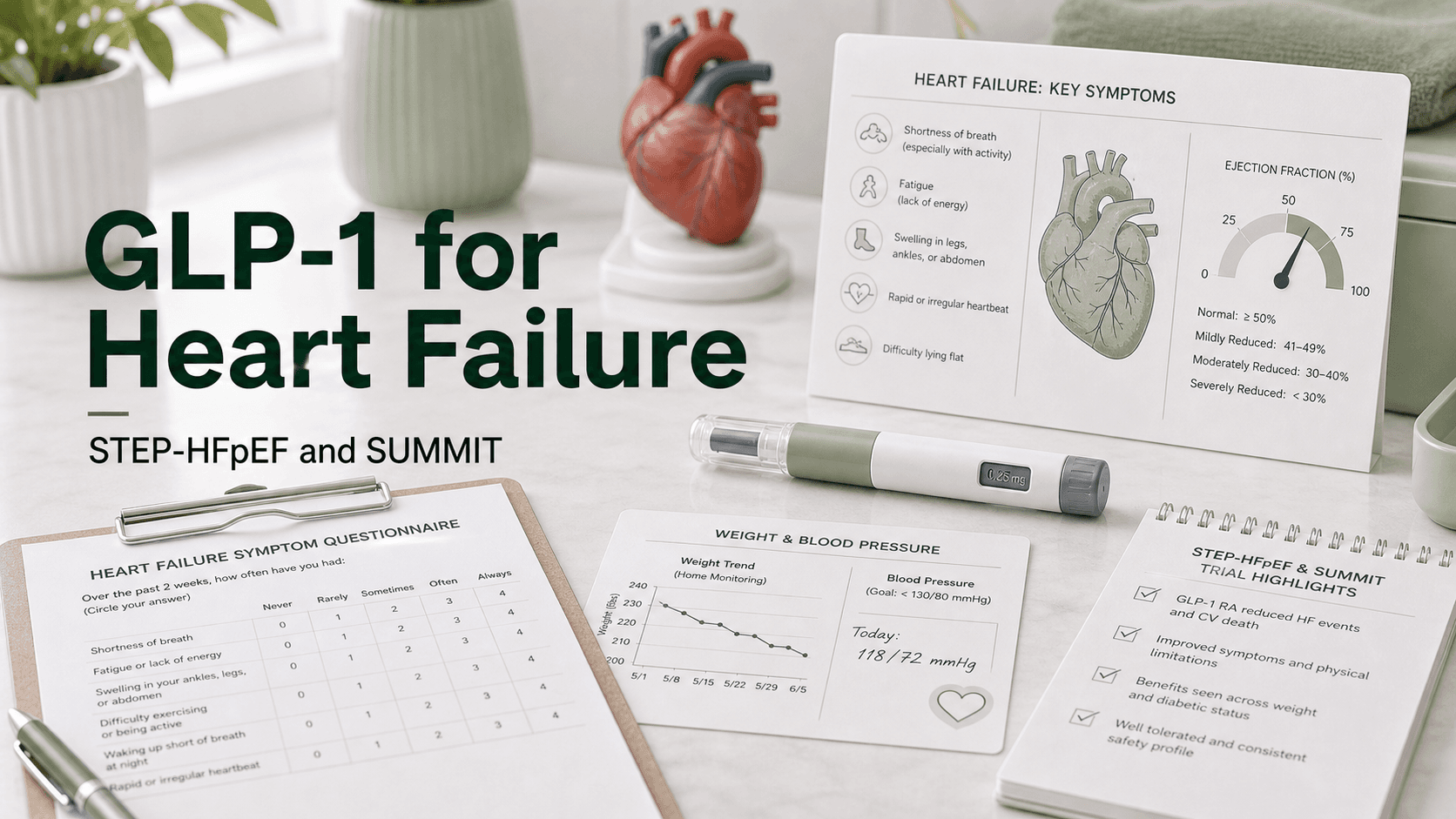

Heart palpitations can feel like a racing, fluttering, pounding, or skipped heartbeat. On GLP-1 medications, they deserve context.
Short answer: palpitations may relate to dehydration, low calorie intake, caffeine changes, anxiety, vomiting or diarrhea, low blood sugar risk, electrolyte shifts, or small heart-rate increases seen with some GLP-1 medications. New, severe, or persistent palpitations should be discussed with a clinician.
Common Triggers to Check
| Trigger | Why it matters |
|---|---|
| Dehydration | Lower fluid volume can raise heart rate |
| Under-eating | Can cause shakiness and adrenaline symptoms |
| Low blood sugar | Especially with insulin or sulfonylureas |
| Caffeine | Appetite changes can change tolerance |
| Vomiting or diarrhea | Fluid and electrolyte losses |
| Anxiety or poor sleep | Can amplify heartbeat awareness |
How Much GLP-1s Actually Raise Heart Rate
A small rise in resting heart rate is a labeled effect of every drug in this class. The size of it is the part that gets lost online.
| Product | Mean resting heart rate change | Placebo arm in the same trials |
|---|---|---|
| Wegovy (semaglutide 2.4 mg) | +1 to 4 bpm | Reference group |
| Ozempic (semaglutide 0.5 mg and 1 mg) | +2 to 3 bpm | Mean decrease of 0.3 bpm |
| Zepbound (tirzepatide) | +1 to 3 bpm | No increase |
| Mounjaro (tirzepatide) | +2 to 4 bpm | +1 bpm |
Averages hide individual swings, and the labels report those too.
- On Wegovy, more adults than placebo recorded a maximum change from baseline at some visit of 10 to 19 bpm (41% vs 34%) and of 20 bpm or more (26% vs 16%).
- On Mounjaro, episodes of sinus tachycardia accompanied by a rise of at least 15 bpm from baseline were reported in 4.6% at 5 mg, 5.9% at 10 mg and 10% at 15 mg, against 4.3% on placebo. The label calls the clinical relevance of these heart rate increases uncertain.
Two useful conclusions. A few beats per minute is not what a pounding chest feels like, so when the sensation is dramatic the triggers in the table above are usually doing more work than the drug's average effect. And the swing data are dose-related for tirzepatide, which makes a recent step up a real line of inquiry rather than a coincidence.
How to Stop a Racing Heart on a GLP-1
There is no maneuver that stops a GLP-1-related racing heart on demand. What works is identifying which trigger is driving it, because two of the common ones, dehydration and low blood sugar, are correctable within the hour, and the rest are dose and prescriber decisions.
Step 1: get a number. Count your pulse at the wrist for a full 60 seconds while seated, not straight after standing, eating, or climbing stairs. In adults, a resting rate above 100 bpm meets the definition of tachycardia. A single reading of 105 after coffee and a flight of stairs is different information from 105 measured cold on three separate mornings.
Step 2: match the number to a trigger.
| What you find alongside it | What it points at | Next step |
|---|---|---|
| Vomiting, diarrhea, or a day of poor fluid intake behind it | Volume depletion, the scenario behind semaglutide's labeled kidney warning | Rehydrate with fluid and electrolytes, and tell the prescriber if you cannot keep fluids down |
| Sweating, shaking or hunger with it, and you take insulin or a sulfonylurea | Low blood sugar, which lists fast heartbeat among its symptoms in the Ozempic and Zepbound medication guides | Check glucose and follow the hypoglycemia plan your clinician gave you |
| More coffee or energy drinks than usual, or a short night | Stimulant and sleep load rather than the injection | Hold caffeine steady for several days and see whether the episodes track it |
| It started within days of a dose increase and nothing else changed | Dose escalation, which is dose-related for tirzepatide in the label data above | Ask the prescriber whether to sit on the current dose instead of stepping up; do not adjust it yourself |
| A resting pulse that stays elevated across several days of readings | A sustained increase in resting heart rate | This is the label's own stopping trigger, described next |
Step 3: use the label's rule for when the drug itself has to change. Wegovy's prescribing information tells clinicians to monitor heart rate at regular intervals, instructs patients to inform their healthcare providers of palpitations or the feeling of a racing heartbeat at rest, and states that if a patient experiences a sustained increase in resting heart rate, the drug should be discontinued. That is a prescriber decision, and it depends on someone having the resting-pulse readings to show. Keeping the log described in the next section is what makes that conversation possible.
Nothing in this section applies while any item on the Red Flags list is present. Those go to urgent evaluation first, and the trigger hunt happens afterward.
Red Flags
Seek urgent care for palpitations with chest pain, shortness of breath, fainting, severe dizziness, one-sided weakness, confusion, sustained very fast heart rate, irregular rhythm that does not settle, or symptoms after a dosing error.
What to Track
Track pulse, blood pressure if available, hydration, recent dose changes, caffeine, alcohol, food intake, vomiting or diarrhea, glucose readings if diabetic, and other medications.
Internal Reading Path
FAQ
Can GLP-1 medications increase heart rate?
Some GLP-1 medications are associated with heart-rate changes, on average a rise of a few beats per minute. A clinician should interpret this in the context of symptoms and history.
Are palpitations always dangerous?
No, but new, persistent, severe, or symptom-associated palpitations need medical review.
Can dehydration cause palpitations?
Yes. Fluid loss and low intake can contribute.
Is a resting pulse over 100 normal on a GLP-1?
No. Above 100 bpm at rest in an adult is tachycardia, and the labeled average effect of these drugs is a rise of roughly 1 to 4 bpm, so the average effect does not explain it on its own. Report a resting pulse that stays that high across several days, because a sustained increase in resting heart rate is the point at which Wegovy's label instructs discontinuation.
Why This Symptom Can Happen on GLP-1 Treatment
GLP-1 Heart Palpitations: Racing Heart, Triggers, and Red Flags usually needs to be understood in the context of delayed gastric emptying, appetite suppression, dose escalation, lower food intake, hydration changes, and other medications. GLP-1 and GIP/GLP-1 drugs can change how quickly food moves, how full someone feels, and how much they naturally eat or drink. Those changes can improve weight and glucose outcomes, but they can also create side effects when the dose, meal pattern, or hydration plan is not matched to the person's tolerance.
Symptoms often show up during the first few weeks or after a dose increase. They can also appear after a large meal, high-fat meal, alcohol, dehydration, constipation, or a long gap between meals. The timing is useful because it helps a clinician decide whether the symptom is likely dose-related, food-pattern related, or possibly unrelated to the medication.
First 24 to 48 Hours: What to Track
A useful symptom log does not need to be complicated. Record the dose date, dose strength, meals, fluids, bowel movements, alcohol, caffeine, exercise, and any other medications. Include severity from 1 to 10 and whether the symptom affects eating, drinking, sleeping, work, or exercise.
| Track this | Why it helps |
|---|---|
| Dose timing | Symptoms may peak after injection or escalation |
| Meal size and fat content | Large or greasy meals often worsen GI symptoms |
| Fluid intake | Dehydration can worsen headache, dizziness, constipation, and palpitations |
| Bowel pattern | Constipation can drive bloating, reflux, and abdominal pain |
| Blood sugar, if diabetic | Low or high glucose can mimic other symptoms |
| Red flags | Severe, persistent, or systemic symptoms need care |
Dose Escalation Questions
Many side effects become more disruptive when the dose is increased before the previous dose feels stable. Before moving up, it is reasonable to ask whether symptoms are mild and improving, whether protein and fluids are adequate, whether constipation is controlled, and whether work or daily function is being affected.
Do not adjust the dose independently. The practical question for the prescriber is whether to hold the current dose longer, step down, treat the symptom, review meal timing, or evaluate another cause.
Questions to Bring to the Prescriber or Pharmacist
- Does my current dose and timing match the official label or my prescription?
- Are my symptoms or concerns expected at this stage, or do they suggest changing the plan?
- Should I delay escalation, restart lower, hold steady, or be evaluated before continuing?
- Are any of my other medications increasing risk, especially insulin, sulfonylureas, blood pressure medication, diuretics, or drugs affected by delayed gastric emptying?
- What exact symptoms should make me call urgently or seek same-day care?
- If cost or supply interrupts therapy, what is the safest backup plan?
Bottom Line for GLP-1 Heart Palpitations: Racing Heart, Triggers, and Red Flags
The practical answer is rarely just one number, food list, or yes-or-no rule. For GLP 1 heart palpitations, the safest approach is to combine the direct answer with the variables that change it: product type, dose, timing, side effects, storage history, other medications, and the person's medical context. When those variables are unclear, the best next step is to ask the prescriber or pharmacist before acting.
Additional Scenarios Readers Commonly Compare
| Scenario | How to think about it |
|---|---|
| Symptoms started after a dose increase | Treat escalation as a likely contributor and ask whether to hold the dose longer |
| The plan changed because of supply | Confirm whether a restart or lower dose is safer after the gap |
| Advice online conflicts with the label | Use the label, pharmacy, and prescriber as the authority |
| The medication is compounded | Verify concentration, BUD, storage, sterility, and dose instructions directly with the pharmacy |
| The goal is maintenance | Prioritize sustainable intake, resistance training, monitoring, and follow-up |
More FAQ
Why do different websites give different answers?
Most differences come from assuming different products, concentrations, patient goals, dose histories, or risk tolerance. A chart or tip can be mathematically correct but still wrong for a specific prescription.
What information should I keep in my notes?
Keep the medication name, dose, date taken, pharmacy label, concentration if vial-based, side effects, food and fluid changes, weight trend, and any clinician instructions. This makes follow-up safer and more specific.
When is it better not to troubleshoot at home?
Do not troubleshoot at home when symptoms are severe, rapidly worsening, involve chest pain or fainting, include repeated vomiting or dehydration, suggest allergic reaction, or involve a possible dosing or storage error.
Edge Cases That Change the Answer
For GLP 1 heart palpitations, the usual advice can change when there is a long medication gap, a recent dose increase, active vomiting or diarrhea, diabetes medications that can cause low blood sugar, kidney disease, pregnancy planning, surgery or anesthesia, a compounded vial, or uncertainty about the exact product. Those details should be treated as decision points, not footnotes.
A practical way to handle edge cases is to pause and sort the issue into one of three buckets. The first bucket is routine planning: questions about meals, timing, cost, or what to ask at the next visit. The second bucket is same-week clinical guidance: persistent side effects, repeated missed doses, uncertain conversions, or a plan that cannot be filled. The third bucket is urgent evaluation: severe pain, chest symptoms, fainting, allergic reaction symptoms, dehydration, confusion, or a possible large dosing error.
| Bucket | Examples | Best next step |
|---|---|---|
| Routine planning | Meal changes, mild symptoms, coverage questions | Bring notes to the next visit |
| Prompt guidance | Persistent symptoms, switch timing, unclear label, storage uncertainty | Call prescriber or pharmacist |
| Urgent care | Severe pain, fainting, chest pain, allergic symptoms, dehydration | Seek same-day or emergency care |
Practical Takeaway
If a reader remembers only one thing from this page, it should be that GLP 1 heart palpitations is context-dependent. The safest answer comes from matching the general information to the exact medication, dose, timing, symptoms, product label, and medical history. When those details are incomplete, the right move is to ask before acting.
Summary
GLP-1 palpitations may be benign or context-driven, but chest pain, fainting, shortness of breath, severe dizziness, or persistent racing heart should be treated urgently.
References
- GLP-1 receptor agonists and heart rate: systematic review and meta-analysis (NCBI PMC) — GLP-1 RAs significantly raised resting heart rate versus placebo in people with overweight or obesity (overall ~3.5 bpm; semaglutide ~3.35 bpm).
- WEGOVY (semaglutide) injection and tablets, Prescribing Information — DailyMed (NLM) — Section 5.9: mean resting heart rate increase of 1 to 4 bpm; maximum changes from baseline of 10 to 19 bpm in 41% vs 34% and of 20 bpm or more in 26% vs 16%; instruction to report palpitations at rest and to discontinue for a sustained resting heart rate increase.
- MOUNJARO (tirzepatide) Prescribing Information — DailyMed (NLM) — mean heart rate increase of 2 to 4 bpm vs 1 bpm on placebo; sinus tachycardia episodes with a rise of at least 15 bpm in 4.6%, 5.9% and 10% at 5, 10 and 15 mg vs 4.3% on placebo.
- ZEPBOUND (tirzepatide) Prescribing Information — DailyMed (NLM) — mean heart rate increase of 1 to 3 bpm compared with no increase in placebo-treated patients; fast heartbeat listed among low blood sugar symptoms in the medication guide.
- OZEMPIC (semaglutide) Prescribing Information — DailyMed (NLM) — mean heart rate increase of 2 to 3 bpm vs a mean decrease of 0.3 bpm on placebo.
- Sinus Tachycardia — StatPearls, NCBI Bookshelf — resting heart rate above 100 bpm defines tachycardia in adults; dehydration and hypoglycemia among the non-cardiac causes.