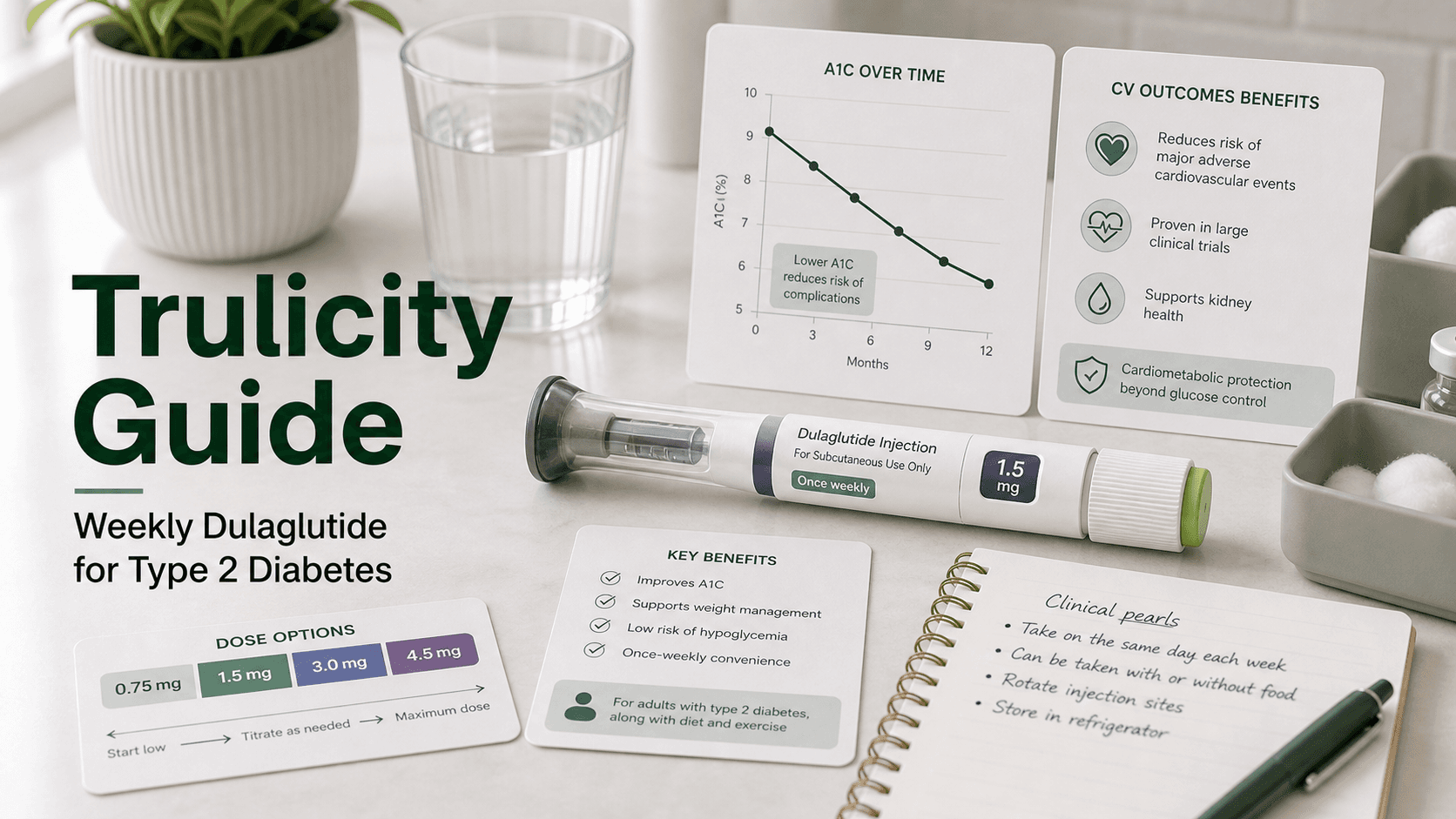
Trulicity was the second weekly GLP-1 to hit U.S. pharmacies after Bydureon, and for years it was Eli Lilly's flagship diabetes injectable. It is still widely prescribed in 2026 — especially for patients who want once-weekly dosing and a simple, no-titration auto-injector pen — but the rise of Ozempic and Mounjaro has shifted the conversation.
Direct answer: Trulicity is dulaglutide, a once-weekly subcutaneous GLP-1 receptor agonist from Eli Lilly. The FDA approved it on September 18, 2014 for type 2 diabetes. Doses come pre-filled in single-use pens at 0.75 mg, 1.5 mg, 3 mg, and 4.5 mg. At the 1.5 mg dose it lowers A1C by roughly 1.2–1.5 percentage points and produces average weight loss of about 6–10 pounds over 6–12 months. The REWIND cardiovascular outcomes trial in 9,901 patients showed a 12% reduction in major adverse cardiovascular events over a median 5.4 years. List price is approximately $987 per month; commercial savings cards drop costs to as low as $25.
What Trulicity Is
| Quick fact | Trulicity |
|---|---|
| Active ingredient | Dulaglutide |
| Drug class | GLP-1 receptor agonist |
| Manufacturer | Eli Lilly |
| First FDA approval | September 18, 2014 |
| Indication | Type 2 diabetes (glycemic control) + cardiovascular risk reduction in T2D |
| Dosing rhythm | Once weekly subcutaneous injection |
| Available strengths | 0.75 mg, 1.5 mg, 3 mg, 4.5 mg (all 0.5 mL prefilled pens) |
| Typical starting dose | 0.75 mg weekly |
| List price | ~$987 per month |
| Savings card price | As low as $25/month for commercially insured patients |
Dulaglutide is a long-acting GLP-1 analogue fused to a modified human IgG4 Fc fragment, which gives it the long half-life needed for weekly dosing. The pen is an auto-injector — the patient does not see the needle and there is no priming or dose dial. Press to skin, click, hold for several seconds.
How Trulicity Works
Trulicity activates the GLP-1 receptor — same biological target as Ozempic, Wegovy, Rybelsus, and Victoza. Once active, the receptor:
- Increases glucose-dependent insulin release from pancreatic beta cells
- Suppresses glucagon secretion when blood sugar is elevated
- Slows gastric emptying
- Reduces appetite via central GLP-1 receptors in the brain
- Improves post-prandial glucose control
The Fc fragment fusion is what makes Trulicity different from short-acting GLP-1s like exenatide twice-daily. It gives dulaglutide a half-life of about 5 days — long enough for once-weekly dosing while staying in a fairly stable plasma concentration window.
How to Take Trulicity
- Inject once weekly on the same day each week, any time of day
- Site rotation: abdomen, thigh, or upper arm
- Injection can be done with or without food
- If a dose is missed and at least 3 days remain until the next scheduled dose, take it as soon as possible; otherwise skip and resume the regular schedule
- The pen does not need refrigeration after first use for up to 14 days at room temperature (below 86°F)
- Store unopened pens refrigerated at 36–46°F
There is no dose dial. Each pen is a fixed strength — moving to a higher dose means switching to a different pen, not adjusting the existing one.
Dosing Schedule
Trulicity uses a straightforward stepwise titration based on glycemic response:
| Step | Dose | When |
|---|---|---|
| Start | 0.75 mg weekly | Often used as the starting dose, especially for patients sensitive to GI side effects |
| Or start | 1.5 mg weekly | The more common starting dose if tolerated |
| Step up | 3 mg weekly | If A1C control insufficient after at least 4 weeks |
| Maximum | 4.5 mg weekly | If A1C control insufficient after at least 4 weeks at 3 mg |
The 3 mg and 4.5 mg doses were added to the label in 2020 after the AWARD-11 trial showed dose-dependent A1C and weight benefit. Most patients land at 1.5 mg as a long-term maintenance dose.
What the REWIND Trial Showed
REWIND is the landmark cardiovascular outcomes trial that distinguishes Trulicity from most older GLP-1s. Published in The Lancet on July 13, 2019, it enrolled 9,901 adults with type 2 diabetes at multiple international sites and ran for a median 5.4 years — the longest follow-up of any GLP-1 cardiovascular outcomes trial.
Key design and result data:
- Mean age: 66.2 years, median A1C 7.2%, 46.3% women
- Only 31.5% had prior cardiovascular disease — making REWIND notable as a primarily primary prevention trial
- Primary endpoint: composite of cardiovascular death, non-fatal MI, non-fatal stroke (3-point MACE)
- Result: 594 events (12.0%) in the dulaglutide group vs. 663 events (13.4%) in placebo — a 12% relative risk reduction, hazard ratio 0.88, statistically significant
- Stroke reduced by ~24% — the strongest single component effect
That primary-prevention profile is unusual among CVOT-positive GLP-1s. SUSTAIN-6 (Ozempic) and LEADER (Victoza) enrolled mostly secondary prevention populations.
A1C and Weight Loss Data
Across the AWARD program (10 Phase 3 trials), Trulicity at the 1.5 mg dose produced:
- A1C reduction: roughly 1.2 to 1.5 percentage points from baseline
- Weight loss: about 6–10 lb over 6–12 months as a secondary outcome
- 3 mg dose: an additional ~0.2 percentage points A1C and ~1–2 lb weight loss vs 1.5 mg
- 4.5 mg dose: ~0.4 additional A1C percentage points and ~3 lb more weight loss vs 1.5 mg
These are diabetes-trial numbers. Trulicity has never been FDA-approved for chronic weight management, and weight effects are smaller than what Ozempic, Wegovy, or Zepbound produce at obesity-trial doses.
Trulicity vs. Ozempic
This is the most-asked comparison in 2026. Both are weekly GLP-1 injections for type 2 diabetes — but they are not equivalent.
| Trulicity | Ozempic | |
|---|---|---|
| Molecule | Dulaglutide | Semaglutide |
| Manufacturer | Eli Lilly | Novo Nordisk |
| Approved | 2014 | 2017 |
| Doses | 0.75, 1.5, 3, 4.5 mg | 0.25, 0.5, 1, 2 mg |
| A1C reduction at max dose | ~1.4–1.8 percentage points | ~1.8–2.0 percentage points |
| Average weight loss | 5–10 lb | 10–14 lb |
| MACE reduction (CVOT) | 12% (REWIND, 5.4 yr) | 26% (SUSTAIN-6, 2.1 yr) |
| Cardiovascular indication | T2D with cardiovascular disease or risk factors | T2D with established cardiovascular disease |
| List price | ~$987/month | ~$997/month |
| Pen type | Single-use auto-injector, no dose dial | Multi-dose dial pen |
| Refrigeration after first use | Up to 14 days at room temp | Up to 56 days at room temp |
SUSTAIN-7, a head-to-head trial of semaglutide 1 mg vs. dulaglutide 1.5 mg over 40 weeks, found semaglutide produced 6.5 kg weight loss vs. 3.0 kg for dulaglutide — more than double. Ozempic generally outperforms Trulicity for both A1C and weight. Trulicity wins on injection simplicity (no dose dial, fully visible pen-stay times), broader primary-prevention CVOT data, and slightly better tolerability for some patients.
Side Effects
| Side effect | How often | Notes |
|---|---|---|
| Nausea | Common at start and dose increases | Usually fades within 4–8 weeks |
| Diarrhea | Common | Often mild |
| Vomiting | Less common than with semaglutide | Worse at higher doses |
| Abdominal pain | Reported | Persistent or severe pain needs evaluation |
| Decreased appetite | Frequent | Often a goal |
| Injection-site reactions | Mild and infrequent | Rotate sites |
| Fatigue, headache | Reported | Mostly mild |
Boxed warning: contraindicated in patients with personal or family history of medullary thyroid carcinoma (MTC) or MEN 2. Other serious risks include pancreatitis, hypersensitivity reactions, acute kidney injury, severe GI disease (including gastroparesis), gallbladder problems, and diabetic retinopathy complications. Hypoglycemia risk rises when combined with insulin or sulfonylureas.
Cost (2026)
| Channel | Monthly cost |
|---|---|
| List price (any dose) | ~$987 |
| GoodRx Gold | ~$946 |
| Eli Lilly Trulicity Savings Card (commercial insurance) | As low as $25/month |
| Cash without coupons | ~$900–$1,050 |
| Medicare Part D | Tier varies — typically covered with prior authorization |
The Lilly savings card caps benefit at $150 per 28-day supply and $1,800 per calendar year, but for most commercially insured patients it brings monthly cost to $25.
Who Trulicity Is Best For
Trulicity tends to be the right choice when:
- Type 2 diabetes is the primary diagnosis, especially with cardiovascular risk factors but no established CVD (the REWIND population)
- The patient strongly prefers an auto-injector with no dose dial and no needle visibility
- Refrigeration constraints make the longer-room-temperature-tolerant Ozempic less practical
- Insurance covers Trulicity better than Ozempic (varies by formulary)
- A1C control is the goal and large weight loss is not the priority
It tends to be a poor fit when:
- Maximum A1C reduction is needed — Ozempic and Mounjaro typically do more
- Significant weight loss is a primary goal — switch to Wegovy, Zepbound, or Mounjaro
- The patient has personal or family history of MTC or MEN 2
- There is severe gastroparesis or recurrent pancreatitis
What People Get Wrong About Trulicity
- "Trulicity is Ozempic." Different molecules. Dulaglutide is a GLP-1-Fc fusion peptide; semaglutide is a modified peptide alone. They share a class, not an exact mechanism profile.
- "Trulicity is approved for weight loss." It is not. Weight effects are a secondary benefit; the indication is type 2 diabetes glycemic control plus cardiovascular risk reduction.
- "The 4.5 mg pen is the standard maintenance dose." Most patients sit at 1.5 mg long-term. Higher doses are titration options when A1C remains above target.
- "Trulicity can be reused like an insulin pen." Each pen is single-use. There is no dose dial — the entire pen empties in one injection.
- "You have to inject in the morning." Trulicity can be injected any time of day, with or without food. Only the weekly schedule matters.
- "REWIND proved Trulicity prevents heart attacks in healthy adults." REWIND showed a 12% MACE reduction in patients with type 2 diabetes and cardiovascular risk factors — not in people without diabetes.
Frequently Asked Questions
How long has Trulicity been on the market? The FDA approved Trulicity on September 18, 2014, so it has roughly a decade of post-marketing data in 2026.
Is Trulicity better than Ozempic? For pure A1C and weight outcomes, Ozempic generally edges out Trulicity in head-to-head data (SUSTAIN-7). Trulicity has stronger primary-prevention cardiovascular data via REWIND and is often easier to inject because the pen has no dose dial.
Can Trulicity cause weight loss? Yes — typically 6–10 lb at the 1.5 mg dose, slightly more at 3 mg and 4.5 mg. It is not approved for chronic weight management, but weight effects are real.
What is the maximum dose of Trulicity? 4.5 mg once weekly, added to the label in 2020 after the AWARD-11 trial.
Does Trulicity need to be refrigerated? Unopened pens stay refrigerated at 36–46°F. After first use (or if removed from the fridge), pens are stable at room temperature for up to 14 days — shorter than Ozempic's 56-day room-temperature window.
Is there a generic Trulicity? Not in the U.S. as of May 2026. Dulaglutide patent protection runs into the late 2020s, so generic versions are not yet available.
Can I miss a dose of Trulicity? If at least 3 days remain until the next scheduled dose, take the missed dose as soon as possible. If less than 3 days remain, skip it and resume the regular schedule.
Last reviewed: May 13, 2026
Sources
- TRULICITY Prescribing Information (FDA Label, 2024)
- Trulicity for Cardiovascular Disease — REWIND Trial (Lilly)
- Dulaglutide and Cardiovascular Outcomes in Type 2 Diabetes (REWIND) — The Lancet
- FDA Approves Trulicity (Lilly Press Release, 2014)
- Trulicity (dulaglutide) FDA Approval History — Drugs.com
- Trulicity 2026 Prices, Coupons & Savings — GoodRx
- Trulicity Costs in 2026: With and Without Insurance — Noom