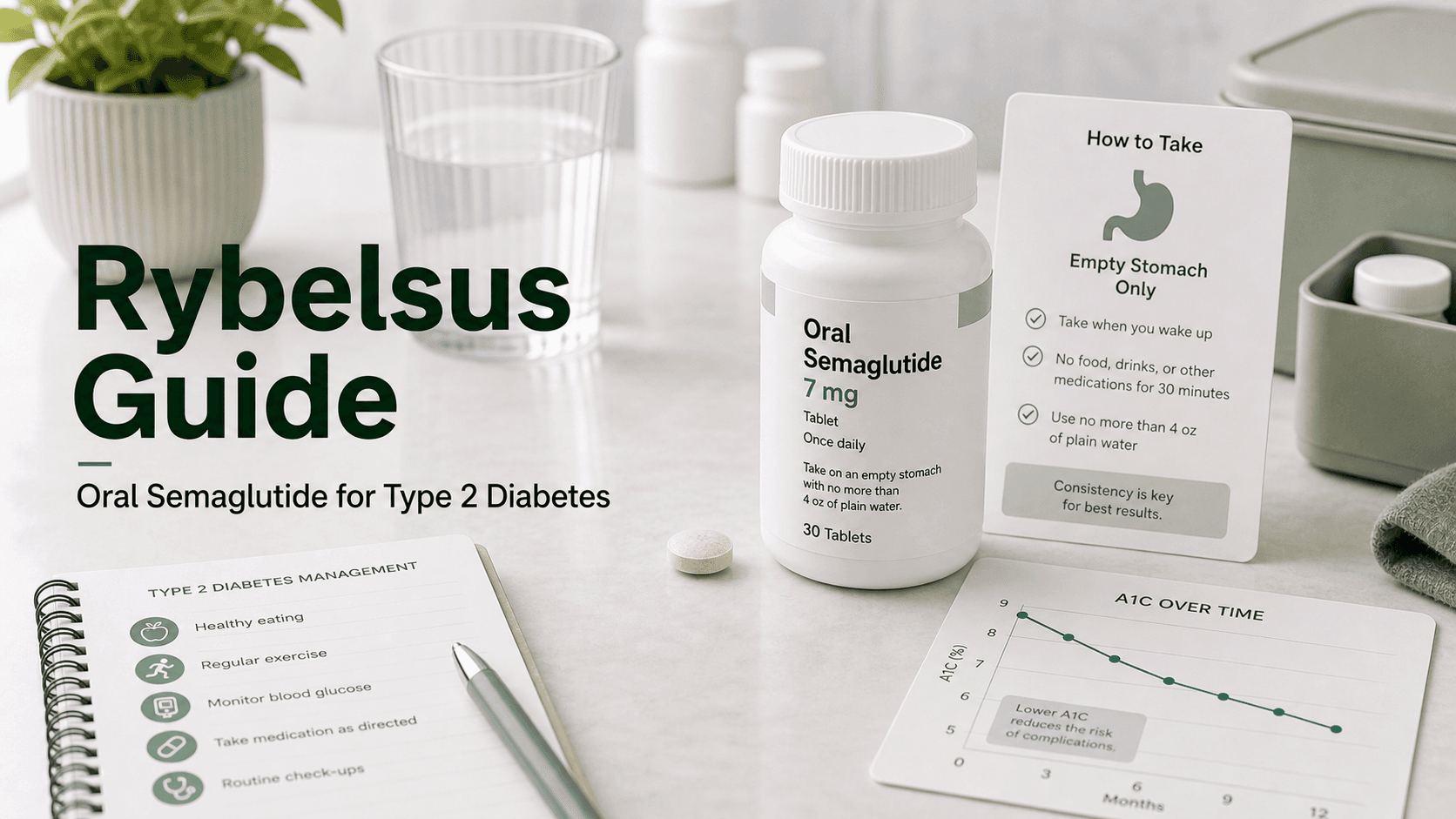
Rybelsus is the original GLP-1 pill, and as of 2026 it is still the reference product for oral semaglutide in type 2 diabetes — a label it now shares with a second Novo Nordisk product, Ozempic tablets. Same molecule as Ozempic and Wegovy, in a daily tablet that you have to take on a completely empty stomach.
Direct answer: Rybelsus is oral semaglutide approved by the FDA in September 2019 for type 2 diabetes in adults. It comes in three strengths — 3 mg, 7 mg, and 14 mg — taken once daily with no more than 4 oz of plain water on an empty stomach, then a 30-minute wait before food, drink, or any other medication. At the 14 mg dose it cuts A1C by about 1.0 to 1.5 percentage points and produces modest weight loss of roughly 4 to 7 pounds over six months. It is not FDA-approved for weight management. List price is $1,027.51 per month, though most commercially insured patients pay as little as $25 with the manufacturer savings card.
What Rybelsus Is
Rybelsus is Novo Nordisk's oral version of semaglutide. The active ingredient is identical to what is in the Ozempic and Wegovy injections — the difference is how it gets into the body. (It is typed "Rebelsus" and "Rybelus" nearly as often as it is typed correctly. There is one product, spelled Rybelsus.)
| Quick fact | Rybelsus |
|---|---|
| Active ingredient | Semaglutide |
| Drug class | GLP-1 receptor agonist |
| Manufacturer | Novo Nordisk |
| First FDA approval | September 20, 2019 |
| Indication | Type 2 diabetes: glycemic control, plus reduction of major adverse cardiovascular events in adults at high CV risk (added to the U.S. label in October 2025) |
| Dosing rhythm | Once daily oral tablet |
| Available strengths (R1) | 3 mg, 7 mg, 14 mg |
| Available strengths (R2) | 1.5 mg, 4 mg, 9 mg — now marketed as OZEMPIC tablets under the same prescribing information |
| List price | $1,027.51 per month |
| Savings card price | As low as $25/month for commercially insured patients |
Rybelsus is not Ozempic in a pill — even though both contain semaglutide. The injection has roughly 80% bioavailability, while oral semaglutide sits closer to 1%. That is why pill doses run 3–14 mg while the injection caps at 2 mg.
How Rybelsus Works
Once absorbed, semaglutide activates the GLP-1 receptor — the same target hit by every drug in this class. Activating the receptor:
- Slows gastric emptying so meals stay in the stomach longer
- Triggers glucose-dependent insulin release from the pancreas
- Suppresses glucagon (the hormone that raises blood sugar)
- Quiets food noise and reduces appetite via brain receptors
- Lowers post-meal glucose spikes
That is the mechanism of action (MOA) in one paragraph. Per the FDA label, semaglutide is a GLP-1 analogue with 94% sequence homology to human GLP-1 that selectively binds and activates the GLP-1 receptor, lowering blood glucose by stimulating insulin secretion and suppressing glucagon in a glucose-dependent way — which is why hypoglycemia risk is low unless the drug is paired with insulin or a sulfonylurea. Two structural features give it staying power the native hormone lacks: it is more than 99% bound to plasma albumin, which slows renal clearance and shields it from metabolic degradation, and it is stabilized against breakdown by the DPP-4 enzyme. The result is an elimination half-life of about one week, with drug still measurable in circulation roughly five weeks after the last tablet.
The challenge with a peptide drug like semaglutide is that stomach acid normally destroys peptides before they reach the bloodstream. Rybelsus solves this with SNAC — sodium N-(8-[2-hydroxybenzoyl] amino) caprylate — an absorption enhancer co-formulated into each tablet.
SNAC creates a local pH bubble around the tablet that protects semaglutide from proteolytic breakdown and helps it cross the stomach lining. Absorption predominantly occurs in the stomach itself, not the small intestine, which is unusual for an oral drug and is exactly why an empty stomach matters so much. Peak concentration arrives about an hour after the tablet; steady state takes 4 to 5 weeks.
How to Take Rybelsus
The administration window matters as much as the dose. Per the FDA label:
- Take first thing in the morning before any food or drink
- Swallow the tablet with no more than 4 ounces (120 mL) of plain water — no coffee, no juice, no tea
- Do not split, crush, chew, or dissolve the tablet — swallow whole
- Wait at least 30 minutes before eating, drinking anything else, or taking other oral medications
- Take at most one tablet per day
Skip a missed dose entirely and resume the next morning. Do not double up.
The label's own pharmacokinetic data explains why the rules are that specific. Absorption was higher with 50 mL of water than with 240 mL, and there was no clinically significant difference between 50 mL and 120 mL — so 4 oz is a ceiling, not a target, and a small sip works as well as a full glass. Absorption also rose the longer the post-dose fast ran, tested at 15, 30, 60 and 120 minutes. Thirty minutes is the labeled minimum, not the optimum; if your morning allows 60, take the 60.
Storage. Keep tablets at 20°C to 25°C (68°F to 77°F), with excursions permitted between 15°C and 30°C (59°F to 86°F). Store and dispense in the original bottle — the label says it twice, because the tablets need protecting from moisture. Do not decant a week's worth into a pill organizer on a bathroom counter. No refrigeration, unlike the injectable pens.
Dosing Schedule
The standard titration runs across two months minimum:
| Step | Dose | Duration |
|---|---|---|
| Start | 3 mg daily | 30 days (purely for tolerability — not effective at lowering A1C) |
| Up-titrate | 7 mg daily | At least 30 days |
| Maximum | 14 mg daily | Maintenance if more A1C control is needed |
The 3 mg dose is not therapeutic — it exists to ease patients past the worst of the GI side effects before stepping up.
The R2 formulation (1.5/4/9 mg) that launched in late 2025 with higher bioavailability is no longer waiting on a rebrand. As of the prescribing information dated January 30, 2026, it is labeled OZEMPIC (semaglutide) tablets and shares a single prescribing information document with Rybelsus. Same molecule, better absorption, different numbers stamped on the tablet — and, importantly, the two are not substitutable on a mg-to-mg basis.
Rybelsus vs. Ozempic Tablets, and How to Switch
Since January 2026 both oral semaglutide products live under one FDA label. They are the same molecule with different absorption efficiency, so the strengths do not line up one-to-one and pharmacists cannot swap them.
| Feature | Rybelsus | Ozempic tablets |
|---|---|---|
| Strengths | 3 mg, 7 mg, 14 mg | 1.5 mg, 4 mg, 9 mg |
| Tablet shape | Oval, debossed with the strength on one side and "novo" on the other | Round, debossed with the strength on one side and "novo" on the other |
| Absolute bioavailability | 0.4% to 1% | 1% to 2% |
| Starting dose | 3 mg daily for 30 days (not effective for glycemic control) | 1.5 mg daily for 30 days (not effective for glycemic control) |
| Step-up at day 31 | 7 mg daily | 4 mg daily |
| Maximum from day 61 | 14 mg daily | 9 mg daily |
| Substitutable mg-for-mg? | No | No |
Despite the different milligram numbers, a study in healthy subjects found no clinically significant difference in steady-state exposure between the matched strengths — 3/7/14 mg of Rybelsus against 1.5/4/9 mg of Ozempic tablets. The lower numbers are the point: better absorption means less drug is needed for the same blood level.
Switching between the two tablets. The label sets three rules. Do not switch during the first 30 days (the initiation phase). After that, patients may switch at matched maintenance doses. And start the new product the day after stopping the old one, with no gap and no overlap.
| If you are on | Switch to |
|---|---|
| Rybelsus 7 mg daily | Ozempic tablets 4 mg daily |
| Rybelsus 14 mg daily | Ozempic tablets 9 mg daily |
| Ozempic tablets 4 mg daily | Rybelsus 7 mg daily |
| Ozempic tablets 9 mg daily | Rybelsus 14 mg daily |
Switching from the Ozempic injection to a pill. The label covers exactly one injection dose: 0.5 mg weekly. Patients on Ozempic 0.5 mg may switch to tablets. Wait one week after the last 0.5 mg injection, then start Rybelsus 7 mg or 14 mg daily (or Ozempic tablets 4 mg or 9 mg daily). There is no labeled conversion from the 1 mg or 2 mg injection doses to any tablet dose, so a switch from those doses is a clinical judgment call rather than a labeled step.
What the PIONEER Trials Showed
Rybelsus was studied in the PIONEER program — 10 Phase 3 trials covering monotherapy, combination therapy, and a cardiovascular outcomes study.
PIONEER 3 (vs Januvia): Rybelsus 14 mg produced 63% greater A1C reduction than Januvia 100 mg over 26 weeks. Roughly 1.7x more patients hit an A1C target under 7%.
PIONEER 4 (vs liraglutide): Rybelsus 14 mg achieved A1C reduction comparable to liraglutide 1.8 mg, with 42% greater weight loss than the daily injection over 52 weeks. Almost 70% of patients reached A1C below 7%.
PIONEER monotherapy: A1C drops of 0.6 to 1.1 percentage points versus placebo at 26 weeks.
Weight changes: 14 mg dose reduced body weight by approximately 2.3 kg (~5 lb) versus placebo as monotherapy, and around 3.8 kg (~8 lb) in combination therapy settings.
PIONEER 6 (cardiovascular): Showed no increase in major adverse cardiovascular events compared to placebo. Health Canada expanded its label in January 2026 to include cardiovascular risk reduction, and the U.S. label has now done the same. As of the October 2025 indications update, oral semaglutide is indicated both as an adjunct to diet and exercise to improve glycemic control in adults with type 2 diabetes and to reduce the risk of major adverse cardiovascular events — cardiovascular death, non-fatal myocardial infarction or non-fatal stroke — in adults with type 2 diabetes who are at high risk for those events. The "glycemic control only" framing is out of date.
The headline real-world takeaway: A1C drops of about 1.0–1.5 percentage points at the 14 mg dose, and modest weight loss of 4–7 lb over six months as a secondary effect — well below what the same molecule delivers as a weight-loss injection.
Side Effects
The side effect profile mirrors the injectable form, but GI symptoms are often slightly more pronounced because of higher peak daily concentrations.
| Side effect | How often | Notes |
|---|---|---|
| Nausea | Common, especially during titration | Usually improves within 4–8 weeks |
| Vomiting | Common at 7 mg and 14 mg | Worse with large or fatty meals |
| Diarrhea | Common | Often resolves with hydration |
| Constipation | Common | Fiber and water help |
| Decreased appetite | Frequent | Watch protein intake |
| Abdominal pain | Reported | Tell a clinician if severe or persistent |
| Headache, fatigue | Reported | Mostly mild |
The boxed warning matches every GLP-1: contraindicated in patients with personal or family history of medullary thyroid carcinoma (MTC) or multiple endocrine neoplasia type 2 (MEN 2). Serious adverse reactions include pancreatitis, gallbladder disease, acute kidney injury, hypersensitivity, and diabetic retinopathy complications. Hypoglycemia risk rises when Rybelsus is combined with insulin or sulfonylureas.
The label also notes that SNAC, the absorption enhancer, crosses the placenta and reaches fetal tissues in rats — breastfeeding is not recommended during Rybelsus treatment, a stricter rule than the injection carries.
Drug Interactions and the Rest of Your Morning Medications
Two different problems get conflated here. One is the 30-minute window, which is a scheduling problem for every other pill you take in the morning. The other is a genuine pharmacokinetic interaction, and the label names exactly one.
Levothyroxine is the real interaction. Total thyroxine exposure (AUC, adjusted for endogenous levels) rose 33% (90% CI 1.25 to 1.42) when a single 600 mcg dose of levothyroxine was given alongside semaglutide tablets. Peak concentration was unchanged. That is not a timing artifact you can space around — it is more thyroid hormone in the blood from the same prescribed dose, and it warrants thyroid monitoring rather than clever scheduling. Both drugs also want an empty stomach and a fasting window, so the two compete for the same slot in the morning.
Everything else the label tested came back clean. No clinically significant pharmacokinetic differences were observed with omeprazole, lisinopril, S-warfarin, R-warfarin, metformin, digoxin, ethinyl estradiol, levonorgestrel, furosemide or rosuvastatin. Semaglutide also has very low potential to inhibit or induce CYP enzymes or drug transporters in vitro. So if you take omeprazole or warfarin, the problem is fitting them around the 30-minute fast, not a drug-level interaction.
| What you take | The actual issue | What to do |
|---|---|---|
| Levothyroxine | Thyroid hormone exposure up 33% | Thyroid function monitoring; discuss dose with your prescriber |
| Insulin or a sulfonylurea | Additive hypoglycemia risk | The label says to consider reducing the insulin or sulfonylurea dose when starting |
| Narrow therapeutic index drugs generally | Delayed gastric emptying can shift absorption | Increased clinical or laboratory monitoring |
| Omeprazole, warfarin, metformin, digoxin, oral contraceptives, furosemide, rosuvastatin, lisinopril | No clinically significant PK change | Just respect the 30-minute window |
The label's blanket instruction is the sensible one: when Rybelsus is used with any oral drug that has a narrow therapeutic index or requires monitoring, increase clinical or laboratory monitoring.
Kidneys, Liver, and Pregnancy
The specific-populations data is unusually uncomplicated for a drug this widely prescribed.
- Kidney disease: no clinically significant pharmacokinetic differences across mild, moderate and severe renal impairment, including end-stage renal disease. No labeled dose adjustment.
- Liver disease: no clinically significant pharmacokinetic differences across mild, moderate and severe hepatic impairment by Child-Pugh class. No labeled dose adjustment.
- Body weight, age, sex, race, ethnicity: no clinically significant differences across 40 to 188 kg, or across adults aged 18 and up.
- Upper GI disease: chronic gastritis and GERD did not meaningfully change semaglutide pharmacokinetics.
- Planned pregnancy: discontinue at least 2 months before trying to conceive, because of the long washout. That interval is on the label, and it follows directly from a one-week half-life with drug present for about five weeks after the last dose.
- Breastfeeding: not recommended during treatment.
None of that removes the need for monitoring — acute kidney injury from volume depletion after severe vomiting or diarrhea is a labeled warning, and it was one of the sections revised in October 2025 along with acute pancreatitis, severe gastrointestinal adverse reactions and acute gallbladder disease.
Cost (2026)
| Channel | Monthly cost |
|---|---|
| List price (any dose) | $1,027.51 |
| Commercial insurance + Novo savings card | As low as $25/month |
| Medicare Part D | Tier varies — often covered with prior authorization |
| Cash without coupons | Roughly $900–$1,050 depending on pharmacy |
Coverage is generally easier to secure than Ozempic for the same patient, because Rybelsus is positioned as a tier-1 oral GLP-1 in many type 2 diabetes formularies. For the injection side of that comparison, see what Ozempic costs without insurance.
Rybelsus vs. The Other GLP-1 Pills
| Pill | Indication | Top dose | Mean weight loss at top dose | Food rule |
|---|---|---|---|---|
| Rybelsus | Type 2 diabetes only | 14 mg daily | ~4–7 lb over 6 mo | Empty stomach + 30 min fast |
| Oral Wegovy | Chronic weight management | 25 mg daily | ~13.6% body weight (71 wk) | Empty stomach + 30 min fast |
| Foundayo (orforglipron) | Chronic weight management | 36 mg daily | ~8–12% body weight (52 wk+) | No food or water restriction |
If the goal is glycemic control and the patient prefers a pill, Rybelsus is the only one with a T2D label. If the goal is weight loss, the higher-dose oral Wegovy or the unrestricted Foundayo do more. Our guide to where to buy oral semaglutide lines up each pill and what it costs.
Who Rybelsus Is Best For
Rybelsus is usually the right call when:
- The diagnosis is type 2 diabetes and metformin alone is not getting A1C to target
- The patient strongly prefers a pill over an injection
- Insurance covers Rybelsus better than Ozempic (sometimes the case on commercial plans)
- The patient can reliably do the 30-minute morning fast every day
- Modest weight loss is a welcome bonus rather than the primary goal
It is usually a poor fit when:
- Weight loss is the main objective — oral Wegovy or an injectable is more direct
- Morning medication timing is rigid (levothyroxine, omeprazole, warfarin)
- The patient has a personal or family history of MTC or MEN 2
- There is a history of severe gastroparesis or pancreatitis
What People Get Wrong About Rybelsus
- "Rybelsus is approved for weight loss." It is not. Only oral Wegovy and Foundayo carry the weight-loss indication in the oral GLP-1 category.
- "Rybelsus works like an Ozempic injection." Same molecule, very different exposure profile. The injection delivers ~80x more drug per mg dosed because of the bioavailability gap.
- "You can take Rybelsus with coffee." No. Plain water only, 4 oz max, and a 30-minute fast before anything else — including coffee.
- "The 3 mg dose works for blood sugar." The 3 mg starter dose is a tolerability bridge. Therapeutic effect on A1C kicks in at 7 mg and especially at 14 mg.
- "Generic semaglutide is available." Not in the U.S. Semaglutide patent protection runs into the early 2030s. Anyone selling "generic Rybelsus" online is selling unregulated compounded product, not an FDA-approved generic.
- "A missed dose can be made up later in the day." Skip it. Taking Rybelsus after food drops absorption to near zero.
Frequently Asked Questions
Is Rybelsus the same as Ozempic? Same active ingredient (semaglutide), different formulations and indications. Rybelsus is an oral tablet for type 2 diabetes. Ozempic is a weekly injection for type 2 diabetes with additional cardiovascular and kidney indications.
Can I take Rybelsus for weight loss? The FDA has not approved Rybelsus for chronic weight management. Some clinicians prescribe it off-label, but weight loss is typically modest (4–7 lb over 6 months). Oral Wegovy and Foundayo are the oral options with weight-loss indications.
Why do I have to fast for 30 minutes after Rybelsus? The SNAC absorption enhancer only works on a completely empty stomach. Food, drink, or other medications in the stomach reduce semaglutide absorption to near zero.
What happens if I miss a dose? Skip it entirely and resume the next morning. Do not double up. Taking Rybelsus later in the day after eating wastes the dose.
Is Rybelsus cheaper than Ozempic? Not on list price — Rybelsus ($1,027.51/month) runs slightly above Ozempic ($997.58/month), close enough that list price is rarely what decides it. With a savings card, both can drop to $25/month for commercially insured patients. What actually decides cost is formulary placement, and that is where Rybelsus often wins.
Can I crush Rybelsus to make it easier to swallow? No. The tablet must be swallowed whole. Crushing, splitting, or chewing destroys the SNAC formulation and ruins absorption.
How long does it take Rybelsus to start working? Glucose effects begin within the first week, but full A1C benefit takes 8–12 weeks as titration completes. Appetite changes often appear within the first 2 weeks.
What is Rybelsus's mechanism of action? Semaglutide is a GLP-1 analogue with 94% sequence homology to human GLP-1. It selectively activates the GLP-1 receptor, which stimulates insulin secretion and suppresses glucagon in a glucose-dependent manner, slows gastric emptying in the early postprandial phase, and reduces appetite through brain GLP-1 receptors. Its long duration comes from being more than 99% albumin-bound and resistant to DPP-4 breakdown, giving a half-life of about one week.
Is Rybelsus becoming Ozempic tablets? Not replacing it — joining it. Since the January 30, 2026 prescribing information, Rybelsus (3/7/14 mg) and Ozempic tablets (1.5/4/9 mg) are two products sharing one label. The Ozempic tablet is the higher-bioavailability formulation, which is why its milligram numbers are lower for the same effect. They are not substitutable on a mg-to-mg basis, so a pharmacy cannot swap one for the other.
Can I switch from an Ozempic injection to Rybelsus? Only from the 0.5 mg weekly dose, per the label. Wait one week after the last 0.5 mg injection, then start Rybelsus at 7 mg or 14 mg daily. There is no labeled conversion from Ozempic 1 mg or 2 mg injections to any tablet dose.
Does Rybelsus interact with levothyroxine? Yes, and it is the one interaction the label singles out. Total thyroxine exposure increased 33% when levothyroxine was given with semaglutide tablets. If you take both, expect thyroid function monitoring. Note also that both drugs require an empty stomach, so they compete for the same morning window.
Do I need a lower Rybelsus dose with kidney or liver disease? No. The label reports no clinically significant pharmacokinetic differences across mild, moderate or severe renal impairment (including end-stage renal disease) or across any Child-Pugh class of hepatic impairment, and it specifies no dose adjustment for either.
Last reviewed: August 20, 2026
Sources
- RYBELSUS Prescribing Information (FDA Label, 2024)
- RYBELSUS A1C and Weight Data — Novo Medlink
- Dosing & Prescribing — RYBELSUS (Novo Medlink)
- A Pharmacological and Clinical Overview of Oral Semaglutide — PMC
- Oral Semaglutide — PMC/NIH Review
- RYBELSUS Official Patient Site — Novo Nordisk
- RYBELSUS Updated Prescribing Information (FDA, 2025)
- RYBELSUS and OZEMPIC (semaglutide) Tablets — Full Prescribing Information, label revised January 30, 2026 (DailyMed)