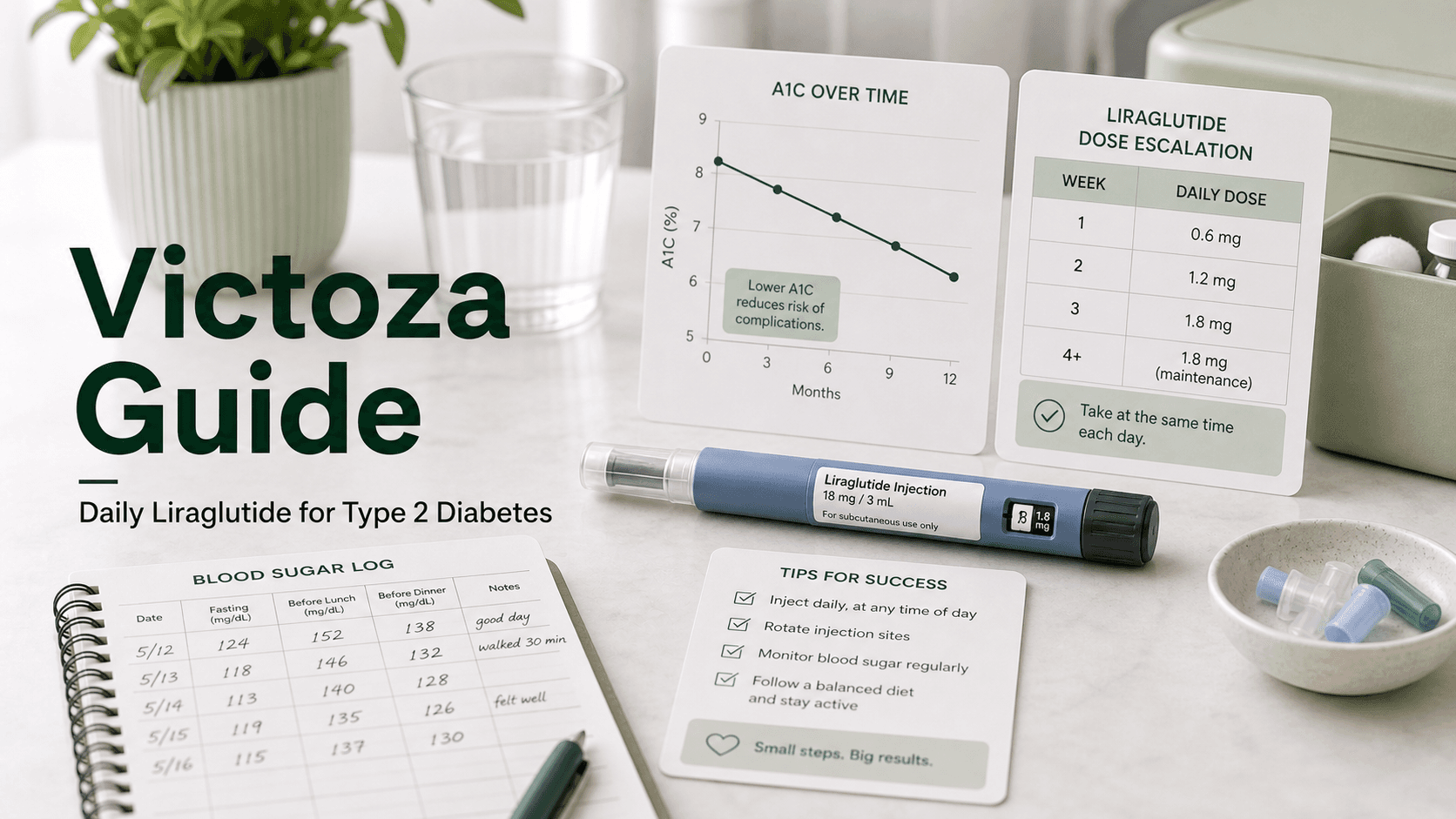
Victoza is the diabetes face of liraglutide — the same molecule sold as Saxenda for obesity, but at a lower daily dose and a different indication. Approved in 2010, it was the second GLP-1 to reach the U.S. market (after Byetta) and the first once-daily option. In 2026, with authorized generics now on shelves, Victoza is enjoying a price-driven second wind.
Direct answer: Victoza is liraglutide, a once-daily subcutaneous GLP-1 receptor agonist from Novo Nordisk. The FDA approved it on January 25, 2010 for type 2 diabetes in adults. The standard dose schedule is 0.6 mg → 1.2 mg → 1.8 mg daily, titrated at minimum 1-week intervals. It produces A1C reductions of about 1.0 to 1.5 percentage points and average weight loss of 4–6 pounds over 6 months. The LEADER trial in 9,340 patients showed a 13% reduction in major adverse cardiovascular events (HR 0.87). List price for brand Victoza is roughly $840–$1,000 per month; authorized generic liraglutide from Teva and Hikma now lists at $200–$450 per month without insurance.
What Victoza Is
| Quick fact | Victoza |
|---|---|
| Active ingredient | Liraglutide |
| Drug class | GLP-1 receptor agonist |
| Manufacturer | Novo Nordisk (authorized generics from Teva and Hikma) |
| First FDA approval | January 25, 2010 |
| Indication | Type 2 diabetes (glycemic control) + cardiovascular risk reduction in T2D with CV disease |
| Dosing rhythm | Once daily subcutaneous injection |
| Available strengths | Multi-dose pen delivering 0.6, 1.2, or 1.8 mg per injection (18 mg/3 mL pen) |
| List price (brand) | ~$840–$1,000/month |
| Generic price (Teva, Hikma) | $200–$450/month |
| Generic launch | December 2024 (Hikma); 2025 (Teva, Meitheal) |
Liraglutide is a once-daily GLP-1 analogue with a fatty acid chain that binds reversibly to albumin, extending the half-life to about 13 hours. That is long enough for once-daily dosing but well short of weekly options like Ozempic and Trulicity.
How Victoza Works
Victoza activates the GLP-1 receptor, producing the standard GLP-1 effects:
- Glucose-dependent insulin secretion from pancreatic beta cells
- Glucagon suppression when blood sugar is elevated
- Slower gastric emptying
- Reduced appetite via central GLP-1 receptors
- Better post-prandial glucose control
Because it is the same molecule as Saxenda (which is dosed at 3.0 mg daily for obesity), Victoza's mechanism is identical — only the dose ceiling differs. At Victoza's 1.8 mg max dose, weight loss is modest. The full appetite-suppression and weight-loss effect that Saxenda harnesses requires nearly double the dose.
Victoza vs. Saxenda: Same Molecule, Different Job
This is the most important framing to understand Victoza in 2026.
| Victoza | Saxenda | |
|---|---|---|
| Active ingredient | Liraglutide | Liraglutide |
| FDA indication | Type 2 diabetes + CV risk reduction | Chronic weight management |
| Dose range | 0.6 / 1.2 / 1.8 mg daily | 0.6 → 3.0 mg daily |
| Maximum dose | 1.8 mg | 3.0 mg |
| Pen | 18 mg/3 mL multi-dose | 18 mg/3 mL multi-dose |
| FDA approval | January 2010 | December 2014 |
| Typical A1C drop | 1.0–1.5 percentage points | Not the primary endpoint |
| Typical weight loss | 4–6 lb | 12–15 lb (~5–8% body weight) |
| 2026 list price | ~$840–$1,000/month | ~$1,349/month |
| Generic available? | Yes (Teva, Hikma, Meitheal) | Yes (Teva, August 2025) |
Same drug. Different label and different dose ceiling. A clinician treating type 2 diabetes with Victoza is using the same molecule a clinician treating obesity is using with Saxenda — but Saxenda titrates higher, generates more weight loss, and costs more per month. Choose the indication that matches the diagnosis (it dictates coverage).
How to Take Victoza
- Inject once daily at any time of day, with or without food
- Stay consistent — same approximate time each day improves adherence
- Site rotation: abdomen, thigh, or upper arm
- The pen is a multi-dose dial — dial up 0.6, 1.2, or 1.8 mg and inject
- Unopened pens stay refrigerated at 36–46°F
- In-use pens can be stored at room temperature (below 86°F) or refrigerated for up to 30 days
- Use a new pen needle for each injection
The 30-day in-use window is similar to Saxenda and longer than Trulicity's 14 days at room temperature.
Dosing Schedule
Standard titration:
| Step | Dose | Duration |
|---|---|---|
| Start | 0.6 mg daily | At least 1 week (tolerability dose — not therapeutic for A1C) |
| Step up | 1.2 mg daily | Therapeutic for many patients |
| Maximum | 1.8 mg daily | If additional A1C control is needed after at least 1 week at 1.2 mg |
The titration is faster than weekly GLP-1s like Trulicity or Ozempic because daily dosing reaches steady state quickly. The 0.6 mg starter dose is purely tolerability — it does not meaningfully lower A1C on its own.
Missed-dose rule: If a dose is missed and it has been more than 3 days, do not resume at the previous dose. Restart at 0.6 mg and re-titrate to avoid severe GI side effects.
What the LEADER Trial Showed
LEADER is the cardiovascular outcomes trial that earned Victoza its CV risk reduction indication. Published in NEJM in 2016, it enrolled 9,340 adults with type 2 diabetes at high cardiovascular risk and ran for a median 3.8 years.
Key results:
- Primary endpoint: 3-point MACE (cardiovascular death, non-fatal MI, non-fatal stroke)
- 608 events (13.0%) in the liraglutide group vs. 694 events (14.9%) in placebo
- 13% relative risk reduction, hazard ratio 0.87, statistically significant for superiority
- Cardiovascular death reduced by 22% (HR 0.78)
- All-cause mortality reduced by 15% (HR 0.85)
- Most participants had established cardiovascular disease (this was largely a secondary prevention trial — different from REWIND's primary prevention skew)
LEADER was one of the first GLP-1 outcomes trials to show clear cardiovascular benefit and is the reason the Victoza label includes CV risk reduction in T2D patients with established cardiovascular disease.
A1C and Weight Loss Data
Across the LEAD program (Phase 3 trials) and real-world use:
- A1C reduction from baseline 8.2%: 0.84% at 1.2 mg and 1.14% at 1.8 mg as monotherapy
- In combination with metformin: about 1.1 percentage points at both 1.2 mg and 1.8 mg
- Average weight loss: 4–6 lb over 6 months at the 1.8 mg maintenance dose
- Roughly half of patients reach an A1C below 7%
- The PIONEER 4 trial found that oral semaglutide 14 mg had 42% greater weight loss than Victoza 1.8 mg over 52 weeks
Victoza's weight effects are smaller than what semaglutide or tirzepatide deliver — and that gap is even larger versus the same molecule at its higher Saxenda dose.
Victoza vs. Ozempic
| Victoza | Ozempic | |
|---|---|---|
| Active ingredient | Liraglutide | Semaglutide |
| Dosing | Once daily | Once weekly |
| Max dose | 1.8 mg daily | 2 mg weekly |
| A1C reduction at max | ~1.0–1.5 percentage points | ~1.8–2.0 percentage points |
| Weight loss | 4–6 lb | 10–14 lb |
| MACE reduction | 13% (LEADER) | 26% (SUSTAIN-6) |
| Generic available | Yes (multiple manufacturers) | No |
| List price | $840–$1,000 (brand); $200–$450 (generic) | ~$997/month |
Ozempic is generally more potent on both A1C and weight. Victoza's edge in 2026 is price — the only GLP-1 with FDA-approved authorized generic competition for diabetes use.
Side Effects
| Side effect | How often | Notes |
|---|---|---|
| Nausea | Common at start and dose increases | Usually fades within 4–8 weeks |
| Diarrhea | Common | Often mild |
| Vomiting | Less common than at higher GLP-1 doses | Worse with fatty meals |
| Constipation | Reported | Fiber and hydration help |
| Decreased appetite | Frequent | Often a goal |
| Headache | Reported | Mostly mild |
| Injection-site reactions | Mild and infrequent | Rotate sites |
| Hypoglycemia | Higher risk when combined with insulin or sulfonylureas | Adjust those medications as needed |
Boxed warning: contraindicated in patients with personal or family history of medullary thyroid carcinoma or MEN 2. Other serious risks: pancreatitis, acute gallbladder disease, renal impairment, hypersensitivity reactions, severe GI disease. The label also notes a non-arteritic anterior ischemic optic neuropathy (NAION) signal that is under ongoing regulatory review across the GLP-1 class.
Cost (2026)
| Channel | Monthly cost |
|---|---|
| List price (brand Victoza) | ~$840–$1,000 |
| Authorized generic liraglutide (Teva, Hikma, Meitheal) | $200–$450 |
| GoodRx coupon (generic) | ~$190–$280 |
| Manufacturer savings card (brand) | As low as $25 for commercially insured |
| Target / Costco cash (generic) | $193 (2 pens) – $680 (3 pens, Costco) |
| Medicare Part D | Tier varies — often covered with prior authorization |
The arrival of authorized generics in late 2024 and 2025 fundamentally changed Victoza's positioning. For a patient paying cash, generic liraglutide is the cheapest brand-quality GLP-1 in the U.S. as of May 2026. The obesity-dose version of the same molecule has its own generic picture, which we cover in our Saxenda generic guide.
Who Victoza Is Best For
Victoza tends to be the right choice when:
- Type 2 diabetes is the primary diagnosis, especially with established cardiovascular disease (the LEADER population)
- Daily injection is acceptable — the patient prefers a daily routine over weekly
- Cost matters and the patient is paying cash or has limited insurance — generic liraglutide is the lowest-priced FDA-approved GLP-1
- The patient has previously tolerated liraglutide well (perhaps on Saxenda)
- A more modest, predictable A1C response is acceptable
It tends to be a poor fit when:
- The patient prefers weekly dosing — Ozempic, Trulicity, or Mounjaro fit better
- Maximum A1C reduction is needed — semaglutide or tirzepatide do more
- Weight loss is the primary goal — Saxenda (same molecule, higher dose) or Wegovy/Zepbound do more
- Personal or family history of MTC or MEN 2
- Recurrent pancreatitis or severe gastroparesis
What People Get Wrong About Victoza
- "Victoza is Saxenda." Same molecule, different doses, different indications. Victoza caps at 1.8 mg daily for diabetes; Saxenda titrates to 3.0 mg daily for obesity.
- "Victoza is once weekly." It is once daily. The weekly versions of GLP-1 (Ozempic, Trulicity, Bydureon) are different drugs.
- "You can use Victoza for weight loss." Off-label some clinicians do, but weight loss at the 1.8 mg cap is modest (4–6 lb). Saxenda is the on-label option for chronic weight management with the same molecule.
- "Generic Victoza isn't real." Teva, Hikma, and Meitheal have FDA-approved authorized generics on the U.S. market in 2026. These are bioequivalent to brand Victoza, not compounded knockoffs.
- "Restart Victoza at the same dose after missing a few days." If more than 3 days have passed, the label requires restarting at 0.6 mg and re-titrating. Skipping that step causes severe GI symptoms.
- "LEADER proves liraglutide is the best heart-protective GLP-1." LEADER showed a 13% MACE reduction in a high-CV-risk T2D population. SUSTAIN-6 (semaglutide) showed 26% in a similar population. Both are class-leading; semaglutide's effect is numerically larger.
Frequently Asked Questions
Is Victoza the same as Saxenda? Same active ingredient (liraglutide), same pen device, different doses and different FDA indications. Victoza tops out at 1.8 mg daily for diabetes; Saxenda goes to 3.0 mg daily for chronic weight management.
How long has Victoza been on the market? The FDA approved Victoza on January 25, 2010, so it has roughly 16 years of real-world use as of 2026.
Does Victoza cause weight loss? Yes — typically 4–6 lb over 6 months at the 1.8 mg dose. That is smaller than what Saxenda (3.0 mg daily) or weekly semaglutide produces, but real.
Is there a generic Victoza? Yes. Hikma launched the first authorized generic in December 2024; Teva followed in 2025, and Meitheal also entered the market. Generic monthly prices are $200–$450 depending on quantity and pharmacy.
Can Victoza be used with insulin? Yes, but insulin or sulfonylurea doses often need to be reduced to avoid hypoglycemia. Self-monitoring and clinician adjustment are essential.
What is the difference between Victoza and Ozempic? Victoza is once-daily liraglutide; Ozempic is once-weekly semaglutide. Ozempic generally produces more A1C reduction and more weight loss; Victoza has the convenience advantage of being available as a generic in 2026.
Last reviewed: May 13, 2026
Sources
- VICTOZA Prescribing Information (FDA Label, 2023)
- Liraglutide (Victoza): The First Once-Daily Incretin Mimetic Injection — PMC
- Victoza Dosing, Cost, and Results: The Complete 2026 Guide — BodySpec
- Liraglutide (Victoza): A Quick Guide for Pharmacists — Pharmacy Times
- Generic Liraglutide Costs in 2026: Insurance vs. No Insurance — Noom
- Liraglutide (Victoza) 2026 Prices, Coupons & Savings — GoodRx
- Victoza Official Product Site — Novo Nordisk