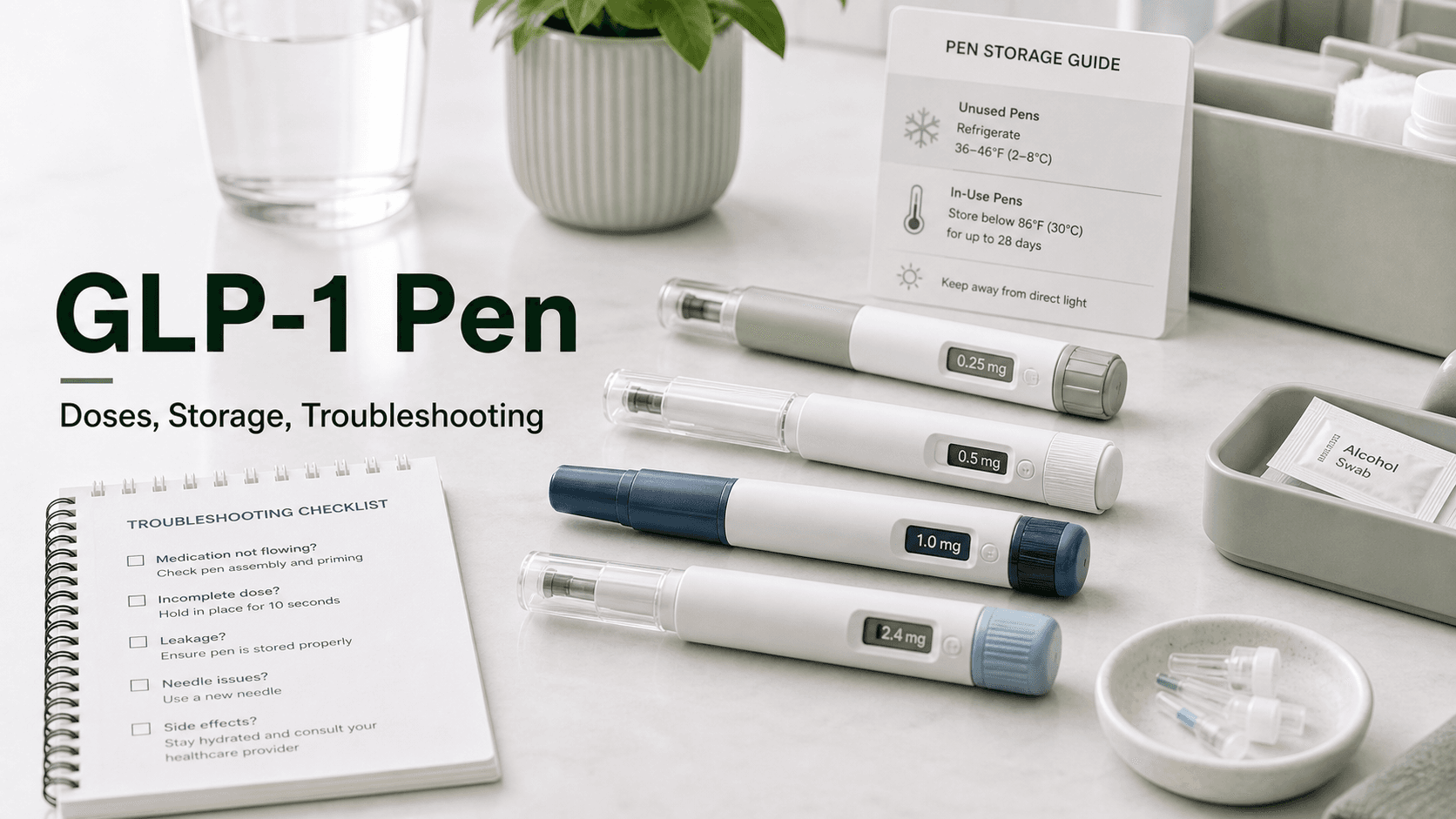
Almost every brand-name GLP-1 ships as a pen, but the pens are not interchangeable. Wegovy comes two ways: a single-dose pen with a hidden needle, and a four-dose FlexTouch dial pen at the 2.4 mg maintenance dose. Ozempic uses a four-dose dial pen made by Novo Nordisk. Mounjaro ships as a single-dose autoinjector or a four-dose KwikPen — the KwikPen started in the UK and EU and now sits on the US label too. Zepbound launched as a single-dose autoinjector, then in January 2026 the FDA approved a four-dose Zepbound KwikPen — the first monthly tirzepatide pen for weight management in the US. Saxenda is a daily multi-dose dial pen. Different priming rules, different storage windows, different mistakes.
Direct answer: Brand-name GLP-1 pens fall into two designs. Single-dose autoinjectors (the Wegovy single-dose pen, original Zepbound, US Mounjaro) hide the needle and deliver one preset dose per device — no priming, no dialing. Multi-dose dial pens (Ozempic, the four-dose Wegovy FlexTouch, Mounjaro KwikPen, the Zepbound KwikPen, Saxenda) require attaching a pen needle, priming, and dialing the dose — and the Lilly KwikPens want a prime before every weekly dose, not just the first. Store unused pens in the fridge at 36–46°F (2–8°C). Once in use, room temperature is fine up to 28 days for the Wegovy single-dose pen, 30 days for Saxenda and for the Mounjaro and Zepbound KwikPens, and 56 days for Ozempic and the four-dose Wegovy FlexTouch. Never freeze. Take the pen out 15–30 minutes before injecting to reduce sting.
The Five Main GLP-1 Pens at a Glance
| Drug | Pen name | Design | Doses per pen | Frequency | In-use limit |
|---|---|---|---|---|---|
| Wegovy (semaglutide) | Wegovy single-dose pen | Single-dose, hidden needle | 1 | Weekly | Up to 28 days room temp |
| Wegovy (semaglutide) 2.4 mg | FlexTouch | Multi-dose dial | 4 | Weekly | 56 days |
| Ozempic (semaglutide) | Ozempic pen (multidose) | Multi-dose dial | 4 | Weekly | 56 days |
| Mounjaro (tirzepatide) US | Single-dose autoinjector | Single-dose, hidden needle | 1 | Weekly | Single use; 21 days max out of the fridge |
| Mounjaro (tirzepatide) US/UK/EU | KwikPen | Multi-dose dial | 4 | Weekly | 30 days |
| Zepbound (tirzepatide) | Single-dose autoinjector | Single-dose, hidden needle | 1 | Weekly | Single use; 21 days max out of the fridge |
| Zepbound KwikPen (NEW Jan 2026) | KwikPen | Multi-dose dial | 4 | Weekly | 30 days |
| Saxenda (liraglutide) | Multi-dose pen | Multi-dose dial | Varies (3 mL pen) | Daily | 30 days |
Wegovy FlexTouch (Semaglutide, Weekly)
The Wegovy pen is the simplest device on the market. It is a single-dose, single-use autoinjector with the needle hidden inside.
- Doses per pen: 1. You receive 4 pens per monthly box.
- Strengths: 0.25, 0.5, 1, 1.7, 2.4, and 7.2 mg (Wegovy HD).
- Needle: Built in, 32G, hidden. Nothing to attach.
- Priming: Not required. The pen is preprimed.
- Technique: Pull off the cap, press the pen firmly against clean skin, hold for 5–10 seconds, and wait for two clicks. Read them the way Novo does: click 1 means the injection has started, click 2 means it is still ongoing. The finish line is the yellow bar stopping, not the second click — and the bar will not fill the whole window. Pulling away early means an incomplete dose.
Storage: refrigerator at 36–46°F (2–8°C) until first use, then up to 28 days at room temperature (up to 86°F / 30°C). Keep in the original carton to protect from light. Never freeze.
The Four-Dose Wegovy FlexTouch (2.4 mg Only)
Novo's answer to a monthly pen is the Wegovy FlexTouch, and it is a genuinely different device from the single-dose pen above. The US label lists it as 9.6 mg/3 mL (3.2 mg/mL) in a single-patient-use pen delivering four 2.4 mg/0.75 mL doses — one month per pen. It exists at the 2.4 mg maintenance dose only; titration still runs on single-dose pens. If you are paying cash for either Wegovy pen, our guide to Wegovy cost without insurance has the current self-pay prices.
- Needles: the carton holds 1 pen plus 4 NovoFine Plus 32G needles. Other compatible disposable needles up to 8 mm can be substituted. New needle every injection, and store the pen with no needle attached.
- Flow check: before the first injection with each new pen only. Dial to the flow-check symbol, hold the pen needle-up, press until the counter reads 0, look for a drop at the tip. Doses two through four skip this step.
- Dialing: you can only select 2.4 mg — the counter stops there. Novo's instruction is blunt: do not set the dose by counting clicks.
- Hold time: press the dose button until the counter shows 0, then keep pressing and count slowly to 6 before pulling the needle out.
- In-use limit: 56 days at 59–86°F (15–30°C) or in the fridge — double the single-dose pen's 28, and the same window as Ozempic.
- Eyesight caveat: the label does not recommend the FlexTouch for self-injection by people who are visually impaired, because the dose has to be read off the counter.
Ozempic Pen (Semaglutide, Weekly)
The Ozempic multidose pen looks like a free-dialing multi-dose pen but is actually strength-locked — each color delivers only its dialed strength, with four maintenance doses per pen.
- Red label: 0.25 mg starter and 0.5 mg maintenance (2 mg total per pen)
- Blue label: 1 mg only (4 mg total per pen)
- Yellow label: 2 mg only (8 mg total per pen)
- Needle: 32G, 4mm — NovoFine Plus needles ship in the carton (6 with the red starter pen, 4 with the blue and yellow pens). Use a new one every dose.
- Priming: Required only with a brand-new pen. Dial to the flow-check symbol, press until the counter reads 0, watch for a drop at the tip. If nothing appears, repeat up to six times, then change the needle and try once more.
- Hold time: press until the dose counter reads 0, then count 6 seconds with the button still held.
- In-use storage: Room temperature or refrigerator for up to 56 days after first use — the longest in-use window of any major GLP-1.
Zepbound (Tirzepatide, Weekly) — Single-Dose Autoinjector and the New KwikPen
Original Zepbound launched as a single-dose autoinjector, similar in feel to Wegovy FlexTouch — hidden needle, no priming, push-and-hold delivery.
- Strengths: 2.5, 5, 7.5, 10, 12.5, 15 mg
- Doses per pen: 1
- Hold time: Until the gray plunger stops moving (about 5–10 seconds)
The New Monthly Zepbound KwikPen (FDA-approved January 2026)
In January 2026, the FDA approved a label expansion allowing Zepbound to be delivered in Lilly's four-dose KwikPen. Each KwikPen holds 2.4 mL and delivers four weekly doses of 0.6 mL at one of the six approved strengths — 2.5, 5, 7.5, 10, 12.5, or 15 mg. One pen = one month of treatment. Available through LillyDirect Pharmacy for self-pay patients starting February 2026, priced from $299/month for 2.5 mg.
KwikPen differences vs. the single-dose autoinjector:
- You attach a needle. Pen needles are not in the carton — Lilly does not make them. See the KwikPen needle rules below.
- You prime before every weekly dose, not just the first. Lilly's instruction reads "prime before each weekly injection": dial 2 clicks to the extended line, hold the pen needle-up, tap the cartridge, push the knob until it stops and count slowly to 5 until a drop appears.
- You dial the dose before each weekly injection — turn the knob until it stops, and do not count clicks as you go.
- 30-day in-use limit once first opened, or after four doses, whichever comes first. An unopened KwikPen left at room temperature also has to go after 30 days.
- Single-patient use — never share, even with a new needle.
For people who hate cold pens stacked in the fridge door, or who travel, the KwikPen is a quality-of-life upgrade. For people who prefer never to see or handle a needle, the original autoinjector is still simpler.
Zepbound KwikPen vs Autoinjector: The Side-by-Side
Same drug, same six strengths, same weekly schedule. Everything about handling them is different — which is why the question gets typed as often as "quick pen vs auto injector" as it does by the real spelling.
| Factor | Single-dose autoinjector | KwikPen |
|---|---|---|
| What arrives per box | 4 pens, one dose each | 1 pen, four weekly doses |
| Volume | 0.5 mL per pen | 2.4 mL per pen, 0.6 mL per dose |
| Needle | Hidden and factory-attached; you never see it | You screw one on, one per dose, none supplied in the carton |
| Priming | Never | Every week, before every dose |
| Dialing | Never | Turn the knob until it stops; do not count clicks |
| Injection cue | Press the purple button up to 10 seconds: first click = started, second loud click = finished, gray plunger visible = confirmed | Push the knob until it stops, count slowly to 5, and the 0 must show in the dose window before the needle comes out |
| Out of the fridge | 21 days total, cumulative, then discard | 30 days from first use, or four doses, whichever comes first |
| Unopened at room temperature | Counts against the same 21 days | Discard after 30 days |
| Fridge footprint | 4 pens a month | 1 pen a month |
| Sharing | Never | Never, even with a fresh needle |
Two things follow from that table. First, the KwikPen is the device that can fail quietly: skip the prime, or pull the needle before the dose window reads 0, and you have short-dosed yourself with nothing obvious to show for it. The autoinjector gives you a click and a visible gray plunger. Second, Lilly's instructions say it is not necessary to bring the single-dose pen to room temperature before injecting — warming is a comfort trick, not a requirement.
Mounjaro (Tirzepatide, Weekly)
In the US, Mounjaro is a single-dose autoinjector identical in form to the Zepbound autoinjector — hidden needle, no priming, push and hold. The full weekly routine for that device sits in our Mounjaro injection guide.
In the UK and EU, Mounjaro ships as a KwikPen holding four weekly doses. The US label now lists a Mounjaro KwikPen as well — the same four-dose, 2.4 mL device as the Zepbound KwikPen, in all six strengths from 10 mg/2.4 mL up to 60 mg/2.4 mL.
- KwikPen priming: Dial 2 clicks to the prime position (the extended line in the dose window), hold needle-up, push the dose knob in, hold for 5 seconds, watch for a drop. Never dial more than 2 clicks to prime — over-priming wastes drug and can leave you short of a fourth full dose. Prime before every weekly dose, not only the first: that is the line in Lilly's instructions people skim past.
- Hold time after injection: 5 seconds with the knob fully pressed.
- In-use storage: Up to 30 days at room temperature (up to 86°F / 30°C).
Saxenda (Liraglutide, Daily)
Saxenda is the outlier — daily dosing, multi-dose dial pen, 3 mL cartridge.
- Dose range: 0.6 mg starting, escalating weekly to 3.0 mg by week 5.
- Pen lasts: Anywhere from 17 days (at 0.6 mg) to 6 days (at 3.0 mg) per pen.
- Needle: 32G, 4–6mm pen needles. A new needle every injection.
- Priming: Required for each new pen before first use.
- In-use storage: Up to 30 days after first use, fridge or room temp (15–30°C / 59–86°F).
Step-by-Step: Multi-Dose Dial Pen (Ozempic, KwikPen, Saxenda)
- Wash your hands.
- Pull the pen from the fridge 15–30 minutes early. Cold pens sting.
- Inspect the window. Liquid should be clear and colorless. Cloudy or particulate fluid means discard.
- Attach a new needle. Peel the paper tab, twist clockwise onto the pen, remove both caps. Keep the small inner cap to dispose of the needle later.
- Prime (new pens only). Dial to the flow-check symbol or the manufacturer's prime position. Hold needle-up, tap to bring bubbles to the top, press the dose button until a drop appears. If no drop, prime once more.
- Dial your dose. Confirm the number in the dose window matches your prescription.
- Inject subcutaneously at 90° in abdomen, thigh, or upper arm. Press the dose button fully.
- Hold for 5–10 seconds with the button pressed before withdrawing — this prevents under-dosing.
- Remove the needle with the outer cap, drop it into a sharps container, and re-cap the pen.
- Return the pen to its in-use storage (fridge or room temp within the labeled window).
Step-by-Step: Single-Dose Autoinjector (Wegovy, Zepbound, US Mounjaro)
- Wash hands and warm the pen.
- Check the window — clear and colorless.
- Choose and clean the site. Let alcohol fully dry.
- Pull the cap straight off. The needle is inside; do not touch it.
- Press the pen firmly against skin at 90°.
- Wait for two clicks (or until the colored plunger stops moving). Hold 5–10 seconds.
- Lift straight off. Confirm the dose indicator has fully moved.
- Drop the entire pen into a sharps container — these pens are not reusable.
Needle Gauges and Lengths
Pen needles for every major brand are 31–32 gauge, 4mm as the standard. Saxenda and the EU Mounjaro KwikPen sometimes ship with 6mm needles, but 4mm is fine for almost all adults — research shows shorter needles deliver subcutaneous medication just as effectively with less pain.
- Ozempic: 32G, 4mm NovoFine Plus included with the pen.
- Wegovy / Mounjaro (US) / Zepbound autoinjector: No external needle — hidden, factory-installed.
- KwikPen (Mounjaro EU / Zepbound): 32G, 4mm pen needles sold separately, universal pen-needle fit.
- Saxenda / Victoza: 32G, 4–6mm pen needles.
Zepbound and Mounjaro KwikPen Needles: What Fits
Lilly does not manufacture pen needles and does not put any in the KwikPen carton. What the company publishes instead is a compatibility rule: the KwikPen takes ISO 11608-2 compliant pen needles from brands such as Embecta (formerly BD), Novo Nordisk and Terumo, in any length and gauge combination on that list — lengths of 4, 5, 6, 8 and 12.7 mm, gauges from 29G to 34G. Not every combination is actually sold at retail.
So there is no single "correct" needle size for Zepbound. What the market defaults to is the short, thin end of that range: Novo ships 32G, 4 mm NovoFine Plus needles inside the Ozempic and Wegovy FlexTouch cartons, and 32G 4 mm is what most pharmacies hand over when you ask for KwikPen needles. Ask your prescriber before going longer than 4 mm.
Buy four needles per KwikPen — one per weekly dose, since the prime and the injection share the same needle — plus a few spares, because Lilly's own fix for a pen that will not release a drop while priming is to change the needle and try again.
Use a new needle for every dose. Reusing dulls the tip, increases sting, and raises lipohypertrophy risk.
Storage: Fridge, In-Use, Travel
| Product | Refrigerator (unused) | In-use limit | Max room temp |
|---|---|---|---|
| Wegovy single-dose pen | 36–46°F (2–8°C) | 28 days | 86°F (30°C) |
| Wegovy FlexTouch (4 doses) | 36–46°F (2–8°C) | 56 days | 86°F (30°C) |
| Ozempic pen | 36–46°F (2–8°C) | 56 days | 86°F (30°C) |
| Zepbound autoinjector | 36–46°F (2–8°C) | Single use; 21 days total out of the fridge | 86°F (30°C) |
| Mounjaro single-dose pen (US) | 36–46°F (2–8°C) | Single use; 21 days total out of the fridge | 86°F (30°C) |
| Zepbound KwikPen | 36–46°F (2–8°C) | 30 days | 86°F (30°C) |
| Mounjaro KwikPen | 36–46°F (2–8°C) | 30 days | 86°F (30°C) |
| Saxenda | 36–46°F (2–8°C) | 30 days | 86°F (30°C) |
Two clauses on that table trip people up. The 21 days on the tirzepatide single-dose pens is a running total, not a per-trip allowance — four days on a counter now and three days in a suitcase later both come out of the same 21. And the 30 days on a KwikPen applies twice over: an unopened KwikPen sitting at room temperature has to go after 30 days, and an opened one has to go 30 days after first use or after four doses, whichever lands first, even with drug left in the cartridge.
Never freeze. A frozen pen must be discarded even if it looks fine — the active peptide degrades. Keep pens in the original carton to protect from light.
Travel
- Short trips (under in-use window): Carry the pen at room temperature in original packaging. No ice needed.
- Longer trips: Insulated cooler with a gel pack, not direct contact with ice (freezing risk). Keep away from cabin freezers.
- Air travel: Carry-on only — hold luggage temperatures can drop below freezing. Bring the pharmacy label and prescription for screening.
Multi-Dose vs Single-Dose: Trade-Offs
| Factor | Single-dose autoinjector | Multi-dose dial pen |
|---|---|---|
| Setup time | Pull cap, press, done | Attach needle, prime, dial, inject |
| Needle handling | Hidden, never seen | You touch and dispose of the needle |
| Priming | Never | First use of each new pen |
| Fridge volume | 4 pens per month | 1 pen per month |
| Travel weight | Higher | Lower |
| Dose errors | Almost impossible | Possible if dialing wrong |
| Best for | Needle-averse, first-timers | Frequent travelers, long-term users |
Common Errors and How to Fix Them
"The pen won't dial"
- The pen is empty. A dial pen stops at the last available dose. Check the dose counter; if it won't reach your prescribed number, switch to a new pen.
- The dose was already dialed past zero in error. Dial back to zero (most pens allow reverse dialing) and start again.
"The pen won't dispense / nothing comes out"
- Needle is bent or clogged. Replace the needle.
- Pen was not primed. Repeat the prime step before injecting.
- Pen was stored frozen. Discard immediately — the liquid may look clear but the drug is degraded.
"I heard a click but no liquid"
- For autoinjectors, the first click is not the end. Hold 5–10 seconds and wait for the second click or for the colored plunger to fully travel.
- For dial pens, watch the dose counter return to zero before withdrawing.
"The dose window didn't go back to zero"
- On a KwikPen, the 0 in the dose window is the receipt. If it is not showing, the dose is not finished. Lilly's instruction is to put the needle back into your skin and finish the dose rather than write it off.
- A drop of medicine left on the needle tip afterwards is normal and does not change the dose you received.
"A drop leaked at the tip after I withdrew"
- Small leakage is normal and does not significantly change dose. Do not redose.
- If leakage is large, your hold time was too short next time, hold the full 5–10 seconds.
"The pen is making clicking sounds when I dial"
- Normal. The clicks are the dial mechanism counting units. They are not a sign of damage.
"I forgot to prime a new pen"
- For Saxenda, an unprimed first dose may be short. For a KwikPen it is worse: priming is required before every weekly dose, so a skipped prime can short any of the four. If you realize after injection, contact your prescriber — do not redose.
Disposal
Every used pen or needle goes into a sharps container — rigid plastic, puncture-resistant sides and bottom, leak-resistant, with a tight-fitting lid. If you cannot get an FDA-cleared container, the FDA's own fallback is a heavy-duty plastic household container, a laundry detergent bottle being the example it names, kept upright, labeled clearly, and out of reach of children and pets. Swap it out when it is about three-quarters full rather than pressing down on the contents. Most pharmacies and many local hazardous-waste programs accept full sharps containers. Never put loose pens or needles in regular trash, recycling, or toilets.
Pen vs Vial + Syringe (Compounded Market)
Compounded semaglutide and tirzepatide often ship as a multi-dose vial that you draw up with an insulin syringe. Compared to brand-name pens:
- Vial + syringe pros: Cheaper per mg; flexible micro-dosing; one vial covers multiple weeks.
- Vial + syringe cons: More steps; risk of dose errors; needs sterile technique; intimidating for new injectors.
- Pen pros: Faster, near-foolproof; preset doses; no math.
- Pen cons: More expensive; fixed dose steps (cannot fine-tune); larger fridge footprint with single-dose models.
For first-time injectors, pens win on safety. For experienced users at maintenance doses, vials win on cost and flexibility. If cost is the deciding factor, see our guide to the Zepbound generic question.
What People Get Wrong
- Pulling the autoinjector off after the first click. That click is the start, not the end. On a Zepbound or Mounjaro pen, wait for the second loud click and check that the gray plunger is visible. On a Wegovy pen, the second click still means "ongoing" — wait for the yellow bar to stop moving.
- Skipping the prime on a KwikPen. It is not a first-use-only step: Lilly asks for a prime before each of the four weekly doses. On Saxenda, an unprimed first dose can be partial.
- Reusing pen needles. Even one reuse dulls the tip and raises lump risk.
- Storing pens in the freezer or against the fridge back wall. Freezing destroys the drug.
- Injecting straight from the fridge. Cold injection stings; warm 15–30 min first.
- Throwing pens in regular trash. Use a sharps container.
- Sharing a pen. Even with a new needle, the cartridge can carry trace blood. Single-patient use only.
- Mixing up pen colors. Especially Ozempic — each color is a fixed strength. Wrong pen = wrong dose.
Frequently Asked Questions
How many doses are in a GLP-1 pen? Wegovy and the original Zepbound autoinjector: 1 dose per pen. Ozempic, Mounjaro KwikPen, the new Zepbound KwikPen: 4 weekly doses per pen. Saxenda: variable depending on daily dose (a 3 mL pen lasts 6–17 days).
Do GLP-1 pens come with needles? Ozempic (4 to 6 NovoFine Plus per carton), the Wegovy FlexTouch (4 NovoFine Plus 32G) and Saxenda include needles in the box. The Wegovy single-dose pen, the US Mounjaro autoinjector and the Zepbound single-dose autoinjector have built-in hidden needles — nothing to attach, nothing to buy. Zepbound and Mounjaro KwikPens do not come with needles: Lilly does not make pen needles, so you buy compatible ones separately, four per pen.
How long can a pen sit at room temperature? Wegovy: 28 days. Ozempic: 56 days. Mounjaro KwikPen, Zepbound KwikPen, Saxenda: 30 days. All at up to 86°F (30°C). Single-use autoinjectors should be used the day they leave the fridge.
Can you freeze a GLP-1 pen? No. Freezing degrades the peptide even if the liquid looks clear. Discard frozen pens.
Is the Zepbound KwikPen the same as the autoinjector? No. The KwikPen (FDA approved January 2026) is a four-dose dial pen with a refillable needle and primer step. The original Zepbound autoinjector is single-use with a hidden needle and no priming.
Is there a Wegovy KwikPen? No. KwikPen is Eli Lilly's device name and appears only on Lilly products — Zepbound, Mounjaro and Lilly's insulins. Novo Nordisk's equivalent is the FlexTouch, and it exists: the four-dose Wegovy FlexTouch holds 9.6 mg/3 mL and delivers four weekly 2.4 mg doses from one pen. If you searched "Wegovy KwikPen" wanting a monthly Wegovy pen, the FlexTouch is the thing you are looking for.
Is the Zepbound KwikPen 3 mL? No — 2.4 mL. Each KwikPen holds four 0.6 mL doses at one strength, listed on the label as 10 mg/2.4 mL through 60 mg/2.4 mL. The 3 mL figure belongs to other pens: Ozempic and the Wegovy FlexTouch are both 3 mL cartridges, as is the Saxenda pen.
What is a KwikPen? KwikPen is Eli Lilly's registered device name for its prefilled, disposable multi-dose pens — the same hardware idea it has sold for years as the Humalog KwikPen for insulin, now filled with tirzepatide for Zepbound and Mounjaro. Every KwikPen holds multiple doses, takes a screw-on pen needle you buy separately, and is a single-patient device.
What are the doses on a Zepbound KwikPen? Four, one per week, all at the strength printed on the pen you were dispensed — 2.5, 5, 7.5, 10, 12.5 or 15 mg. You cannot dial a smaller dose: turning the knob gives you one full 0.6 mL dose and stops. Changing strength means a new pen, which is why titration months and maintenance months look different at the pharmacy.
Do you have to prime the Zepbound KwikPen every week? Yes. Lilly's instruction is to prime before each weekly injection, not just when the pen is new — 2 clicks to the extended line, needle pointing up, push the knob and count to 5 until a drop appears. This is the single biggest handling difference from the Ozempic pen and the Wegovy FlexTouch, which are flow-checked once per new pen.
Is the Ozempic pen a FlexTouch or a FlexPen? Neither name is on the US Ozempic label — Novo lists it simply as a single-patient-use pen with multiple weekly doses. FlexTouch is the name Novo puts on the four-dose Wegovy pen; FlexPen is an older Novo pen platform. In the hand, the Ozempic pen and the Wegovy FlexTouch work the same way: attach a NovoFine Plus needle, flow-check a new pen, dial, then hold the button and count 6 seconds.
What needle gauge should I use? 32G, 4mm is the standard for almost every brand-name GLP-1 pen — it is what Novo puts in the Ozempic and Wegovy FlexTouch cartons. Some Saxenda users use 6mm. Lilly does not name a size for its KwikPens; it publishes a compatibility list running 29G to 34G and 4 mm to 12.7 mm and tells you to ask your prescriber. Shorter, thinner needles are less painful and equally effective for subcutaneous delivery.
Why two clicks on the Wegovy and Zepbound autoinjectors? The first click signals that injection has started. On the Zepbound and Mounjaro pens the second loud click means finished, and a visible gray plunger confirms it — some people also hear a soft click just before it, which is normal. On the Wegovy pen the second click means the injection is still ongoing, and the real end signal is the yellow bar coming to a stop. Pulling off early delivers an incomplete dose either way.
Last reviewed: May 13, 2026
Sources
- How to Use the Wegovy Pen — Novo Nordisk
- Ozempic Pen and Needles — NovoMedLink
- FDA Approves Monthly KwikPen Option for Tirzepatide — AJMC
- Announcing Zepbound KwikPen — LillyDirect
- Zepbound KwikPen Press Release — Eli Lilly
- Mounjaro KwikPen Importance of Priming — Lilly Medical
- Mounjaro KwikPen Instructions for Use — Lilly
- Saxenda Pen Instructions — Novo Nordisk
- GLP-1 Pen Needles Guide — The GLP Spot
- How to Inject Ozempic, Wegovy, Zepbound — WeightWatchers
- Pen vs Vial for Compounded Semaglutide and Tirzepatide — TrimRX
- Zepbound Prescribing Information — FDA
- Zepbound Label, KwikPen Presentation and Instructions for Use — DailyMed
- Mounjaro Label, KwikPen Presentation and Storage — DailyMed
- Wegovy Label, FlexTouch Presentation and Instructions for Use — DailyMed
- Ozempic Label, Pen Storage and Instructions for Use — DailyMed
- Zepbound KwikPen Needle Compatibility — Lilly
- How to Use the Zepbound KwikPen — Lilly
- Zepbound Dosing, How to Use and How to Inject — Lilly
- Sharps Disposal Containers — FDA
- Humalog KwikPen Presentations — Lilly