Is Mounjaro approved for weight loss?
No. Mounjaro's FDA label covers blood sugar control and heart risk in type 2 diabetes, while Zepbound, the same molecule, is the version approved for weight loss.
According to the current Mounjaro prescribing information (revised August 2026), Mounjaro is approved:
- with diet and exercise, to improve blood sugar control in adults and children 10 and older with type 2 diabetes
- to reduce the risk of major cardiovascular events in adults with type 2 diabetes who are at high risk for them
The FDA approved Mounjaro on May 13, 2022 (Drugs@FDA, NDA 215866). When it approved Zepbound on November 8, 2023, the agency noted that tirzepatide, Zepbound's active ingredient, "is already approved under the trade name Mounjaro". The Zepbound label covers weight reduction in adults with obesity, or with overweight plus at least one weight-related condition, and moderate to severe obstructive sleep apnea in adults with obesity.
The weight loss is real. The difference is the indication, which drives who can get it covered. For the full label-by-label breakdown, see our Mounjaro vs Zepbound comparison. Dosing and safety basics are in the Mounjaro guide.
How much weight do people lose on Mounjaro?
People with type 2 diabetes lost about 5 to 11 kg in Mounjaro's own trials and 12.8% to 14.7% of body weight in a dedicated 72-week weight-loss trial. People without diabetes lost more on the same doses.
Weight change in the SURPASS trials (type 2 diabetes)
The SURPASS program tested Mounjaro for blood sugar control. Weight was a secondary measure, and these trials had no weight-focused diet program. The figures below come from Section 14 of the Mounjaro label.
| Trial (all type 2 diabetes) | Length | Mounjaro 5 mg | 10 mg | 15 mg | Comparator |
|---|---|---|---|---|---|
| SURPASS-1 (no other diabetes drugs) | 40 weeks | −6.3 kg | −7.0 kg | −7.8 kg | Placebo: −1.0 kg |
| SURPASS-2 (added to metformin) | 40 weeks | −7.6 kg | −9.3 kg | −11.2 kg | Semaglutide 1 mg: −5.7 kg |
| SURPASS-3 (metformin ± SGLT2 inhibitor) | 52 weeks | −7.0 kg | −9.6 kg | −11.3 kg | Insulin degludec: +1.9 kg |
| SURPASS-4 (high cardiovascular risk) | 52 weeks | −6.4 kg | −8.9 kg | −10.6 kg | Insulin glargine: +1.7 kg |
| SURPASS-5 (added to basal insulin) | 40 weeks | −5.4 kg | −7.5 kg | −8.8 kg | Placebo: +1.6 kg |
Source: Mounjaro prescribing information, revised August 2026. Mean change from baseline.
SURPASS-2 is the head-to-head trial people quote most. Among 1,879 adults on metformin with an average starting weight of 93.7 kg, the 15 mg dose took off 11.2 kg (about 24.7 lb), compared with 5.7 kg (about 12.6 lb) on semaglutide 1 mg (Frías et al., NEJM 2021). Semaglutide 1 mg is an Ozempic diabetes dose, not the higher Wegovy dose.
SURMOUNT-2 vs SURMOUNT-1: with and without diabetes
The SURMOUNT trials were built to measure weight loss. All participants also got counseling on a diet of about 500 fewer calories a day and at least 150 minutes of activity a week. SURMOUNT-2 enrolled adults with type 2 diabetes, a BMI of 27 or higher, and an HbA1c of 7% to 10%. SURMOUNT-1 excluded diabetes. Each trial gave its participants one fixed dose for the full 72 weeks.
| 72-week result (official estimate) | SURMOUNT-2: type 2 diabetes | SURMOUNT-1: no diabetes |
|---|---|---|
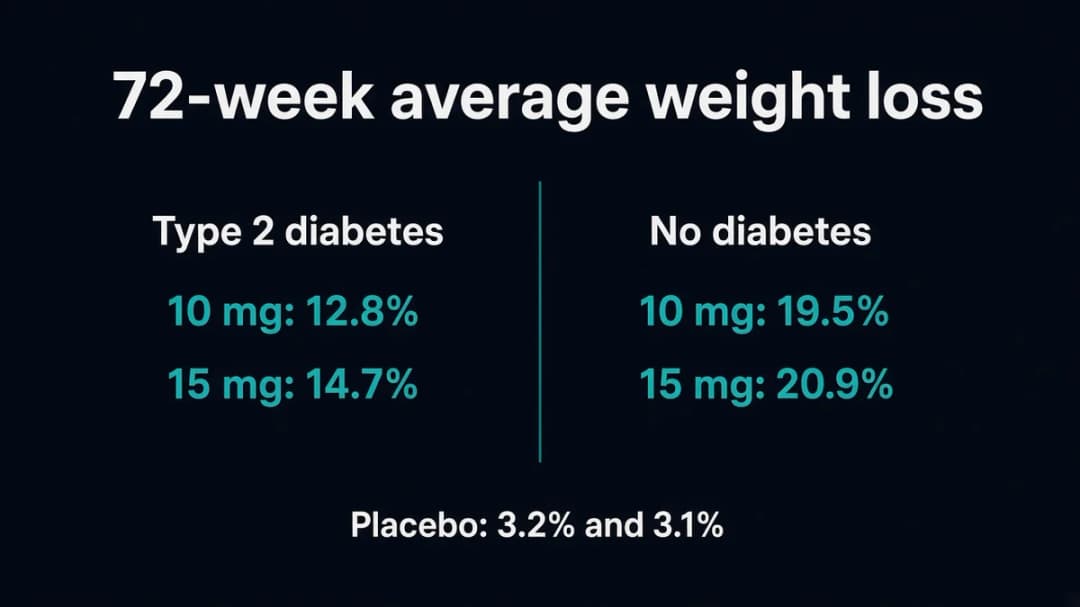
| Placebo | −3.2% | −3.1% |
| Tirzepatide 5 mg | not tested | −15.0% |
| Tirzepatide 10 mg | −12.8% | −19.5% |
| Tirzepatide 15 mg | −14.7% | −20.9% |
| Lost 20% or more (15 mg) | 30.8% of people | 56.7% of people |
| Average starting weight | 100.7 kg | 104.8 kg |
Sources: Garvey et al., Lancet 2023 (SURMOUNT-2); Jastreboff et al., NEJM 2022 (SURMOUNT-1); Zepbound label Table 2.
In pounds, the SURMOUNT-2 15 mg result is roughly 33 lb from an average starting weight of about 222 lb. The SURMOUNT-1 15 mg result is roughly 48 lb from about 231 lb. These are averages, and individual results ranged widely in both directions. We cover the non-diabetes data in more depth in tirzepatide for weight loss.
Mounjaro weight loss timeline: what to expect week by week
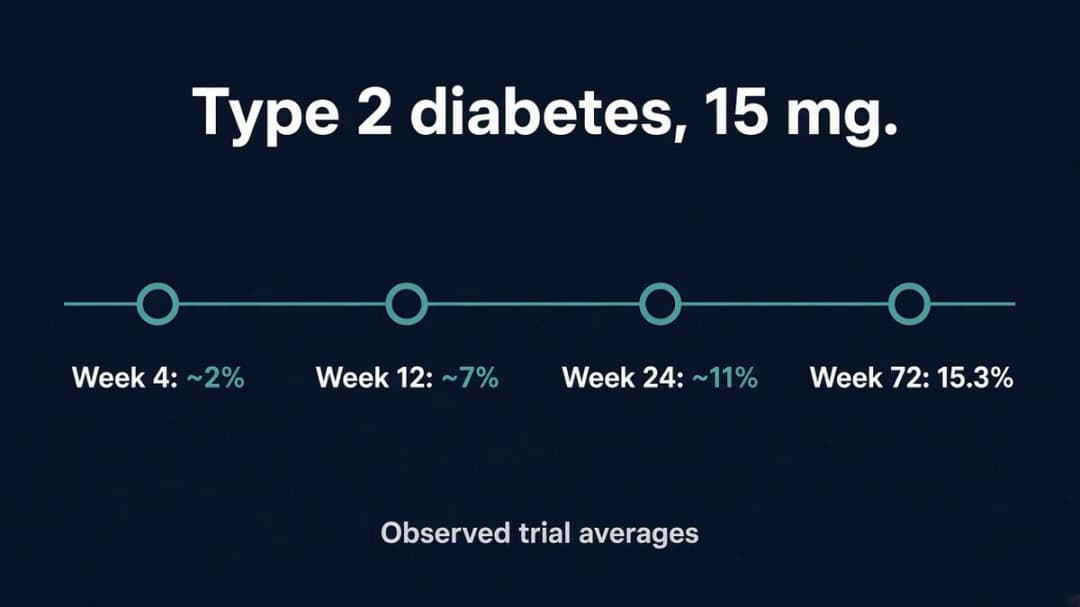
Weight drops fastest in the first 24 weeks, while the dose is still being raised. Loss slows after that and mostly levels off between weeks 48 and 72.
The table below is read from the time-course charts in the Zepbound label (Figures 3 and 4). Those charts show SURMOUNT-1 and SURMOUNT-2, the same tirzepatide doses sold as Mounjaro. Values are approximate, rounded to the nearest whole percent. They are observed averages among people still being weighed at each visit, so the week-72 values run slightly higher than the official estimates above.
| Week (about) | Dose step in the 15 mg arm | Type 2 diabetes, 10 mg | Type 2 diabetes, 15 mg | No diabetes, 15 mg |
|---|---|---|---|---|
| 4 (1 month) | 2.5 mg finished, 5 mg starts | ~2% | ~2% | ~3% |
| 8 (2 months) | 7.5 mg starts | ~4% | ~5% | ~6% |
| 12 (3 months) | 10 mg starts | ~6% | ~7% | ~9% |
| 16 (4 months) | 12.5 mg starts | ~8% | ~8% | ~11% |
| 20 (5 months) | 15 mg reached | ~9% | ~10% | ~13% |
| 24 (6 months) | 15 mg | ~10% | ~11% | ~15% |
| 36 (8 months) | 15 mg | ~12% | ~13% | ~18% |
| 48 (11 months) | 15 mg | ~12% | ~14% | ~20% |
| 60 (14 months) | 15 mg | ~13% | ~15% | ~22% |
| 72 (17 months) | 15 mg | 13.0% observed (12.8% official) | 15.3% observed (14.7% official) | 22.0% observed (20.9% official) |
Source: Zepbound prescribing information, revised August 2026, Figures 3 and 4. The dose steps follow the trials' schedule of a 2.5 mg increase every 4 weeks, with up to 20 weeks of escalation.
A few practical reads from these curves:
- Month one is modest. About 2% to 3% by week 4 is typical, and 2.5 mg is only the starting step.
- Months two to six do most of the work. With type 2 diabetes on 15 mg, the loss averaged about 2% of body weight a month over the first 24 weeks (our arithmetic from the chart).
- Months 8 to 17 are slow. With diabetes, the 15 mg arm went from about 13% at week 36 to about 15% at week 72. A flattening curve is the expected shape, not a sign the drug stopped working. Our guide to the GLP-1 plateau covers what clinicians check when it happens early.
What affects how much weight you lose on Mounjaro?
Diabetes status, dose, and time on treatment matter most. Diet and activity support add to the effect.
- Type 2 diabetes. On the same 15 mg dose, adults with diabetes lost 14.7% in SURMOUNT-2, while adults without it lost 20.9% in SURMOUNT-1.
- Dose. In SURMOUNT-1, 5 mg averaged 15.0% and 15 mg averaged 20.9%. On the Mounjaro label, each step from 5 to 15 mg added weight loss in every SURPASS trial. Your prescriber raises the dose for blood sugar control and for how well you tolerate it.
- Other diabetes medicines. Weight loss was smallest in SURPASS-5, where people were also on basal insulin (5.4 to 8.8 kg). Insulin and sulfonylureas also raise the risk of low blood sugar with Mounjaro, and the label notes that lowering their dose may reduce that risk.
- Lifestyle support. In SURMOUNT-3, adults without diabetes first lost 6.9% with a 12-week intensive diet program. They then lost another 18.4% on tirzepatide, for a total of 24.3% (Wadden et al., Nature Medicine 2023).
- Staying on it. Results depend on continued weekly use. See the stopping data below.
The Zepbound label states that weight reduction "was observed with ZEPBOUND irrespective of age, sex, race, ethnicity, baseline BMI, and glycemic status." How much weight was lost still varied between groups.
Can you take Mounjaro for weight loss if you don't have diabetes?
A prescriber can legally write Mounjaro off-label, but for weight management alone, Zepbound is the FDA-approved product with the same ingredient and doses.
Off-label prescribing is a clinical judgment, and for weight loss without diabetes it rarely makes practical sense when an approved version of the same drug exists. The bigger obstacle is coverage. If you're weighing tirzepatide for weight, talk to a clinician about which product fits your diagnosis, other medicines, and insurance.
Does insurance cover Mounjaro for weight loss?
Usually not. Plans typically cover Mounjaro only with a type 2 diabetes diagnosis. Weight-loss requests go through Zepbound or other obesity-drug criteria, if the plan covers those drugs at all.
Cigna's current national GLP-1 prior authorization policy is a clear example. Cigna policy CNF 360 (reviewed June 3, 2026) approves Mounjaro for type 2 diabetes in patients 10 and older. It lists "Weight Loss Treatment" as not medically necessary, noting that "the products in this policy are not FDA-approved for weight loss." Prediabetes is excluded too. Your own plan's rules may differ, so check its formulary or prior authorization criteria.
If you have type 2 diabetes, coverage is usually for glucose control, and the weight loss comes with it. If you don't, start with our GLP-1 insurance coverage guide, or compare cash routes in Mounjaro cost without insurance.
Switching from Mounjaro to Zepbound
Switching is a change of brand, not of drug. Both contain tirzepatide, both are once-weekly injections, and both come in the same 2.5 mg to 15 mg strengths, so there's no milligram conversion to work out.
Points to settle with your prescriber:
- Which dose to start on. The Zepbound label sets maintenance doses of 5, 10, or 15 mg for weight reduction. Your prescriber decides which of these you start on after the switch.
- Don't double up. The Zepbound label says using it together with other tirzepatide products or any GLP-1 receptor agonist is not recommended.
- Coverage is separate. Zepbound needs its own approval under your plan's obesity-drug criteria, which usually look at BMI and weight-related conditions rather than diabetes. That's only if the plan covers obesity drugs.
Mounjaro side effects to expect
Stomach and gut side effects are the most common. They rise with dose and mostly happen while the dose is being increased.
In the label's pooled placebo-controlled diabetes trials, nausea affected 12%, 15%, and 18% of people on 5, 10, and 15 mg, compared with 4% on placebo. Diarrhea affected 12% to 17% (9% on placebo), and vomiting 5% to 9% (2% on placebo). Decreased appetite, constipation, indigestion, and abdominal pain were also reported in at least 5% of people.
The label also carries:
- A boxed warning about thyroid C-cell tumors seen in rodents. Mounjaro shouldn't be used if you or a family member has had medullary thyroid carcinoma, or if you have MEN 2.
- Warnings for pancreatitis, gallbladder disease, and low blood sugar when used with insulin or sulfonylureas.
- A contraception note. Tirzepatide can make oral birth control less effective. The label advises a non-oral or added barrier method for 4 weeks after starting and after each dose increase.
Our Mounjaro side effects guide covers timing and management.
What happens to your weight if you stop Mounjaro?
On average, people regain much of the weight when tirzepatide stops. In SURMOUNT-4, people switched to placebo regained 14.0% of their body weight within a year, while those who stayed on it kept losing.
SURMOUNT-4 enrolled 783 adults without diabetes. All took tirzepatide at their maximum tolerated dose (10 or 15 mg) for 36 weeks and lost an average of 20.9%. At week 36, 670 were randomly assigned to continue or switch to placebo for 52 more weeks (Aronne et al., JAMA 2024):
- Continued tirzepatide: a further −5.5% from week 36 to 88, for −25.3% overall
- Switched to placebo: +14.0% regained, ending 9.9% below their starting weight
- 89.5% of those who continued kept at least 80% of their loss, compared with 16.6% on placebo
The trial didn't include people with type 2 diabetes, but it is the main randomized test of stopping tirzepatide. For people with diabetes, stopping Mounjaro also removes its blood sugar effect, so it's a decision to make with your prescriber. For practical approaches, see how to stop a GLP-1 without regaining weight.
Frequently Asked Questions
How much weight can you lose on Mounjaro in a month?
In the first month, on the 2.5 mg starting dose, average loss in the trials was about 2% to 3% of body weight. For a 220-lb person, that's roughly 4 to 7 lb. From months two to six, adults with type 2 diabetes on 15 mg averaged about 2% a month, and the pace slowed after that.
How long does it take Mounjaro to work for weight loss?
Weight starts falling in the first 4 weeks, but most of the effect builds over the first 6 to 9 months as the dose rises. In SURMOUNT-2, adults with diabetes on 15 mg were down about 11% at week 24 and about 13% at week 36, according to the label's time-course chart.
Do people with type 2 diabetes lose less weight on Mounjaro?
Yes, on average. At 72 weeks on 15 mg, adults with type 2 diabetes lost 14.7% in SURMOUNT-2, compared with 20.9% for adults without diabetes in SURMOUNT-1. A smaller number on the scale can still mean a meaningful improvement in blood sugar.
What dose of Mounjaro gives the most weight loss?
The 15 mg maximum dose produced the most weight loss in every SURPASS trial and in SURMOUNT-1 and SURMOUNT-2, but the gap between 10 mg and 15 mg was small. In SURMOUNT-2 it was 12.8% vs 14.7%. Mounjaro doses go up only after at least 4 weeks on the current dose, and the right maintenance dose depends on blood sugar control and side effects.
Is Mounjaro or Zepbound better for weight loss?
They are the same drug at the same doses, so they produce the same weight loss. The difference is the approved use. Mounjaro is for type 2 diabetes, and Zepbound is for chronic weight management and obstructive sleep apnea with obesity. That usually decides which one your insurance will pay for.
Can I get Mounjaro for weight loss without diabetes?
A prescriber can write it off-label, but most insurers won't cover it without a type 2 diabetes diagnosis. Cigna's 2026 policy, for example, lists weight loss as not medically necessary for Mounjaro. Zepbound is the on-label option for weight loss alone.
Does Mounjaro keep working after the first year?
Weight mostly holds steady after about a year, as long as treatment continues. In the 3-year SURMOUNT-1 extension in adults with obesity and prediabetes, the average loss at 176 weeks was 12.3%, 18.7%, and 19.7% on 5, 10, and 15 mg, compared with 1.3% on placebo (Jastreboff et al., NEJM 2025).
Will I regain weight if I stop Mounjaro?
Most people do. In SURMOUNT-4, adults who switched to placebo after 36 weeks regained 14.0% of body weight over the next 52 weeks. Those who kept taking tirzepatide lost another 5.5%. If you're thinking about stopping, plan it with your prescriber.
Sources
- Mounjaro (tirzepatide) prescribing information, DailyMed, revised August 2026
- Zepbound (tirzepatide) prescribing information, DailyMed, revised August 2026
- FDA: approval of Zepbound for chronic weight management, November 8, 2023
- Drugs@FDA: Mounjaro, NDA 215866
- Frías JP et al. Tirzepatide versus semaglutide once weekly in patients with type 2 diabetes (SURPASS-2). NEJM 2021
- Garvey WT et al. Tirzepatide once weekly for the treatment of obesity in people with type 2 diabetes (SURMOUNT-2). Lancet 2023
- Jastreboff AM et al. Tirzepatide once weekly for the treatment of obesity (SURMOUNT-1). NEJM 2022
- Jastreboff AM et al. Tirzepatide for obesity treatment and diabetes prevention (SURMOUNT-1, 3 years). NEJM 2025
- Wadden TA et al. Tirzepatide after intensive lifestyle intervention (SURMOUNT-3). Nature Medicine 2023
- Aronne LJ et al. Continued treatment with tirzepatide for maintenance of weight reduction (SURMOUNT-4). JAMA 2024
- Cigna National Formulary policy CNF 360: Diabetes – GLP-1 agonists prior authorization, reviewed June 3, 2026