Which weight loss pills are FDA approved in 2026?
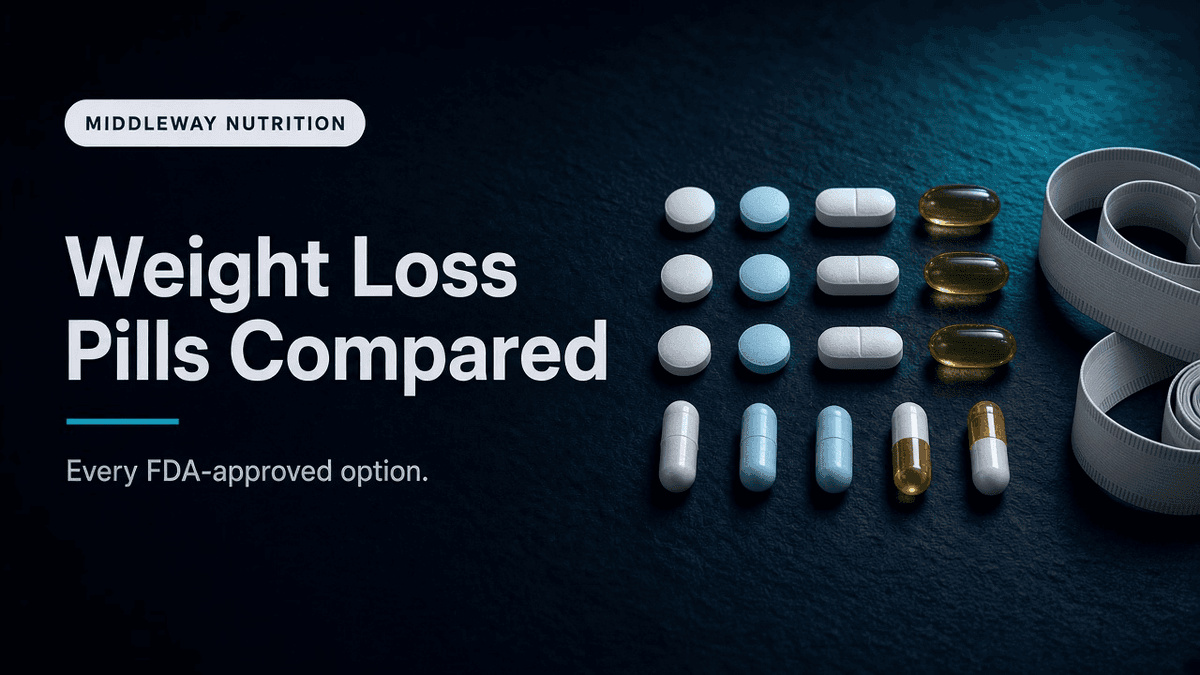
Five pills are approved for long-term weight management and four stimulants for short-term use. Anything else sold as a "diet pill" or "fat burner" is a supplement the FDA has not approved.
Approved for long-term use:
- Oral semaglutide 25 mg (Wegovy pill), approved December 22, 2025
- Orforglipron (Foundayo), approved April 1, 2026
- Phentermine/topiramate ER (Qsymia), plus a generic version
- Naltrexone/bupropion ER (Contrave)
- Orlistat 120 mg (Xenical), plus orlistat 60 mg (alli) over the counter
Approved for short-term use (a few weeks): phentermine (Adipex-P, Lomaira and generics), diethylpropion, phendimetrazine and benzphetamine.
The long-term pills are labeled for adults with a BMI of 30 or more, or 27 or more with a weight-related condition such as high blood pressure or type 2 diabetes. Qsymia and Xenical are also approved for some adolescents 12 and older. Ozempic tablets (the oral semaglutide that is replacing Rybelsus in the US) are approved only for type 2 diabetes, not weight loss, and no oral tirzepatide is FDA approved.
How do weight loss pills compare on results and cost?
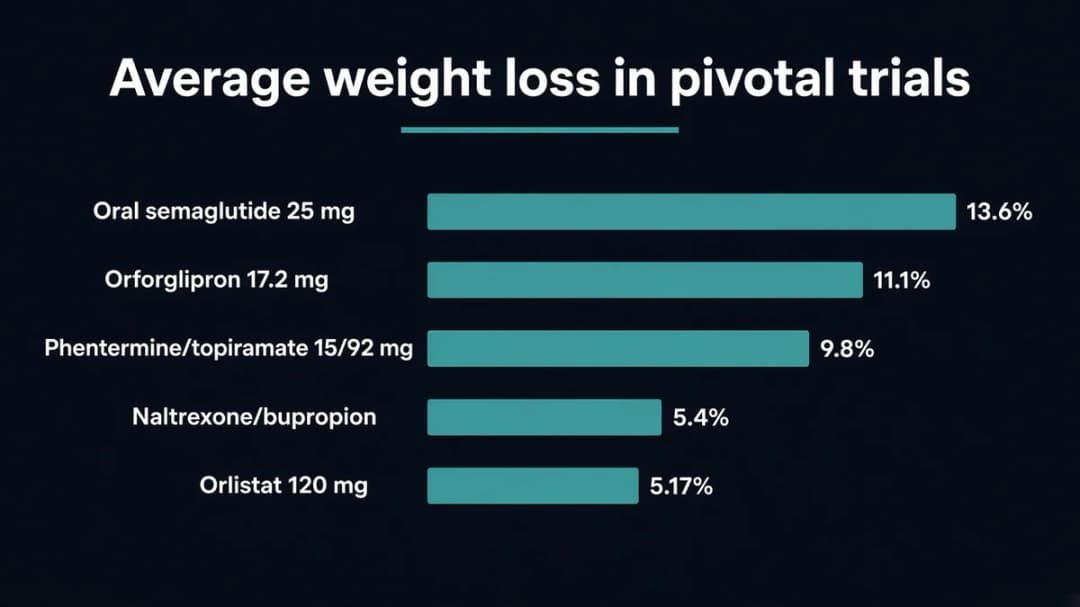
The GLP-1 pills lead on average weight loss, Qsymia is next, and Contrave and orlistat produce smaller losses. Trial results come from each FDA label; prices come from manufacturer pages checked November 4, 2026.
| Pill (generic, brand) | Pivotal trial | Avg. weight loss vs placebo | How taken | Controlled? | Self-pay price, Nov 4, 2026 |
|---|---|---|---|---|---|
| Oral semaglutide 25 mg (Wegovy pill) | OASIS 4, 64 wk | 13.6% vs 2.4% | Daily, empty stomach, 30-min wait | No | $149 to $299/mo by dose |
| Orforglipron 17.2 mg (Foundayo) | ATTAIN-1, 72 wk | 11.1% vs 2.1% | Daily, any time, food OK | No | $149 to $349/mo by dose |
| Phentermine/topiramate ER 15/92 mg (Qsymia) | CONQUER, 56 wk | 9.8% vs 1.2% | Daily, morning | Schedule IV | $74.99/30 days |
| Naltrexone/bupropion ER 32/360 mg (Contrave) | COR-I, 56 wk | 5.4% vs 1.3% | 2 tablets twice daily | No | $99/mo |
| Orlistat 120 mg (Xenical) | XENDOS, 4 yr | 5.17% vs 2.75% | With each fatty meal, 3x daily | No | None published |
| Orlistat 60 mg (alli, OTC) | Label | 5 to 10 lb over 6 months for most users | With each fatty meal, max 3 daily | No | About $66 to $70 per 120 capsules |
| Phentermine 37.5 mg (Adipex-P, generics) | Short trials | "A fraction of a pound a week" more | Daily, morning | Schedule IV | Generic, low cost |
Two caveats: the trials differed in length and population, so this is not a head-to-head ranking, and the figures are intention-to-treat averages that include people who stopped the drug. For context, CMS's National Average Drug Acquisition Cost data (effective October 21, 2026) lists generic phentermine 37.5 mg at about $0.07 per tablet and Xenical at about $4.59 per capsule. That is what pharmacies pay, not the price at the counter.
What are the GLP-1 weight loss pills?
The Wegovy pill and Foundayo are daily tablets that act on the GLP-1 receptor, like Wegovy and Zepbound injections. They are the most effective pills available; our GLP-1 pill guide compares them in depth.
Wegovy pill (oral semaglutide). Semaglutide is a peptide, so the tablet is taken each morning on an empty stomach with up to 4 ounces of water, then a 30-minute wait before food, drinks or other pills. The dose steps up every 30 days from 1.5 mg to 4 mg, 9 mg and then 25 mg. In OASIS 4, adults without diabetes lost 13.6% of body weight at 64 weeks on 25 mg versus 2.4% on placebo (FDA label, Study 7). Novo Nordisk's approval announcement cites 16.6%, which counts only people who kept taking the drug. NovoCare lists $149 (1.5 mg), $199 (4 mg) and $299 (9 and 25 mg) a month; see our Wegovy pill cost breakdown.
Foundayo (orforglipron). Orforglipron is a small non-peptide molecule, taken any time of day with or without food. The label starts at 0.8 mg and can rise in 30-day steps to a maximum of 17.2 mg. In ATTAIN-1, adults without diabetes lost 11.1% at 72 weeks on 17.2 mg versus 2.1% on placebo; in ATTAIN-2, adults with type 2 diabetes lost 9.6% versus 2.5%. The NEJM trial report calls the top arm 36 mg, which is the same dose on the trial formulation's scale. Lilly's regular self-pay prices run from $149 (0.8 mg) to $349 (14.5 and 17.2 mg), with temporary cuts through December 31, 2026; see our Foundayo coupon guide.
Shared warnings. Both labels carry a boxed warning about thyroid C-cell tumors and are contraindicated with a personal or family history of medullary thyroid carcinoma or MEN 2. Nausea, constipation, diarrhea and vomiting are most common; pancreatitis and gallbladder disease are rarer risks.
How well does Qsymia (phentermine/topiramate) work?
Qsymia is the most effective non-GLP-1 pill, with about 10% average loss at its top dose. It combines low-dose phentermine with extended-release topiramate.
In CONQUER, a 56-week trial of adults with overweight or obesity and at least two related conditions, people on 15/92 mg lost 9.8% of body weight, those on 7.5/46 mg lost 7.8%, and placebo lost 1.2% (Qsymia label, Study 2; Gadde et al., Lancet 2011). In EQUIP, adults with a BMI of 35 or more lost 10.9% on 15/92 mg versus 1.6% on placebo.
- How it's taken: 3.75/23 mg once each morning for 14 days, then 7.5/46 mg. The dose can be raised based on results, and the top dose must be tapered off to avoid seizures.
- Common side effects: tingling in the hands and feet, dizziness, altered taste, insomnia, constipation and dry mouth.
- Do not use if: pregnant, or with glaucoma, hyperthyroidism, or an MAO inhibitor in the past 14 days.
- Pregnancy rules: topiramate raises the risk of cleft lip and palate, so a negative pregnancy test is needed before starting and monthly after, under an FDA safety program (REMS).
- Status: Schedule IV controlled substance.
Vivus lists a cash price of $74.99 per 30-day prescription through its Qsymia Engage home delivery pharmacy. A generic phentermine/topiramate ER from Teva also has a current FDA label.
How well does Contrave (naltrexone/bupropion) work?
Contrave produces modest weight loss, about 4 percentage points more than placebo. It pairs naltrexone, an opioid blocker, with the antidepressant bupropion and is not a controlled substance.
In COR-I, adults lost 5.4% of body weight at 56 weeks on the full 32/360 mg dose versus 1.3% on placebo, and 42% lost at least 5% versus 17% on placebo (Contrave label, Table 6). When combined with intensive behavior therapy in COR-BMOD, average loss reached 8.1% versus 4.9%. About half of COR-I patients stopped the drug early.
- How it's taken: 1 tablet in week 1, building to 2 tablets in the morning and 2 in the evening from week 4.
- Boxed warning: suicidal thoughts and behaviors, because it contains bupropion.
- Do not use if: you have uncontrolled high blood pressure, a seizure disorder, an eating disorder such as bulimia or anorexia, chronic opioid use, or another bupropion product.
- Common side effects: nausea, constipation, headache, vomiting, dizziness, insomnia and dry mouth.
Currax lists Contrave at $99 a month with free shipping through its CurAccess home delivery program, or no more than $199 at a retail pharmacy with its savings card.
How does orlistat (Xenical and alli) work?
Orlistat blocks the enzyme that digests fat; at 120 mg it cuts dietary fat absorption by about 30%. It is the only FDA-approved weight loss drug sold over the counter.
Prescription Xenical (120 mg). In the 4-year XENDOS trial of 3,304 adults with obesity, the Xenical label reports weight loss of 5.17% on orlistat versus 2.75% on placebo. The published trial also found a 37.3% lower risk of developing type 2 diabetes, mainly in people with impaired glucose tolerance. Xenical is marketed by H2-Pharma, which also sells an authorized generic.
Over-the-counter alli (60 mg). The alli Drug Facts label is for overweight adults 18 and older and says that for every 5 pounds lost by diet alone, orlistat can help you lose 2 to 3 pounds more; most people in studies lost 5 to 10 pounds over 6 months. A 120-capsule pack cost about $66 to $70 at major retailers in November 2026 (for example, H-E-B).
- How it's taken: 1 capsule with each main meal containing fat, up to 3 a day.
- Side effects: oily spotting (27% on Xenical vs 1% on placebo), gas with discharge, fecal urgency, oily stools and, less often, fecal incontinence.
- Vitamins: take a multivitamin with vitamins A, D, E and K at least 2 hours apart from orlistat, or at bedtime.
- Do not use if: you have chronic malabsorption or cholestasis, take cyclosporine, or have had an organ transplant (Xenical and alli labels).
What about phentermine and other short-term diet pills?
Phentermine is the best-known diet pill, but its label approves it only as "a short-term (a few weeks) adjunct." It is a stimulant related to amphetamine and a Schedule IV controlled substance.
The label gives no average figure, only that patients lost "a fraction of a pound a week" more than placebo in older short trials. In a more modern 28-week trial (Aronne et al., Obesity 2013), 46.2% of people on phentermine 15 mg lost at least 5% of body weight versus 15.5% on placebo. The usual dose is 37.5 mg once in the morning; Lomaira is an 8 mg tablet taken up to three times a day before meals.
The phentermine label rules it out with heart disease, uncontrolled high blood pressure, hyperthyroidism, glaucoma, a history of drug abuse, recent MAO inhibitor use, or pregnancy. Side effects include a racing heart, raised blood pressure, insomnia and dry mouth. For a direct comparison with GLP-1 drugs, see phentermine vs semaglutide.
Three older stimulants carry the same "few weeks" indication and current FDA labels: diethylpropion (Schedule IV), phendimetrazine (Schedule III) and benzphetamine (Schedule III).
Two once-popular pills are off the market. Sibutramine (Meridia) was removed in October 2010 for safety reasons, and lorcaserin (Belviq) was withdrawn at FDA request in February 2020 over cancer findings.
Do over-the-counter fat burners work?
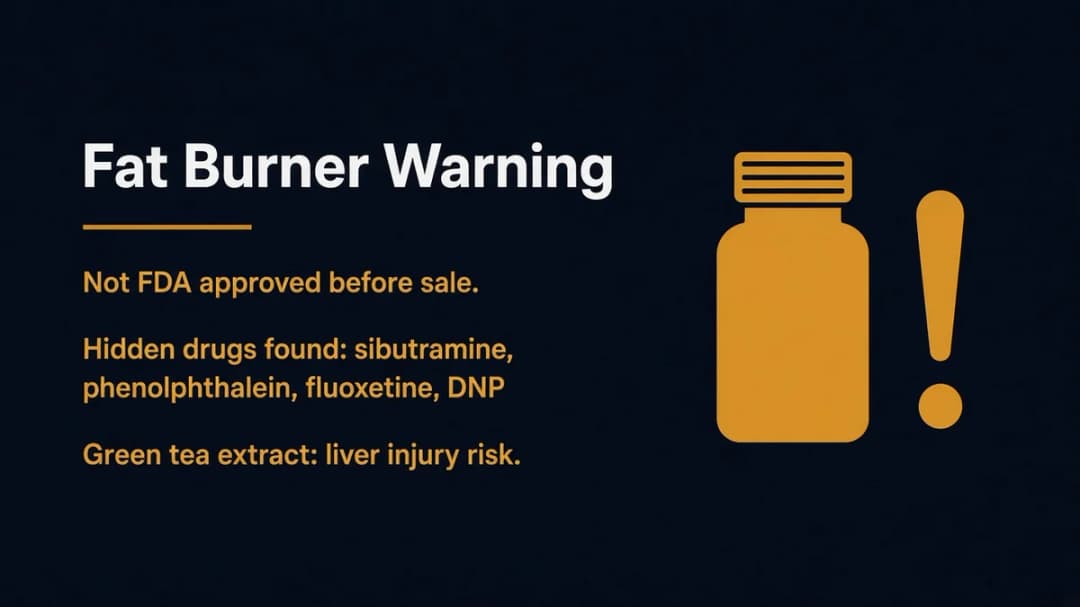
Mostly no. "Fat burner" pills are dietary supplements, and the FDA does not approve supplements for safety or effectiveness before they are sold. The NIH Office of Dietary Supplements concludes that the evidence for weight-loss supplements is "inconclusive and unconvincing" (ODS fact sheet).
Some products are dangerous. The FDA's weight loss product fraud notifications list products found to contain hidden drugs, and the 2026 entries alone include sibutramine, phenolphthalein, fluoxetine and DNP (2,4-dinitrophenol), which can cause dangerously high body temperature and death. The FDA warns that "if a product is not on the list, that does not mean it is safe."
How common fat-burner ingredients grade out (our grades, based on ODS and the meta-analyses cited):
| Ingredient | What the evidence shows | Safety flag | Our grade |
|---|---|---|---|
| Caffeine | Possible modest effect, no strong caffeine-only trials | FDA: 400 mg a day generally safe for most adults (FDA) | Weak |
| Green tea extract (EGCG) | 0.04 kg vs placebo outside Japan, not significant (Jurgens 2012) | Well-established cause of liver injury (LiverTox) | Weak |
| Garcinia cambogia (HCA) | 0.88 kg vs placebo, relevance uncertain (Onakpoya 2011) | Liver toxicity cases reported | Very weak |
| Glucomannan | 0.22 kg vs placebo, not significant (Onakpoya 2014) | Tablets linked to esophageal blockage | Very weak |
| Chromium picolinate | 1.1 kg vs placebo, low-quality evidence (Tian 2013) | Generally well tolerated | Very weak |
| CLA | 0.70 kg vs placebo (Onakpoya 2012) | Case reports of hepatitis | Very weak |
| Raspberry ketone | No human trials of the ingredient alone | Safety never studied in humans | None |
| Bitter orange (synephrine) | Small, poor-quality, inconclusive trials | Reports of stroke, heart attack and arrhythmia | None |
Products marketed as "natural GLP-1" boosters are supplements too; see our guide to GLP-1 supplements.
How do you choose a weight loss pill with your clinician?
The right pill depends on your goal, health conditions, budget and tolerance for side effects. Decide with a clinician who knows your history; this is a framework, not personal medical advice.
- Eligibility first. Long-term pills are labeled for a BMI of 30 or more, or 27 or more with a weight-related condition. Medicines are not recommended during pregnancy or while trying to conceive (NIDDK).
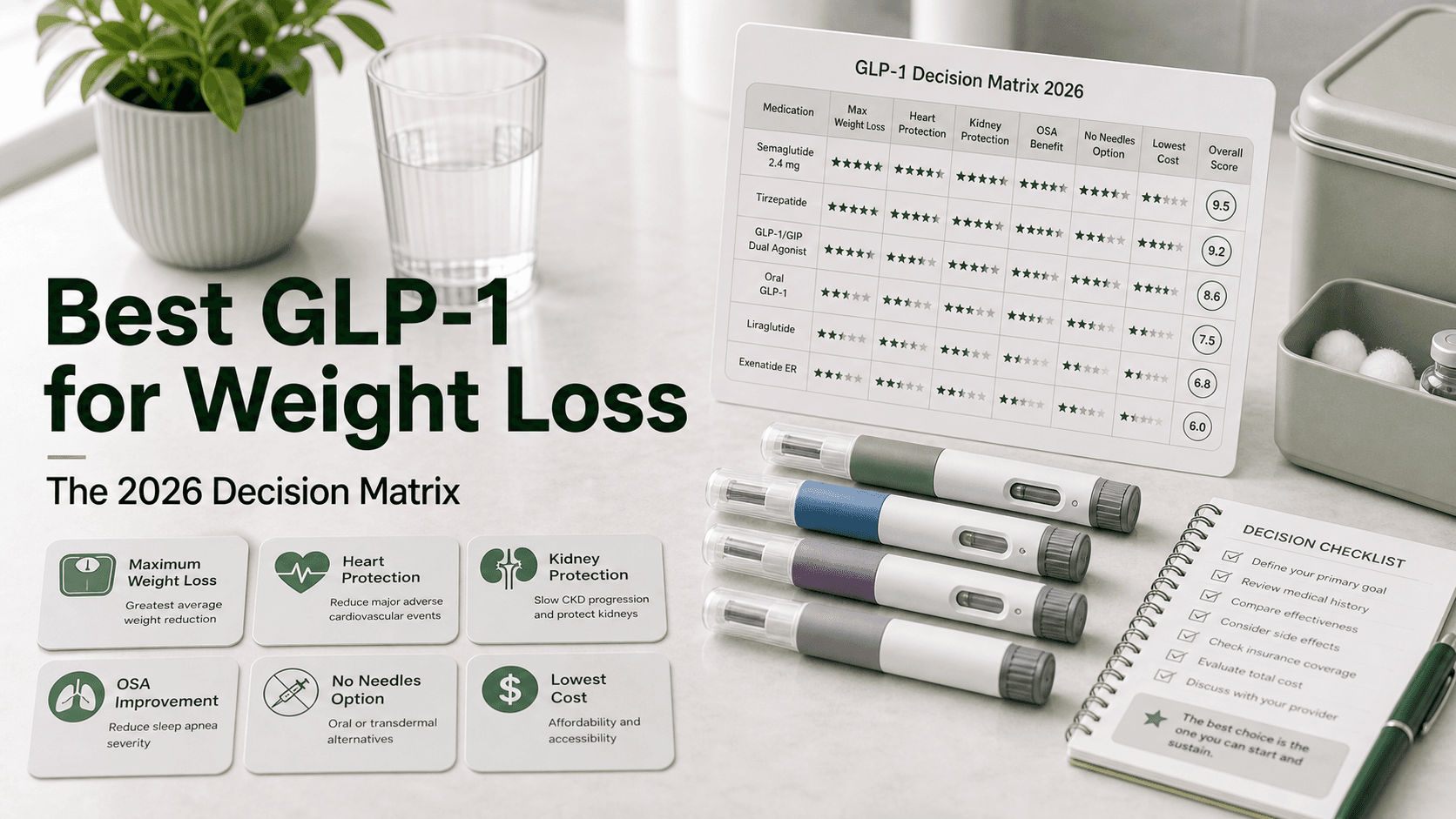
- Largest expected loss. The GLP-1 pills, then Qsymia. Injections such as tirzepatide produce more on average; see our guides to weight loss injections and which GLP-1 is best for weight loss.
- Ruling options out. Heart disease rules out phentermine; seizures, eating disorders or opioid use rule out Contrave; glaucoma rules out phentermine and Qsymia; a family history of medullary thyroid cancer rules out the GLP-1 pills.
- Cost. Qsymia and Contrave are the cheapest brand-name options for cash payers. With commercial coverage, savings cards can cut the GLP-1 pills to $25 a month for eligible patients; Lilly offers Foundayo to eligible Medicare Part D patients for $50 a month.
- The 12-week check. Per NIDDK, losing less than 5% after 12 weeks on the full dose usually means stopping or switching.
Frequently Asked Questions
What is the most effective weight loss pill?
In pivotal trials, the Wegovy pill (oral semaglutide 25 mg) produced the largest average loss: 13.6% at 64 weeks versus 2.4% on placebo. Foundayo's top dose produced 11.1% at 72 weeks versus 2.1%. The trials differed, so this is not a direct comparison.
Can you buy weight loss pills over the counter?
Only one FDA-approved weight loss drug is sold without a prescription: orlistat 60 mg (alli). Every other over-the-counter "diet pill" or "fat burner" is a dietary supplement that the FDA has not approved for weight loss.
Which weight loss pills are controlled substances?
Phentermine, Qsymia and diethylpropion are Schedule IV controlled substances, and phendimetrazine and benzphetamine are Schedule III. The Wegovy pill, Foundayo, Contrave and orlistat are not controlled.
Are weight loss pills as effective as injections?
Not quite. The strongest injections produced larger average losses in their trials than any pill; for example, semaglutide 7.2 mg produced 18.7% in the STEP UP trial.
Do fat burners actually work?
Not in any meaningful way. Meta-analyses of green tea extract, garcinia, glucomannan, chromium and CLA show average effects of roughly 1 kg or less versus placebo, and green tea extract and garcinia have been linked to liver injury.
Does insurance cover weight loss pills?
Some plans do and some do not, so check with your insurer. With coverage and a savings card, the Wegovy pill and Foundayo can cost as little as $25 a month for eligible patients, and the makers of Qsymia and Contrave offer low cash prices.
What happens when you stop taking a weight loss pill?
Most people regain weight after stopping, according to NIDDK. Talk with your clinician before stopping; the top Qsymia dose, for example, has to be tapered to avoid seizures.
Sources
- FDA, Drugs@FDA: Wegovy tablets, Foundayo
- Wegovy label (06/2026) and NovoCare pricing
- Foundayo label (07/2026) and Lilly pricing
- Wharton S, et al. Orforglipron for obesity (ATTAIN-1). N Engl J Med. 2025.
- DailyMed labels: Qsymia, Contrave, Xenical, alli, phentermine
- Gadde KM, et al. CONQUER. Lancet. 2011.
- Torgerson JS, et al. XENDOS. Diabetes Care. 2004.
- Aronne LJ, et al. Phentermine/topiramate vs its components. Obesity. 2013.
- CMS, NADAC 2026
- NIDDK on prescription weight-loss medicines
- NIH ODS weight-loss supplements fact sheet
- FDA fraud notifications and supplement Q&A