GLP-1 Qualifications: Who Actually Qualifies in 2026
GLP-1 qualification is two separate questions. The first is whether the FDA-approved label fits you. The second — usually harder — is whether your insurance company will pay for it. The label criteria are written by the agency that approved the drug. The insurance criteria are written by people whose job is to limit spend. Mixing them up is the most common reason people think they "don't qualify" when they actually do, and vice versa.
Eligibility can differ if you have had weight-loss surgery; see using a GLP-1 after gastric bypass.
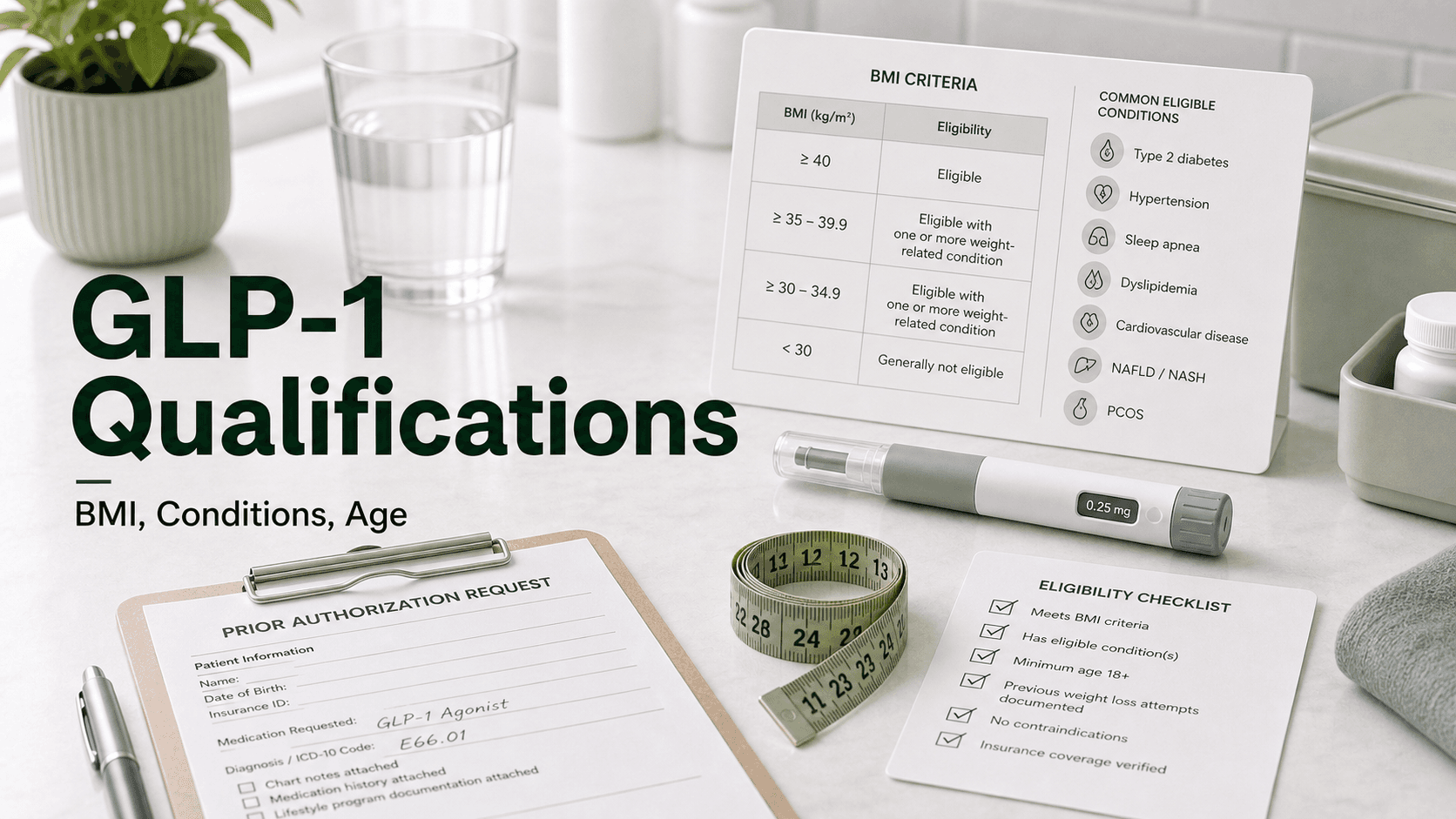
Direct answer: Under FDA labeling for chronic weight management, adults qualify for a GLP-1 with a BMI of 30 kg/m² or higher, OR a BMI of 27 kg/m² or higher with at least one weight-related condition. The labels do not publish a closed list of qualifying conditions; the Wegovy and Zepbound trial descriptions name dyslipidemia, hypertension, obstructive sleep apnea and cardiovascular disease as examples, and payers work from a broader list of their own. Wegovy and Saxenda are also approved from age 12; Zepbound, oral Wegovy, and Foundayo are adults only (18+). On the diabetes side the floor drops further: Mounjaro, Victoza, and Trulicity are approved from age 10 for type 2 diabetes, and no GLP-1 label sets an upper age limit. Insurance plans typically apply the same BMI rule but add: documented BMI history, a 3–6 month supervised lifestyle attempt, and in many cases a prior failed trial of metformin (for Ozempic/Mounjaro under a diabetes indication).
FDA-Approved Qualification Criteria
These are the rules written on the prescribing label. A licensed prescriber can write the prescription if you meet them — independent of whether insurance will cover it.
Adult BMI Criteria (all weight-management GLP-1s)
The BMI required for a GLP-1 turns on a single question: whether you also carry a weight-related condition.
| BMI | Additional requirement | Qualifies? |
|---|---|---|
| ≥30 kg/m² (obesity) | None — BMI alone is enough | Yes |
| 27–29.9 kg/m² (overweight) | At least one weight-related condition | Yes |
| 25–26.9 kg/m² | Not in label for weight management | Generally no |
| <25 kg/m² | Healthy weight range | No |
Two label updates are worth knowing. FDA approved efficacy supplements for semaglutide on March 8, 2024 and for tirzepatide on October 18, 2024, and the indication language now reads "adults with obesity, or adults with overweight in the presence of at least one weight-related comorbid condition" rather than printing BMI numbers. The 30/27 thresholds did not disappear, they moved: the Clinical Studies sections of both labels define the trial populations as obesity (BMI ≥30 kg/m²) or overweight (BMI 27 to 29.9 kg/m²) with at least one weight-related comorbid condition. That is the mapping clinicians and insurers still operationalize, and it is what every prior authorization form is built around.
Drug-Specific FDA Indications
| Drug | Primary indication | Minimum age |
|---|---|---|
| Wegovy (semaglutide injection) | Chronic weight management; CV risk reduction in established CVD; noncirrhotic MASH with F2–F3 fibrosis | 12 |
| Wegovy (oral semaglutide) | Chronic weight management in adults; CV risk reduction in established CVD | 18 |
| Zepbound (tirzepatide) | Chronic weight management; moderate-to-severe OSA with obesity | 18 |
| Saxenda (liraglutide) | Chronic weight management | 12 |
| Ozempic (semaglutide) | Type 2 diabetes; CV risk reduction; CKD progression in T2D | 18 |
| Mounjaro (tirzepatide) | Type 2 diabetes | 10 |
| Rybelsus (oral semaglutide) | Type 2 diabetes; CV risk reduction in T2D at high CV risk | 18 |
| Foundayo (orforglipron) | Chronic weight management | 18 |
| Victoza (liraglutide) | Type 2 diabetes; CV risk reduction in T2D with established CVD | 10 |
| Trulicity (dulaglutide) | Type 2 diabetes; CV risk reduction | 10 |
Two rows in that table get reported wrong almost everywhere, so they are worth stating plainly. Foundayo is orforglipron — Lilly's oral small-molecule GLP-1, a different molecule from semaglutide, not a low-dose oral semaglutide. And Mounjaro is not adults-only: FDA approved the pediatric efficacy supplement on December 19, 2025, and the current label indicates it for "adults and pediatric patients 10 years of age and older with type 2 diabetes mellitus." That extension is often still reported as an April 2026 change, which is the date of a later labeling revision, not of the pediatric approval.
What Counts as a "Weight-Related Condition"
There is no FDA-published list of qualifying comorbidities. The labels say "at least one weight-related comorbid condition" and then name examples — Zepbound's trial description gives dyslipidemia, hypertension, obstructive sleep apnea and cardiovascular disease, Wegovy's gives dyslipidemia and hypertension — with "such as" doing the work. The list below is the working set payers actually accept, not a label enumeration. Prior authorization forms ask for documentation either way — an ICD-10 code, a recent lab, or a sleep study, not a self-report.
- Type 2 diabetes — A1C ≥6.5%, fasting glucose ≥126 mg/dL on two occasions, OGTT 2-hour ≥200 mg/dL, or random glucose ≥200 mg/dL with symptoms.
- Prediabetes — A1C 5.7–6.4% or fasting glucose 100–125 mg/dL. Accepted under Medicare's Bridge program and many commercial plans.
- Hypertension — Diagnosed and either treated or with documented BP ≥130/80 mmHg.
- Dyslipidemia — LDL elevated, low HDL, or elevated triglycerides; can be treated or untreated.
- Obstructive sleep apnea — Confirmed by polysomnography or home sleep study with AHI ≥15 events per hour (Zepbound's standalone OSA indication uses this threshold).
- Established cardiovascular disease — Prior MI, prior stroke, symptomatic peripheral artery disease, or angiographic CAD.
- MASH (metabolic dysfunction–associated steatohepatitis) — Biopsy-confirmed or imaging-supported in many newer payer policies.
- Heart failure with preserved ejection fraction (HFpEF) in patients with obesity — Now named explicitly in Medicare's GLP-1 Bridge criteria as a qualifying diagnosis at BMI ≥30, and increasingly accepted by commercial plans.
- Osteoarthritis with weight-bearing impact — Less universally accepted, but qualifies under some plans.
- PCOS with metabolic features — Often accepted as a documented comorbidity, though not on every plan's list.
A "weight-related condition" you saw on a list ten years ago — like gallbladder disease, GERD, or stress incontinence — is generally not enough on its own for current insurance criteria. Six conditions (T2D, HTN, dyslipidemia, OSA, CVD, MASH) cover almost every approved case in practice, though that grouping is payer convention rather than anything the FDA published.
Qualifying Conditions and What Documents Them
Prior authorization turns on paperwork, not on the diagnosis in your head. What a reviewer is looking for, condition by condition:
| Qualifying condition | What the plan wants to see |
|---|---|
| Type 2 diabetes | A1C ≥6.5%, or two fasting glucose readings ≥126 mg/dL |
| Prediabetes | A1C 5.7–6.4%, or fasting glucose 100–125 mg/dL |
| Hypertension | Charted BP readings, usually alongside an active antihypertensive |
| Dyslipidemia | A lipid panel within the last year, treated or untreated |
| Obstructive sleep apnea | Polysomnogram or home sleep test showing AHI ≥15 events per hour |
| Established cardiovascular disease | Records of a prior MI, prior stroke, symptomatic PAD, or angiographic CAD |
| MASH | Biopsy, or an imaging-supported diagnosis on newer policies |
Two of these have graduated from supporting comorbidity to standalone indication, which changes the conversation entirely. The current Wegovy injection label, revised June 2026, approves it in its own right for noncirrhotic MASH with moderate-to-advanced fibrosis, stages F2 to F3, in adults — an accelerated approval. Zepbound works the same way for sleep apnea: moderate-to-severe OSA in adults with obesity is its own indication, and the trials behind it defined moderate OSA as an AHI of 15 to 30 events per hour and severe OSA as an AHI of 30 or more. If either diagnosis is yours, you are not asking a plan to accept a comorbidity in support of a weight-loss request. You are asking for a drug labeled for the disease you have.
Insurance Prior Authorization Criteria
This is where most qualified-on-paper patients hit a wall. Insurance criteria layer additional requirements on top of FDA labeling. The most common stack:
- Documented BMI history, often two readings over 6 months, in the chart.
- 3–6 months of supervised lifestyle intervention — diet program, behavioral counseling, or medically supervised weight management, with documentation from a dietitian, weight-loss clinic, or primary care.
- For diabetes indications: a prior trial of metformin, typically 3 months at a tolerated dose, before semaglutide or tirzepatide for T2D.
- For weight indications: a prior trial of phentermine, orlistat, or another covered weight medication on some restrictive formularies.
- Comorbidity documentation: a recent lab, sleep study, or ICD-10 code for the qualifying condition.
- Ongoing program participation during therapy and ≥5% weight loss at reauthorization (usually 6–12 months in).
A few realities of 2026 PA:
- Turnaround is set by rule, not by custom, and the rule depends on who your plan is. A Medicare Part D sponsor must decide a standard coverage determination no later than 72 hours after receiving the request, 24 hours if expedited, and a standard redetermination within 7 calendar days. An employer group health plan must decide a non-urgent pre-service claim within 15 days, and an urgent one within 72 hours. Commercial pharmacy prior authorization outside those two frameworks has no single federal clock.
- On appeal, an ERISA group health plan owes you a decision on a pre-service appeal within 30 days if it runs one level of review, or 15 days per level if it runs two, and you get at least 180 days from the denial notice to file. Published success rates specific to GLP-1 appeals do not exist; treat any percentage you see quoted as an estimate rather than a measured figure.
- Medicare Part D historically did not cover weight-loss GLP-1s. CMS's GLP-1 Bridge demonstration runs July 1, 2026 to December 31, 2027, carries a $50 copay, and covers Foundayo, Wegovy (injection or tablet), and Zepbound KwikPen only. Eligibility is 18+ plus any one of three routes: BMI ≥35 on its own; BMI ≥30 with HFpEF, uncontrolled hypertension, or CKD stage 3a or above; or BMI ≥27 with prediabetes, prior MI, prior stroke, or symptomatic PAD. Criteria are judged at the time GLP-1 therapy was started, not at the time of the request. Beneficiaries whose GLP-1 is already covered by their Part D plan, and those with type 2 diabetes, moderate-to-severe sleep apnea, or fatty liver disease, are excluded from the Bridge.
- Ozempic and Mounjaro for off-label weight loss without a T2D diagnosis are almost universally denied by commercial insurers.
Age Eligibility, Including Pediatric
Age cutoffs depend on the drug and the indication, not the class.
- Wegovy (subcutaneous semaglutide) — approved from age 12 for adolescents with a BMI at or above the 95th percentile on age- and sex-specific growth charts (the clinical definition of pediatric obesity).
- Saxenda (liraglutide) — approved from age 12 with body weight >60 kg (132 lb) and a BMI corresponding to adult BMI ≥30.
- Zepbound (tirzepatide) — adults 18+ only; pediatric safety and efficacy not yet established.
- Oral Wegovy — adults 18+ only.
- Ozempic, Rybelsus, Foundayo — adults 18+ only.
- Mounjaro (tirzepatide), Victoza (liraglutide), Trulicity (dulaglutide) — approved from age 10, but only under a type 2 diabetes indication. None of the three carries a weight-management indication, so the age floor is low and the qualifying condition is narrow.
Age Limits and Age Restrictions by Drug
Sorted by the floor, lowest first:
| Drug | FDA-approved minimum age | What the age applies to |
|---|---|---|
| Mounjaro (tirzepatide) | 10 | Type 2 diabetes |
| Victoza (liraglutide) | 10 | Type 2 diabetes |
| Trulicity (dulaglutide) | 10 | Type 2 diabetes |
| Wegovy injection (semaglutide) | 12 | Weight management, BMI ≥95th percentile for age and sex |
| Saxenda (liraglutide) | 12 | Weight management, body weight above 60 kg (132 lb) |
| Wegovy tablets (semaglutide) | 18 | Weight management |
| Zepbound (tirzepatide) | 18 | Weight management, OSA |
| Foundayo (orforglipron) | 18 | Weight management |
| Ozempic (semaglutide) | 18 | Type 2 diabetes |
| Rybelsus (semaglutide) | 18 | Type 2 diabetes |
Turning 18 lifts every age restriction at once. An 18-year-old who meets the BMI criteria can be prescribed anything in that table, including the adults-only products.
There is no upper age limit on any GLP-1 label. Zepbound's label, for instance, reports no overall difference in safety or effectiveness between patients 65 and older and younger adults. What actually restricts prescribing in older patients is sarcopenia risk, frailty, and polypharmacy — clinical judgment calls at the visit, not eligibility rules on a form.
For adolescents, providers also weigh psychosocial readiness, family support, and growth trajectory. Adolescent prescribing typically happens inside a pediatric obesity program, not as a one-visit refill from urgent care.
Contraindications That Override Qualification
Meeting BMI and comorbidity criteria does not override absolute contraindications. The labeled list is short and identical across Wegovy, Zepbound, Saxenda, Ozempic and Foundayo: personal or family history of medullary thyroid carcinoma (MTC) or multiple endocrine neoplasia type 2 (MEN2), and a prior serious hypersensitivity reaction — anaphylaxis or angioedema — to that drug or its excipients. Pregnancy and breastfeeding are frequently listed elsewhere as contraindications, but they are not: the Wegovy label handles pregnancy in Use in Specific Populations, instructing that the drug be discontinued in pregnant patients using it for weight reduction, not that it is contraindicated. Relative contraindications — pancreatitis history, severe gastroparesis, active proliferative retinopathy — usually trigger a discussion rather than an automatic no.
See the full breakdown: GLP-1 contraindications: the complete absolute and relative list.
BMI Quick Reference
BMI is weight in kilograms divided by height in meters squared, or — in US units — weight in pounds × 703, divided by height in inches squared.
Every figure below is the first whole pound, and the first whole kilogram, at which BMI actually reaches the threshold — the weight genuinely needed to cross the line, not the rounded-down number most charts print. That distinction matters on a prior authorization form: at 5'8", the widely copied "177 lb" figure is a BMI of 26.9, which is under the line. The real crossing point is 178 lb. Metric rows use the standard centimeter equivalent of each height.
| Height | BMI 27 starts at | BMI 30 starts at |
|---|---|---|
| 4'10" (147 cm) | 130 lb (59 kg) | 144 lb (65 kg) |
| 4'11" (150 cm) | 134 lb (61 kg) | 149 lb (68 kg) |
| 5'0" (152 cm) | 139 lb (63 kg) | 154 lb (70 kg) |
| 5'1" (155 cm) | 143 lb (65 kg) | 159 lb (73 kg) |
| 5'2" (157 cm) | 148 lb (67 kg) | 165 lb (74 kg) |
| 5'3" (160 cm) | 153 lb (70 kg) | 170 lb (77 kg) |
| 5'4" (163 cm) | 158 lb (72 kg) | 175 lb (80 kg) |
| 5'5" (165 cm) | 163 lb (74 kg) | 181 lb (82 kg) |
| 5'6" (168 cm) | 168 lb (77 kg) | 186 lb (85 kg) |
| 5'7" (170 cm) | 173 lb (79 kg) | 192 lb (87 kg) |
| 5'8" (173 cm) | 178 lb (81 kg) | 198 lb (90 kg) |
| 5'9" (175 cm) | 183 lb (83 kg) | 204 lb (92 kg) |
| 5'10" (178 cm) | 189 lb (86 kg) | 210 lb (96 kg) |
| 5'11" (180 cm) | 194 lb (88 kg) | 216 lb (98 kg) |
| 6'0" (183 cm) | 200 lb (91 kg) | 222 lb (101 kg) |
| 6'1" (185 cm) | 205 lb (93 kg) | 228 lb (103 kg) |
| 6'2" (188 cm) | 211 lb (96 kg) | 234 lb (107 kg) |
| 6'3" (190 cm) | 217 lb (98 kg) | 241 lb (109 kg) |
| 6'4" (193 cm) | 222 lb (101 kg) | 247 lb (112 kg) |
Two worked examples, since these are the numbers people actually plug in:
- 5'7" at 155 lb is a BMI of 24.3 — inside the healthy range, below the overweight band entirely, so no GLP-1 qualifies under the weight-management label at that weight. That height reaches BMI 27 at 173 lb and BMI 30 at 192 lb.
- 80 kg at 175 cm is a BMI of 26.1, a shade under the BMI 27 pathway. The same 80 kg at 170 cm is 27.7, which does qualify with one documented weight-related condition. Identical weight, opposite answers, because BMI divides by height squared and 5 cm moves the result by more than a full point.
If you are within 5 lb of the threshold, ask for two BMI measurements in your chart over 4–6 months — many PA forms accept the higher reading or the average.
If You Don't Qualify
Not qualifying today is not necessarily a permanent answer. Options grouped by likely usefulness:
- Document your BMI trend. If you are at BMI 26 and gaining, two consecutive readings at 27+ over a few months will move you onto the BMI 27 pathway if a comorbidity is also present.
- Get the comorbidity worked up. Many patients who think they have only weight as a problem have undiagnosed prediabetes, dyslipidemia, hypertension, or OSA. A standard panel plus a screening sleep study identifies a qualifying comorbidity in a large share of cases.
- Use a covered alternative. Bupropion-naltrexone (Contrave), phentermine-topiramate (Qsymia), and orlistat are FDA-approved for the same BMI thresholds and are sometimes covered when GLP-1s are not. Metformin, while not a weight-loss drug, has modest weight effects and is widely covered.
- Bariatric surgery referral. Medicare's national coverage determination requires all three of BMI ≥35, at least one obesity-related comorbidity, and a previously unsuccessful attempt at medical treatment for obesity — there is no BMI-alone pathway, and Medicare states plainly that treatment for obesity alone remains non-covered. The BMI ≥40-with-no-comorbidity route comes from the older NIH consensus criteria and survives on many commercial plans, but not on Medicare. Some payers cover surgery before GLP-1.
- Cash-pay branded. LillyDirect lists Zepbound self-pay at $299 to $449 a month for both single-dose vials and the KwikPen, with the $449 ceiling conditional on refilling within 45 days; without that, the regular price runs $499 at 7.5 mg and $699 at 10 mg and above. NovoCare Pharmacy lists the Wegovy pen at $199 a month for new patients for two fills through December 31, 2026, then $349 a month for 0.25 through 2.4 mg and $399 for Wegovy HD 7.2 mg, and the Wegovy pill at $149 to $299 depending on dose. No insurance criteria apply, but prices are program terms and change without notice.
- Lifestyle program with a downstream PA path. Enrolling in a supervised program now creates the 3–6 month lifestyle documentation many plans require — useful even if you intend to push for a GLP-1 later.
What People Get Wrong About Qualifying
- "My BMI is 26 so I cannot qualify." Correct under current FDA labeling, but only just. Many patients qualify within months of intentional weight gain, growth, or a re-check with calibrated equipment. More importantly, a documented comorbidity is the bigger lever.
- "My doctor said I'm healthy so I do not qualify." Healthy on a snapshot may still mean prediabetic, dyslipidemic, or apneic on workup. Ask for a full lipid panel, A1C, and OSA screening if BMI is in the 27–29 range.
- "Ozempic is denied so all GLP-1s are denied." Ozempic for off-label weight loss is denied; Wegovy or Zepbound for chronic weight management is a separate PA pathway.
- "My adolescent cannot take a GLP-1." Wegovy and Saxenda are approved from age 12 with adolescent obesity criteria.
- "I failed metformin so I don't qualify." The opposite — failing metformin is usually the step therapy gate that lets you onto a GLP-1 for T2D.
- "Medicare doesn't cover GLP-1s." True historically. The GLP-1 Bridge demonstration opened July 1, 2026 for eligible Part D beneficiaries, and the criteria are broader than the prediabetes-and-cardiovascular-disease version usually quoted: BMI ≥35 on its own also qualifies, as does BMI ≥30 with HFpEF, uncontrolled hypertension, or CKD stage 3a or above.
Frequently Asked Questions
What is the minimum BMI for a GLP-1? 27 kg/m² with at least one weight-related condition, or 30 kg/m² with no other requirement.
What BMI is required for GLP-1 coverage? Insurers work off the same two numbers the label uses — BMI 30, or BMI 27 with a documented weight-related condition — then layer on requirements the FDA never asked for: a BMI history in the chart, 3 to 6 months of supervised lifestyle intervention, and proof of the comorbidity. The BMI guideline itself is rarely what sinks a claim. The documentation around it usually is.
Do I need a comorbidity if my BMI is already 30 or higher? No. At BMI 30 and above, BMI alone satisfies the weight-management label. The comorbidity requirement attaches only to the 27 to 29.9 band. An unrelated diagnosis — a leaky mitral valve, say — neither strengthens nor blocks that pathway, though your plan can still demand the lifestyle documentation and, on restrictive formularies, a prior trial of another weight medication before it pays.
Can you qualify for a GLP-1 if you are not diabetic? Yes. Wegovy, Zepbound, Saxenda, and Foundayo are labeled for weight management, not diabetes, so a non-diabetic patient qualifies on BMI alone at 30 or above, or on BMI 27 to 29.9 plus one weight-related condition — hypertension, dyslipidemia, sleep apnea, established cardiovascular disease, and MASH all count, and none of them involve blood sugar. The wall non-diabetic patients hit is on the benefit side rather than the label side: some plans cover GLP-1s for diabetes and exclude weight-management drugs outright. That is a plan design exclusion, not a verdict on whether you qualify.
Are there age restrictions, and is there an upper age limit? Yes at the bottom, no at the top. The floor is 10 for Mounjaro, Victoza, and Trulicity under a type 2 diabetes indication, and 12 for Wegovy injection and Saxenda under weight management. Everything else is 18 and up. No GLP-1 label sets a maximum age.
Does PCOS count as a qualifying condition? PCOS — PCOD, in a lot of the world — is not one of the conditions the FDA names in the weight-management indication, so on a strict reading of the label it does not open the BMI 27 pathway by itself. Many plans accept it when metabolic features are documented alongside it. PCOS also travels with prediabetes, dyslipidemia, and hypertension often enough that one of those is usually the cleaner qualifying condition to put on the form.
Does prediabetes count as a comorbidity? The weight-management labels do not enumerate qualifying conditions at all. They say "at least one weight-related comorbid condition" and name examples in the trial descriptions — dyslipidemia, hypertension, obstructive sleep apnea, cardiovascular disease — with prediabetes not among them. So it is not a label comorbidity, but it is accepted by many commercial plans and it is one of the named qualifying diagnoses at BMI ≥27 under Medicare's Bridge demonstration.
Do I need to fail metformin first? For Ozempic or Mounjaro under a T2D indication, most insurers require a 3-month metformin trial. For Wegovy or Zepbound under a weight-management indication, metformin failure is not standard.
Does insurance require a lifestyle program? Most plans require 3–6 months of documented supervised lifestyle intervention. This can be a dietitian, behavioral counseling, or a medically supervised weight management program.
Can teenagers qualify? Yes for Wegovy and Saxenda from age 12, with a BMI at or above the 95th percentile. Saxenda adds a body weight requirement above 60 kg (132 lb). Zepbound is adults only. Adolescent eligibility is scored against age- and sex-specific growth charts rather than the adult 30 and 27 cutoffs, so a 13-year-old at 189 lb is judged on where that falls on the percentile curve for their height, age, and sex — not on the adult table above. Under 12, the only GLP-1 options are Mounjaro, Victoza, and Trulicity, and only for type 2 diabetes, from age 10.
What if my BMI is 26? You generally do not qualify under FDA labeling. Consider documenting BMI over time, getting a full metabolic and OSA workup, and discussing alternatives like Contrave or Qsymia.
Does Medicare cover GLP-1s for weight loss in 2026? Standard Part D does not. The CMS GLP-1 Bridge demonstration provides time-limited access from July 1, 2026 through December 31, 2027, at a $50 copay, covering Foundayo, Wegovy injection or tablet, and Zepbound KwikPen. Eligibility is 18+ and any one of three routes: BMI ≥35 alone; BMI ≥30 with heart failure with preserved ejection fraction, uncontrolled hypertension, or chronic kidney disease stage 3a or above; or BMI ≥27 with prediabetes, prior MI, prior stroke, or symptomatic peripheral artery disease. You are judged on where you were when you started GLP-1 therapy, not on today's number. Anyone whose Part D plan already covers their GLP-1, and anyone with type 2 diabetes, moderate-to-severe sleep apnea, or fatty liver disease, is outside the Bridge.
How long does prior authorization take? It depends on the plan type, and the deadlines are regulatory rather than customary. Medicare Part D sponsors have 72 hours for a standard coverage determination and 24 hours if expedited, then 7 calendar days for a standard redetermination. Employer group health plans have 15 days for a non-urgent pre-service claim, 72 hours if urgent, and 30 days to decide a single-level pre-service appeal, with at least 180 days for you to file that appeal. There is no published success rate specific to GLP-1 appeals.
Can I qualify on cash-pay if insurance denies me? Yes. Lilly Direct (Zepbound vials) and NovoCare (Wegovy direct) bypass insurance criteria entirely. The qualification floor is still the FDA-approved indication.
Last reviewed: August 20, 2026
Sources
- Wegovy Prescribing Information — FDA accessdata
- Zepbound Prescribing Information — FDA accessdata
- Medicare GLP-1 Bridge — CMS
- FDA Approves Zepbound for Moderate-to-Severe OSA — FDA
- Wegovy for Adolescents — Novo Nordisk
- GLP-1 Medications for Weight Loss: How to Get Started — Yale Medicine
- Qualifying for GLP-1 Weight Loss — Hopkins MD
- Zepbound Prior Authorization Criteria 2026 — Honest Care
- Ozempic Prior Authorization Criteria — Klarity
- GLP-1 Receptor Agonists for Obesity: Eligibility Across 99 Countries — Lancet Diabetes & Endocrinology
- Changes Are Coming: Medicare Access to GLP-1 Medications — Obesity Action Coalition
- Wegovy (semaglutide) Prescribing Information, revised 6/2026 — DailyMed
- Zepbound (tirzepatide) Prescribing Information, revised 4/2026 — DailyMed
- Mounjaro (tirzepatide) Prescribing Information, revised 4/2026 — DailyMed
- Saxenda (liraglutide) Prescribing Information — DailyMed
- Foundayo (orforglipron) Prescribing Information — DailyMed
- Ozempic (semaglutide) Prescribing Information — DailyMed
- Victoza (liraglutide) Prescribing Information — DailyMed
- Trulicity (dulaglutide) Prescribing Information — DailyMed
- Rybelsus / Ozempic tablets (oral semaglutide) Prescribing Information, revised 1/2026 — DailyMed
- Medicare GLP-1 Bridge: Information for Providers (clinical eligibility criteria) — CMS
- Weight loss drugs: who's eligible, covered drugs, $50 copay — Medicare.gov
- NCD 100.1, Bariatric Surgery for Treatment of Co-Morbid Conditions Related to Morbid Obesity — CMS Medicare Coverage Database
- 42 CFR 423.568, Standard timeframe and notice requirements for coverage determinations — eCFR
- 42 CFR 423.590, Timeframes and responsibility for making redeterminations — eCFR
- 29 CFR 2560.503-1, Claims procedure (group health plan claim and appeal deadlines) — eCFR
- Drugs@FDA approval history for Wegovy (NDA 215256), Zepbound (NDA 217806), Mounjaro (NDA 215866) and Foundayo (NDA 220934) — FDA
- Zepbound self-pay pricing — LillyDirect
- Wegovy and Ozempic self-pay pricing — NovoCare Pharmacy