Ozempic hair loss and muscle loss are both consequences of losing weight quickly rather than direct effects of semaglutide on follicles or muscle fibres. That distinction is the useful part, because it means Ozempic hair loss and muscle loss respond to the same three interventions: slow the rate of loss, raise protein intake, and lift weights.
Neither effect is unique to this drug. Both appear after bariatric surgery, after severe illness, and after any aggressive diet. Semaglutide produces them more often simply because it is unusually good at producing rapid, sustained weight loss.
Why Hair Sheds During Weight Loss
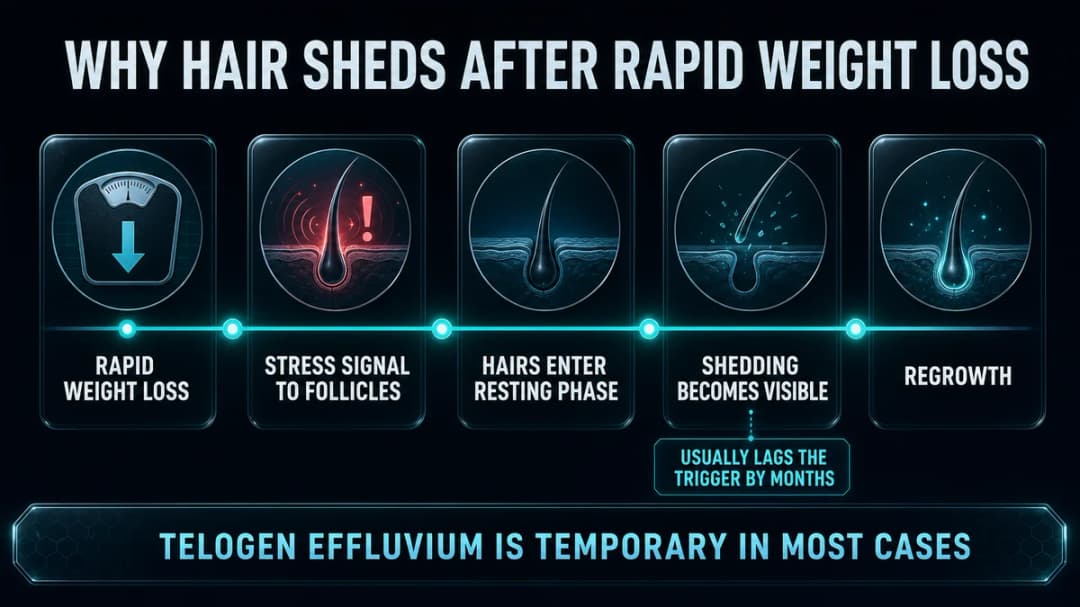
The mechanism is telogen effluvium. Hair follicles cycle between a growth phase and a resting phase, and a physiological stressor pushes an abnormally large share of them into resting at once. Two to three months later, those hairs release together. The shedding you notice in the shower is the delayed echo of something that happened in the spring.
Rapid weight loss qualifies as that stressor. So do low protein intake, low iron stores, thyroid disturbance, and sharp calorie restriction, all of which can occur simultaneously on a GLP-1 drug if intake is not managed.
Semaglutide labelling lists alopecia as an uncommon adverse event at low single digit rates. User surveys report far higher figures, which is unsurprising: people who experience a side effect are more likely to answer a survey about it. The true rate probably sits between the two, and it is higher in women, who tend to notice density loss earlier and who more often start with marginal iron stores.
The important reassurance is that the follicle is not destroyed. This is a cycling disturbance, not scarring, and it is fundamentally different from androgenetic hair loss.
| Phase | Timing relative to starting rapid loss | What is happening |
|---|---|---|
| Trigger | Weeks 0 to 8 | Follicles shift into the resting phase. Nothing visible |
| Shedding | Months 2 to 4 | Noticeably more hair on the pillow, brush and shower floor |
| Peak | Months 3 to 6 | Density loss becomes visible, usually diffuse rather than patchy |
| Regrowth | Months 6 to 12 | Short new hairs at the hairline and parting |
| Resolution | Months 9 to 18 | Density typically returns to near baseline |

What Helps the Hair
- Slow the pace of weight loss if it is running faster than about one percent of body weight per week
- Hit protein targets consistently. Keratin is protein, and hair is a low priority tissue when supply is short
- Ask for ferritin, full blood count, thyroid function and vitamin D. Ferritin in particular is worth checking, since many dermatologists aim well above the bottom of the reference range for hair health
- Be patient with regrowth. Topical treatments do not shorten telogen effluvium meaningfully, though they may be appropriate if there is coexisting pattern hair loss
Our GLP-1 hair loss guide covers the workup in more detail.
Why Muscle Is Lost Alongside Fat
Any substantial energy deficit costs some lean tissue. The body does not preferentially burn fat; it draws on whatever is available and adjusts based on the signals it receives. Two signals matter most: how much protein is arriving, and whether the muscle is being asked to do anything.
Body composition substudies using DXA in the semaglutide obesity programme found that a meaningful minority of total weight lost was lean mass, in the region of 40 percent. That figure sounds alarming until it is put in context. Lean mass includes water, glycogen and organ tissue, not just skeletal muscle, and the proportion is broadly similar to what occurs with diet induced weight loss of the same magnitude. GLP-1 drugs are not uniquely catabolic. They are just uniquely effective, so more total weight moves.
The concern is real but specific: losing skeletal muscle reduces resting metabolic rate, reduces strength, and makes weight regain after stopping more likely to land as fat rather than muscle.
What Actually Protects Lean Mass
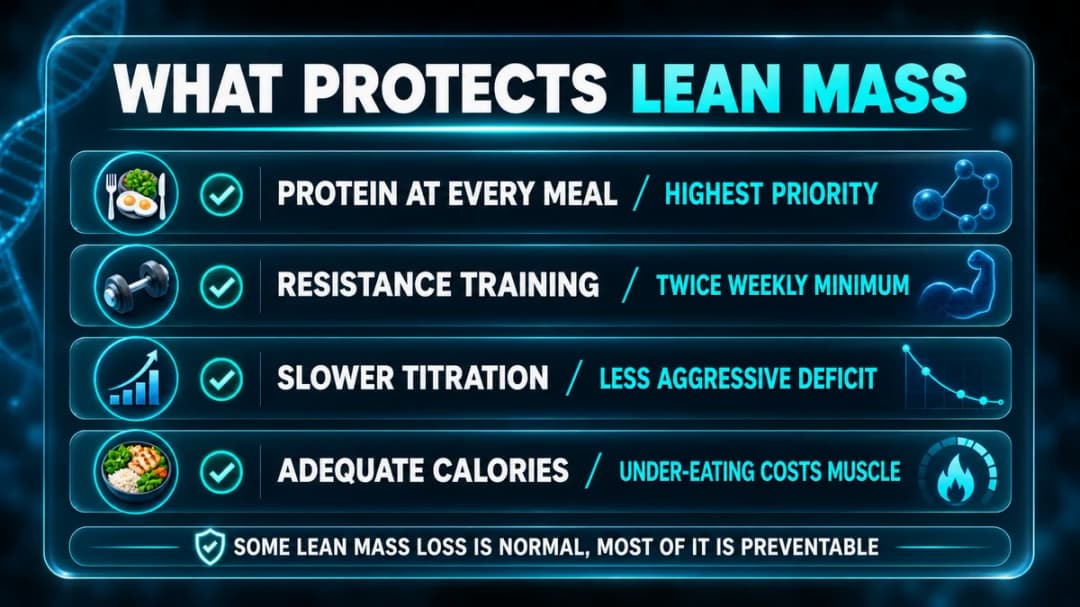
| Intervention | Evidence quality | Practical target |
|---|---|---|
| Resistance training | Strongest available | Two to three sessions weekly, compound lifts, progressive load |
| Higher protein intake | Strong | 1.6 to 2.2 g per kg of body weight daily, spread across meals |
| Slower rate of loss | Reasonable | Around 0.5 to 1 percent of body weight per week |
| Adequate total energy | Reasonable | Avoid drifting below roughly 1,200 kcal for extended periods |
| Creatine monohydrate | Moderate, mostly in training contexts | 3 to 5 g daily, taken consistently |
| Peptides marketed for muscle preservation | Weak to absent in this context | Not supported by evidence in people losing weight on GLP-1 drugs |
That last row matters. Various compounds are promoted for preserving muscle during GLP-1 treatment. There is no controlled human evidence that any of them do so in this specific setting, and none is an approved medicine for it. Training and protein are the interventions with actual support.
Protein is often the harder of the two, because appetite suppression makes 130 g of protein a day genuinely difficult. Front loading protein at each meal, using dairy and fortified liquids on low appetite days, and treating protein as the non negotiable component of every plate are the tactics that work. See how much protein on GLP-1 and building muscle on GLP-1 drugs.
Do Ozempic Hair Loss and Muscle Loss Mean You Should Stop?
Usually not, and not without discussing it with your prescriber. Stopping to save hair means accepting weight regain, and regain brings its own risks. Hair shedding from telogen effluvium resolves on its own once weight stabilises. Muscle loss is better addressed by adding training and protein than by removing the medication.
There are exceptions. Rapid, unsustainable weight loss, persistent inability to eat, or a pattern of hair loss that is patchy rather than diffuse all warrant a proper clinical review rather than a nutrition tweak.
FAQ
Does Ozempic directly cause hair loss?
No. Semaglutide does not act on hair follicles in any established way. The shedding is telogen effluvium triggered by rapid weight loss, low protein intake, or nutrient deficiencies that develop alongside reduced eating.
When does Ozempic hair loss start and stop?
Shedding typically begins two to three months after significant weight loss starts, peaks over the following three months, and resolves within six to twelve months once weight and nutrition stabilise. Regrowth appears first as short hairs at the parting and hairline.
How much muscle do you lose on Ozempic?
Body composition studies suggest lean mass makes up a substantial share of total weight lost, in the region of 40 percent, though lean mass includes water and glycogen as well as muscle. The proportion is similar to other forms of rapid weight loss and is reduced by resistance training and higher protein intake.
Will my hair grow back if I stay on Ozempic?
Usually yes. Telogen effluvium resolves once the trigger stops, and reaching a weight plateau counts as stopping the trigger even if the drug continues. Persistent shedding beyond a year deserves investigation for other causes.
Do protein shakes prevent muscle loss on Ozempic?
They help you reach the protein target, which is one of the two things that matters. They do nothing on their own without resistance training. Protein plus load is the combination with evidence behind it, and either alone is markedly less effective.