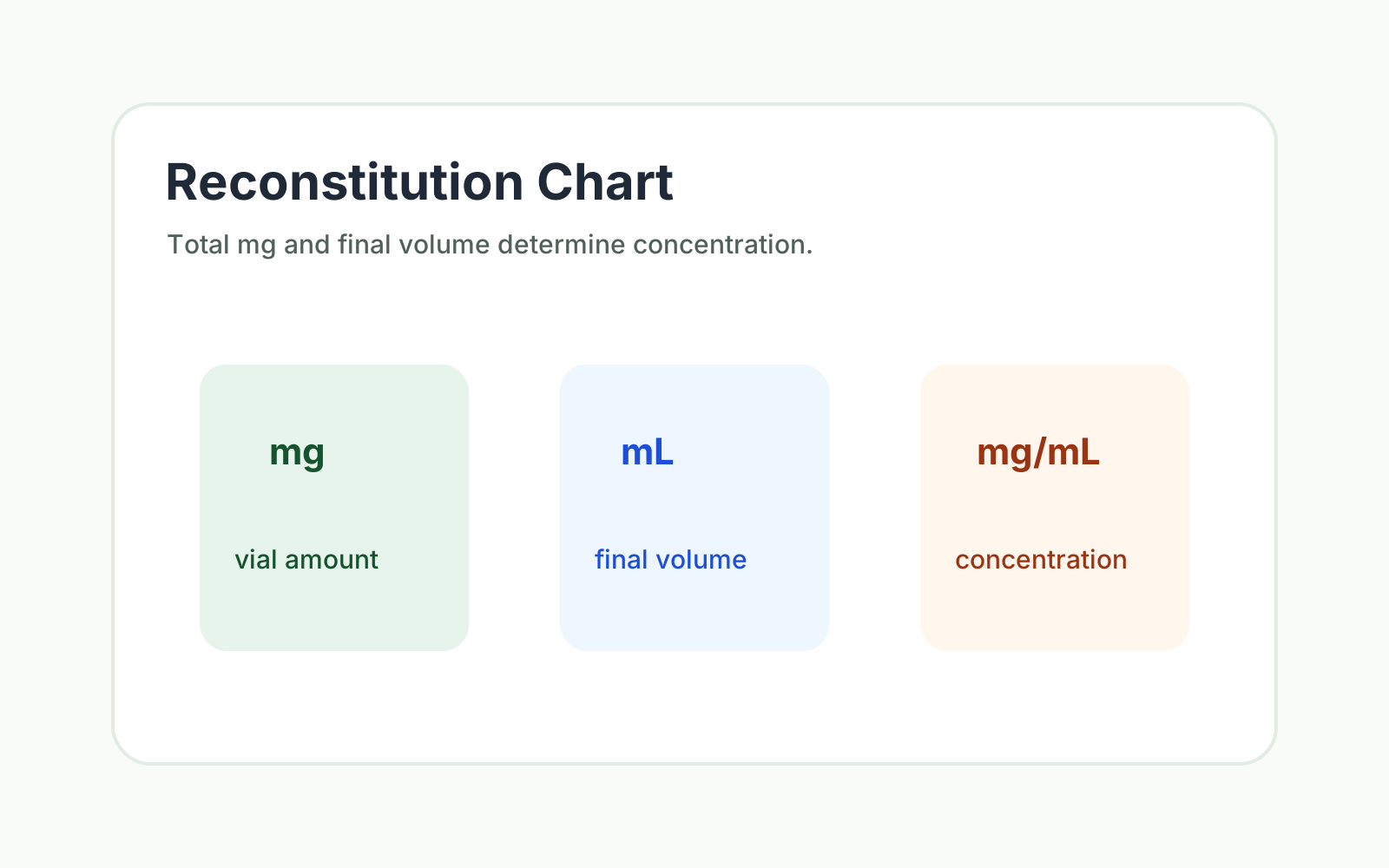
A retatrutide reconstitution chart is a concentration chart. It shows how total vial amount and final liquid volume translate into mg/mL, then into U-100 syringe units.
Short answer: concentration equals total mg divided by final mL. U-100 units then equal dose mg divided by concentration mg/mL, multiplied by 100.
Retatrutide is investigational and is not an FDA-approved obesity or diabetes medication. Do not use internet charts as treatment instructions.
Concentration Examples
| Vial amount | Final volume | Concentration |
|---|---|---|
| 5 mg | 1 mL | 5 mg/mL |
| 5 mg | 2 mL | 2.5 mg/mL |
| 10 mg | 1 mL | 10 mg/mL |
| 10 mg | 2 mL | 5 mg/mL |
| 20 mg | 2 mL | 10 mg/mL |
Changing the final volume changes every unit conversion.
Example U-100 Unit Chart
| Dose | 2.5 mg/mL | 5 mg/mL | 10 mg/mL |
|---|---|---|---|
| 1 mg | 40 units | 20 units | 10 units |
| 2 mg | 80 units | 40 units | 20 units |
| 4 mg | 160 units | 80 units | 40 units |
| 8 mg | 320 units | 160 units | 80 units |
| 12 mg | 480 units | 240 units | 120 units |
High dose examples can exceed syringe capacity. Do not split doses or change preparation volume unless directed by a licensed clinician or pharmacy.
Why Retatrutide Charts Need More Caution
Search results for retatrutide often come from research-peptide or calculator pages. That intent is different from a labeled medication page. With an investigational product, there may be no FDA-approved commercial label, device, pharmacy standard, or patient dosing instruction to anchor the chart.
That makes source quality, medical supervision, and product identity especially important.
What to Confirm Before Trusting Any Chart
Confirm:
- Whether the product is part of a legitimate clinical trial or medical program.
- The exact compound identity and strength.
- The total vial amount.
- The final volume and concentration.
- The syringe type.
- Sterility, storage, beyond-use date, and discard instructions.
- Whether use is legal and clinically appropriate in your setting.
This Is Not a Mixing Guide
This article explains the math behind charts. It does not instruct you how to prepare, mix, store, or inject retatrutide.
If a product arrives without clear professional instructions, do not fill in the blanks from a search result.
Internal Reading Path
- Retatrutide dosage calculator
- Retatrutide dosage chart
- Retatrutide side effects
- Retatrutide storage
FAQ
Is retatrutide approved?
As of this review date, retatrutide should be treated as investigational rather than an FDA-approved obesity medication.
Is 2 mg retatrutide 40 units?
Only at 5 mg/mL on a U-100 syringe.
Can I choose the final volume myself?
Do not choose a reconstitution volume from the internet. Preparation should come from qualified clinical or pharmacy instructions.
How to Read the Label Before Doing Any Math
For retatrutide reconstitution chart, the label matters more than any online chart. A safe conversion starts by identifying the medication name, the prescribed dose in milligrams, the concentration in milligrams per milliliter, the syringe type, and whether the product is a branded pen, commercial vial, compounded vial, or research-market vial. If any of those details are missing, the calculation is incomplete.
A U-100 syringe is a volume tool. It does not know what drug is inside the vial. On that syringe, 100 units equals 1 mL, 50 units equals 0.5 mL, and 10 units equals 0.1 mL. The concentration tells you how many milligrams are in that volume. That is why two people can both say they are taking the same milligram dose but draw up different unit amounts.
| Label item | What to look for | Why it changes the answer |
|---|---|---|
| Medication name | Semaglutide, tirzepatide, retatrutide, or brand name | Similar names are not interchangeable |
| Dose | Usually written in mg | This is the actual medication amount |
| Concentration | mg/mL or total mg plus final mL | This determines the syringe units |
| Device | Pen, vial, U-100 syringe, or other device | Pens are not usually converted to units |
| Date and storage | Expiration, BUD, refrigeration | Unsafe product should not be calculated into use |
Common Conversion Mistakes
The most common mistake is treating units like a medication dose. Units are only a volume marking. Another common mistake is copying a chart that assumes a concentration that does not match the vial. A third mistake is using a unit number from a friend, clinic forum, or old prescription after the pharmacy changed the concentration.
A safer thought process is: first confirm the mg dose, then confirm the mg/mL concentration, then calculate mL, then convert mL to U-100 units. If the resulting number is fractional, unusually high, or above the syringe capacity, the next step is not rounding. The next step is asking the pharmacy how that prescription is meant to be measured.
Worked Scenario Framework
Use this framework for any vial-based GLP-1 calculation. Suppose the prescribed dose is written in mg. Divide that dose by the concentration in mg/mL. The result is mL. If the syringe is U-100, multiply mL by 100 to get units.
| Step | Example question | Safe action |
|---|---|---|
| 1 | What dose was prescribed? | Use the written mg dose, not memory |
| 2 | What is the concentration? | Read mg/mL from the label or ask the pharmacy |
| 3 | What syringe is used? | Confirm U-100 before using unit math |
| 4 | Is the answer measurable? | Ask before rounding fractional units |
| 5 | Does the result match the label? | Resolve conflicts before injecting |
Questions to Bring to the Prescriber or Pharmacist
- Does my current dose and timing match the official label or my prescription?
- Are my symptoms or concerns expected at this stage, or do they suggest changing the plan?
- Should I delay escalation, restart lower, hold steady, or be evaluated before continuing?
- Are any of my other medications increasing risk, especially insulin, sulfonylureas, blood pressure medication, diuretics, or drugs affected by delayed gastric emptying?
- What exact symptoms should make me call urgently or seek same-day care?
- If cost or supply interrupts therapy, what is the safest backup plan?
Bottom Line for Retatrutide Reconstitution Chart: Concentration, Units, and Safety Context
The practical answer is rarely just one number, food list, or yes-or-no rule. For retatrutide reconstitution chart, the safest approach is to combine the direct answer with the variables that change it: product type, dose, timing, side effects, storage history, other medications, and the person's medical context. When those variables are unclear, the best next step is to ask the prescriber or pharmacist before acting.
Additional Scenarios Readers Commonly Compare
| Scenario | How to think about it |
|---|---|
| Symptoms started after a dose increase | Treat escalation as a likely contributor and ask whether to hold the dose longer |
| The plan changed because of supply | Confirm whether a restart or lower dose is safer after the gap |
| Advice online conflicts with the label | Use the label, pharmacy, and prescriber as the authority |
| The medication is compounded | Verify concentration, BUD, storage, sterility, and dose instructions directly with the pharmacy |
| The goal is maintenance | Prioritize sustainable intake, resistance training, monitoring, and follow-up |
More FAQ
Why do different websites give different answers?
Most differences come from assuming different products, concentrations, patient goals, dose histories, or risk tolerance. A chart or tip can be mathematically correct but still wrong for a specific prescription.
What information should I keep in my notes?
Keep the medication name, dose, date taken, pharmacy label, concentration if vial-based, side effects, food and fluid changes, weight trend, and any clinician instructions. This makes follow-up safer and more specific.
When is it better not to troubleshoot at home?
Do not troubleshoot at home when symptoms are severe, rapidly worsening, involve chest pain or fainting, include repeated vomiting or dehydration, suggest allergic reaction, or involve a possible dosing or storage error.
Detailed Reader Scenarios
A stronger page for retatrutide reconstitution chart needs to answer the situations people actually bring to search. The same keyword can represent a careful planner, someone with active symptoms, someone whose pharmacy instructions are confusing, or someone who is trying to decide whether the issue is urgent. The sections below turn the topic into practical scenarios without replacing medical judgment.
Scenario 1: Early evidence sounds promising
Promising evidence is not the same as a finished clinical answer. Trial populations, endpoints, dose schedules, and follow-up length all matter. A result in one group may not apply to someone with different conditions, medications, or risk factors.
Scenario 2: The topic is being discussed before labels catch up
Emerging GLP-1 and peptide topics often move faster online than in official prescribing information. That creates a risk of assuming availability, dose equivalence, safety, or access before those questions are settled.
Scenario 3: Mechanism is mistaken for outcome
A plausible mechanism can explain why scientists are interested, but it does not prove a patient benefit. The stronger question is whether a human trial measured a meaningful outcome, how large the effect was, and what safety tradeoffs appeared.
Evidence Questions
| Ask | Why it matters |
|---|---|
| Was this studied in humans? | Animal and cell data are early signals |
| Was it randomized? | Reduces bias compared with observation alone |
| How long was follow-up? | Short studies miss durability and rare events |
| What dose was used? | Effects and side effects can be dose-specific |
| Is it approved? | Regulatory status changes access and safety framing |
Edge Cases That Change the Answer
For retatrutide reconstitution chart, the usual advice can change when there is a long medication gap, a recent dose increase, active vomiting or diarrhea, diabetes medications that can cause low blood sugar, kidney disease, pregnancy planning, surgery or anesthesia, a compounded vial, or uncertainty about the exact product. Those details should be treated as decision points, not footnotes.
A practical way to handle edge cases is to pause and sort the issue into one of three buckets. The first bucket is routine planning: questions about meals, timing, cost, or what to ask at the next visit. The second bucket is same-week clinical guidance: persistent side effects, repeated missed doses, uncertain conversions, or a plan that cannot be filled. The third bucket is urgent evaluation: severe pain, chest symptoms, fainting, allergic reaction symptoms, dehydration, confusion, or a possible large dosing error.
| Bucket | Examples | Best next step |
|---|---|---|
| Routine planning | Meal changes, mild symptoms, coverage questions | Bring notes to the next visit |
| Prompt guidance | Persistent symptoms, switch timing, unclear label, storage uncertainty | Call prescriber or pharmacist |
| Urgent care | Severe pain, fainting, chest pain, allergic symptoms, dehydration | Seek same-day or emergency care |
Practical Takeaway
If a reader remembers only one thing from this page, it should be that retatrutide reconstitution chart is context-dependent. The safest answer comes from matching the general information to the exact medication, dose, timing, symptoms, product label, and medical history. When those details are incomplete, the right move is to ask before acting.
Summary
Retatrutide reconstitution charts are concentration math. They do not solve product quality, legality, sterility, or clinical supervision.
References
- Jastreboff AM, et al. Triple-Hormone-Receptor Agonist Retatrutide for Obesity — A Phase 2 Trial. New England Journal of Medicine, 2023. (Retatrutide remains investigational; trial doses were 1, 4, 8, and 12 mg.)
- U.S. Food and Drug Administration. Understanding the Risks of Compounded Drugs. (Compounded and non-FDA-approved products are not verified for strength, sterility, or quality.)