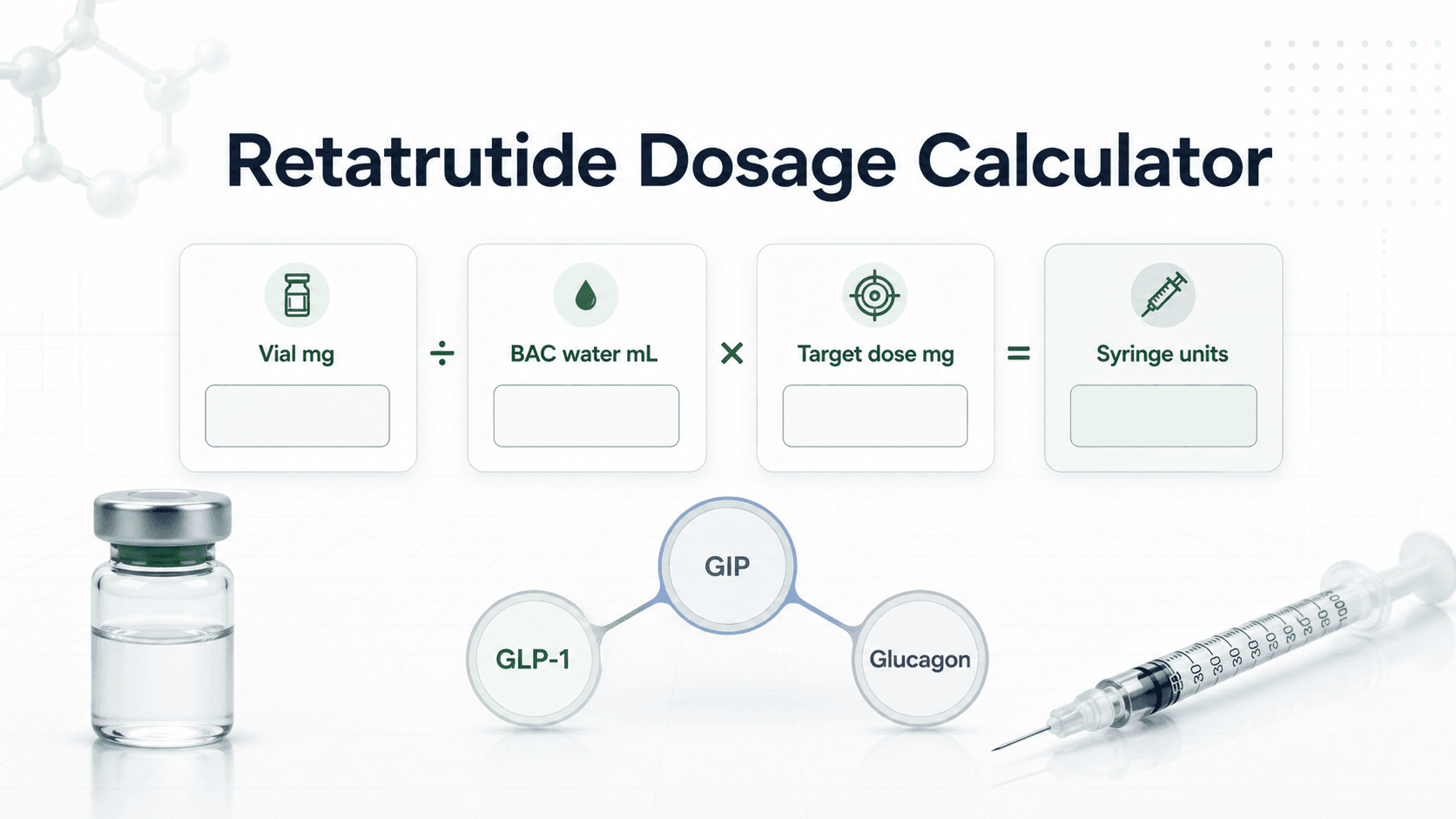
A retatrutide dosage calculator has to answer four questions: how many mg are in the vial, how many mL of bacteriostatic water were added, what mg amount is being measured, and what that equals on a U-100 syringe. Sellers, forums and calculator tools all shorten retatrutide to reta, so a reta dosage calculator and a retatrutide dosage calculator are the same four inputs and the same arithmetic.
The core calculator formula is:
syringe units = target dose mg × BAC water mL × 100 ÷ vial mg
The supporting formulas are:
concentration = vial mg ÷ BAC water mL
mL to draw = target dose mg ÷ concentration
This page explains the math. Retatrutide is investigational and is not an FDA-approved medication as of April 28, 2026. This guide is not a recommendation to use it or a substitute for medical care.
Quick calculator setup
| Input | Example | Why it matters |
|---|---|---|
| Vial amount | 10 mg | Total retatrutide in the vial |
| BAC water added | 2 mL | Determines concentration |
| Target amount | 1 mg | Amount being measured |
| Syringe type | U-100 | 100 units = 1 mL |
Using those values:
10 mg vial ÷ 2 mL = 5 mg/mL.
1 mg ÷ 5 mg/mL = 0.2 mL.
0.2 mL × 100 = 20 units.
So a 1 mg draw from a 10 mg vial mixed with 2 mL is 20 units on a U-100 syringe.
Retatrutide calculator formulas
| Goal | Formula |
|---|---|
| Find concentration | vial mg ÷ BAC water mL |
| Convert target mg to mL | target mg ÷ concentration |
| Convert mL to U-100 units | mL × 100 |
| Direct units formula | target mg × BAC water mL × 100 ÷ vial mg |
| Doses per vial | vial mg ÷ target mg |
These formulas are the same math used by most online peptide calculators. The quality difference is whether the page clearly explains the assumptions and warnings.
Retatrutide concentration chart
| Vial size | BAC water added | Concentration | 1 mg equals | 2 mg equals | 4 mg equals |
|---|---|---|---|---|---|
| 5 mg | 1 mL | 5 mg/mL | 20 units | 40 units | 80 units |
| 5 mg | 2 mL | 2.5 mg/mL | 40 units | 80 units | 160 units |
| 10 mg | 1 mL | 10 mg/mL | 10 units | 20 units | 40 units |
| 10 mg | 2 mL | 5 mg/mL | 20 units | 40 units | 80 units |
| 10 mg | 4 mL | 2.5 mg/mL | 40 units | 80 units | 160 units |
| 20 mg | 2 mL | 10 mg/mL | 10 units | 20 units | 40 units |
| 20 mg | 4 mL | 5 mg/mL | 20 units | 40 units | 80 units |
| 30 mg | 3 mL | 10 mg/mL | 10 units | 20 units | 40 units |
| 30 mg | 6 mL | 5 mg/mL | 20 units | 40 units | 80 units |
Large unit numbers can exceed a 1 mL syringe. Very small unit numbers can be hard to measure accurately. Both situations are reasons to stop and clarify the setup rather than forcing the math.
How much BAC water for each reta vial size
The vial mg is fixed the moment you buy it. The water volume is the only input you choose, and all it decides is which unit mark a given mg amount lands on. Pick the concentration first, then read the water volume out of this table.
| Vial amount | Add for 20 mg/mL | Add for 10 mg/mL | Add for 5 mg/mL | Add for 2.5 mg/mL |
|---|---|---|---|---|
| 5 mg | 0.25 mL | 0.5 mL | 1 mL | 2 mL |
| 6 mg | 0.3 mL | 0.6 mL | 1.2 mL | 2.4 mL |
| 10 mg | 0.5 mL | 1 mL | 2 mL | 4 mL |
| 15 mg | 0.75 mL | 1.5 mL | 3 mL | 6 mL |
| 20 mg | 1 mL | 2 mL | 4 mL | 8 mL |
| 24 mg | 1.2 mL | 2.4 mL | 4.8 mL | 9.6 mL |
| 30 mg | 1.5 mL | 3 mL | 6 mL | 12 mL |
| 50 mg | 2.5 mL | 5 mL | 10 mL | 20 mL |
| 60 mg | 3 mL | 6 mL | 12 mL | 24 mL |
Every cell is vial mg ÷ target concentration. Two limits apply to the right-hand columns. First, a vial is also sold by glass capacity, and you cannot put in more water than the glass holds once headspace is allowed for, so 12 mL, 20 mL and 24 mL are arithmetic rather than instructions. Second, water measured in syringe units is easier than water measured by eye: 100 units on a U-100 syringe is 1 mL, so 2.4 mL is 240 units, or three draws on a 100-unit barrel.
Once the concentration is set, the unit marks follow from concentration alone. The vial size no longer matters.
| Concentration | 0.5 mg | 1 mg | 2 mg | 4 mg | 6 mg | 8 mg | 12 mg |
|---|---|---|---|---|---|---|---|
| 2.5 mg/mL | 20 units | 40 units | 80 units | 160 units* | 240 units* | 320 units* | 480 units* |
| 5 mg/mL | 10 units | 20 units | 40 units | 80 units | 120 units* | 160 units* | 240 units* |
| 10 mg/mL | 5 units | 10 units | 20 units | 40 units | 60 units | 80 units | 120 units* |
| 20 mg/mL | 2.5 units | 5 units | 10 units | 20 units | 30 units | 40 units | 60 units |
* More than 100 units, which is more than one full 1 mL syringe. The 2.5 unit cell is below the smallest reliable mark on most barrels. Both are signals that the mix is wrong for the amount being measured, not that the amount should be split across draws by default.
For reference on what those mg columns represent, the phase 2 obesity trial tested weekly retatrutide doses of 1 mg, 4 mg, 8 mg and 12 mg, with initial doses of 2 mg or 4 mg in the escalating groups.
Worked examples
Example 1: 10 mg vial mixed with 2 mL
10 mg ÷ 2 mL = 5 mg/mL.
At 5 mg/mL:
| Target amount | mL | U-100 units |
|---|---|---|
| 0.5 mg | 0.1 mL | 10 units |
| 1 mg | 0.2 mL | 20 units |
| 2 mg | 0.4 mL | 40 units |
| 4 mg | 0.8 mL | 80 units |
Example 2: 20 mg vial mixed with 2 mL
20 mg ÷ 2 mL = 10 mg/mL.
At 10 mg/mL:
| Target amount | mL | U-100 units |
|---|---|---|
| 0.5 mg | 0.05 mL | 5 units |
| 1 mg | 0.1 mL | 10 units |
| 2 mg | 0.2 mL | 20 units |
| 4 mg | 0.4 mL | 40 units |
Example 3: 30 mg vial mixed with 6 mL
30 mg ÷ 6 mL = 5 mg/mL.
This produces the same concentration as a 10 mg vial mixed with 2 mL. The units for each target amount are the same, but the vial contains more total doses.
Example 4: 5 mg vial mixed with 2 mL
5 mg ÷ 2 mL = 2.5 mg/mL.
At 2.5 mg/mL:
| Target amount | mL | U-100 units |
|---|---|---|
| 0.25 mg | 0.1 mL | 10 units |
| 0.5 mg | 0.2 mL | 20 units |
| 1 mg | 0.4 mL | 40 units |
| 2 mg | 0.8 mL | 80 units |
This is the most dilute setup on the page and the easiest to read at sub-milligram amounts: every 20 units is 0.5 mg. The tradeoff is volume, since 2 mg already fills 80 of the 100 units on a 1 mL barrel.
Units back to mg
The calculator also runs backwards, which is what you need when a mark has already been drawn and the question is what it contains:
mg = syringe units ÷ 100 × concentration mg/mL
Written out from the vial label, that is mg = units × vial mg ÷ (BAC water mL × 100).
| Units drawn | mL | At 2.5 mg/mL | At 5 mg/mL | At 10 mg/mL | At 20 mg/mL |
|---|---|---|---|---|---|
| 5 units | 0.05 mL | 0.125 mg | 0.25 mg | 0.5 mg | 1 mg |
| 10 units | 0.1 mL | 0.25 mg | 0.5 mg | 1 mg | 2 mg |
| 20 units | 0.2 mL | 0.5 mg | 1 mg | 2 mg | 4 mg |
| 25 units | 0.25 mL | 0.625 mg | 1.25 mg | 2.5 mg | 5 mg |
| 30 units | 0.3 mL | 0.75 mg | 1.5 mg | 3 mg | 6 mg |
| 40 units | 0.4 mL | 1 mg | 2 mg | 4 mg | 8 mg |
| 50 units | 0.5 mL | 1.25 mg | 2.5 mg | 5 mg | 10 mg |
| 60 units | 0.6 mL | 1.5 mg | 3 mg | 6 mg | 12 mg |
| 80 units | 0.8 mL | 2 mg | 4 mg | 8 mg | 16 mg |
| 100 units | 1 mL | 2.5 mg | 5 mg | 10 mg | 20 mg |
Read one row across and the point of the whole page shows up. On a 5 mg vial mixed with 2 mL, 20 units is 0.5 mg. On a 10 mg vial mixed with 1 mL, the same 20 units on the same syringe is 2 mg, four times as much. A unit number copied from someone else's post is meaningless without their vial mg and their water volume.
Reading the dose on 0.3 mL, 0.5 cc and 1 mL syringes
All three barrels use the same U-100 scale: 1 unit is 0.01 mL and 100 units is 1 mL. A 0.5 cc syringe is not a different scale, only a shorter barrel that stops at 50 units.
| Barrel | Also written as | Holds | Max U-100 units | Typical marks |
|---|---|---|---|---|
| 0.3 mL | 0.3 cc, 30-unit | 0.3 mL | 30 units | 1 unit, half-unit on some |
| 0.5 mL | 0.5 cc, .50cc, 50-unit | 0.5 mL | 50 units | 1 unit |
| 1 mL | 1 cc, 100-unit | 1 mL | 100 units | 2 units on many brands |
The marks get called units, ticks or IU in forum posts; on a U-100 barrel those are all the same graduation. Two practical consequences. A draw should sit well inside the barrel it is measured in, because 12 units on a 100-unit barrel marked in 2-unit steps is a coarser measurement than the same 12 units on a 30-unit barrel. And the same syringe measures the bacteriostatic water going in, which is why odd volumes are easy: 0.6 mL is 60 units and 1.2 mL is 120 units, meaning one full 1 mL barrel plus 20 more.
Doses per vial
Doses per vial is separate from concentration. It depends on total vial mg and target mg.
| Vial amount | 0.5 mg amounts | 1 mg amounts | 2 mg amounts | 4 mg amounts |
|---|---|---|---|---|
| 5 mg | 10 | 5 | 2.5 | 1.25 |
| 10 mg | 20 | 10 | 5 | 2.5 |
| 20 mg | 40 | 20 | 10 | 5 |
| 30 mg | 60 | 30 | 15 | 7.5 |
If the result includes a half dose, that means the vial does not divide evenly at that target amount. It does not mean the leftover should automatically be used later.
How long a vial lasts at one injection a week
Doses per vial turns into weeks as soon as the interval is weekly.
| Vial amount | 1 mg weekly | 2 mg weekly | 4 mg weekly | 8 mg weekly |
|---|---|---|---|---|
| 10 mg | 10 weeks | 5 weeks | 2.5 weeks | 1.25 weeks |
| 15 mg | 15 weeks | 7.5 weeks | 3.75 weeks | 1.9 weeks |
| 20 mg | 20 weeks | 10 weeks | 5 weeks | 2.5 weeks |
| 24 mg | 24 weeks | 12 weeks | 6 weeks | 3 weeks |
| 30 mg | 30 weeks | 15 weeks | 7.5 weeks | 3.75 weeks |
| 50 mg | 50 weeks | 25 weeks | 12.5 weeks | 6.25 weeks |
| 60 mg | 60 weeks | 30 weeks | 15 weeks | 7.5 weeks |
A 24 mg vial at 2 mg a week is 12 doses, which is where the "one vial for three months" framing comes from. The arithmetic answer and the practical answer are different questions: 12 weeks is a long time for one reconstituted vial to stay in use, and sterility and stability are not things the calculator can settle. See how to store retatrutide before planning around a number in this table.
How BAC water changes the calculator result
Adding more bacteriostatic water does not add more retatrutide. It spreads the same total mg across more volume.
| Setup | Concentration | Practical result |
|---|---|---|
| Less water | Higher mg/mL | Fewer syringe units per mg |
| More water | Lower mg/mL | More syringe units per mg |
| Same vial mg, different water | Different concentration | Different unit marks for the same mg amount |
Lower concentration can make small amounts easier to measure. Higher concentration can reduce injection volume. The tradeoff is precision versus volume, and it should be decided before mixing.
For the detailed mixing workflow, see how to reconstitute retatrutide. For broader context, use the retatrutide guide and retatrutide dosage guide.
Retatrutide is not the same as semaglutide or tirzepatide
Retatrutide is often discussed beside semaglutide and tirzepatide because all three affect incretin-related pathways, but the receptor profile is different. Retatrutide is being studied as a triple agonist: GLP-1, GIP, and glucagon receptor activity.
That matters because dose numbers across these compounds are not interchangeable. A semaglutide chart cannot be used for retatrutide. A tirzepatide unit chart cannot be used for retatrutide. The vial math may look similar, but the drug, evidence base, tolerability, and regulatory status are different.
Safety and legal context
Retatrutide remains investigational. There is no FDA-approved commercial retatrutide product, no approved retail brand, and no standard prescription label equivalent to Ozempic, Wegovy, Mounjaro, or Zepbound. Research-market products may vary in purity, identity, sterility, storage history, and labeling accuracy. For the routes people actually use to obtain it, see how to get retatrutide.
Calculator math cannot solve those quality-control issues. It can only explain volume conversion after the vial amount and water volume are known.
Seek medical care urgently for severe abdominal pain, persistent vomiting, dehydration symptoms, allergic reaction symptoms, chest pain, fainting, or severe weakness. Do not continue escalating or repeating use after a severe reaction.
Calculator checklist before using a number
| Question | Do not proceed unless the answer is clear |
|---|---|
| What is the compound? | Retatrutide, not another GLP/GIP medication |
| How many mg are in the vial? | Total amount before mixing |
| How many mL were added? | Actual water volume used |
| What syringe type? | This page assumes U-100 |
| What amount is being measured? | Target amount in mg |
| Was the vial stored correctly? | Temperature and sterility matter |
FAQ
How do you calculate retatrutide units?
Use target dose mg × BAC water mL × 100 ÷ vial mg. For example, 1 mg from a 10 mg vial mixed with 2 mL equals 1 × 2 × 100 ÷ 10 = 20 units.
How much BAC water should you add to retatrutide?
There is no universal answer. The water volume determines concentration and syringe units. More water means more units per mg; less water means fewer units per mg. Use clinician, protocol, or pharmacy guidance rather than guessing.
What is the concentration of a 10 mg vial mixed with 2 mL?
10 mg ÷ 2 mL = 5 mg/mL.
How many units is 1 mg of retatrutide?
It depends on concentration. At 5 mg/mL, 1 mg is 20 units. At 10 mg/mL, 1 mg is 10 units. At 2.5 mg/mL, 1 mg is 40 units.
How much BAC water for 30 mg retatrutide?
There is no required volume, only the concentration you want. 30 mg with 3 mL gives 10 mg/mL, where 1 mg is 10 units and 2 mg is 20 units. 30 mg with 6 mL gives 5 mg/mL, where 1 mg is 20 units and 2 mg is 40 units. The 6 mL option needs a vial with room for 6 mL.
How much BAC water for 20 mg retatrutide?
20 mg with 1 mL gives 20 mg/mL, so 1 mg is 5 units and 5 mg is 25 units. 20 mg with 2 mL gives 10 mg/mL, so 1 mg is 10 units. 20 mg with 4 mL gives 5 mg/mL, so 1 mg is 20 units. Same vial, same total drug, three different unit numbers for the identical dose.
How much BAC water for 10 mg, 15 mg and 60 mg vials?
10 mg: 1 mL for 10 mg/mL, 2 mL for 5 mg/mL. 15 mg: 1.5 mL for 10 mg/mL, 3 mL for 5 mg/mL. 60 mg: 3 mL for 20 mg/mL, 6 mL for 10 mg/mL. At 10 mg/mL a 1 mg amount is 10 units in all three cases, because concentration is the only thing the syringe knows about.
How much BAC water goes into a 6 mg vial of reta?
0.6 mL (60 units of water) gives 10 mg/mL, so 1 mg is 10 units. 1.2 mL gives 5 mg/mL, so 1 mg is 20 units. 3 mL gives 2 mg/mL, so 1 mg is 50 units and the whole vial is three full 1 mL syringes.
Is 1 mL of retatrutide the same as a 1 mg dose?
No. mL is volume and mg is mass, and the link between them is concentration. 1 mL of a 5 mg/mL mix is 5 mg. 1 mL of a 10 mg/mL mix is 10 mg. 1 mL equals 1 mg only at 1 mg/mL, which is what a 5 mg vial mixed with 5 mL would give.
A 5 mg vial reconstituted with 2 mL of bacteriostatic water: what dose is 20 units?
5 mg ÷ 2 mL = 2.5 mg/mL. 20 units is 0.2 mL, and 0.2 mL × 2.5 mg/mL = 0.5 mg. So each 20 units is 0.5 mg, 40 units is 1 mg and 80 units is 2 mg on that mix.
What is the mg dose of reta in mL for a 50 mg vial?
With 5 mL added the vial is 10 mg/mL: 1 mg is 0.1 mL (10 units), 2 mg is 0.2 mL (20 units), 4 mg is 0.4 mL (40 units), 8 mg is 0.8 mL (80 units). With 2.5 mL added it is 20 mg/mL, so those volumes halve: 4 mg is 0.2 mL and 8 mg is 0.4 mL.
How many doses are in a 10 mL vial of reta?
A vial described in mL is being described by its glass capacity, not by how much retatrutide is inside it. Doses per vial is vial mg ÷ target mg and nothing else. If that 10 mL vial holds 30 mg and the target is 2 mg, it is 15 doses whether you added 3 mL of water or 6 mL. The mL figure only caps how much water will fit.
How do you dose retatrutide in mL rather than units?
mL to draw = target mg ÷ concentration. At 5 mg/mL, 1 mg is 0.2 mL and 2 mg is 0.4 mL. At 10 mg/mL, 1 mg is 0.1 mL and 2 mg is 0.2 mL. On a U-100 syringe the same numbers are read as units by multiplying by 100, since 1 unit is 0.01 mL.
How many mg do you start with on reta if you reconstitute with 100 units of BAC water?
100 units of water is 1 mL, and water volume does not change the starting mg, only the unit mark it lands on. With 1 mL in a 10 mg vial the mix is 10 mg/mL, so a 2 mg amount is 20 units and a 4 mg amount is 40 units. For what those numbers correspond to, the phase 2 obesity trial used weekly doses of 1 mg, 4 mg, 8 mg or 12 mg with initial doses of 2 mg or 4 mg, and reported that gastrointestinal side effects were partially mitigated by the lower 2 mg start. Retatrutide has no approved label, so there is no official starting dose; see the retatrutide dosage guide for how research-market protocols handle escalation.
How long does a 24 mg vial last at one dose a week?
24 mg is 24 weekly doses at 1 mg, 12 at 2 mg, 6 at 4 mg and 3 at 8 mg. Reconstituted with 2.4 mL the vial is 10 mg/mL, so a 2 mg dose is 20 units. Twelve weeks of use out of one reconstituted vial is a storage and sterility question rather than a math question.
What does 1 mg of retatrutide look like on a 0.5 cc syringe?
A 0.5 cc barrel is a U-100 syringe that stops at 50 units. From a 5 mg vial mixed with 1 mL (5 mg/mL), 1 mg is 20 units. From the same vial mixed with 2 mL (2.5 mg/mL), 1 mg is 40 units. Mixed with 2.5 mL (2 mg/mL), 1 mg is 50 units and fills the barrel exactly. Note that a 0.5 cc barrel cannot measure 1 mL of bacteriostatic water in one pull; that takes two 50-unit draws.
Is retatrutide approved?
No. As of April 28, 2026, retatrutide is investigational and not FDA-approved.
Bottom line
A retatrutide dosage calculator is concentration math: vial mg, BAC water mL, target mg, and U-100 syringe units. The direct formula is target mg × BAC water mL × 100 ÷ vial mg, and it runs backwards as units ÷ 100 × concentration when the question is what a mark on the barrel already holds. Use the math to understand labels and examples, not to replace medical guidance or quality-control checks.
References
- Jastreboff AM, Kaplan LM, Frías JP, et al. Triple–Hormone-Receptor Agonist Retatrutide for Obesity — A Phase 2 Trial. New England Journal of Medicine. 2023. PubMed
- Collins L, Costello RA. Glucagon-Like Peptide-1 Receptor Agonists. StatPearls. NCBI Bookshelf. NCBI Bookshelf
- Insulin Syringes Sizes and Lengths: Importance and How to Choose. Healthline. Healthline