
Direct answer: The standard retatrutide dosage chart runs 2 mg → 4 mg → 8 mg → 12 mg, holding four weeks at each tier. The registrational Phase 3 TRIUMPH ladder also starts at 2 mg but steps 2 → 4 → 6 → 9 → 12 mg, reaching its 12 mg ceiling in 16 weeks. A slower community ramp starting at 0.5 mg is the third option. All three schedules, every draw volume, what each dose returned on the scale, and a comparison against tirzepatide are in the tables below.
- Starting dose is 2mg/week — that is the initiation dose in all four TRIUMPH Phase 3 trials; the Phase 2 obesity trial used starting doses of 1mg, 2mg or 4mg depending on the arm. A 0.5mg/week community start is the slower alternative for GI-sensitive users
- Maximum studied dose is 12mg/week — the ceiling in the Phase 2 trial and in all four registrational TRIUMPH trials, which used five dose levels in total (2, 4, 6, 9 and 12mg). No published retatrutide trial has tested 15mg/week
- Every trial escalated on a fixed 4-week interval, and the starting dose mattered: in Phase 2, the same 8mg target produced nausea in 60.0% of people who started at 4mg versus 17.1% of those who started at 2mg
- Your syringe draw volume changes at every dose tier depending on how you reconstituted — the tables below remove all guesswork
- Retatrutide's trial weight-loss numbers run higher than semaglutide's and tirzepatide's, but no head-to-head result has been published — TRIUMPH-5 is the first direct comparison against tirzepatide and is still running
- There is no published missed-dose rule for retatrutide; the guidance below is extrapolated from the tirzepatide and semaglutide labels and is flagged as such
The dose range for retatrutide studied in humans runs from 0.5 mg to 12 mg per week, but the math gets messier once you factor in vial concentrations, syringe units, reconstitution volumes, and what happens when you stall at 8 mg or have a rough week at 4 mg. This page gives you every table you need: week-by-week titration, dose-by-concentration draw volumes, unit conversions, and a side-by-side comparison against semaglutide and tirzepatide. Print it. Bookmark it. Tape it inside your cabinet door.
What Is the Retatrutide Dosage Range?
Retatrutide (LY3437943) — shortened to "reta" in most forums, group chats and vendor listings — is a triple-agonist peptide developed by Eli Lilly. It targets GLP-1, GIP, and glucagon receptors simultaneously — that third receptor (glucagon) is what separates it from tirzepatide. Retatrutide's trial weight-loss numbers are higher than tirzepatide's, but those come from separate trials in different populations, so the glucagon arm is a plausible explanation rather than a measured one.
The dose range for retatrutide studied in humans:
- Lowest studied weekly dose: 0.5mg (a maintenance arm in the Phase 2 type-2-diabetes trial; the Phase 1 single-dose study went as low as 0.1mg)
- Trial target doses: 4mg, 9mg and 12mg in the TRIUMPH Phase 3 program; 1mg, 4mg, 8mg and 12mg in the Phase 2 obesity trial
- Common community maintenance dose: 8–12mg/week
- Maximum studied dose: 12mg/week (Phase 2 and all four TRIUMPH Phase 3 trials)
- Initiation dose in Phase 3: 2mg/week for every participant
There is no approved FDA dose yet. Lilly said on 23 July 2026 that it is completing the manufacturing data package and plans to submit retatrutide for U.S. approval in Q1 2027, so an approval decision would come later than that. Everything below reflects Phase 2 and Phase 3 trial protocols and community experience. For a cross-referenced overview of the retatrutide dosage protocol with reconstitution and syringe-unit tables maintained separately, the PeptideDosage protocol hub is a useful complement.
Phase 2 vs Phase 3 Protocol: What Changed?
Most dosage charts online only show the Phase 2 protocol. Phase 3 (TRIUMPH) uses a slower start and higher ceiling. Both are worth knowing.
| Parameter | Phase 2 Protocol | Phase 3 TRIUMPH (registrational) | Slow Community Ramp |
|---|---|---|---|
| Starting dose | 1mg, 2mg or 4mg by arm | 2mg/week | 0.5mg/week |
| Escalation interval | Every 4 weeks | Every 4 weeks | Every 4 weeks |
| Dose steps | 2 → 4 → 8 → 12mg | 2 → 4 → 6 → 9 → 12mg | 0.5 → 1 → 2 → 3 → 4 → 5 → 8 → 10 → 12mg |
| Maximum dose | 12mg/week | 12mg/week | 12mg/week |
| Duration to max | ~12 weeks | 16 weeks | ~32 weeks |
| Recommended for | Experienced GLP-1 users | The ladder Lilly actually filed on | New users, GI-sensitive individuals |
| Source | Trial protocol | Lilly, TRIUMPH program | Community practice, not a trial |
| {: .dosage-table} |
Honestly, most community protocols split the difference — starting at 1mg and escalating every 4 weeks at a pace somewhere between the two. On the starting dose there is real trial evidence: the Phase 2 investigators reported that gastrointestinal events were "partially mitigated with a lower starting dose (2 mg vs. 4 mg)". Nothing has tested the 0.5mg community opener.
What the TRIUMPH Phase 3 Trials Actually Used
Worth being precise about this, because the "TRIUMPH protocol" gets described online in several ways that the trials never used. The registrational Phase 3 program is four trials, TRIUMPH-1 through TRIUMPH-4, and every one of them caps at 12mg. There is no 15mg arm anywhere in the program and no arm starting below 2mg. Everyone randomized to retatrutide began at 2mg once weekly and stepped up on a fixed ladder every four weeks — the program used five dose levels in all: 2, 4, 6, 9 and 12mg.
| Target dose | Escalation ladder | Weeks to target |
|---|---|---|
| 4mg | 2mg → 4mg | 4 weeks |
| 9mg | 2mg → 4mg → 6mg → 9mg | 12 weeks |
| 12mg | 2mg → 4mg → 6mg → 9mg → 12mg | 16 weeks |
| {: .dosage-table} |
Two things fall out of that table. First, the trial ladder uses 6mg and 9mg steps that almost every community chart skips — jumping straight from 4mg to 8mg is a convention, not a protocol. Second, TRIUMPH-1 ran 16 weeks of escalation followed by 64 weeks of maintenance for an 80-week total, so titration is only a fifth of the protocol and maintenance is where the weight actually comes off.
The four trials and their dose arms:
| Trial | Population | Duration | Dose arms |
|---|---|---|---|
| TRIUMPH-1 | BMI ≥27 with a weight-related condition, no type 2 diabetes (2,339 randomized) | 80 weeks | 4mg, 9mg, 12mg, placebo |
| TRIUMPH-2 | BMI ≥27 with type 2 diabetes (1,152 randomized) | 80 weeks | 4mg, 9mg, 12mg, placebo |
| TRIUMPH-3 | BMI ≥35 with established cardiovascular disease (1,949 randomized) | 80 weeks | 9mg, 12mg, placebo |
| TRIUMPH-4 | BMI ≥27 with knee osteoarthritis, no type 2 diabetes (445 randomized) | 68 weeks | 9mg, 12mg, placebo |
| {: .dosage-table} |
The 0.5mg ladder in the Phase 2 vs Phase 3 table above is a slower community adaptation. It is a reasonable choice if you are GI-sensitive and it is used widely — just don't call it the TRIUMPH protocol, and don't treat 15mg as a validated ceiling, because no published retatrutide trial has gone above 12mg. The Phase 2 protocol records the Phase 1 dose ranges as 0.1–6mg single-dose and 0.5–12mg multiple-dose, which is where the 12mg ceiling came from in the first place.
What Indication Is Retatrutide Being Developed For?
Retatrutide is an investigational drug developed primarily for chronic weight management in obesity, and it is not FDA-approved for any use. The landmark Phase 2 trial enrolled adults with a body-mass index of 30 or higher, or a BMI of 27 to under 30 plus at least one weight-related condition (without diabetes), and these obesity-trial criteria are the context behind the body-weight discussion later on this page.
Retatrutide Starting Dose Chart
The retatrutide starting dose is 0.5mg, 1mg, or 2mg per week depending on which protocol you follow and your prior GLP-1 history. Hold the starting dose for a full 4 weeks before any escalation — that is the interval every trial used, and the Phase 2 trial found GI events were partially mitigated by the lower of its two starting doses (2mg vs 4mg).
| Starting Dose | Protocol | Who Should Use It | First Escalation | Hold Period |
|---|---|---|---|---|
| 0.5mg/week | Slow community ramp (conservative) | New to GLP-1 class compounds; GI-sensitive; first-time peptide users | → 1.0mg/week at week 5 | 4 weeks at 0.5mg |
| 1.0mg/week | Hybrid community standard | Some semaglutide or tirzepatide history; moderate GI tolerance | → 2.0mg/week at week 5 | 4 weeks at 1.0mg |
| 2.0mg/week | TRIUMPH Phase 3 (trial standard; one of three Phase 2 starting doses) | Experienced GLP-1 users (≥6 months semaglutide or tirzepatide); high tolerance | → 4.0mg/week at week 5 | 4 weeks at 2.0mg |
One clarification on that middle row: 2mg is not only for experienced users. It is what every TRIUMPH Phase 3 participant started on, including people who had never taken a GLP-1 drug. The 0.5mg and 1mg starts below exist to soften the first month, not because 2mg is unsafe as an opener. In the Phase 2 obesity trial, the arms that opened at 4mg rather than 2mg were the ones with the worst nausea.
Choosing the Right Retatrutide Starting Dose
If you're new to the GLP-1 class entirely, start at 0.5mg/week. No trial has tested that opener — it is a community adaptation, and it is not the TRIUMPH ramp, which starts at 2mg. What the trial record does show is that the starting dose changes tolerability: in Phase 2, reaching 8mg from a 2mg start produced nausea in 17.1% of participants versus 60.0% reaching the same 8mg from a 4mg start.
If you're stepping over from tirzepatide 5–10mg or semaglutide 1–2.4mg with no major side effects in the last 8 weeks, 2mg/week is reasonable. Your GI tract is already adapted to incretin slowing.
If you're in between — some GLP-1 history but you remember nausea on titration — start at 1mg/week. Splitting the difference is what most community protocols actually do.
What "Starting Dose" Doesn't Mean
The starting dose is not your maintenance dose. The therapeutic weight-loss range is 8–12mg/week, reached after 12 to 32 weeks of titration depending on protocol. Starting low and escalating slowly is how you get to the therapeutic dose without dropping out — not a permanent dose.
Retatrutide Week-by-Week Dosage Chart (Weeks 1–24+)
This is the table most people come here for — the reta dosing chart in full. Two ladders side by side: the Phase 2 trial ramp and the slower community ramp (which is not a trial protocol). Use the Phase 2 column if you've used semaglutide or tirzepatide before. Use the slow-ramp column if this is your first GLP-1 class compound or you're GI-sensitive. The trial ladder (2 → 4 → 6 → 9 → 12mg over 16 weeks) is in the TRIUMPH table above.
| Week | Phase 2 Dose | Slow Ramp Dose | Phase Name | Expected Effect |
|---|---|---|---|---|
| 1–4 | 2mg | 0.5mg | Initiation | Minimal weight loss; GI adaptation; appetite change by days 2–3 |
| 5–8 | 4mg | 1.0mg | Early escalation | First noticeable appetite suppression; 2–5 lbs typical loss |
| 9–12 | 8mg | 2.0mg | Therapeutic range (P2) / continued escalation (slow ramp) | P2: significant suppression; slow ramp: still building tolerance |
| 13–16 | 12mg (or hold 8) | 3.0mg | Maintenance entry (P2) / mid-escalation (slow ramp) | P2: maximum effect; slow ramp: therapeutic range approaching |
| 17–20 | 12mg | 4.0mg | Maintenance | Slow ramp: first dose in the trial-tested range |
| 21–24 | 12mg | 5.0mg | Maintenance | Slow ramp: comparable to P2 week 5–8 effect |
| 25–28 | 12mg or taper | 8.0mg | Maintenance / slow-ramp therapeutic | Slow ramp: significant suppression begins |
| 29–32 | — | 10.0mg | Slow-ramp high range | Above 9mg, the trials show only small additional weight loss |
| 33–36 | — | 12.0mg | Maximum studied dose | Only if 10mg has plateaued and side effects are manageable |
| 37–40+ | — | 12.0mg | Ceiling | 12mg is the highest dose in any published retatrutide trial — hold here, do not go past it |
When to Pause Escalation
Do not increase your dose if any of these are happening:
- Nausea persisting more than 3 days post-injection
- Vomiting more than twice in a week
- Rapid weight loss above 3–4 lbs/week for 2+ consecutive weeks
- Severe constipation or diarrhea
- Signs of dehydration
Stay at your current dose for an additional 4 weeks. If side effects resolve, escalate. If not, consider dropping back one tier.
Missed Dose Protocol
Retatrutide has no prescribing information, and no missed-dose rule has been published from the trials. What follows is extrapolated from the labelled once-weekly incretins, which is the honest basis for it:
- Missed dose < 4 days ago: Inject as soon as you remember, then resume your regular weekly day. This is the Zepbound (tirzepatide) rule: administer within 4 days (96 hours) of the missed dose.
- Missed dose 4–7 days ago: Skip it and take your next scheduled dose on the regular day — again the tirzepatide rule for a miss beyond 4 days.
- Missed dose > 7 days ago (two or more consecutive weeks): Drop back to your previous dose tier before resuming. The Wegovy (semaglutide) label says that after two or more consecutive missed doses, escalation should be reinitiated at a lower dosage to limit GI side effects.
Do not double-dose under any circumstances.
Dose by Vial Concentration: Draw Volume Reference
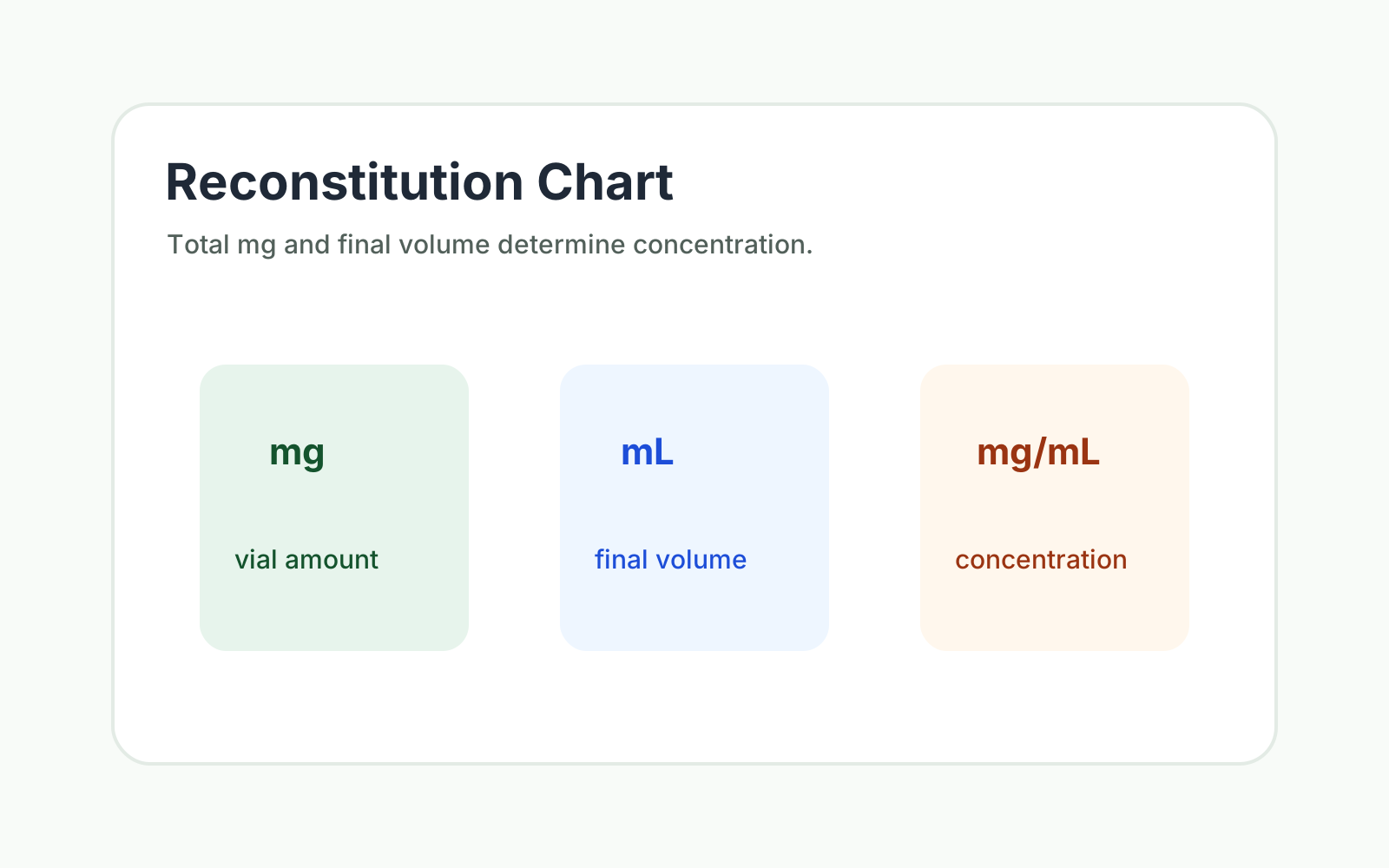
This is where errors happen. The same 4mg dose requires completely different syringe volumes depending on how you reconstituted your vial. These tables cover the five most common setups. If you're reconstituting differently, use the formula: Volume (mL) = Target Dose (mg) ÷ Concentration (mg/mL). Every cell below assumes the vial strength and bacteriostatic-water volume named in its own row, a U-100 insulin syringe (1.00 mL = 100 units), and that the lyophilized powder itself adds no measurable volume — the standard simplification, and the reason a "10mg/mL" vial is really a shade under that.
10mg Vial — Common Reconstitution Options
| Reconstitution | Concentration | 2mg dose | 4mg dose | 8mg dose | 12mg dose |
|---|---|---|---|---|---|
| 10mg + 1mL BW | 10mg/mL | 0.20 mL (20 units) | 0.40 mL (40 units) | 0.80 mL (80 units) | — † |
| 10mg + 2mL BW | 5mg/mL | 0.40 mL (40 units) | 0.80 mL (80 units) | 1.60 mL* (160 units) | — † |
| 10mg + 4mL BW | 2.5mg/mL | 0.80 mL (80 units) | 1.60 mL* (160 units) | 3.20 mL* (320 units) | — † |
*Volumes over 1mL exceed a single 1mL U-100 syringe and are normally split across two injection sites. Preferred max single-site volume is 1mL.
† A 10mg vial cannot produce a 12mg dose at any dilution — 12mg is more drug than the vial holds. Diluting further only spreads the same 10mg over more liquid. A 12mg dose means drawing from a second vial. Charts that print 1.20mL or 2.40mL in a 12mg column for a 10mg vial have done the concentration arithmetic without checking whether that much drug is in the vial at all.
5mg Vial — Conservative Start Protocol
| Reconstitution | Concentration | 0.5mg dose | 1mg dose | 2mg dose | 4mg dose |
|---|---|---|---|---|---|
| 5mg + 1mL BW | 5mg/mL | 0.10 mL (10 units) | 0.20 mL (20 units) | 0.40 mL (40 units) | 0.80 mL (80 units) |
| 5mg + 2mL BW | 2.5mg/mL | 0.20 mL (20 units) | 0.40 mL (40 units) | 0.80 mL (80 units) | 1.60 mL* (160 units) |
5mg vials suit the slow community ramp rather than the TRIUMPH protocol, which opens at 2mg. Check the arithmetic before you buy: four weeks at 0.5mg plus four weeks at 1mg is 6mg of drug, so one 5mg vial does not cover weeks 1–8 — it covers weeks 1–4 at 0.5mg (2mg used) plus three of the four 1mg weeks. Budget two 5mg vials, or one 10mg vial, for that opening block. Also note that reconstituted peptide is not kept indefinitely, so the vial you open at week 1 may not still be in date at week 8. What a full reconstitution kit contains, and where to get one, is covered in our retatrutide kits guide.
Unit Conversion Table: mg to mcg to Insulin Syringe Units
People trip on this constantly. Milligrams, micrograms, and insulin syringe units are three different scales. Here's the complete conversion reference for retatrutide's studied dose range, 0.5mg to 12mg. Both volume columns assume a U-100 insulin syringe and the concentration named in the column header — which in turn assumes a 10mg vial reconstituted with 2mL of bacteriostatic water (5mg/mL) or 1mL (10mg/mL). Charts that carry a 15mg row are extrapolating: no published retatrutide trial has dosed above 12mg.
| Dose (mg) | Dose (mcg) | Volume at 5mg/mL (mL) | U-100 Syringe Units | Volume at 10mg/mL (mL) | U-100 Syringe Units |
|---|---|---|---|---|---|
| 0.5mg | 500mcg | 0.10 mL | 10 units | 0.05 mL | 5 units |
| 1.0mg | 1,000mcg | 0.20 mL | 20 units | 0.10 mL | 10 units |
| 2.0mg | 2,000mcg | 0.40 mL | 40 units | 0.20 mL | 20 units |
| 3.0mg | 3,000mcg | 0.60 mL | 60 units | 0.30 mL | 30 units |
| 4.0mg | 4,000mcg | 0.80 mL | 80 units | 0.40 mL | 40 units |
| 5.0mg | 5,000mcg | 1.00 mL | 100 units | 0.50 mL | 50 units |
| 6.0mg | 6,000mcg | 1.20 mL* | 120 units* | 0.60 mL | 60 units |
| 8.0mg | 8,000mcg | 1.60 mL* | 160 units* | 0.80 mL | 80 units |
| 9.0mg | 9,000mcg | 1.80 mL* | 180 units* | 0.90 mL | 90 units |
| 10.0mg | 10,000mcg | 2.00 mL* | 200 units* | 1.00 mL | 100 units |
| 12.0mg | 12,000mcg | 2.40 mL* | 240 units* | 1.20 mL* | 120 units* |
*Split into two injection sites if volume exceeds 1mL.
How to read this: a 1mL U-100 insulin syringe is graduated 0–100 units, where 100 units = 1.00 mL. A 10mg/mL concentration at 4mg requires 0.40mL = 40 units on the syringe. Simple once you get it. Draw to the 40-unit mark, not 0.40 on the barrel — your syringe probably only shows unit markings, not mL. Anything above 100 units will not fit in one 1mL syringe at all.
Retatrutide vs Tirzepatide vs Semaglutide: Dosage Comparison Chart
People ask this all the time. Here's how the three leading GLP-1 class compounds compare side by side on dosing parameters and clinical outcomes. Read the weight-loss row with care: these are three different trials in three different populations over different durations, not a head-to-head. Dosing facts for semaglutide come from the Wegovy label and for tirzepatide from the Zepbound label.
| Parameter | Retatrutide | Semaglutide (Ozempic/Wegovy) | Tirzepatide (Mounjaro/Zepbound) |
|---|---|---|---|
| Receptor targets | GLP-1 + GIP + Glucagon | GLP-1 only | GLP-1 + GIP |
| Starting dose | 2mg/week in every TRIUMPH trial (0.5–1mg community start) | 0.25mg/week | 2.5mg/week |
| Maximum dose | 12mg/week (highest studied; not approved) | 7.2mg/week (Wegovy HD labelled maximum, after ≥4 weeks at 2.4mg) | 15mg/week (labelled maximum) |
| Escalation interval | Every 4 weeks | Every 4 weeks | Every 4 weeks |
| Time to max dose | 16 weeks (TRIUMPH) / up to 32 weeks (slow ramp) | 16 weeks to 2.4mg, then ≥4 more weeks before 7.2mg | 20 weeks |
| Half-life | ~6 days (Phase 1b) | ~1 week | ~5 days |
| Best published weight loss | 28.3% at 80 weeks (TRIUMPH-1, 12mg, efficacy estimand; 25.0% treatment-regimen) | 18.8% at 72 weeks on 7.2mg; 15.5% on 2.4mg | 20.9% at 72 weeks (SURMOUNT-1, 15mg) |
| FDA approval status | Not approved; Phase 3 complete, U.S. submission planned Q1 2027 | Approved (Wegovy, up to 7.2mg) | Approved (Zepbound, up to 15mg) |
| Route | Subcutaneous injection | Subcutaneous injection | Subcutaneous injection |
| Frequency | Once weekly | Once weekly | Once weekly |
The weight-loss edge for retatrutide is consistent across readouts, but every number above comes from a separate trial, so the spread is an indirect comparison rather than a measured difference. Taking each drug's own primary published figure: retatrutide 25.0% (TRIUMPH-1, treatment-regimen estimand, 80 weeks) against tirzepatide 20.9% (SURMOUNT-1, 72 weeks) is about 4 points, and against semaglutide 18.8% on the 7.2mg dose or 15.5% on 2.4mg (72 weeks) it is roughly 6 to 10 points. Different populations, durations and analysis methods sit behind each of those.
Retatrutide Weight Loss Chart by Dose
The dosage chart tells you what to inject. This is the chart that tells you what each dose returned on the scale. Six readouts now exist — the Phase 2 obesity trial, all four TRIUMPH trials and the TRANSCEND-T2D-1 diabetes trial — and they line up closely. The two obesity readouts most people are searching for are below; for the record, TRIUMPH-2 reported 12.7%, 19.1% and 20.8% at 4mg, 9mg and 12mg in people with type 2 diabetes at 80 weeks, and TRIUMPH-3 reported 21.6% and 22.6% at 9mg and 12mg in severe obesity with cardiovascular disease.
Phase 2 Weight Loss Chart (48 Weeks)
Least-squares mean percentage change in body weight, 338 adults with obesity or overweight without diabetes. The 4mg and 8mg rows are the combined groups — each of those targets was reached from two different starting doses:
| Weekly dose | At 24 weeks | At 48 weeks |
|---|---|---|
| Placebo | −1.6% | −2.1% |
| 1mg | −7.2% | −8.7% |
| 4mg | −12.9% | −17.1% |
| 8mg | −17.3% | −22.8% |
| 12mg | −17.5% | −24.2% |
| {: .dosage-table} |
Look at the 8mg and 12mg rows at 24 weeks: −17.3% and −17.5%, effectively identical. The 12mg advantage only opens up between weeks 24 and 48, and even then it is 1.4 percentage points (22.8% versus 24.2%). That is the strongest single argument on this page for not rushing the ceiling dose.
Phase 3 TRIUMPH-1 Weight Loss Chart (80 Weeks)
2,339 participants, randomized 1:1:1:1. Lilly reported two estimands: the efficacy estimand (people who stayed on drug) and the treatment-regimen estimand (everyone randomized, adherent or not). The second number is the one that reflects real-world dropout.
| Weekly dose | Efficacy estimand | Treatment-regimen estimand | Average loss (efficacy) |
|---|---|---|---|
| Placebo | −2.2% | −3.9% | 5.5 lbs |
| 4mg | −19.0% | −17.6% | 47.2 lbs |
| 9mg | −25.9% | −23.7% | 64.4 lbs |
| 12mg | −28.3% | −25.0% | 70.3 lbs |
| {: .dosage-table} |
In a pre-specified extension, 532 participants with a baseline BMI of 35 or higher who completed the 80-week study and tolerated their assigned dose continued to their maximum tolerated dose of 9mg or 12mg for another 24 weeks. At 104 weeks, the 12mg group averaged 30.3% body weight loss — 85.0 lbs — on the efficacy estimand, and 29.9% on the treatment-regimen estimand.
Phase 3 TRIUMPH-4 Weight Loss Chart (68 Weeks)
445 adults with overweight or obesity and knee osteoarthritis, without diabetes; 84.0% started with a BMI of 35 or higher. This is the trial behind the 28.7% figure at the top of this page. The figures below are the efficacy estimand; on the treatment-regimen estimand the same arms came in at 20.0% and 23.7%.
| Weekly dose | Weight loss at 68 weeks |
|---|---|
| 9mg | −26.4% (about 64.2 lbs) |
| 12mg | −28.7% (about 71.2 lbs) |
| Placebo | −2.1% |
| {: .dosage-table} |
Alongside the weight result, Lilly reported WOMAC knee pain scores falling by up to 4.5 points on average from a baseline of 6.0. In a post-hoc analysis, 14.1% of participants on 9mg and 12.0% on 12mg were completely free of knee pain at 68 weeks, against 4.2% on placebo.
Retatrutide vs Tirzepatide Weight Loss Chart
| Parameter | Retatrutide 12mg | Tirzepatide 15mg |
|---|---|---|
| Trial | TRIUMPH-1 | SURMOUNT-1 |
| Duration | 80 weeks | 72 weeks |
| Mean weight loss | 25.0% treatment-regimen / 28.3% efficacy | 20.9% (trial's primary analysis) |
| Placebo arm | −3.9% | −3.1% |
| Receptors | GLP-1 + GIP + glucagon | GLP-1 + GIP |
| Time to top dose | 16 weeks | 20 weeks |
| {: .dosage-table} |
One caveat that matters more than the numbers: these are separate trials with different populations, durations and estimands, not a head-to-head. On each trial's own primary analysis the gap is about 4 percentage points (25.0% versus 20.9%); comparing TRIUMPH-1's efficacy estimand with SURMOUNT-1's headline figure widens it to about 7, which is part of why the range quoted online varies so much. A direct comparison does now exist: TRIUMPH-5 randomized 800 adults with obesity to retatrutide or tirzepatide, with completion estimated for December 2026. Until it reports, treat the gap as a strong signal, not a measured difference.
Retatrutide and Blood Sugar: Dosing Context for Type 2 Diabetes
Beyond the obesity program, retatrutide was also studied in a separate Phase 2 trial in people with type 2 diabetes, where it showed glucose-lowering as well as weight-lowering effects across a range of doses from 0.5mg to 12mg. Two Phase 3 diabetes readouts have followed: TRIUMPH-2 reported A1C reductions of up to 1.6% at 80 weeks, and TRANSCEND-T2D-1 up to 2.0% at 40 weeks from a baseline of 7.9%. Because the glucagon-receptor arm is what sets retatrutide apart from semaglutide and tirzepatide and can influence glycemic markers, anyone with type 2 diabetes or prediabetes should discuss dose escalation and glucose monitoring with their care team rather than self-managing it. This is trial-context information only; retatrutide is not FDA-approved as a diabetes treatment.
Retatrutide Dosage for Adults Chart: Body Weight Context
Here's something almost no dosage chart for adults addresses: should a 180-pound person and a 350-pound person follow the exact same titration? Honestly, probably not — though the trials didn't stratify dosing by bodyweight in Phase 2.
What the data shows: the dose response is steep at the bottom and flat at the top. In the Phase 2 trial at 48 weeks, moving from 4mg to 8mg was worth 5.7 percentage points of weight loss (17.1% to 22.8%), while 8mg to 12mg added only 1.4 (22.8% to 24.2%). TRIUMPH-1 shows the same shape over 80 weeks: 6.9 points from 4mg to 9mg, then 2.4 points from 9mg to 12mg. Staying at 8mg is reasonable if you're already losing 1–2 lbs/week with manageable side effects. See our full retatrutide dosage guide for individualized protocol guidance.
Dose Decision Framework by Response
| Current Dose | Response at Week 4 | Recommendation |
|---|---|---|
| 2mg | Losing <1 lb/week, mild GI | Escalate to 4mg on schedule |
| 2mg | Losing <1 lb/week, severe GI | Hold 4 more weeks at 2mg |
| 4mg | Losing 1–2 lbs/week | Escalate per schedule |
| 4mg | Losing 2+ lbs/week, GI rough | Hold at 4mg — consider 4mg as maintenance |
| 8mg | Weight loss plateau 3+ weeks | Escalate to 12mg |
| 8mg | Losing 1+ lb/week, manageable | Consider 8mg as maintenance — no need to push to 12mg |
| 12mg | Intolerable GI effects | Drop back to 8mg for 4–8 weeks, retry escalation |
GI Side Effect Rates by Dose Tier
This fills a gap almost no other chart covers, and the numbers are worth getting right rather than estimating. The table below is the reported adverse-event incidence in TRIUMPH-1, the largest retatrutide trial, by assigned target dose across the full 80 weeks — not rates measured while sitting at each tier, which no trial has published. Rates from the earlier Phase 2 trials follow underneath:
| Target dose (mg/week) | Nausea (%) | Vomiting (%) | Diarrhea (%) | Constipation (%) | Stopped for an adverse event (%) |
|---|---|---|---|---|---|
| 4mg | 28.6% | 10.6% | 25.2% | 23.8% | 4.1% |
| 9mg | 38.4% | 22.8% | 34.1% | 25.9% | 6.9% |
| 12mg | 42.4% | 25.3% | 32.0% | 26.1% | 11.3% |
| Placebo | 14.8% | 4.8% | 13.5% | 10.9% | 4.9% |
The Phase 2 trial is the one place the record shows what a starting dose is worth, because it ran the same target dose from two different openers. Reported nausea, from the posted trial results: 8mg reached from a 2mg start, 17.1%; the same 8mg reached from a 4mg start, 60.0%. Vomiting ran 5.7% versus 25.7% across that same pair. At 12mg (2mg start) nausea was 45.2%, and placebo was 11.4%.
Key insight: the trial reports describe these events as generally mild to moderate, mostly resolving during treatment, with most participants continuing on drug. The starting-dose comparison above is the one titration variable with trial evidence behind it; the rest of the pacing advice on this page is convention.
For a detailed breakdown of side effect management strategies, see our retatrutide side effects guide.
How to Inject Retatrutide: Dose Administration Basics
The dosage chart is only useful if the administration is right. Short version:
- Site: Subcutaneous injection — abdomen (2 inches from navel), upper thigh, or outer upper arm
- Rotation: Rotate injection sites weekly to prevent lipodystrophy
- Temperature: Remove from refrigerator 15–20 minutes before injecting
- Pinch: Pinch 1–2 inches of skin, inject at 45–90 degrees
- Day: Same day every week — set a recurring calendar reminder
Full step-by-step injection protocol including reconstitution is covered in our retatrutide injection guide.
Storage and Reconstitution Quick Reference
| Condition | Lyophilized (powder) | Reconstituted (liquid) |
|---|---|---|
| Temperature | Store at room temp or refrigerate | Refrigerate at 2–8°C |
| Shelf life | Vendor-stated, usually 12–24 months sealed | Commonly treated as 28 days |
| Light sensitivity | Keep away from direct light | Keep away from direct light |
| Freeze? | Avoid repeated freeze-thaw | Do not freeze |
None of that row is a manufacturer specification. Retatrutide has no prescribing information and no published stability data, so the 28-day figure is a convention carried over from other reconstituted peptides rather than a tested shelf life for this molecule. Treat it as a practical ceiling, not a guarantee.
Retatrutide Dosage Calculator: Manual Method
No interactive tool here — just the math you need to run it yourself:
Formula: Volume (mL) = Target Dose (mg) / Concentration (mg/mL)
Concentration formula: Concentration (mg/mL) = Vial Size (mg) / Bacteriostatic Water Added (mL)
Example: 10mg vial + 2mL bacteriostatic water = 5mg/mL. Target dose = 8mg. Volume = 8 / 5 = 1.6mL. Split into two 0.8mL injections. Sanity-check the vial too: that draw takes 8 of the 10mg in it, so the 2mg left behind is not another dose.
U-100 syringe conversion: Units = Volume (mL) x 100
So 0.8mL = 80 units. 0.4mL = 40 units.
Run this calculation before every single injection at a new dose tier. Errors compound across a protocol.
Where to Source Retatrutide
Retatrutide is currently not FDA-approved. Availability is through research supply vendors with third-party lab verification. Always verify:
- HPLC testing certificate (purity ≥98%)
- Certificate of Analysis from independent lab
- Batch-specific documentation
Recommended source: Ascension Peptides — retatrutide listed as R-10 (10 mg) and R-30 (30 mg), with batch-specific third-party certificates covering HPLC purity, LC-MS identity and endotoxin.
Frequently Asked Questions
The information on this page is based on published Phase 2 and Phase 3 clinical trial data and is provided for educational purposes. Retatrutide is not FDA-approved. Consult a licensed healthcare provider before beginning any peptide protocol. Individual responses to dosing vary significantly.