
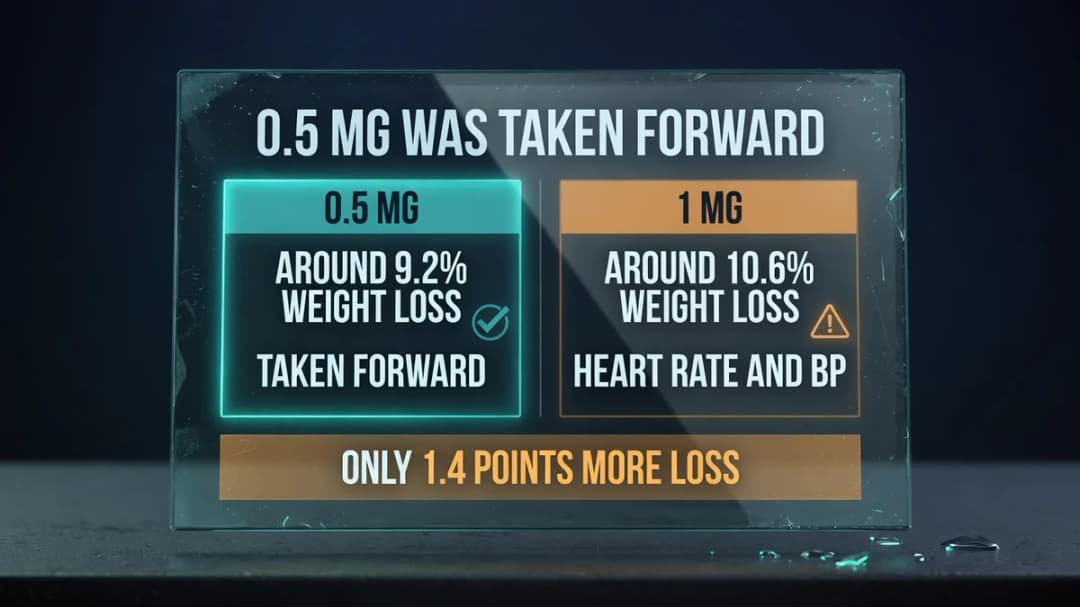
In the published phase 2 obesity work, tesofensine was tested at 0.25 mg, 0.5 mg and 1 mg daily, and 0.5 mg was the dose taken forward because the highest dose added cardiovascular effects without adding much weight loss. Any tesofensine dosage guide has to lead with that, because unlike a GLP-1 drug where the ceiling is set by nausea, the ceiling here is set by heart rate and blood pressure.
Tesofensine is not a peptide. It is a small molecule triple monoamine reuptake inhibitor, blocking reuptake of dopamine, noradrenaline and serotonin. Its pharmacology sits closer to the stimulant class than to anything metabolic, which is the fact that should shape how anyone thinks about dosing it.
Tesofensine Dosage Guide: What Each Trial Dose Produced
The phase 2 trial, TIPO-1, ran 24 weeks in adults with obesity alongside a modest calorie restriction.
| Daily dose | Mean weight loss over 24 weeks | Tolerability |
|---|---|---|
| Placebo | Around 2 percent | Reference |
| 0.25 mg | Around 4.5 percent | Generally well tolerated |
| 0.5 mg | Around 9.2 percent | Dry mouth, insomnia, nausea common |
| 1 mg | Around 10.6 percent | Clear increases in heart rate and blood pressure |
The shape of that table is the whole argument. Going from 0.5 mg to 1 mg bought roughly 1.4 additional percentage points of weight loss and introduced a cardiovascular signal. That is a poor trade, and it is why later development used 0.5 mg.
Later phase 3 work was conducted in Mexico, where the compound has been pursued for regulatory approval. It is not approved in the United States, the United Kingdom or the European Union.
Timing Matters More Than With Most Compounds
Tesofensine has a long half life and its noradrenergic and dopaminergic activity is stimulating. Reports consistently describe insomnia when it is taken later in the day, and insomnia in turn drives appetite in the opposite direction from what anyone is trying to achieve.
Morning administration, ideally early and consistently at the same time, is the pattern that appears throughout the reported use. Splitting the dose is not something the trials did and offers no obvious advantage.


Cycle Length
The published trials ran 24 weeks. Reported non clinical use tends toward shorter blocks of 12 to 16 weeks with a break, on the reasoning that a stimulating monoamine drug is not something to take indefinitely without supervision.
That reasoning is sensible but it is reasoning, not evidence. No study has compared continuous with cycled use, and the break interval people recommend is convention.
There is a second argument for finite blocks that has nothing to do with tolerance. Appetite suppressants of this class do not change eating behaviour after they stop, so a defined block only makes sense as a window in which to build habits that survive it. Used as an indefinite crutch, the compound carries indefinite cardiovascular exposure for a benefit that reverses on stopping.
Onset is slow relative to what people expect. The long half life means concentrations accumulate over the first weeks, so appetite effects build rather than appearing on day one. Judging a dose after a few days, and increasing it because nothing has happened, is the commonest way people end up higher than they intended.
The Cardiovascular Ceiling
This is the part of a tesofensine dosage discussion that matters most and gets least attention.
Blocking noradrenaline reuptake raises sympathetic tone. In the trials, the 1 mg dose produced measurable increases in heart rate and blood pressure. At 0.5 mg the effect was smaller but not absent.
The practical implications:
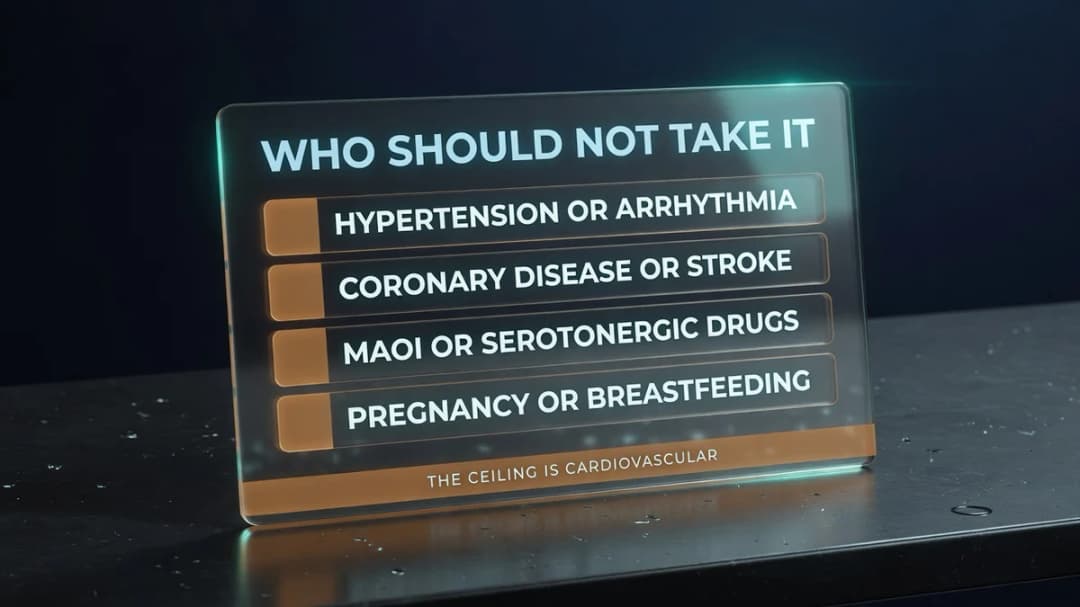
- Anyone with hypertension, arrhythmia, coronary disease or a history of stroke should not be taking this compound
- Blood pressure and resting heart rate are the measurements that should decide whether a dose is appropriate, rather than how it feels
- Stacking with other stimulants, including high caffeine intake, compounds the effect in exactly the way you would expect
- Combining with an MAOI is a serious interaction. Combining with an SSRI, SNRI or other serotonergic agent raises serotonin syndrome concerns
Reported Side Effects at Each Level
| Effect | Prominent at | Notes |
|---|---|---|
| Dry mouth | All doses | The most consistently reported effect |
| Insomnia | 0.5 mg and above | Strongly linked to dose timing |
| Nausea | 0.5 mg and above | Usually early and self limiting |
| Constipation | 0.5 mg and above | Anticholinergic in character |
| Raised heart rate | 1 mg clearly, 0.5 mg modestly | The dose limiting effect |
| Raised blood pressure | 1 mg clearly | The reason 1 mg was abandoned |
| Agitation, anxiety | Higher doses | More likely with stimulant stacking |
| Mood changes | Uncommon | Monoamine drugs warrant attention here |
How It Compares With the Metabolic Drugs
Tesofensine acts centrally on appetite through monoamine signalling. GLP-1 and dual agonists act on gut derived hormone pathways and slow gastric emptying. The mechanisms do not overlap, which is why combination is discussed.
No human trial has tested tesofensine alongside a GLP-1 agonist. Combining two appetite suppressing drugs with different cardiovascular profiles, without supervision or data, is not a reasonable experiment to run on yourself.
For the approved options and how they compare, see which GLP-1 is best for weight loss, and our tesofensine for weight loss page covers the efficacy question in full.
FAQ
What is the optimal tesofensine dose?
In the trials, 0.5 mg daily gave most of the achievable weight loss with a considerably better tolerability profile than 1 mg. That is a description of trial findings rather than a recommendation, since tesofensine is not approved for use outside the countries pursuing it.
When should tesofensine be taken?
Reported use is almost universally in the morning, because the compound is stimulating and later dosing is associated with insomnia. The trials used once daily administration and did not split doses.
How long does tesofensine stay active?
It has a long half life, on the order of days, which is part of why once daily dosing works and why effects accumulate over the first weeks rather than appearing immediately.
Can tesofensine be combined with semaglutide?
No human trial has tested the combination. The mechanisms are independent, which is why the idea appeals, but combining an appetite suppressing stimulant with a GLP-1 agonist without supervision carries real cardiovascular and gastrointestinal risk.
Who should not take tesofensine?
Anyone with cardiovascular disease, uncontrolled hypertension, arrhythmia, an anxiety disorder, glaucoma, or a history of stroke. Anyone taking an MAOI, and anyone on serotonergic medicines without prescriber input. Anyone pregnant or breastfeeding, since there is no data.