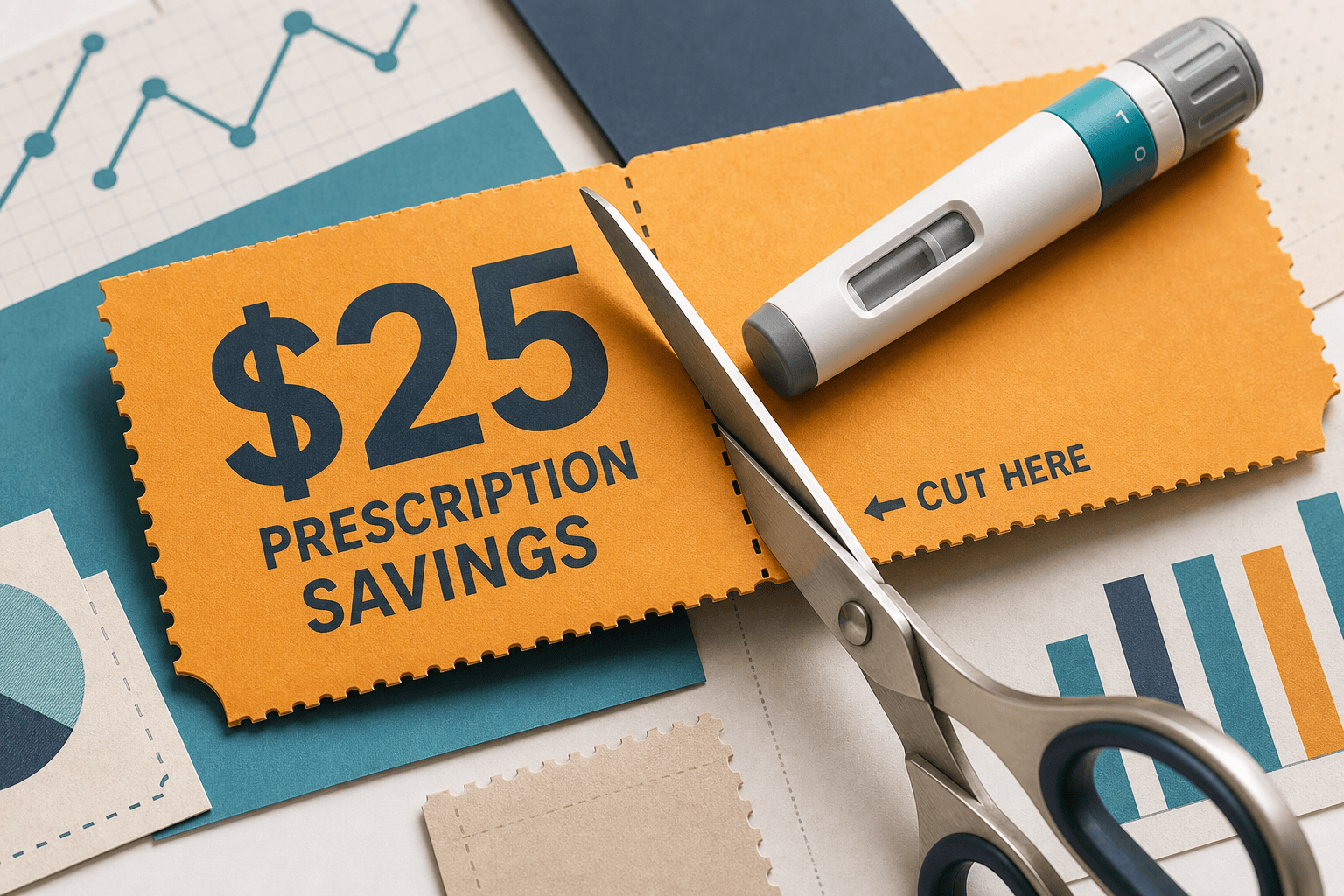
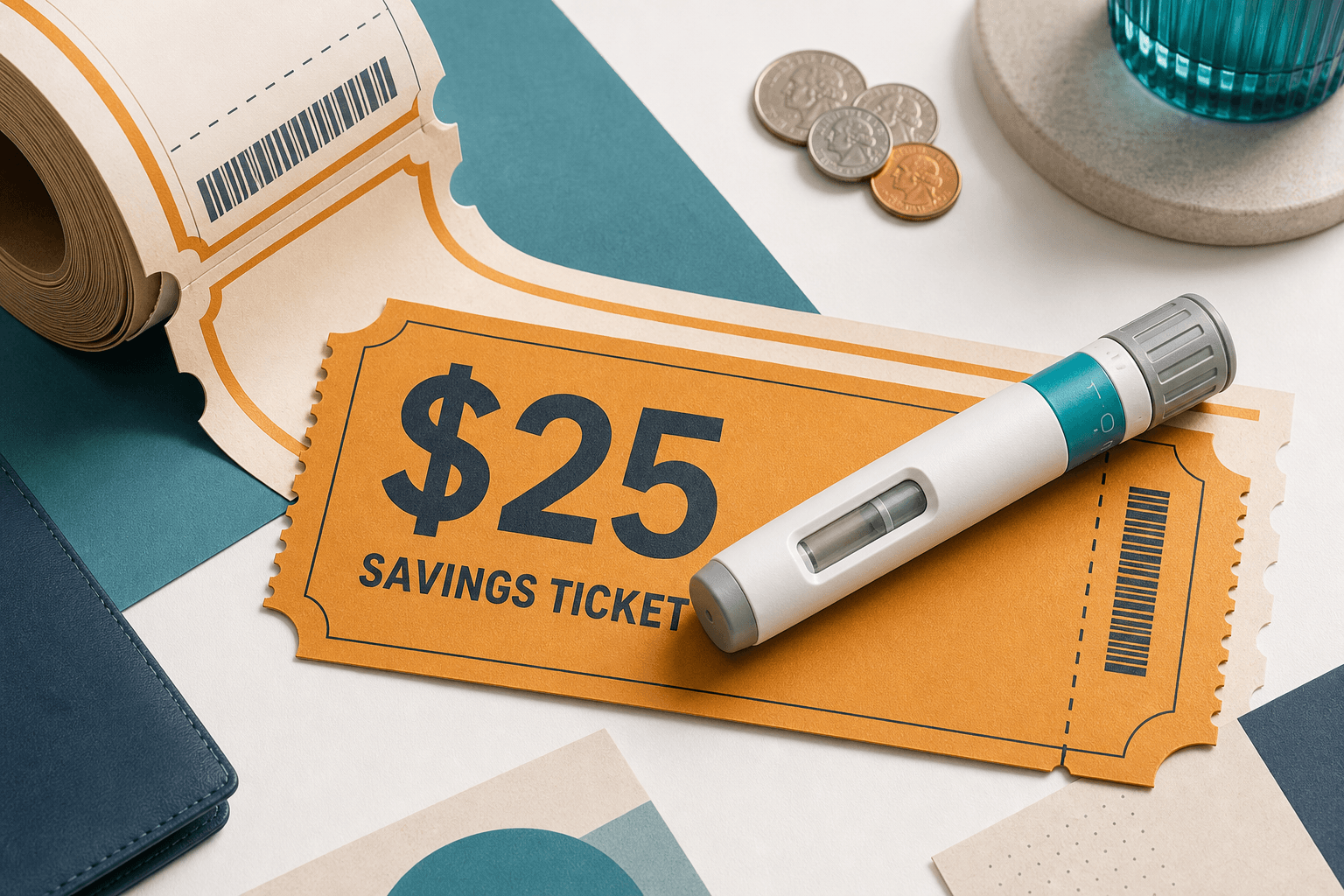
Trulicity (dulaglutide) lists at about $987 per month, and retail cash prices at major chains run $864-$1,094. Eli Lilly's official coupon — the Trulicity Savings Card — is genuinely good if you qualify, but it has hard caps, a calendar-year expiration, and a commercial-insurance wall that locks out Medicare, Medicaid, and cash payers entirely.
Direct answer: With the Trulicity Savings Card, eligible commercially insured patients pay as little as $25 for up to a 3-month prescription, with maximum savings of $150 per 1-month fill, $300 per 2-month fill, or $450 per 3-month fill, a $1,950 annual cap, and a maximum of 13 fills per calendar year. The card expires 12/31/2026. Without commercial insurance, your floor is a GoodRx coupon from $951.97 — there is no Trulicity generic, and because dulaglutide is a biologic, the first copies (biosimilars) cannot arrive until after its compound patent expires in 2027.
Trulicity is FDA approved for type 2 diabetes — the card applies to that approved use, not off-label weight loss. For the drug itself (dosing, results, side effects), see our Trulicity guide.
Trulicity Savings Card: Official 2026 Terms
From Lilly's savings page, the current structure:
| Fill length | You pay | Maximum savings per fill |
|---|---|---|
| 1-month prescription | As little as $25 | $150 |
| 2-month prescription | As little as $25 | $300 |
| 3-month prescription | As little as $25 | $450 |
On top of the per-fill caps: $1,950 maximum savings per calendar year, up to 13 fills per year, and the card expires and savings end on 12/31/2026 (Lilly typically reissues annually, but reserves "sole discretion" to terminate or amend at any time without notice).
The cap math matters. The card only gets you to $25 if your plan covers Trulicity and your copay is $175/month or less. A $400/month copay minus the $150 cap still leaves you paying $250. And a high-deductible plan member paying near-full price early in the year will exhaust the $1,950 annual cap in about two fills.
Who Qualifies for the Trulicity Savings Card
Lilly's eligibility terms:
- Commercial drug insurance that covers Trulicity is required — the card is a copay offset, not a discount off cash price.
- Government programs are excluded: Medicare, Medicare Part D, Medicaid, TRICARE, and "any state prescription drug assistance program."
- Age 18 or older, resident of the US or Puerto Rico.
- Not valid for Massachusetts residents if an AB-rated generic equivalent is available (not currently the case).
- Cannot be combined with other discounts, and the card is not insurance.
- Enrollment: download the activated digital card at trulicity.lilly.com, or call the program at 1-866-923-1953.
Per Lilly's own data, 92% of commercially insured patients pay $30 or less per month once the card is applied; the remaining 8% average $239.
How to Get the Trulicity Coupon
The "Trulicity coupon" people search for is one specific thing: the Trulicity Savings Card, a manufacturer copay card. Lilly does not run a printable in-store coupon, a mail-in rebate, or a cash-price program for Trulicity. There is the card, and there is nothing else from the manufacturer.
Getting it takes a couple of minutes:
- Activate the card at trulicity.lilly.com. It is issued digitally on the spot. There is no income form, no approval wait, and no enrollment fee.
- Keep the numbers, not a screenshot of the marketing page. The pharmacy needs the identifiers printed on the card itself to run the claim.
- Hand it over with your insurance card, not instead of it. The card processes as secondary to your commercial plan. That is exactly why it does nothing at all if your plan excludes Trulicity — there is no primary claim for it to reduce.
- If it will not process, call 1-866-923-1953 before paying full price. There is no retroactive rebate to fall back on.
Then re-check it every January. The current card carries a hard 12/31/2026 expiration and a 13-fill calendar-year maximum, and Lilly reserves the right to amend or terminate the program at any time without notice.
Trulicity Cost Without Insurance
| Pharmacy | Cash price (4-pen carton, 28 days) |
|---|---|
| Walgreens / Rite Aid | $863.85 |
| Target / CVS | $996.40 |
| Walmart | $1,060 |
| Costco | $1,094 |
List price is about $987/month regardless of dose — a 4-pen carton lasts 28 days whether it is 0.75 mg or 4.5 mg pens. GoodRx coupons bring this down moderately:
| Dose (4-pen carton) | Average retail | GoodRx price |
|---|---|---|
| 0.75 mg/0.5 mL | — | $1,024.04 |
| 1.5 mg/0.5 mL | $1,112.69 | $992.51 |
| 3 mg/0.5 mL | $1,112.69 | $965.90 |
| 4.5 mg/0.5 mL | $1,112.69 | $965.58 |
GoodRx's lowest advertised Trulicity price is $951.97 — roughly $150 off retail, still painful. Our GLP-1 cost guide puts these numbers in context across the whole class.
No insurance, or your plan won't cover Trulicity? Pallas Health — a 100% online visit reviewed by a US-licensed clinician, who prescribes only when it is clinically appropriate. FDA-approved options, or compounded medication prepared by US-licensed pharmacies. Ships free if you are eligible, with no membership or platform fees. (Partner link: we may earn a commission. Compounded medications are not FDA-approved and are not generic versions of brand-name drugs.)
Is There a Trulicity Generic?
No — and there will not be a "generic" in the usual sense at all. Dulaglutide is a biologic, so copies must come through the FDA's biosimilar pathway, which is slower and more expensive than small-molecule generics. Trulicity's compound patent runs until 2027; only after that can biosimilar competition begin, and biosimilars typically take additional years from patent expiry to pharmacy shelves. Anything marketed as "generic Trulicity" today is not a regulated equivalent.
Is Switching to a Newer GLP-1 Cheaper?
Often, yes — especially if you are paying cash. Trulicity is the only major GLP-1 left with no manufacturer self-pay program:
- Ozempic (semaglutide) — Novo now sells it direct to cash payers at $349/month for most strengths ($499 for 2 mg). That beats every cash Trulicity price by ~$500+/month, and semaglutide also outperformed dulaglutide on A1C and weight in head-to-head trials.
- Rybelsus (oral semaglutide) — same $25-style commercial savings card structure (capped at $100/month), if you prefer a pill and have commercial coverage.
- Compounded GLP-1s — typically $146-$300/month through licensed pharmacies via telehealth.
If you have commercial insurance that covers Trulicity, the $25 card is excellent and there is little financial reason to switch. If you are cash-pay or on Medicare, the savings card door is closed and the newer drugs' direct-pay channels win on price. Full rankings in our cheapest GLP-1 comparison and the master list of GLP-1 drug coupons and savings programs.
Frequently Asked Questions
Where do I get a Trulicity coupon? From Lilly directly. Activate the digital Trulicity Savings Card at trulicity.lilly.com, or call the program at 1-866-923-1953. There is no printable coupon and no rebate form — the card is the whole program.
Is the Trulicity coupon the same thing as the savings card? Yes. "Trulicity coupon," "Trulicity savings card" and "Trulicity copay card" all refer to the same Lilly program. It is a copay offset that runs on top of commercial insurance, not a discount off the cash price, and it is not insurance.
Are there Trulicity coupons if I don't have commercial insurance? Not from Lilly. Every version of the manufacturer card requires commercial drug coverage that includes Trulicity, and government programs are excluded outright. Your fallback is a pharmacy discount coupon — GoodRx bottoms out around $951.97 for a 4-pen carton, roughly $150 off retail — or switching to a drug that has a manufacturer self-pay channel.
How much is Trulicity with the savings card? As little as $25 per month (or per 3-month fill) if you have commercial insurance that covers it. Lilly says 92% of insured users pay $30 or less. Savings are capped at $150/month and $1,950/calendar year.
Can I use the Trulicity coupon with Medicare or Medicaid? No. The card excludes all government-funded programs — Medicare, Medicare Part D, Medicaid, TRICARE, and state assistance programs. This is a federal anti-kickback rule, not a Lilly choice, and it applies to every manufacturer copay card.
What does Trulicity cost without insurance? List price is about $987/month; retail cash prices run $864-$1,094 depending on pharmacy. GoodRx coupons start at $951.97 for a 4-pen carton.
When will generic Trulicity be available? Not before its compound patent expires in 2027, and as a biologic it will get biosimilars rather than true generics — realistically several more years after that. No biosimilar dulaglutide is FDA approved today.
Does the Trulicity savings card expire? Yes — the current card expires 12/31/2026 with a 13-fill annual maximum. Lilly has historically renewed it each January, but terms can change.
Last reviewed: June 13, 2026
Sources
- Trulicity Savings Card, Cost and Resources — Eli Lilly
- Trulicity Prices, Coupons & Savings Tips — GoodRx
- Trulicity Costs in 2026: With and Without Insurance — Noom
- Top drug patent expirations in the next 5 years — Proclinical
- Novo Nordisk launches introductory self-pay offer for Wegovy and Ozempic — PR Newswire
- Diabetes Savings Card Program — NovoCare
References
- U.S. Food and Drug Administration. TRULICITY (dulaglutide) injection — Prescribing Information. (Dulaglutide approved for type 2 diabetes; once-weekly subcutaneous biologic; Initial U.S. Approval 2014.)
- Collins L, Costello RA. Glucagon-Like Peptide-1 Receptor Agonists. StatPearls, NCBI Bookshelf. (Dulaglutide as a GLP-1 receptor agonist for type 2 diabetes.)