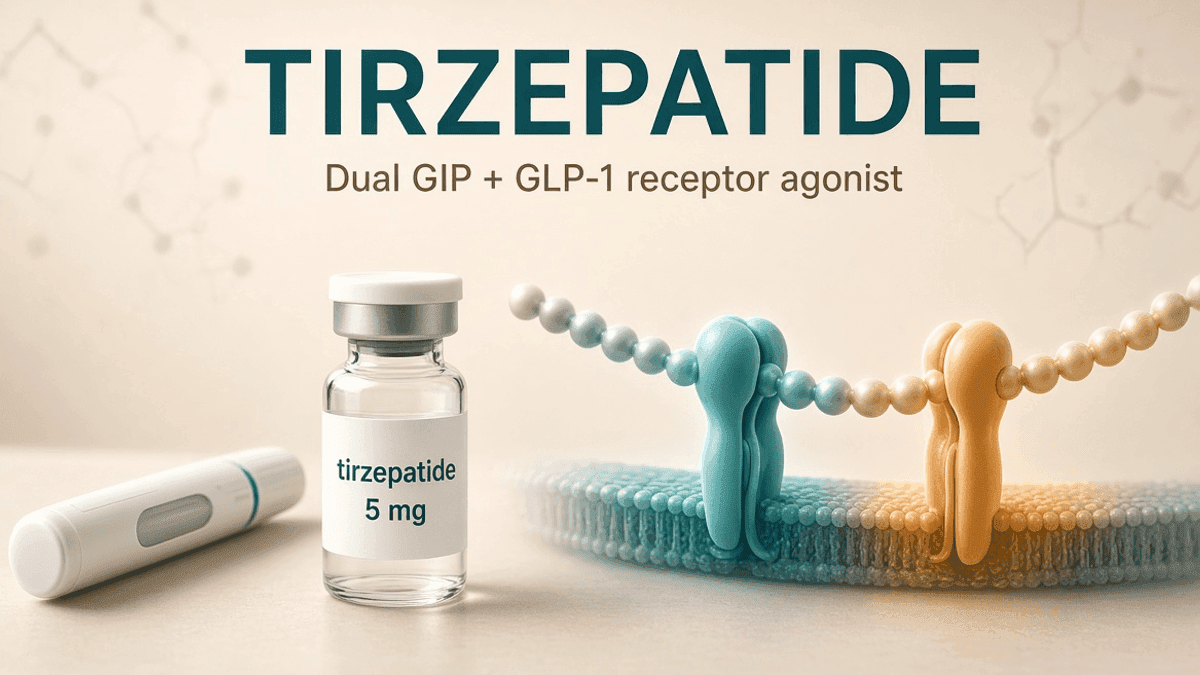
Tirzepatide is a once-weekly injectable medicine that activates two gut-hormone receptors at once: GIP (glucose-dependent insulinotropic polypeptide) and GLP-1 (glucagon-like peptide-1). Eli Lilly sells it under two brand names. Mounjaro treats type 2 diabetes and, since August 2026, also lowers cardiovascular risk in high-risk adults with diabetes. Zepbound treats obesity and obstructive sleep apnea. The molecule inside both pens is identical. In clinical trials it produced more weight loss than any GLP-1-only medicine it has been compared against, including semaglutide.
Key takeaways
- Tirzepatide is a 39-amino-acid peptide built on the GIP hormone sequence and modified so it also switches on the GLP-1 receptor. A fatty-acid chain gives it a half-life of about 5 days.
- Mounjaro and Zepbound are the same drug. The brand decides the approved use, the insurance route and the price, not the chemistry.
- Everyone starts at 2.5 mg a week and moves up in 2.5 mg steps no faster than every 4 weeks, to a maximum of 15 mg.
- In SURMOUNT-1, people without diabetes lost an average of 15.0% to 20.9% of their body weight over 72 weeks, depending on dose, vs 3.1% on placebo.
- Stomach and gut side effects are the main problem: nausea affected 25% to 29% of people on the drug vs 8% on placebo. They usually peak while the dose is being raised.
- Most of the weight comes back if you stop. In SURMOUNT-4, people switched to placebo regained 14% of their body weight within a year.
What is tirzepatide?
Tirzepatide is a synthetic peptide: a chain of 39 amino acids whose backbone is based on human GIP, with changes that let it activate the GLP-1 receptor as well. Lilly developed it under the code LY3298176, and the FDA approved it for the first time on May 13, 2022, as Mounjaro.
Three design features explain how it behaves in the body:
- A C20 fatty diacid side chain. A 20-carbon fatty acid is attached through a linker to the lysine at position 20. It makes the drug stick to albumin, the main protein in blood (about 99% is bound), which shields it from breakdown and from the kidneys.
- Two non-natural amino acids (Aib) at positions 2 and 13. They help protect the peptide from DPP-4, the enzyme that breaks down natural GIP and GLP-1 within minutes.
- A long half-life. Together these changes stretch the half-life to about 5 days, so one injection covers a full week.
The prescribing information gives its molecular weight as 4,813.53 Da (C225H348N48O68). For comparison, semaglutide is a single-receptor GLP-1 drug, which is why tirzepatide is usually described as a "dual agonist" or "twincretin" rather than lumped in with the standard GLP-1 receptor agonist class.
Is tirzepatide the same as Mounjaro and Zepbound?
Yes. Tirzepatide is the generic (chemical) name, and Mounjaro and Zepbound are two brand names for it. Both are made by Eli Lilly, come in the same strengths and contain the same molecule. What differs is the FDA-approved use, which in turn drives insurance coverage. See Mounjaro vs Zepbound for the coverage details.
| Mounjaro | Zepbound | |
|---|---|---|
| Active ingredient | Tirzepatide | Tirzepatide |
| Approved for | Type 2 diabetes (adults and children 10+); cutting heart attack, stroke and cardiovascular death risk in high-risk adults with type 2 diabetes | Chronic weight management; moderate to severe obstructive sleep apnea with obesity |
| First US approval | May 13, 2022 | November 8, 2023 |
| Doses | 2.5 to 15 mg weekly (children: up to 10 mg) | 2.5 to 15 mg weekly |
| Forms | Single-dose pen, single-dose vial, multi-dose vial, KwikPen | Single-dose pen, single-dose vial, multi-dose vial, KwikPen |
| Who it's for | People with type 2 diabetes | Adults with obesity (BMI 30+), or overweight (BMI 27+) plus a weight-related condition |
Both labels say not to combine tirzepatide with another tirzepatide product or with any GLP-1 receptor agonist.
How does tirzepatide work?
GIP and GLP-1 are incretins: hormones your gut releases after you eat that tell the pancreas to release insulin and the brain that food has arrived. Tirzepatide imitates both at the same time, and lasts for days instead of minutes.
Where tirzepatide acts in the body
- GLP-1GIPBrain
Quieter hunger signals and smaller meals. Both receptor types sit in appetite-regulating areas. - GLP-1Stomach
Slower gastric emptying, so food stays longer and post-meal glucose rises less. The effect is strongest early and fades with time. - GLP-1GIPPancreas
More insulin when blood sugar is high (glucose-dependent), and less glucagon telling the liver to release sugar. - GIPFat tissue
Better insulin sensitivity and fat handling. Weight lost is mostly fat mass rather than lean mass.
In practice that produces four overlapping effects:
- Glucose-dependent insulin release. Insulin rises mainly when blood sugar is high, which is why tirzepatide alone rarely causes low blood sugar.
- Less glucagon. The liver gets a weaker signal to release stored sugar.
- Slower stomach emptying. Food leaves the stomach more slowly, which blunts the after-meal sugar spike and prolongs fullness. This effect is strongest after the first doses: in label studies it cut the peak level of a test drug by 55% after the first 5 mg dose, but had no meaningful impact by week 6 on 15 mg.
- Lower appetite. Both GIP and GLP-1 receptors sit in brain areas that regulate hunger. The label credits the weight loss mostly to lower calorie intake, and says the weight lost is more fat mass than lean mass.
What does adding GIP change?
GLP-1-only drugs such as semaglutide already suppress appetite strongly. The FDA label states that "nonclinical studies suggest the addition of GIP may further contribute to the regulation of food intake," and GIP also acts on insulin sensitivity and fat tissue. The clearest evidence that the combination matters is the head-to-head data: in SURMOUNT-5, tirzepatide produced 6.5 percentage points more weight loss than semaglutide (details below).
What is tirzepatide approved for?
As of October 2026, tirzepatide has five FDA-approved uses split across its two brands:
- Type 2 diabetes in adults (Mounjaro), alongside diet and exercise to improve blood sugar.
- Type 2 diabetes in children 10 and older (Mounjaro), approved December 19, 2025, with a maximum dose of 10 mg. Children should not inject themselves with the KwikPen.
- Cardiovascular risk reduction (Mounjaro), approved August 27, 2026: lowering the risk of cardiovascular death, heart attack or stroke in adults with type 2 diabetes who are at high risk.
- Chronic weight management (Zepbound) in adults with obesity, or overweight plus at least one weight-related condition such as high blood pressure or high cholesterol, alongside a reduced-calorie diet and more exercise.
- Moderate to severe obstructive sleep apnea in adults with obesity (Zepbound), approved December 20, 2024. See tirzepatide for sleep apnea.
Tirzepatide's US approvals, 2022 to 2026
- May 13, 2022 · MOUNJARO
Type 2 diabetes in adults. The first approved dual GIP/GLP-1 receptor agonist. - Nov 8, 2023 · ZEPBOUND
Chronic weight management in adults with obesity, or overweight plus a weight-related condition. - Dec 20, 2024 · ZEPBOUND
Moderate to severe obstructive sleep apnea in adults with obesity. - Dec 19, 2025 · MOUNJARO
Type 2 diabetes in children 10 and older (maximum 10 mg). - Early 2026 · BOTH
KwikPen (4 doses per pen) and multi-dose vials added to the US labels. - Aug 27, 2026 · MOUNJARO
Lower risk of heart attack, stroke or cardiovascular death in adults with type 2 diabetes at high risk.
It is not approved for heart failure, fatty liver disease (MASH), chronic kidney disease or type 1 diabetes, although several of these are being studied. Lilly withdrew its US heart-failure application in May 2025 after the FDA indicated another trial would be needed. The GLP-1s for fatty liver page covers the MASH data.
How effective is tirzepatide?
Tirzepatide has been tested in two large trial programs: SURMOUNT for weight and SURPASS for type 2 diabetes. One thing to know before reading any tirzepatide number: Lilly reports two versions of each result. The treatment-regimen estimand counts everyone who was randomized, including people who stopped the drug. The efficacy estimand assumes everyone stayed on treatment and gives bigger numbers. This article uses treatment-regimen figures unless it says otherwise.
Weight loss: SURMOUNT-1
The pivotal obesity trial enrolled 2,539 adults without diabetes, averaging 104.8 kg (231 lb) and a BMI of 38. After 72 weeks:
SURMOUNT-1: average weight change at 72 weeks
The share of people who lost at least 5% of their weight was 85%, 89% and 91% on 5, 10 and 15 mg, vs 35% on placebo. At least 20% loss, roughly what bariatric surgery patients often see, was reached by 30% on 5 mg, 50% on 10 mg and 57% on 15 mg, vs 3% on placebo. For month-by-month expectations, see tirzepatide for weight loss and tirzepatide before and after.
People with type 2 diabetes: SURMOUNT-2
Weight loss is smaller when diabetes is present. In SURMOUNT-2 (938 adults with type 2 diabetes), average weight change at 72 weeks was −12.8% on 10 mg and −14.7% on 15 mg, vs −3.2% on placebo, and HbA1c fell 2.1 points on both doses vs 0.5 on placebo.
After diet and exercise first: SURMOUNT-3
SURMOUNT-3 started with a 12-week intensive lifestyle program (average loss 6.9%). The 579 people who lost at least 5% were then randomized: tirzepatide added a further 18.4% loss over 72 weeks, while the placebo group regained 2.5%.
Tirzepatide vs semaglutide: SURMOUNT-5
SURMOUNT-5 is the only completed head-to-head obesity trial against semaglutide (the drug in Wegovy and Ozempic).
SURMOUNT-5: tirzepatide vs semaglutide, head to head
BODY WEIGHT CHANGE
WAIST CIRCUMFERENCE CHANGE
More detail is in tirzepatide vs semaglutide.
Blood sugar: the SURPASS trials
Across SURPASS-1 to SURPASS-5, the Mounjaro label reports HbA1c reductions from 1.7 to 2.4 percentage points over 40 to 52 weeks, depending on the trial, dose and background treatment. In SURPASS-2 (1,879 adults on metformin), all three doses beat semaglutide 1 mg over 40 weeks:
| SURPASS-2, week 40 | Tirzepatide 5 mg | 10 mg | 15 mg | Semaglutide 1 mg |
|---|---|---|---|---|
| HbA1c change (points) | −2.0 | −2.2 | −2.3 | −1.9 |
| Weight change | −7.6 kg | −9.3 kg | −11.2 kg | −5.7 kg |
Source: Mounjaro prescribing information, Table 5. Semaglutide 1 mg is a diabetes dose; higher semaglutide doses were not tested.
Sleep apnea, heart and long-term diabetes prevention
- Sleep apnea (SURMOUNT-OSA). After 52 weeks, sleep apnea severity (the apnea-hypopnea index, or AHI) fell by 25.3 events per hour vs 5.3 on placebo in people not using CPAP, and by 29.3 vs 5.5 in people using CPAP. That is roughly a 51% to 59% reduction from starting levels of about 50 events per hour.
- Heart (SURPASS-CVOT). In 13,299 adults with type 2 diabetes and heart disease, tirzepatide was compared with another GLP-1 drug, dulaglutide (Trulicity), rather than placebo. Heart attack, stroke or cardiovascular death occurred in 12.1% vs 13.0% of people (hazard ratio 0.92, 95% CI 0.83 to 1.01). That proved tirzepatide was not worse than dulaglutide, which already has a proven heart benefit, but it did not prove it was better. The FDA approved the cardiovascular indication on that basis.
- Preventing diabetes (SURMOUNT-1, 3 years). In the 1,032 participants who had prediabetes, 176 weeks of tirzepatide cut progression to type 2 diabetes from 13.3% to 1.3%, about 93% lower risk. Weight change at 3 years was −12.3% to −19.7% depending on dose, vs −1.3% on placebo.
- Heart failure (SUMMIT). In 731 people with heart failure with preserved ejection fraction and obesity, the combined rate of cardiovascular death or worsening heart failure was 9.9% vs 15.3% (hazard ratio 0.62). The whole benefit came from fewer heart-failure events, not fewer deaths. This is not an approved use.
Tirzepatide dosage
Every tirzepatide course starts at 2.5 mg once a week for 4 weeks. That dose exists only to let the gut adjust; it is not a treatment dose. After that, the dose goes up in 2.5 mg steps, with at least 4 weeks on each dose.
The tirzepatide dose ladder: 2.5 mg steps, at least 4 weeks apart
| Use | Starting dose | Maintenance dose | Maximum |
|---|---|---|---|
| Weight management (Zepbound) | 2.5 mg weekly for 4 weeks | 5, 10 or 15 mg weekly | 15 mg |
| Sleep apnea (Zepbound) | 2.5 mg weekly for 4 weeks | 10 or 15 mg weekly | 15 mg |
| Type 2 diabetes, adults (Mounjaro) | 2.5 mg weekly for 4 weeks | Raised only if more glucose control is needed | 15 mg |
| Type 2 diabetes, children 10+ (Mounjaro) | 2.5 mg weekly for 4 weeks | Raised in 2.5 mg steps only if needed | 10 mg |
If side effects are hard to manage, prescribers commonly hold a dose for longer or step back down rather than push on. The tirzepatide dosage guide and the week-by-week tirzepatide dosage chart go deeper, and tirzepatide units to mg covers syringe math for vials.
Missed doses and changing your injection day
- Missed dose: take it as soon as you remember, as long as it is within 4 days (96 hours) of the missed time. If more than 4 days have passed, skip it and take the next dose on your usual day. See missed tirzepatide dose.
- Changing your day: allowed, as long as the two doses are at least 3 days (72 hours) apart.
Forms, strengths and how to inject
In the US, both Mounjaro and Zepbound now come in four formats. The KwikPen and multi-dose vial were added to the labels in early 2026.
| Format | Doses per device | Volume per dose | Strengths | Notes |
|---|---|---|---|---|
| Single-dose pen (autoinjector) | 1 | 0.5 mL | 2.5, 5, 7.5, 10, 12.5, 15 mg | Needle built in; press and hold |
| Single-dose vial | 1 | 0.5 mL | 2.5, 5, 7.5, 10, 12.5, 15 mg | Needs a 1 mL syringe that can measure 0.5 mL |
| Multi-dose vial | 4 | 0.6 mL | 10 to 60 mg per 2.4 mL (one vial per dose strength) | Contains preservatives; needs a 1 mL syringe that can measure 0.6 mL |
| KwikPen | 4 | 0.6 mL | 10 to 60 mg per 2.4 mL (one pen per dose strength) | Needs pen needles; never share a KwikPen, even with a new needle |

How to inject: inject under the skin of the abdomen, thigh or back of the upper arm, once a week, on the same day each week, at any time of day, with or without food. Rotate the spot each week. If you also use insulin, give it as a separate injection and never mix the two in one syringe. You can use the same body area, but not right next to each other.
How to store tirzepatide
| In the fridge | Out of the fridge | |
|---|---|---|
| Single-dose pen or single-dose vial | 2°C to 8°C (36°F to 46°F), in the carton, until the expiry date | Up to 21 days total at no more than 30°C (86°F) |
| KwikPen or multi-dose vial | 2°C to 8°C (36°F to 46°F), in the carton | Up to 30°C (86°F); throw away after 30 days, 30 days after first use, or after 4 doses, whichever comes first |
Never freeze tirzepatide, and don't use a pen or vial that has been frozen.
How long does tirzepatide stay in your system?
Tirzepatide's half-life is about 5 days (the Zepbound label says 5 to 6 days in people with obesity). After an injection, blood levels peak at around 24 hours (range 8 to 72 hours), and about 80% of the injected dose reaches the bloodstream.
How weekly doses build up in the blood
Two practical rules follow from those numbers:
- It takes about 4 weeks to reach a steady level, which is also why every dose step lasts at least 4 weeks.
- It takes roughly a month to clear. Most drugs are considered gone after about five half-lives, so for tirzepatide that is around 25 to 30 days after the last dose. Appetite and blood-sugar effects fade over that period.
The tirzepatide half-life article explains the math in more detail.
Tirzepatide side effects
Most side effects involve the digestive system. In the two main weight-management trials, 56% of people on tirzepatide reported at least one gastrointestinal side effect at every dose, vs 30% on placebo. These effects are most common while the dose is being raised and usually ease afterwards.
Most common tirzepatide side effects by dose
Side effects led 4.8%, 6.3% and 6.7% of people on 5, 10 and 15 mg to stop treatment, vs 3.4% on placebo. Severe gastrointestinal reactions affected 1.7% to 3.1% of people on tirzepatide vs 1% on placebo. Other reported effects include fatigue (5% to 7%), burping, dizziness, reflux, bloating and a small rise in resting heart rate of 1 to 3 beats per minute.
People with type 2 diabetes on Mounjaro tend to report somewhat lower rates in the 40-week diabetes trials: nausea in 12% to 18%, diarrhea in 12% to 17% and decreased appetite in 5% to 11%. The full breakdown, plus how to manage each one, is in tirzepatide side effects.
Serious risks
The prescribing information lists these warnings:
- Thyroid C-cell tumors (boxed warning). Tirzepatide caused thyroid C-cell tumors in rats. Whether it does in humans is unknown. It must not be used by anyone with a personal or family history of medullary thyroid carcinoma (MTC) or multiple endocrine neoplasia syndrome type 2 (MEN 2). Report a lump in the neck, trouble swallowing, hoarseness or shortness of breath.
- Pancreatitis. Rare, at about 0.2% in the main trials (the same as placebo), but stop the drug and get help for severe stomach pain that spreads to the back, with or without vomiting.
- Gallbladder problems. Gallstones and gallbladder inflammation, often linked to rapid weight loss (inflammation in 0.7% vs 0.2% on placebo).
- Kidney injury from dehydration. Vomiting and diarrhea can dehydrate you enough to injure the kidneys. Drink enough fluid.
- Low blood sugar when combined with insulin or a sulfonylurea. In SURMOUNT-2, blood sugar fell below 54 mg/dL in 10.3% of people taking a sulfonylurea vs 2.1% of those who weren't.
- Serious allergic reactions (about 0.1%), including anaphylaxis and angioedema.
- Diabetic retinopathy complications in people with type 2 diabetes, especially those with existing eye disease. This warning was added in August 2026.
- Breathing in stomach contents during anesthesia or deep sedation. Because the stomach empties more slowly, tell your surgeon or anesthetist that you take tirzepatide before any procedure.
- Severe gastroparesis. Tirzepatide is not recommended for people with severe gastroparesis.
Mood: in January 2026 the FDA asked for the suicidal behavior and ideation warning to be removed from Zepbound, Wegovy and Saxenda after a review of 91 trials with more than 107,000 patients found no increased risk. The Zepbound label dropped it in February 2026. Any new or worsening low mood should still be raised with a doctor.
Who should not take tirzepatide?
The only formal contraindications are a personal or family history of MTC or MEN 2, and a known serious allergy to tirzepatide or any ingredient. Tirzepatide is not recommended for people with severe gastroparesis. People with a history of pancreatitis or diabetic eye disease, or who are pregnant or planning a pregnancy, need an individual discussion with a prescriber.
Drug interactions
- Birth control pills. Tirzepatide can make oral contraceptives less reliable. In label studies, a single 5 mg dose cut the peak levels of the pill's hormones by 55% to 66%. If you use the pill, switch to a non-oral method or add a barrier method (such as condoms) for 4 weeks after starting tirzepatide and for 4 weeks after each dose increase. Patches, rings, implants and IUDs are not expected to be affected.
- Insulin and sulfonylureas (such as glipizide, glimepiride or glyburide). The combination raises the risk of low blood sugar, and the dose of these may need to be lowered.
- Oral drugs with a narrow therapeutic window, such as warfarin. Slower stomach emptying can change how they are absorbed, so these may need closer monitoring, mainly early on and after dose increases.
- Other GLP-1 or tirzepatide products. Don't combine them.
Pregnancy, breastfeeding, kidneys and liver
- Pregnancy. The Zepbound label says weight loss offers no benefit during pregnancy and may harm the fetus, so Zepbound should be stopped as soon as pregnancy is recognized. The Mounjaro label allows use during pregnancy only if the benefit justifies the risk. Neither US label sets a specific stop-before-conception period, but the UK NHS advises stopping tirzepatide at least 4 weeks before trying to get pregnant. Lilly runs a pregnancy registry (1-844-524-0039).
- Breastfeeding. In a small study of 11 women given a single 5 mg dose, tirzepatide was undetectable in 164 of 171 breast-milk samples, and the total amount passed to milk was less than 0.02% of the dose. Long-term data in infants are lacking.
- Kidneys and liver. No dose adjustment is needed for kidney impairment (including end-stage kidney disease) or liver impairment. People with kidney problems should be careful about dehydration from vomiting or diarrhea.
- Older adults. About 9% of people in the weight-management trials were 65 or older, and no overall differences in safety or effectiveness were seen.
What happens when you stop tirzepatide?
Tirzepatide treats a chronic condition rather than curing it, and the weight-loss data reflect that.
SURMOUNT-4: what happened when people stopped
Staying on a lower dose may be an option. In SURMOUNT-MAINTAIN (Lancet, 2026), people who first lost weight on their maximum dose and were then randomized for a year kept an average total loss of 21.9% if they stayed on that dose, 16.6% if they dropped to 5 mg and 9.9% if they switched to placebo. Diabetes prevention also fades: in the prediabetes group of SURMOUNT-1, progression to diabetes went up after 17 weeks off treatment, although it stayed lower than in the placebo group (2.4% vs 13.7%).
Protein intake and resistance exercise help protect muscle while the weight comes off. See what to eat on tirzepatide.
How much does tirzepatide cost, and how do you get it?
Tirzepatide needs a prescription in the US. Its pre-discount price is around $1,087 a month. What you actually pay depends on the brand, your insurance and the format.
| Route | What it costs (October 2026) | Who it's for |
|---|---|---|
| Commercial insurance + Lilly savings card | As low as $25 a month | People whose plan covers Mounjaro or Zepbound |
| LillyDirect self-pay, Zepbound KwikPen or vials | $299 (2.5 mg), $399 (5 mg), $449 (7.5 to 15 mg) if each refill is within 45 days; otherwise $499 for 7.5 mg and $699 for 10 to 15 mg | Cash payers; government-insured patients excluded |
| Medicare GLP-1 Bridge | $50 a month copay, July 1, 2026 to December 31, 2027 | Eligible Medicare Part D patients |
The self-pay prices apply to the Zepbound KwikPen and vials, not the single-dose autoinjector pen. For the full price picture, see tirzepatide cost, LillyDirect Zepbound cost and does Medicare cover Zepbound.
Is there a generic, compounded or pill version?
- Generic: none is approved. The FDA accepted two generic applications from Sandoz for review in June 2026, with no approval timeline. More in Zepbound generic.
- Compounded: pharmacies could legally make copies during the shortage, but the FDA declared the shortage over on December 19, 2024, and the grace periods ended on February 18, 2025 for 503A pharmacies and March 19, 2025 for 503B outsourcing facilities. Compounded tirzepatide is not FDA-approved or reviewed for safety, effectiveness or quality. Lilly also warns about counterfeit products sold online. See compounded tirzepatide.
- Pills: there is no FDA-approved oral tirzepatide. Every approved product is an injection. Some telehealth companies sell compounded tirzepatide tablets or drops, which have no published trials behind them. Lilly's approved pill, Foundayo (orforglipron, approved April 1, 2026), is a different molecule that acts only on the GLP-1 receptor. See tirzepatide pills.
Tirzepatide vs other weight-loss drugs
| Tirzepatide | Semaglutide | Orforglipron | Retatrutide | |
|---|---|---|---|---|
| Brands | Mounjaro, Zepbound | Ozempic, Wegovy | Foundayo | None (investigational) |
| Receptors | GIP + GLP-1 | GLP-1 | GLP-1 | GIP + GLP-1 + glucagon |
| How it's taken | Weekly injection | Weekly injection or daily tablet | Daily tablet | Weekly injection |
| Weight result | −20.2% vs −13.7% for semaglutide (SURMOUNT-5, 72 weeks) | See left | −11.1% on the top dose vs −2.1% (ATTAIN-1, treatment-regimen) | Phase 3 trials running |
| FDA status | Approved | Approved | Approved April 2026 | Not approved |
Retatrutide adds a third receptor and is still in Phase 3; see retatrutide vs tirzepatide. Trial populations and durations differ, so only SURMOUNT-5 is a true head-to-head comparison.
Frequently asked questions
Is tirzepatide a GLP-1?
Partly. It activates the GLP-1 receptor, but it also activates the GIP receptor, which standard GLP-1 drugs do not. That is why it is classed as a dual GIP/GLP-1 receptor agonist rather than a plain GLP-1 receptor agonist.
Is tirzepatide the same as Ozempic?
No. Ozempic contains semaglutide, which activates only the GLP-1 receptor. Tirzepatide is a different molecule that activates both GIP and GLP-1 receptors. In the SURMOUNT-5 head-to-head trial, tirzepatide produced more weight loss (20.2% vs 13.7% at 72 weeks).
How quickly does tirzepatide work?
Appetite often drops within the first weeks, but the drug takes about 4 weeks to reach a steady level and much longer to reach a full dose: on the fastest schedule, 15 mg is reached at week 20. In SURMOUNT-1 the main results were measured at week 72, so judge the drug over months, not weeks.
How much weight can you lose on tirzepatide?
In SURMOUNT-1, average weight loss at 72 weeks was 15.0% on 5 mg, 19.5% on 10 mg and 20.9% on 15 mg. Results vary a lot between people: 57% of people on 15 mg lost at least 20% of their weight, while about 1 in 10 lost less than 5%. People with type 2 diabetes typically lose less.
Can you take tirzepatide if you don't have diabetes?
Yes. Zepbound is approved for adults with obesity, or overweight plus at least one weight-related health condition, whether or not they have diabetes. Mounjaro's approvals are limited to people with type 2 diabetes.
Does tirzepatide cause muscle loss?
Some lean mass is lost along with fat, as with any significant weight loss, but the label states that tirzepatide produces greater fat mass loss than lean mass loss. Eating enough protein and doing resistance training help protect muscle.
Do you have to take tirzepatide forever?
It is designed as a long-term treatment. In SURMOUNT-4, people who stopped after 36 weeks regained 14% of their body weight over the next year, while those who continued lost another 5.5%. Some people may keep most of their loss on a lower maintenance dose, but that decision should be made with a prescriber.
Can you drink alcohol on tirzepatide?
The labels don't ban alcohol. However, alcohol can worsen nausea and dehydration, and in people with diabetes taking insulin or a sulfonylurea, it adds to the risk of low blood sugar. Ask your prescriber what's sensible for you.
Who makes tirzepatide?
Eli Lilly and Company, of Indianapolis, discovered and makes tirzepatide. It sells it as Mounjaro and Zepbound, and directly to patients through LillyDirect.
Medical disclaimer: This article is for general education only and is not medical advice. Tirzepatide is a prescription medicine; talk with a licensed clinician before starting, stopping or changing any medication. Figures are from the FDA prescribing information for Zepbound (August 28, 2026) and Mounjaro (August 27, 2026) and the trial publications listed below.
References
- Eli Lilly and Company. ZEPBOUND (tirzepatide) injection, prescribing information, August 2026. DailyMed
- Eli Lilly and Company. MOUNJARO (tirzepatide) injection, prescribing information, August 2026. DailyMed
- Jastreboff AM, et al. Tirzepatide once weekly for the treatment of obesity (SURMOUNT-1). N Engl J Med. 2022. PMID 35658024
- Jastreboff AM, et al. Tirzepatide for obesity treatment and diabetes prevention (SURMOUNT-1, 3 years). N Engl J Med. 2025. PMID 39536238
- Garvey WT, et al. Tirzepatide once weekly for the treatment of obesity in people with type 2 diabetes (SURMOUNT-2). Lancet. 2023. PMID 37385275
- Wadden TA, et al. Tirzepatide after intensive lifestyle intervention in adults with overweight or obesity (SURMOUNT-3). Nat Med. 2023. PMID 37840095
- Aronne LJ, et al. Continued treatment with tirzepatide for maintenance of weight reduction in adults with obesity (SURMOUNT-4). JAMA. 2024. PMID 38078870
- Aronne LJ, et al. Tirzepatide as compared with semaglutide for the treatment of obesity (SURMOUNT-5). N Engl J Med. 2025. PMID 40353578
- Malhotra A, et al. Tirzepatide for the treatment of obstructive sleep apnea and obesity (SURMOUNT-OSA). N Engl J Med. 2024. PMID 38912654
- Frías JP, et al. Tirzepatide versus semaglutide once weekly in patients with type 2 diabetes (SURPASS-2). N Engl J Med. 2021. PMID 34170647
- SURPASS-CVOT investigators. Tirzepatide versus dulaglutide and cardiovascular outcomes in type 2 diabetes. N Engl J Med. 2025. PMID 41406444
- Packer M, et al. Tirzepatide for heart failure with preserved ejection fraction and obesity (SUMMIT). N Engl J Med. 2025. PMID 39555826
- SURMOUNT-MAINTAIN investigators. Lancet. 2026. PMID 42119587
- Coskun T, et al. LY3298176, a novel dual GIP and GLP-1 receptor agonist for the treatment of type 2 diabetes mellitus. Mol Metab. 2018. PMID 30473097
- US Food and Drug Administration. FDA requests removal of suicidal behavior and ideation warning from GLP-1 receptor agonist medications. January 13, 2026. FDA
- US Food and Drug Administration. FDA clarifies policies for compounders as national GLP-1 supply begins to stabilize. FDA
- Centers for Medicare & Medicaid Services. Medicare GLP-1 Bridge. CMS
- Eli Lilly and Company. Zepbound coverage and savings. zepbound.lilly.com
- NHS. Tirzepatide: a medicine to manage type 2 diabetes and treat obesity. nhs.uk
For an overview of every tirzepatide topic on this site, see the tirzepatide guide.