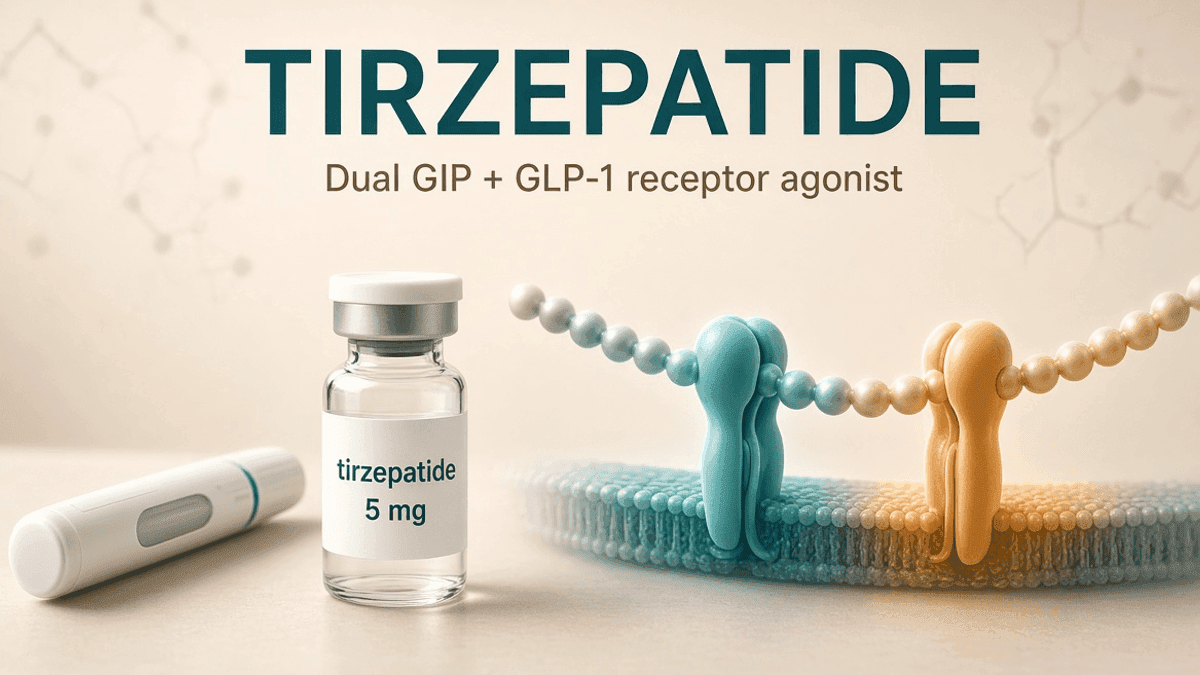

Tirzepatide is started at 2.5 mg injected under the skin once a week, then raised in 2.5 mg steps no sooner than every four weeks until you reach an effective dose, up to a maximum of 15 mg weekly. The 2.5 mg starting dose primes your gut rather than treating disease.
What is the standard tirzepatide titration schedule?
Both brand versions of tirzepatide, Mounjaro (approved for type 2 diabetes) and Zepbound (approved for obesity), follow the same approved titration ladder. According to the FDA prescribing information, you begin at 2.5 mg once weekly for four weeks, move up to 5 mg, and then increase in 2.5 mg increments at intervals of no less than four weeks until you reach a dose that works for you.
| Weeks | Weekly dose | Role on the ladder |
|---|---|---|
| 1–4 | 2.5 mg | Starter (non-therapeutic, GI priming) |
| 5–8 | 5 mg | First maintenance option |
| 9–12 | 7.5 mg | Titration step |
| 13–16 | 10 mg | Maintenance option |
| 17–20 | 12.5 mg | Titration step |
| 21+ | 15 mg | Maximum dose |
This is the fastest schedule the label permits. Reaching 15 mg therefore takes at least about 20 weeks, and in practice many people move more slowly because the goal is the lowest dose that controls blood sugar or drives weight loss, not the highest number on the chart.
Why does tirzepatide start at 2.5 mg?
The 2.5 mg dose is deliberately sub-therapeutic. The FDA label states it is for treatment initiation only and is not intended for glycemic control. Its real purpose is to let your stomach and gut adapt to delayed gastric emptying, the mechanism behind most early nausea, before you reach a dose strong enough to act on appetite and blood sugar. Skipping or rushing this priming month is the most common reason people abandon the drug to side effects they could have avoided.


How do you step up to a higher dose safely?
Four weeks is a minimum interval, not a mandatory promotion date. If you finish a four-week block while still dealing with significant nausea, vomiting, or diarrhea, staying on your current dose for an extra few weeks is allowed and often wise. A practical rule many clinicians use is to step up only once side effects from the current dose have settled. Learning when it makes sense to increase your GLP-1 dose and what the most common tirzepatide side effects feel like will help you time each move.
What are the maintenance doses, and is 15 mg always the goal?
Only three strengths, 5 mg, 10 mg, and 15 mg, are approved maintenance doses; the 2.5 mg, 7.5 mg, and 12.5 mg strengths exist purely as titration stepping stones. The top dose is not a universal target. In the SURMOUNT-1 obesity trial published in the New England Journal of Medicine in 2022, the 5 mg dose already produced about 16% average body-weight loss, rising to 21.4% at 10 mg and 22.5% at 15 mg. Many people settle at 5 or 10 mg with excellent results and never need to climb higher.
How do tirzepatide milligrams translate to syringe units?
Single-dose pens deliver a fixed milligram amount, so units never come into play. The question only matters when tirzepatide is drawn from a multi-dose vial with an insulin (U-100) syringe, where "units" are simply hundredths of a milliliter. Because vial concentration varies, you cannot assume a fixed conversion; you must know the milligrams per milliliter first.
| Concentration | Volume for a 5 mg dose | Units on a U-100 syringe |
|---|---|---|
| 10 mg/mL | 0.50 mL | 50 units |
| 20 mg/mL | 0.25 mL | 25 units |
Always confirm the concentration printed on your specific vial before drawing. For a fuller walkthrough, see how to convert a tirzepatide dose into syringe units and how to reconstitute tirzepatide correctly.
What should you do if you miss a dose?
The FDA label gives a clear window: if you miss a dose, take it as soon as possible within four days (96 hours) of the scheduled day. If more than four days have passed, skip that dose entirely and resume on your next regular day, never doubling up. You can also shift your weekly injection day permanently as long as at least three days (72 hours) separate two doses. More detail lives in our guide to handling a missed tirzepatide dose.
Does the dosing differ for diabetes versus weight loss?
The titration ladder is identical for both indications, which is why the same molecule is sold as Mounjaro and Zepbound. What differs is the practical target. For type 2 diabetes, the dose is titrated to A1c and may stabilize lower; in SURPASS-2, even the 5 mg dose drove large A1c reductions, beating semaglutide 1 mg. For obesity, clinicians more often push toward 10 or 15 mg because weight loss is dose-dependent. Your prescriber tailors the endpoint, but the steps along the way are the same.
What if you cannot tolerate the next dose?
If a dose increase brings on side effects you cannot live with, you have options well short of quitting. Dropping back to the last dose you tolerated, holding there for several extra weeks, and then attempting the step again more gradually is a common and label-compatible strategy, because the four-week interval is a floor rather than a ceiling. Practical measures help too: staying well hydrated, eating smaller and lower-fat meals, stopping when you feel full, and avoiding greasy or very large dinners all blunt the gastrointestinal effects that tend to spike in the days right after a step up. Persistent vomiting, signs of dehydration, or severe abdominal pain are different and warrant a call to your prescriber rather than a home workaround. The dose that matters in the end is the one you can actually stay on, so a comfortable 7.5 mg you take every week will out-perform a 15 mg you abandon after a month.
How long until a tirzepatide dose reaches full effect?
Tirzepatide has a half-life of roughly five days, so it takes about four to five weeks at any given dose to reach steady-state levels in the blood. That pharmacology is exactly why the titration intervals are set at four weeks: each step is meant to plateau before the next increase. It also means the appetite suppression and blood-sugar improvement from a new dose keep building for several weeks, so judging whether a dose is "working" after only a few days is premature. The slow climb is part of the design, not a delay in it, and it is also why steady weekly dosing matters more than chasing the next number.
References
- FDA Mounjaro (tirzepatide) prescribing information
- Jastreboff AM et al., SURMOUNT-1, New England Journal of Medicine, 2022
- Frías JP et al., SURPASS-2 (tirzepatide vs semaglutide), New England Journal of Medicine, 2021
Frequently Asked Questions
Can I stay on 2.5 mg of tirzepatide indefinitely?
It is not designed as a maintenance dose, so most people see limited and short-lived benefit there. Some use it for very gentle, off-label microdosing, but the approved plan moves you to at least 5 mg after the first four weeks.
How quickly can I increase my dose?
No faster than every four weeks per the FDA label. Reaching the 15 mg maximum from the 2.5 mg start takes a minimum of roughly 20 weeks, and slower is often more comfortable.
What is the maximum tirzepatide dose?
15 mg once weekly. There is no approved dose above that, and going higher does not have safety or efficacy data behind it.
Does the injection have to be on the same day each week?
Ideally yes, but you can move the day if at least 72 hours separate consecutive doses, and you can inject at any time of day with or without food.
This article is educational and not a substitute for personalized medical advice from your prescriber.