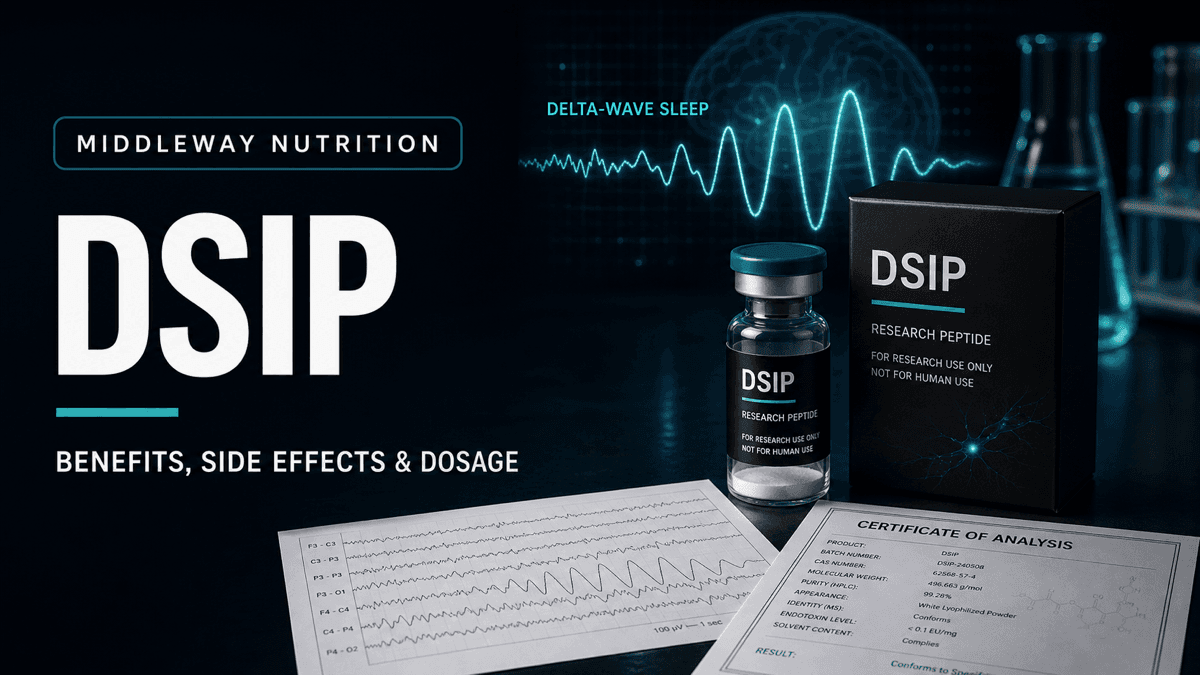
DSIP benefits are usually described as deeper sleep, lower stress and better recovery. The human evidence behind that is a handful of small intravenous studies from the 1980s and early 1990s, with mixed results, plus a larger withdrawal-treatment study that had no placebo group described. Everything else, including longevity, cancer, hormones and recovery, rests on animal work or on inference. This page grades each claim by the kind of evidence behind it.
Key Takeaways
- The strongest human evidence is for sleep, and it is mixed. Small IV studies reported better sleep in chronic insomniacs, but the best double-blind trial (16 patients) found weak effects and concluded the benefit was unlikely to be major
- A 1984 study of 107 withdrawal patients reported symptoms improved in most, but it was clinician-rated, and withdrawal itself changes over time
- Claims about lifespan, tumors, hormones, recovery and anti-aging come from mouse work, one of which used a DSIP and glycine mixture, or from no trial at all
- Only 5 usable first-hand Reddit reports were in the file I read: 3 positive, 1 mixed, 1 did nothing
- DSIP is not FDA-approved for any use, and FDA's 2026 review recommended against adding it to the compounding list. This page is information, not medical advice
For the compound overview, see our DSIP peptide guide. The DSIP dosage chart covers doses and syringe math, and DSIP side effects covers harms. This page stays on benefits and the evidence behind them.
DSIP benefits by evidence tier
Not all "benefits" are equal. The table sorts each claim by the best evidence I could find, using Europe PMC abstracts and FDA's 2026 briefing document on DSIP, which FDA calls emideltide. A higher tier means better evidence, not a bigger effect.
DSIP benefit claims by evidence tier
| What was studied | How far it goes | |
|---|---|---|
| Small human trials | Sleep after IV DSIP: 6 volunteers (1981), 14 and 18 insomniacs (1986 to 1987) | Positive but small and old; FDA says it limits interpretation |
| Small human, negative | 16 insomniacs, double-blind (1992) | Weak effect; authors saw no major therapeutic benefit |
| Clinician-rated study | Alcohol and opiate withdrawal, 107 inpatients (1984) | Most improved; no placebo group described; withdrawal fades alone |
| Single case | One man with narcolepsy (1984) | Observation only |
| Animal only | Stroke recovery in rats; stress-liver markers; mouse lifespan with a DSIP and glycine mix | Not shown in people; glycine confounds the mouse result |
| Anecdote or inference | Deeper sleep from home injections or sprays; recovery; hormones; anti-aging | Untested in humans by these routes |
What the sleep trials found
Sleep is the only area with several human studies, so it deserves the closest look.
The positive early work. The first human study gave six healthy volunteers 25 nmol/kg intravenously in the morning. Total sleep time over the next 130 minutes was 59 percent higher (median) than on placebo, and the following night showed shorter sleep onset, less light sleep and better efficiency, without classic sedation (Schneider-Helmert 1981, PMID 6895513). A 1987 placebo-controlled study of 14 chronic insomniacs gave a week of injections and reported better night sleep plus higher daytime alertness and performance (PMID 3622582). A 1986 laboratory study in 18 insomniacs reported sleep moving to normal values by the end of treatment (PMID 3792404).
The negative one. A double-blind trial in 16 chronic insomniacs gave 25 nmol/kg intravenously on three afternoons. Sleep efficiency and latency were better than placebo, but the authors said the effects were weak, partly due to a change in the placebo group, and concluded short-term treatment was not likely to be of major therapeutic benefit (Bes 1992, PMID 1299794).
How FDA read it. In its 2026 briefing, FDA said small samples, differing baselines, imbalanced sleep outcomes, mixed insomnia types and varying regimens limit what the trials can say, and that there is no information on benefit with long-term use. It also noted there are approved treatments for insomnia with established efficacy. That is a regulatory view, not a verdict on whether DSIP works for any one person.
What does this mean for the claim of "deeper sleep"? The early studies reported more slow-wave and REM sleep and better efficiency in small groups. They tested intravenous injections given slowly, around bedtime or in the afternoon, which is not how DSIP is used at home. No study I found tested the subcutaneous or nasal route for sleep in people. So "DSIP improves deep sleep" is supported in a narrow, old, intravenous setting and untested in the setting that matters to most readers.
Withdrawal, narcolepsy and the rest
Withdrawal. The largest human study gave IV DSIP to 107 inpatients in alcohol or opiate withdrawal. Among those evaluated, symptoms disappeared or improved markedly in 97 percent of opiate patients and 87 percent of alcohol patients, though anxiety was slower to ease (Dick 1984, PMID 6548969). The assessment was clinical, by physicians and nursing staff, and the abstract describes no placebo group. Withdrawal symptoms fade on their own, which makes improvement hard to attribute. Some opioid patients relapsed into anxiety and insomnia after treatment stopped, per FDA's summary. This is a clinic-supervised setting and not a basis for self-treatment.
Narcolepsy. A single case report from 1984 described a 35-year-old man whose sleep attacks became less frequent after DSIP injections (PMID 6548968). One person is an observation, not a benefit.
Stress, alertness and mood. A 1983 review of five human studies by the same group reported higher alertness and better performance while awake, and psychotherapist ratings suggesting improved stress tolerance (PMID 6689058). These are the authors' summaries of small studies, and I found no independent replication.
Animal-only findings. Intranasal DSIP at 120 mcg/kg improved motor recovery in rats after induced stroke (Tukhovskaya 2021, PMID 34500605). In rats under stress, DSIP changed liver oxidation markers in a dose-dependent way (PMID 26902351). Neither is evidence of a human benefit.
The card below summarizes where the evidence stands for each area.

The longevity and cancer claim
The biggest overreach online comes from a mouse series. In female SHR mice, a product called Deltaran, given for five days a month for life, was linked to a lighter body weight, fewer tumors and a longer life in the last survivors; a 2009 report described the oldest 10 percent living 16 percent longer (Voitenkov 2009, PMID 20405733). Deltaran is not pure DSIP. FDA's review notes it is a mixture of DSIP and glycine at 1:10 by weight, and that glycine has its own reported anti-tumor and anti-mutagen properties, so the effect cannot be assigned to DSIP. FDA also said the study was not designed to assess cancer risk.
Even so, an AI-compiled DSIP guide on r/BiohackPhilippines presents the tumor result as lifetime DSIP use cutting cancer 2.6-fold, and adds claims that DSIP improves insulin sensitivity and stabilizes blood pressure, with implied roles in the kidneys and liver. The post itself says it was assembled with an AI notebook. I treat those lines as unsupported for people.
What Reddit users report
I read 461 scraped Reddit items from 12 subreddits and 25 threads (r/NTNPerformance supplied 264, r/BodyHackGuide 167). Most were guide posts about other peptides, vendor posts and questions. After removing those, only 5 posts or comments from 4 subreddits (r/cfs, r/Peptidesource, r/NTNPerformance, r/BodyHackGuide) described first-hand DSIP use. That is far too few for a pattern, and these are self-selected posters.
Three reported a benefit, one reported mixed results and one reported nothing.
What 5 Reddit users said DSIP did for them
The most detailed positive report came from an r/cfs poster with mild ME/CFS who also has sleep apnea and uses a machine for it, and who wrote that there was a "very noticeable difference when I wake up in the morning - noticed it working after first night of using it." They said it made waking less unrefreshing but did not help the fatigue itself (a r/cfs poster, Jul 2026). The same poster also started a 40 Hz light and sound routine, so other changes were running at the same time. A second positive was a brief note that DSIP helps with sleep and stacks with a growth hormone secretagogue. The third, on r/Peptidesource, was written as a log about a research subject in a promotional style and credits a stack of about seven compounds, so I would weigh it lightly.
The flat report came from a commenter who ran two full vials: "I tried it two times for the full vial with dosing under the direction of a licensed medical professional, and nothing." (a r/NTNPerformance commenter, May 2026) The mixed report said DSIP helped with sleep sometimes but was inconsistent, in a list of peptides they would skip next time.
Timing and tolerance. Only the r/cfs poster gave a timeline (the first night). A guide post in the same file says the first few nights are often subtle and that most people who respond notice a change after one to two weeks, but it gives no data. One commenter warned that others report tolerance and loss of response; I found no study of that.
Read with care. Every positive report here came from someone using several compounds at once or with a second sleep intervention, so DSIP's own share is unknowable. The two negative or mixed reports are as small a sample as the positives. None of this is a response rate.
How the human DSIP evidence built up and stalled
- 1977
First isolated from rabbit blood and shown to have sleep-inducing properties - 1981
First human pilot: 6 volunteers, IV, no side effects reported - 1984
107 withdrawal patients treated; one narcolepsy case report - 1986 to 1987
Studies in 18 and 14 chronic insomniacs report better sleep - 1992
Double-blind trial in 16 insomniacs finds weak effects - 2026
FDA review recommends against adding DSIP to the compounding list
Who might reasonably care about DSIP, and who should not
The evidence supports one narrow question: whether intravenous DSIP can modestly improve sleep in some people with chronic insomnia. It does not support DSIP as a recovery drug, a hormone booster, an anti-aging tool or a treatment for anything else. It also does not show benefit for the injection or nasal spray people buy online.
People who sleep badly are better served by checking for sleep apnea, medication effects, alcohol, caffeine timing and anxiety, and by CBT for insomnia, which has strong evidence. DSIP is not a safe substitute for any of that. Anyone pregnant, breastfeeding, on sedatives or opioids, or with low blood pressure should not use research peptides without clinical input; the side effects page explains why.
If you still want to look at the research material, Ascension Peptides lists DSIP 10 mg at $60.00 as of 2026-10-11 (list price $94.99). Ascension says Kovera Labs tests every batch for HPLC purity, LC-MS identity, net content, endotoxin, sterility and heavy metals, with over 98% of batches passing and public batch COAs. Prices are in USD, shipping is US only and all sales are final. A first-time buyer can use code PEPTIDEDECK for 50% off. Testing speaks to what is in the vial, not to whether it works.
Frequently Asked Questions
What are the benefits of DSIP?
The best-supported claim is modest sleep improvement in some chronic insomniacs given intravenous DSIP in 1980s studies. A withdrawal study and a narcolepsy case report exist. Claims about longevity, hormones and recovery are animal-only or unproven.
Does DSIP really improve deep sleep?
Early small studies reported more slow-wave sleep and better efficiency after IV DSIP. A 1992 double-blind trial found only weak effects. No study tested the subcutaneous or nasal route for sleep in people.
How long does DSIP take to work?
There is no trial answer. The human studies measured effects within hours or over a week of injections. In my Reddit sample one poster felt a difference the first night, and a guide post says one to two weeks, without data.
Is DSIP better than melatonin?
They are different. Melatonin has far more human evidence for timing problems such as jet lag. DSIP has a small, mixed intravenous record. Nothing I found compares them directly.
Does DSIP help with anxiety, hormones or anti-aging?
Not in any trial I could verify. Withdrawal-related anxiety eased more slowly than other symptoms in the 1984 study, and the longevity and tumor mouse studies used a DSIP and glycine mixture.
Where to buy research-grade DSIP
If you decide to buy research material despite the thin evidence, Ascension Peptides lists DSIP 10 mg at $60.00 as of 2026-10-11, with Kovera Labs batch testing and public COAs. Weigh the evidence in this article first, and speak with a clinician if you have a health condition or take medication. Our guide to buying DSIP compares vendors.
Medical Disclaimer: DSIP is not approved by the FDA for any condition, and research-grade vials are not intended for human consumption. This article is educational, summarizes published studies, an FDA briefing document and anonymous online reports, and is not medical advice or a recommendation to use any product. Consult a qualified healthcare professional about any health concern, including trouble sleeping.