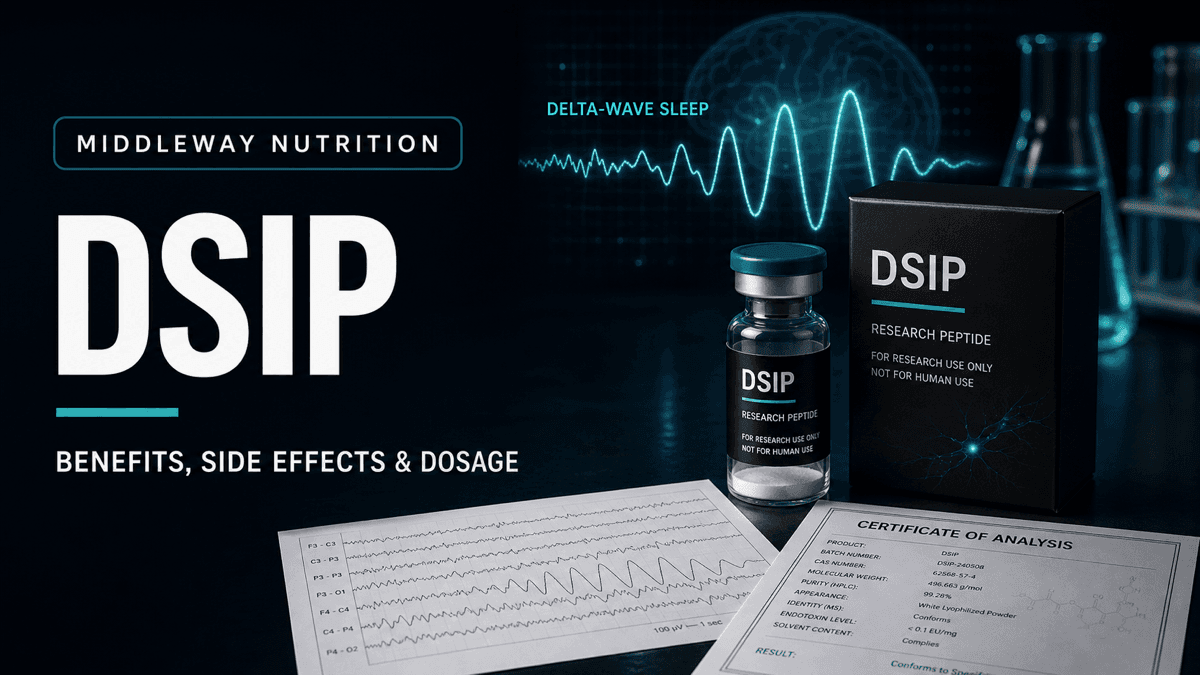
DSIP peptide benefits center on sleep depth rather than sedation, the side effects reported most often are vivid dreams and morning heaviness, and dosage in the literature clusters low. That last point is worth sitting with before anything else, because DSIP is one of the few research peptides where the older human trials disagree with each other in public, and the honest version of this topic is more useful than the confident one.
- DSIP is a nine-amino-acid neuropeptide (Trp-Ala-Gly-Gly-Asp-Ala-Ser-Gly-Glu, roughly 849 Da) first isolated from rabbit cerebral blood in the mid-1970s.
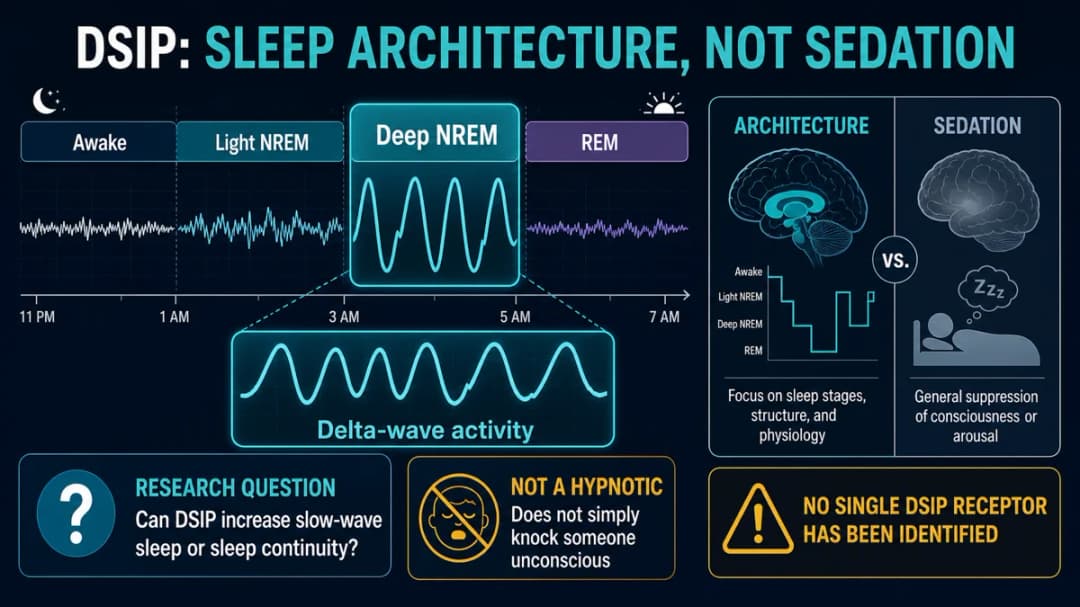
- The research signal is about sleep architecture, specifically slow-wave sleep, not about knocking someone unconscious.
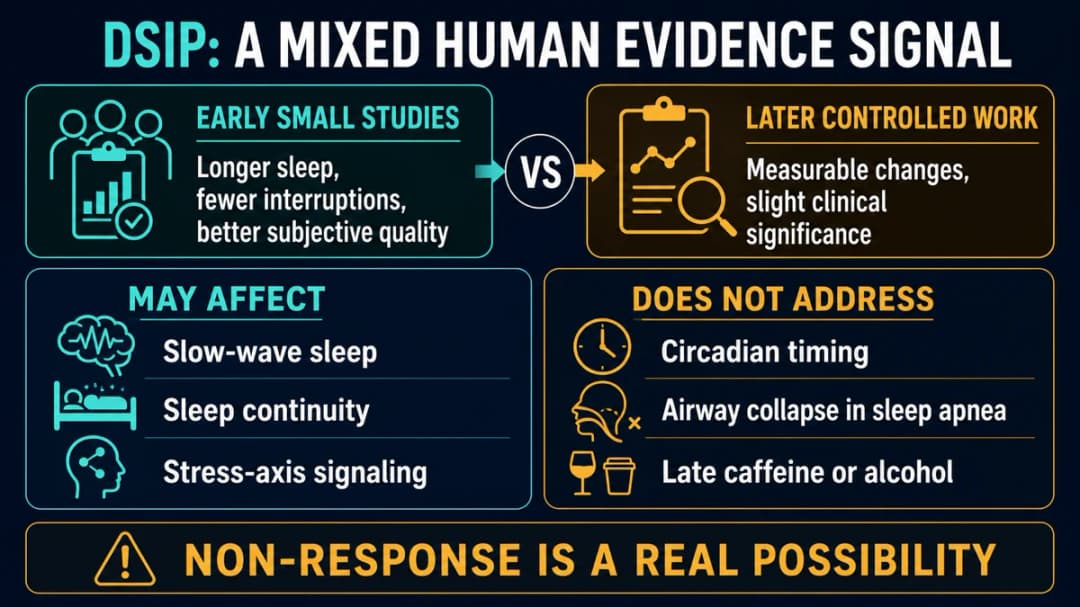
- Human trial results are genuinely mixed: early small studies were encouraging, later controlled work found changes too small to matter clinically.
- The 100 to 300 mcg subcutaneous figures you see online are community convention, not trial doses. Every published human trial used intravenous dosing at 25 to 30 nmol/kg (about 1.5 to 1.8 mg for an adult), and [FDA's July 2026 briefing document](https://www.fda.gov/media/193344/download) found no human data for the subcutaneous route.
- Plasma clearance is fast, on the order of minutes to half an hour depending on the source, which is why timing gets discussed more than dose.
What DSIP Actually Is
Delta sleep-inducing peptide, sometimes written as emideltide or shortened to the sequence letters WAGGDASGE, is a short endogenous neuropeptide. Nine residues, a molecular weight near 848.8 Da, and a tissue distribution broad enough that calling it a brain peptide undersells it: hypothalamic and pituitary tissue, yes, but also endocrine tissue well outside the skull. It is not a synthetic invention; the synthesized research material is a copy of a molecule the body already makes.
The name is an artifact of how it was found. The original isolation work used rabbits, and the observation that the recovered fraction pushed awake animals toward delta-wave activity is what the label was built on. A single animal observation became a permanent name, and that naming decision has caused fifty years of overpromising, because "sleep-inducing" implies a sedative and DSIP does not behave like one.
The mechanism has never been cleanly mapped to a single receptor, and any guide that tells you otherwise is filling in blanks. What the literature actually describes is a set of overlapping influences: a shift in the proportion of delta-wave (stage 3 to 4 NREM) sleep, measurable effects on the HPA axis including reduced ACTH after intravenous administration, indirect interaction with GABAergic and serotonergic tone, and documented cross-talk with the opioid system that explains why the older withdrawal literature exists at all. Growth hormone enters the picture only at one remove. Because GH secretion clusters inside the deepest sleep stages, anything that lengthens those stages has a plausible route to influencing overnight GH output, which is a very different claim from saying the peptide acts on GH directly.
DSIP is sold and studied as a research compound. It is not an approved medicine in the US, there is no regulator-sanctioned human dose, and no supplier can honestly describe it as a treatment for insomnia or anything else.
DSIP Benefits
The benefits worth listing are the ones with evidence attached, graded by what kind of evidence that is.
Slow-wave sleep and sleep continuity (human data, mixed). This is the central claim and the one with actual human trials behind it. Work published in the early 1980s on chronic insomnia reported longer sleep duration, fewer interruptions and better subjective sleep quality without next-day sedation, in small groups. Later controlled studies in insomniac populations found measurable increases in total sleep time and NREM time but concluded the clinical significance was slight. Both results are real. The reasonable reading is that DSIP may help a specific subgroup, people who spend enough hours in bed but wake unrefreshed, and does little for people whose sleep is already fine or whose problem is timing.
Reduced stress-axis signaling (human and animal data). Intravenous DSIP has been associated with reductions in circulating ACTH in human subjects, and animal work supports a dampening effect on stress-hormone responses. This is a mechanistic finding, not a proven anxiety benefit, but it offers a plausible route by which evening cortisol-driven awakenings could improve.
Withdrawal symptom research (older clinical data, supervised settings only). European clinical work in the 1980s examined DSIP during alcohol and opiate withdrawal, with interest in symptom and sleep improvement. This belongs firmly under medical supervision and should not be read as a self-directed use case.
Recovery and GH rhythm (indirect, inferred). If deep sleep genuinely improves, downstream recovery markers plausibly improve with it. Note the conditional. This is inference from sleep physiology, not a demonstrated DSIP outcome, and any source presenting it as proven is overreaching.
Antioxidant and neuroprotective properties (preclinical only). Some animal and in-vitro work suggests DSIP reduces oxidative stress. Interesting, early, and not something to buy the compound for.
What DSIP does not have evidence for is worth stating plainly: it does not reset circadian timing, it does nothing for airway collapse in sleep apnea, and it will not out-argue late caffeine or alcohol. Non-response appears common enough that anyone researching it should expect it as a real possibility.
DSIP Side Effects
The documented safety record is thin rather than clean. Animal toxicity studies have not flagged significant problems at research-level doses, and most adverse effects in the human literature were mild. But the human sample sizes are small and the studies are decades old, and the serious events that did occur matter: in the 1984 withdrawal study of 107 patients (PMID 6548969), FDA's July 2026 briefing document counts 3 serious events, 2 of them low blood pressure (hypotension) at the start of the first injection. FDA's conclusion was that the safety of DSIP is insufficiently characterized. "Clean profile" here means "nothing alarming was found in limited work," not "established as safe."
Effects reported across studies and user accounts:
- Vivid or unusually detailed dreams. The most commonly mentioned effect, and consistent with a genuine change in sleep architecture rather than a warning sign.
- Morning heaviness or slow starts. Reported more at the upper end of the dose range. Counterintuitively, this often reflects too much rather than too little.
- Mild headache. Usually transient.
- Lightheadedness. Reported occasionally, more so when combined with alcohol.
- Mild nausea. Uncommon.
- Injection-site redness or stinging. Standard for any subcutaneous peptide and usually a technique or site-rotation issue.
- Increased sleep fragmentation. The paradoxical one. Some people report more awakenings, generally at higher amounts, which suggests a poor dose fit rather than a need to escalate.
Where the data is thin, and it is thin in several places: there is essentially no long-term safety characterization in humans, no controlled data on interactions with sedatives, benzodiazepines, alcohol or prescription hypnotics, and nothing meaningful on pregnancy, breastfeeding or use alongside psychiatric medication. Combining DSIP with other CNS-active compounds means stacking unknowns on unknowns. People with untreated sleep apnea, active withdrawal, or unstable psychiatric conditions fall outside anything the research supports.
DSIP Dosage Chart
There is no approved dosing standard for DSIP. The subcutaneous figures below are community convention: they are what people circulate online, not doses taken from a published protocol. The human trials that exist (for example PMID 6895513, PMID 1299794) all gave DSIP intravenously at 25 to 30 nmol/kg, roughly 1.5 to 1.8 mg for an adult, and FDA's July 2026 briefing document found no clinical data for subcutaneous use. The table is descriptive, not a protocol, and nothing here is an instruction to administer anything.
| Goal or context | Community-reported range (not from trials) | Frequency | Community cycle length |
|---|---|---|---|
| Sensitivity check | 50 mcg | Once, 30 to 60 min before sleep | Single trial before deciding anything |
| Sleep quality, low end | 100 to 200 mcg | Evening, 30 to 60 min before sleep | 5 to 10 nights, then a break |
| Sleep quality, standard discussion range | 100 to 300 mcg | Evening, 30 to 60 min before sleep | 5 to 10 nights, then a break |
| Stress-linked sleep disruption | 100 to 300 mcg | Evening, 1 to 2 h before sleep | Short cycles, reassessed each time |
| Recovery and GH-window interest | 200 to 500 mcg | Evening, 45 to 60 min before sleep | Short cycles; upper end rarely justified |
| Community-reported ceiling | 500 mcg | Evening | Online reports describe next-day drag above this; no published source for the figure |
Two things about this table matter more than the numbers themselves.
First, higher is not better here, and the reports are consistent on that point. Accounts of morning heaviness and worse fragmentation cluster at the top of the range, not the bottom. In the literature and in user discussion, the pattern where 150 mcg helps and 400 mcg makes the following day worse shows up repeatedly.
Second, timing gets emphasized because clearance is fast. Reported plasma half-life varies by source, from around seven or eight minutes up to roughly thirty, though observed effects are described as persisting well beyond that. The discrepancy is real and unresolved in the literature, which is precisely why protocols specify a narrow pre-sleep window rather than a time of day.
Cycling appears in almost every online discussion, usually five to ten nights followed by time off. That length is a community habit, not something taken from a published protocol. The stated reason is not dependence, for which there is no evidence, but practicality: continuous use makes it impossible to tell whether the compound is still doing anything.
Reconstitution and Storage
DSIP ships as a lyophilized white powder and requires bacteriostatic water before it can be used at all. The powder is added to the water, not the other way around, with the stream directed down the vial wall rather than onto the cake. Swirl, never shake. Peptide chains this short are not especially fragile, but agitation still causes unnecessary degradation.
Concentration is a function of vial size and water volume, so it has to be calculated per vial. A 10 mg vial reconstituted with 2 mL of bacteriostatic water yields 5,000 mcg per mL, which on a U-100 insulin syringe puts 100 mcg at 2 units and 200 mcg at 4 units. A different water volume produces different math entirely, which is where most dosing errors originate.
Storage follows the usual pattern: lyophilized powder holds well frozen at around minus 20 degrees Celsius and stays stable at room temperature for shipping windows, while reconstituted material belongs in the refrigerator at 2 to 8 degrees Celsius and is generally treated as usable for two to three weeks. Keep it out of light and away from repeated freeze-thaw cycles.
Stacking
Genuine documentation for DSIP combinations is limited, so most stacking talk is rationale rather than evidence.
The one combination with a coherent mechanistic argument pairs DSIP with a growth hormone secretagogue, most often the one covered in our Ipamorelin peptide guide. The reasoning runs through sleep staging rather than through the hormone itself: one compound is being used to lengthen the window in which GH output naturally concentrates, the other to act on the secretion side once that window exists. It is a tidy argument on paper. No controlled trial has tested the pair, and anyone evaluating a new compound learns more by changing one variable at a time.
The cognitive and neuro-peptide cluster is where the more interesting comparisons sit, though these are alternatives more often than additions. Our Selank peptide guide covers the anxiolytic route, which is a better fit when the barrier to sleep is anxiety-driven arousal rather than poor sleep depth. The Semax peptide guide covers a compound aimed at daytime cognition, positioned closer to the opposite end of the cycle. And the Epithalon peptide guide is the relevant read for circadian and melatonin-rhythm questions, which is the problem DSIP specifically does not address.
Melatonin gets raised constantly in this context and belongs in a different category altogether, since it addresses when the sleep window opens rather than what happens inside it. The two are not substitutes for one another and never were. Combining sedatives, alcohol or prescription hypnotics with DSIP has no supporting data and makes any result impossible to interpret.
How to Verify What You Buy
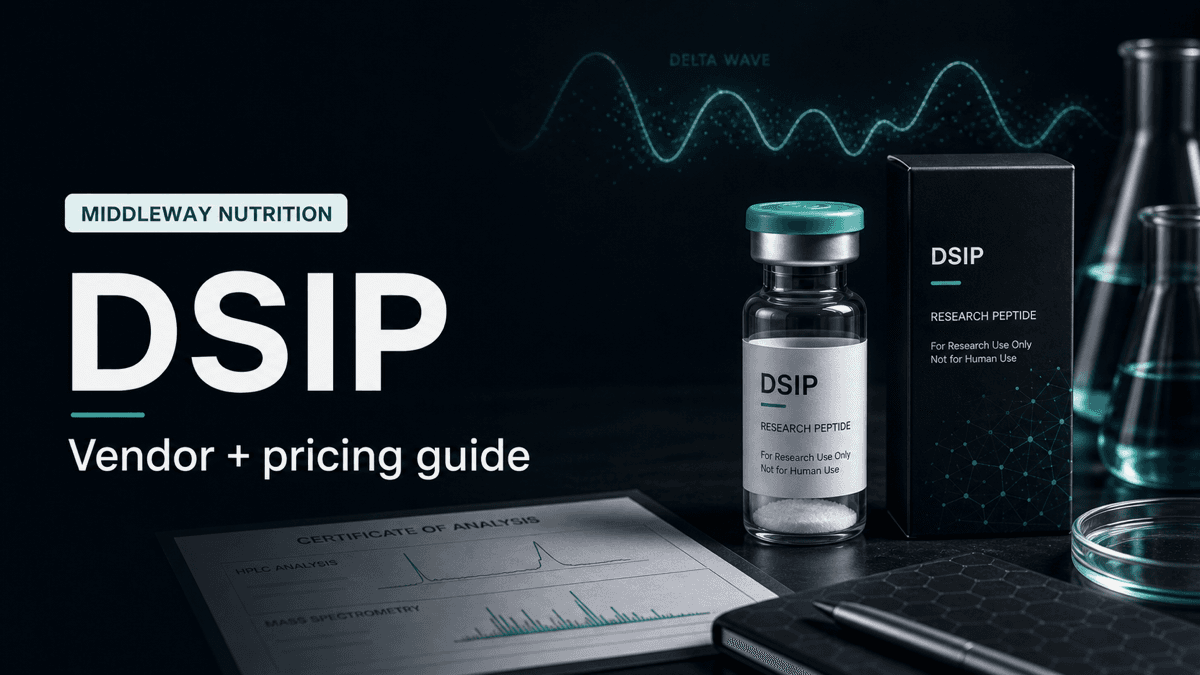
DSIP is a nine-residue peptide that is cheap to synthesize and easy to underfill or substitute, so the only meaningful check is batch-specific third-party testing, HPLC for purity and mass spectrometry for identity, matched to the lot number printed on your vial. A generic certificate with no lot reference proves nothing about what you received. Our guide to where to buy DSIP walks through which suppliers publish per-batch documentation and which only publish marketing claims.
Looking for the numbers behind this guide? Our DSIP dosage chart sets label and trial doses beside what Reddit users report taking, our DSIP side effects separates documented effects from what users report and our DSIP benefits tiers each claimed benefit by the strength of its evidence.
Frequently Asked Questions
What does DSIP peptide actually do?
It is studied as a modulator of sleep architecture, mainly the proportion of slow-wave sleep, alongside effects on stress-axis hormones such as ACTH. It does not sedate the way a hypnotic drug does. The most accurate description is that it may nudge a disturbed sleep pattern toward a more normal one in some people, with meaningful non-response in others.
Is DSIP peptide safe?
The available data shows mostly mild side effects, but it is thin, dated and short-term, and it includes serious events (2 cases of low blood pressure among 107 patients in a 1984 study, per FDA). FDA concluded that safety is insufficiently characterized. Long-term human safety has not been characterized, and interactions with sedatives, alcohol and psychiatric medication are unstudied. Anyone pregnant, breastfeeding, in withdrawal, or with untreated sleep apnea falls entirely outside what the research covers.
How much DSIP peptide do studies report?
The 100 to 300 mcg subcutaneous evening range, the 50 mcg sensitivity check and the 500 mcg "ceiling" are community convention, not trial doses. Published human trials used intravenous dosing at 25 to 30 nmol/kg (about 1.5 to 1.8 mg for an adult), and FDA's July 2026 briefing document found no human data for the subcutaneous route. There is no established human dosing standard, and these figures describe what has been reported rather than what anyone should do.
Is DSIP peptide legal?
In the US, DSIP is legal to sell and possess as a research chemical, but it is not FDA-approved for any human use and cannot lawfully be marketed as a treatment or supplement. Suppliers list it for laboratory research only. In July 2026 FDA's review of DSIP (emideltide) for the 503A compounding list recommended against adding it, citing insufficiently characterized safety, among other concerns (FDA's July 2026 briefing document); the advisory committee's reported 6 to 7 vote comes from news coverage only and we have not verified it on an FDA page. Rules differ by country, and it is worth noting that peptides in this class are typically prohibited in tested competitive sport.