Delta sleep-inducing peptide has been studied since the 1970s, yet most people shopping for it today are buying a nine-amino-acid powder with almost no quality oversight. The compound is cheap to list and easy to underdose, which is exactly why vendor selection matters more here than the price on the label.
If you have been searching where to buy DSIP, this guide gives you the honest version. You will learn where DSIP is actually sold in 2026, what a legitimate vendor looks like, how to read a certificate of analysis before you trust a vial, and what realistic pricing should be. DSIP is sold as a research peptide, not an approved medicine, so the rules are different from anything you would buy at a pharmacy.
Key Takeaways
- DSIP is NOT FDA-approved. There is no prescription pathway and no pharmacy version. Every consumer purchase route is the research-peptide market.
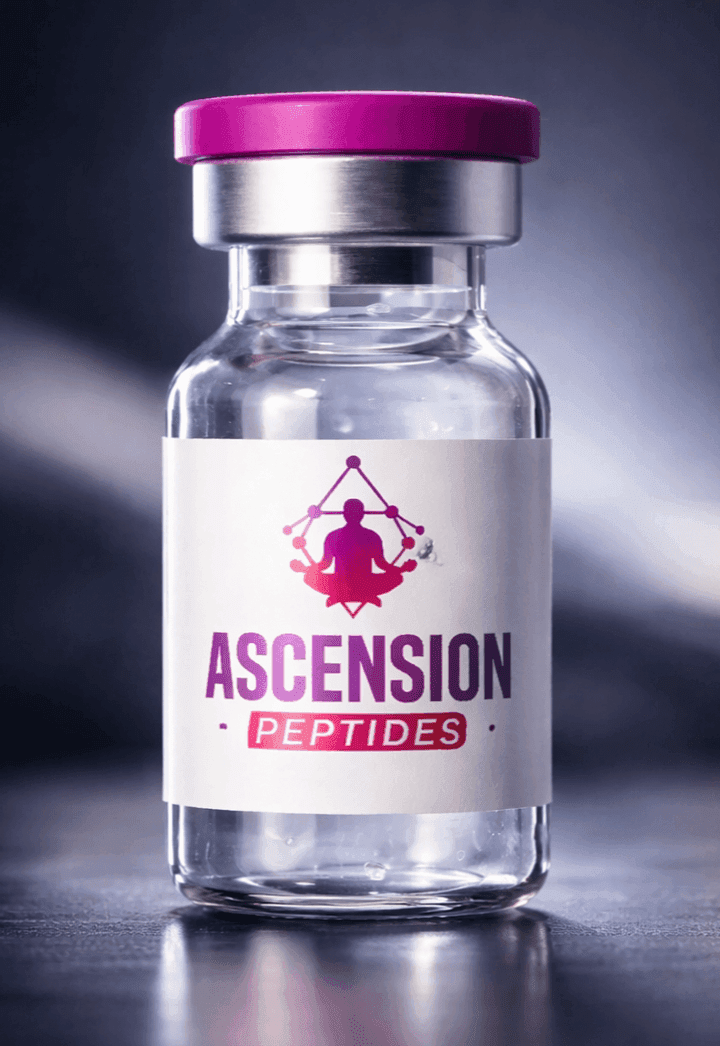
- Ascension Peptides is our top-rated source: every batch tested by Kovera Labs, certificates showing >98% HPLC purity, and a DSIP batch report we checked against the lab's own records.
- Always demand a batch-specific COA tied to your lot number, not a generic product certificate. Look for ≥98% by HPLC plus mass-spec identity.
- DSIP is inexpensive to synthesize, so a 5mg vial commonly runs $35–$50. Suspiciously cheap pricing usually means skipped testing, not a bargain.
- The human evidence for DSIP is genuinely mixed. Buy it understanding it is investigational, and never combine it with sedatives or alcohol.
What DSIP Is, Briefly
DSIP (delta sleep-inducing peptide) is a short neuropeptide, sequence WAGGDASGE, with a molecular weight around 850 daltons. It was first described in the 1970s by Schoenenberger and Monnier, who isolated it from the brains of sleeping rabbits and named it for the delta-wave activity it appeared to promote. It is not a sedative in the way a sleeping pill is. The research interest centers on sleep architecture, meaning the depth and continuity of sleep rather than knocking you out.
Beyond sleep, laboratory work has looked at DSIP in the context of stress and cortisol signaling through the HPA axis, opioid and alcohol withdrawal, and various neuroendocrine effects. It is important to be clear-eyed: early human reports from the 1980s were encouraging, while later controlled trials found objective improvements that were small and of limited clinical significance. Review articles by Graf and Kastin in the 1980s, and a later overview by Kovalzon, all describe DSIP as an unresolved puzzle rather than a proven therapy. That mixed record is part of why it remains a research compound and not a drug.
Where to Buy DSIP in 2026
Here is the part nobody at a pharmacy will help you with: there is no approved DSIP product, no insurance code, and no doctor who can call it in. DSIP for sale online comes from research-chemical and peptide vendors who label it "for research use only." That single market is your realistic sourcing option, so the entire question of where to buy DSIP collapses into which vendor you can actually trust.
The vendors in this space fall into a few rough tiers:
- Established peptide vendors with published testing. These send each batch to an independent lab, post the COA, and let you match the lot number on your vial to the certificate. This is where you want to be.
- Mid-tier shops with generic claims. They advertise "99% pure" and "third-party tested" but only show a single product-level certificate that may predate your batch by months. Sometimes fine, often not.
- Bottom-tier and marketplace listings. No verifiable lab, no lot tracking, pressure pricing. This is where underdosed and mislabeled vials come from.
Because DSIP is cheap to list, the market is crowded with the bottom two tiers. The compound itself is low-cost to synthesize, which removes the usual "you get what you pay for" signal. A clean vial and a dirty vial can cost nearly the same, so price tells you very little. The COA tells you almost everything.
Best Place to Buy DSIP: Ascension Peptides
Ascension Peptides is the vendor we recommend, and the reason is verification. They handle the parts of this market that most listings skip.
Testing you can check yourself. Every batch is independently tested by a third-party lab, currently Kovera Labs, and 85 batch-specific certificates sit in a public COA library. The Kovera reports cover HPLC purity, LC-MS identity, net content per vial, endotoxin, a rapid sterility screen and heavy metals rather than a single recycled chromatogram. We checked one of those reports ourselves, a DSIP batch (KVR-2026-410047), against Kovera's own records, and it matched.
Purity standards. Their certificates use a >98% HPLC purity pass mark, with recent batches testing between 98.9% and 99.9%. With a peptide this short, impurities and synthesis byproducts are easy to hide behind a generic "99%" claim, so a real chromatogram matters.
US shipping and clear terms. Ascension ships within the United States only, with free shipping on orders over $250 and quantity discounts of 3%, 5% and 10% at 3, 5 and 10 units. All sales are final, though damaged or incorrect items are replaced if reported quickly.
If you want to see current pricing and the active COA, check the listing directly at Ascension Peptides.
How to Verify DSIP Quality: The COA
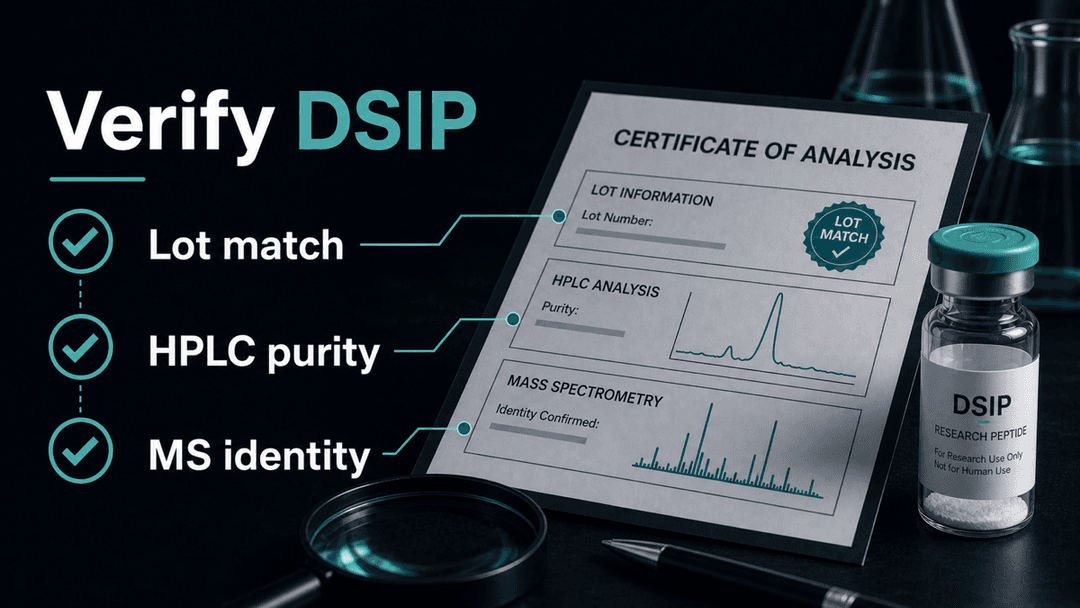
Most guides tell you to "look for third-party testing" and stop there. Here is what actually separates a real certificate from a decorative one.
Batch-specific, not product-level. A product-level COA covers a product line and may have been generated on a different synthesis run. A batch-specific COA references the exact lot number printed on your vial, with a testing date and results that correspond to what shipped to you. The lot on the vial should match the lot on the paper. If it does not, or there is no lot at all, treat the result as meaningless.
HPLC for purity, MS for identity. HPLC (high-performance liquid chromatography) tells you what percentage of the sample is genuinely DSIP. Aim for ≥98%. Mass spectrometry confirms the molecular weight matches DSIP's structure, which protects you from a "high purity" reading on the wrong compound. Ideally you see both.
A verifiable lab. Names like Janoshik and Colmaric Analyticals run public-facing peptide testing and let you cross-reference a certificate ID. If the "lab" on the COA has no website you can find, the certificate is unverified.
Red flags on a COA: no lot number anywhere, a testing date more than six months old, a purity figure with no chromatogram attached, or a certificate that names a generic "sleep peptide" without specifying DSIP.
What DSIP Should Cost
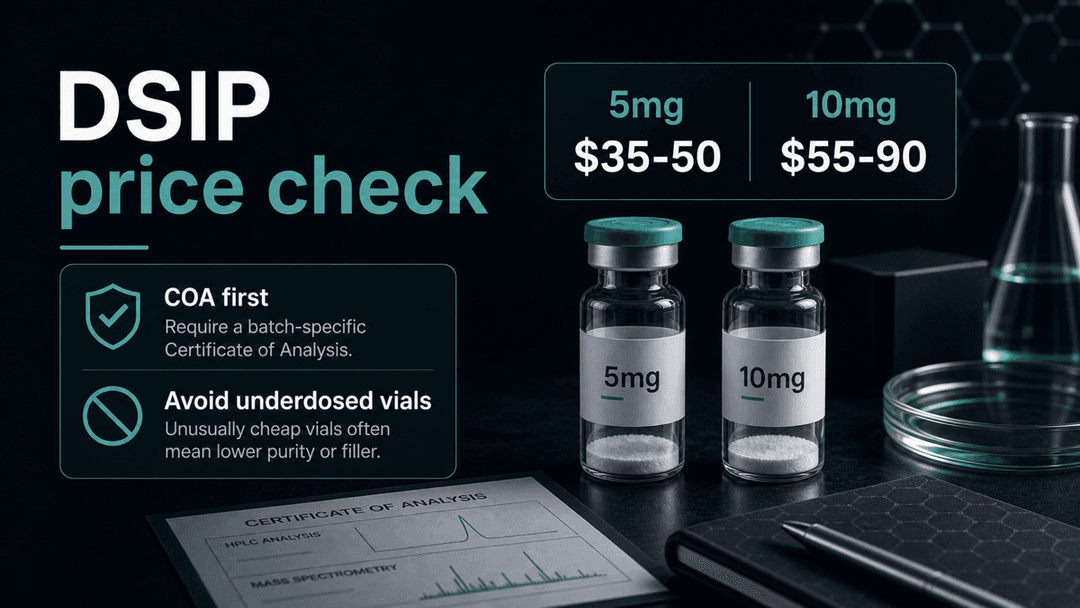
DSIP is one of the cheaper peptides to produce, and pricing reflects that.
- 5mg vials: roughly $35–$50 from quality vendors. The bottom of that range is common, but verify the COA before assuming a low price is a deal.
- 10mg vials: roughly $55–$90. Better value per milligram and the more practical size if you are running a short research cycle.
- Bulk (5+ vials): most vendors discount 5–15% per unit at quantity.
If you see DSIP priced far below this with "free express shipping," the most likely corner cut is testing, which is the line item that adds real cost. Spending a few dollars more for a verifiable batch COA is almost always the better trade.
Red Flags to Avoid
- No COA, or generic COA only. No batch-specific certificate, no sale.
- Vendors that give human dosing protocols. A shop that lists itself as "research use only" while telling you how to dose for sleep is talking out of both sides of its mouth.
- Unverifiable lab names you cannot find online.
- Pressure tactics: countdown timers, fake scarcity, and "today only" bundles from unknown sellers correlate with low-quality operations.
- No reputation. Check community boards like r/Peptides. Vendors with zero footprint, good or bad, deserve caution.
How to Get DSIP
Because DSIP is a research peptide, there is no prescription to chase and no clinic to visit. The practical path is straightforward: choose a vendor that publishes batch-specific COAs, confirm the current certificate shows ≥98% HPLC purity, and order online. US domestic vendors typically deliver within a few business days in discreet packaging. Pay by credit card where possible, since that gives you chargeback protection if the product arrives wrong.
DSIP ships as a lyophilized (freeze-dried) powder. If you are handling it in a research setting, it is reconstituted with bacteriostatic water rather than plain sterile water, because the benzyl alcohol in bacteriostatic water preserves the solution. Reconstituted peptide is kept refrigerated at 2–8°C, protected from light, and not frozen. If you are new to mixing lyophilized compounds, our guide to where to buy peptide capsules and the broader sleep-peptide context in MK-677 for sleep and recovery are useful background reading.
DSIP Vendor Comparison
Top Vendors
Ranked by purity, third-party testing, COA availability, and price.
>98% HPLC (COA pass mark) · Yes, Kovera Labs every batch · Free over $250, US only
LC/MS documented · Yes, published COA · Free over $200
99% claimed · Limited public info · US shipping
99% claimed · Claimed · US shipping
"99%+" · Often none · Varies
Prices are approximate and change often. Always confirm current pricing and the live COA before buying.
Related Buying Guides
Use these next if you are comparing adjacent research-peptide sourcing decisions:
Frequently Asked Questions
Where can I buy DSIP?
DSIP is sold by research-peptide vendors online, since there is no FDA-approved version and no pharmacy stock. Our top recommendation is Ascension Peptides, which has every batch tested by Kovera Labs, publishes batch-specific certificates showing >98% HPLC purity, and ships within the US. We verified one of its DSIP batch reports against the lab's own records. Whatever vendor you choose, the deciding factor should be verifiable batch testing, not the lowest price.
Is DSIP legal to buy?
DSIP is not a scheduled substance, and it is sold legally in the US as a research chemical labeled "not for human consumption." It is not FDA-approved for any medical use, so buying it for research purposes sits outside the standard drug-approval system. Laws vary by country, so confirm the rules in your own jurisdiction before ordering.
How much does DSIP cost?
A 5mg vial typically runs $35–$50 from quality vendors, and 10mg vials run roughly $55–$90. DSIP is cheap to synthesize, so price is a weak signal for quality. Pay attention to whether the vendor provides a batch-specific COA rather than chasing the lowest number.
How do I know my DSIP is real and high purity?
Ask for a batch-specific certificate of analysis that matches the lot number on your vial. It should show ≥98% purity by HPLC, ideally with a mass-spectrometry identity check, and come from a lab you can verify online such as Janoshik or Colmaric. No lot number, an old testing date, or an unverifiable lab all mean the result cannot be trusted.
Do I need a prescription for DSIP?
No. DSIP is not an approved drug, so there is no prescription pathway. It is purchased directly from research-peptide vendors. The absence of a prescription also means there is no clinical oversight, so understand that you are working with an investigational compound that has mixed human evidence.
Is DSIP safe?
The honest answer is that long-term safety data in humans is limited. Reported effects in research settings include mild grogginess, headache, dizziness, and light hypotension. It should not be combined with sedatives or alcohol, and anyone with untreated sleep apnea or other medical conditions should speak with a clinician first. None of this is medical advice.
The Bottom Line on Where to Buy DSIP
DSIP is one of the more affordable peptides on the market, which is exactly why the buying decision is really a quality decision. Cheap and clean costs nearly the same as cheap and contaminated, so the COA does the work that price normally would. Verify the batch certificate first, check vendor reputation second, and treat price as the least important signal.
For the combination of independent batch testing, >98% HPLC purity on published certificates, and a DSIP report we verified with the lab itself, Ascension Peptides is where we would start. Order from a vendor that shows its work, and you remove most of the risk this market is known for.
Medical Disclaimer: The information in this article is for informational purposes only and does not constitute medical advice. DSIP is not FDA-approved and is not intended to diagnose, treat, cure, or prevent any disease. Always consult a qualified healthcare provider before using any new compound. The purchase and use of research peptides carries legal and health risks that vary by jurisdiction and individual circumstances.