
Glow peptide benefits are usually about one thing, visible quality. Better skin tone. Better texture. Better healing. Less irritation. In most cases, when people say “glow peptide,” they are talking about copper peptides such as GHK-Cu, or about a cosmetic peptide blend trying to create the same effect.
| Stat | Value |
|---|---|
| Main peptide usually associated with “glow” | GHK-Cu |
| Most common targets | Skin, hair, recovery |
| Best known use case | Topical skin support |
Key Takeaways
- Glow peptide usually means a beauty-focused peptide, most often GHK-Cu or a copper peptide blend.
- The strongest interest is in skin appearance, including tone, elasticity, texture, and post-inflammatory recovery.
- Hair support is a secondary benefit people chase, especially for scalp health and follicle support.
- Recovery benefits matter too, especially for irritation, barrier repair, and tissue quality.
- Topical use makes the most practical sense for skin-focused goals.
- A lot of marketing in this category is inflated, so it helps to separate cosmetic claims from realistic outcomes.
If you are looking for a peptide that makes you look fresher rather than just perform better in the gym, this is the lane. The appeal is obvious. People do not just want less fat or more muscle. They want better skin, stronger hair, and a healthier overall look. That is why glow peptides keep getting attention.
What Is a Glow Peptide?
“Glow peptide” is more of a marketing label than a strict scientific classification.
You will also see it typed as one word, glowpeptide, or clipped to glo peptide. Same search, same shelf, no difference in what is inside the bottle.
Most of the time, it refers to peptides used for cosmetic or regenerative goals, especially:
- skin brightness
- smoother texture
- reduced irritation
- improved barrier function
- better healing response
- stronger looking hair
In practice, the peptide most often associated with this idea is GHK-Cu, also called copper peptide. It is a naturally occurring copper-binding peptide studied for wound healing, tissue repair, and skin remodeling, along with hair-related applications.
So if someone asks about glow peptide benefits, the real question is usually: what can GHK-Cu or a similar cosmetic peptide realistically do?
The one exception is the injectable GLOW blend, sometimes sold as GLOW 70. That is a different product with a different evidence base, and it gets its own section below.
Glow Peptide Benefits for Skin
This is the biggest reason people care.
Skin-focused peptide use usually aims to improve how the skin looks and behaves, not just how it feels in the moment. That means people are looking for:
- smoother texture
- better hydration retention
- improved elasticity
- less redness
- faster recovery after irritation
- a more even, healthier appearance
With GHK-Cu in particular, the interest comes from its relationship to tissue repair and remodeling. It has been studied in connection with collagen synthesis, anti-inflammatory and antioxidant activity, and wound healing support.
That does not mean it acts like a magic erase tool. It means it may help support the kind of environment where skin recovers better and looks healthier over time.
Skin Texture and Elasticity
One of the most believable use cases is gradual improvement in skin quality.
People often chase “glow” when what they really mean is this combination:
- less roughness
- less dullness
- more bounce
- more even tone
- less angry-looking skin after irritation or breakouts
That is where peptide-based skin support makes sense. You are not forcing an overnight cosmetic effect. You are trying to improve the quality of the skin itself.
Barrier Recovery and Irritation Support
This is the underrated benefit.
A lot of people use harsh actives, over-exfoliate, or damage their skin barrier without realizing it. A peptide that supports calmer recovery is often more useful than another aggressive active.
That is why glow peptide products often do well with people who want their skin to look stronger and less reactive, not just tighter.
Glow Peptide Benefits for Hair
The second big theme is hair.
Copper peptides are often discussed in the context of:
- scalp condition
- follicle environment
- hair quality
- reduced breakage appearance
- support during shedding phases
People usually come in hoping for dramatic regrowth. That expectation needs to be cooled down a bit.
A realistic framing is that peptides may support a healthier scalp environment and potentially improve hair quality or retention signals in some users. That is different from saying they are guaranteed to reverse serious hair loss by themselves.
Still, hair-related peptide interest is not random. The scalp is skin, and the same repair-and-quality logic carries over.
Glow Peptide Benefits for Recovery
This part gets less attention than skin and hair, but it matters.
When people talk about recovery here, they usually mean:
- calming irritation
- healing support after cosmetic procedures
- recovery after inflammation
- tissue quality support
- faster bounce-back in areas that look stressed or damaged
That is one reason peptides like GHK-Cu show up in post-procedure products, scar support formulas, and recovery serums. The theory is simple: if the peptide helps create a better healing environment, the final cosmetic result may look better.
Again, that is a support role, not a miracle role.
Glow Peptide Benefits for Women
Most of the human evidence behind copper peptides was collected in women, which is why this question keeps coming up.
Three of the most cited GHK-Cu cosmetic studies used female subjects:
| Study setup | Subjects | Length | Reported result |
|---|---|---|---|
| GHK-Cu facial cream | 71 women with mild to advanced photoaging | 12 weeks | Increased skin density and thickness, reduced laxity, improved clarity, fewer fine lines, less wrinkle depth |
| GHK-Cu eye cream | 41 women with mild to advanced photodamage | 12 weeks | Performed better than both placebo and a vitamin K cream |
| GHK-Cu on thigh skin | Women, count not reported | 12 weeks | Improved collagen production in 70% of those treated, against 50% for a vitamin C cream and 40% for retinoic acid |
In a separate head-to-head, GHK-Cu produced a 31.6% reduction in wrinkle volume compared with Matrixyl 3000. All of these figures come from the same GHK-Cu gene-data review.
There is an age angle too. Plasma GHK runs about 200 ng/mL at age 20 and falls to roughly 80 ng/mL by age 60. That decline is a large part of why interest in copper peptides climbs through the 40s and 50s.
Now the limits, because they matter more than the numbers:
- None of those trials was designed around menopause, perimenopause, or postpartum shedding. They tested photoaged skin.
- All of them were topical. None tested an injectable GLOW blend.
- There is no human safety data for injectable GHK-Cu, BPC-157, or TB-500 in pregnancy or breastfeeding. That alone is reason to stay off it in those windows.
- Copper peptides are not a treatment for hormonal or patterned hair loss. Heavy or patterned shedding is a dermatology conversation, not a serum decision.
The honest summary: for skin quality, the topical track record was built in exactly this demographic. For the blend, for hormonal hair loss, and for pregnancy, there is nothing to lean on.
Is Glow Peptide Just GHK-Cu?
Usually, but not always.
Many products use the language “glow peptide” because it sounds friendlier than “copper tripeptide-1” or “GHK-Cu.” In real terms, the product may contain:
- GHK-Cu
- copper peptide complexes
- matrix peptides aimed at cosmetic improvement
- signal peptides used in anti-aging formulas
So the exact benefits depend on what is actually in the formula.
If the ingredient list leads with a real copper peptide, then the skin, hair, and repair angle makes sense. If it is just branding with weak ingredient support, the product may not deserve the hype.
What Is GLOW 70? The Injectable GLOW Blend
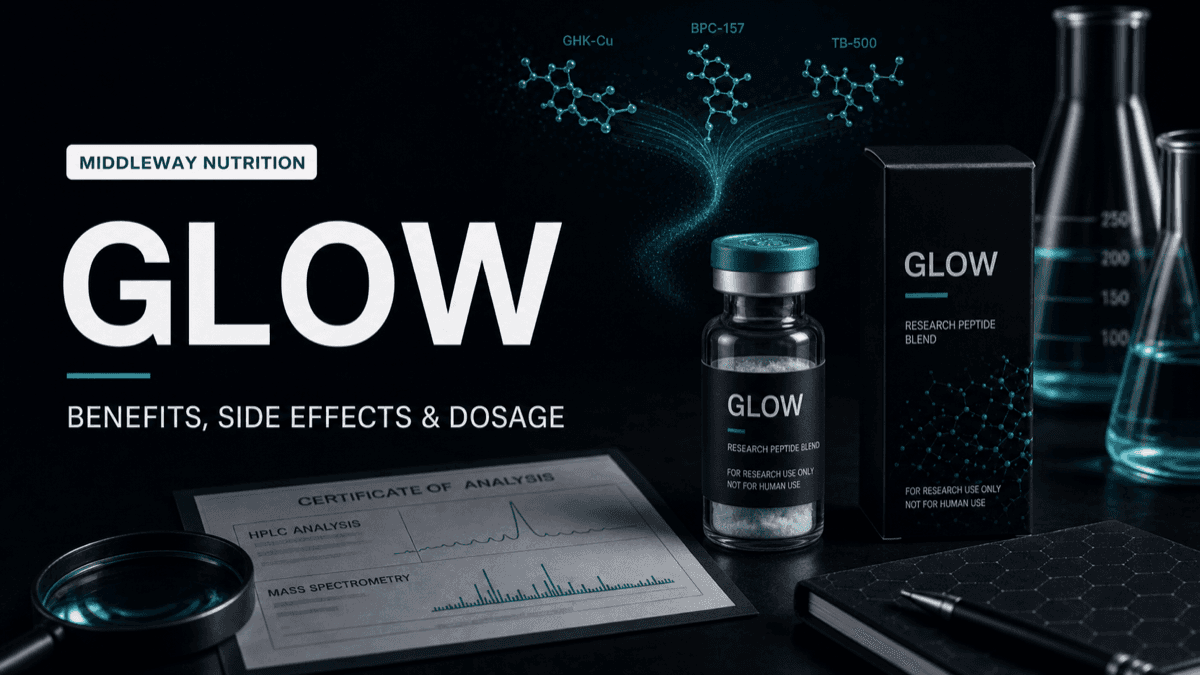
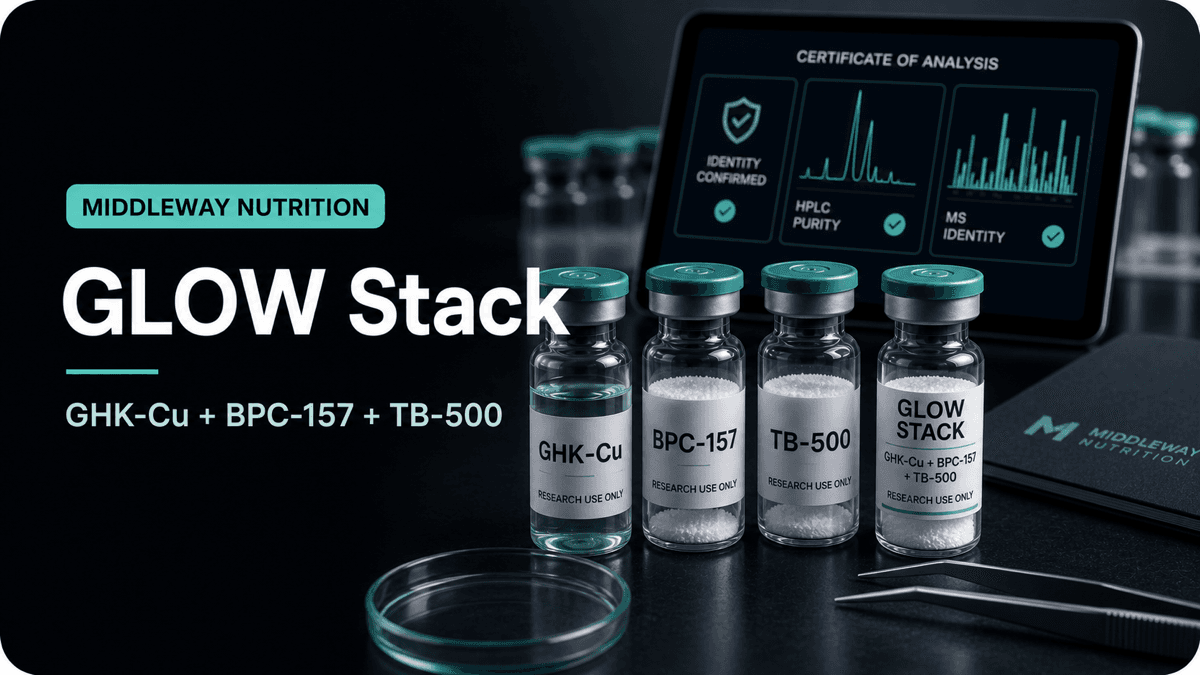
There is a second meaning of “glow peptide” that has nothing to do with a serum. In the research peptide market, GLOW is a fixed three-peptide blend, sold as GLOW, the GLOW stack, the GLOW protocol, or plainly as the GHK-Cu BPC-157 TB-500 blend.
The number in “GLOW 70” is the total milligram content of the vial. It is not a dose and not a potency grade.
| Component | Amount in a 70 mg vial | What it is studied for |
|---|---|---|
| GHK-Cu | 50 mg | Collagen and skin remodeling, wound repair. The only one of the three with human cosmetic trial data, and that data is topical |
| BPC-157 | 10 mg | Tissue protection and repair, almost entirely in animal models |
| TB-500 | 10 mg | Cell migration and tissue remodeling. Sold as a synthetic version of thymosin beta-4 |
That 5:1:1 ratio is the market standard. If a vendor lists a “70 mg blend” with no per-peptide breakdown, there is no way to verify what you bought. Our GLOW stack buying guide covers the certificate-of-analysis checks and current pricing.
Be clear about the evidence gap. No published human trial has tested these three peptides together, so every benefit attributed to GLOW 70 is borrowed from single-compound research. The GHK-Cu human data is cream data. The BPC-157 data is animal data. Thymosin beta-4 has been through randomized human trials, but as an eye drop for severe dry eye, not as an injection for skin or recovery. The blend is sold for research use only and is not an approved drug.
Read the benefits of GLOW 70 as a hypothesis, not a result.
How People Use Glow Peptides
The most practical route is topical use.
That means:
- serum
- cream
- scalp solution
- post-procedure support formula
For a skin-focused article like this, topical use is the cleanest fit because the target is visible tissue quality.
Some people also discuss injectable peptide protocols involving GHK-Cu, but that belongs in a more medical or performance-oriented discussion. If the goal is glow, texture, tone, and surface-level recovery, topical application is what most readers actually care about. For anyone going the vial route, our GHK-Cu buying guide covers vial specs, pricing, and how to verify what you are getting.
What Results Are Realistic?
This is where people need a reset.
Realistic glow peptide benefits look like:
- skin that looks calmer
- skin that feels stronger
- less roughness
- better recovery after stress
- gradual improvement in texture
- hair or scalp quality support
Unrealistic expectations look like:
- instant wrinkle erasure
- dramatic facelift-style change
- guaranteed hair regrowth in advanced hair loss
- overnight scar removal
The truth is less dramatic and more useful. A good peptide can help the skin look healthier and recover better. That is already valuable.
Who Might Care About Glow Peptides Most?
This category usually fits people who:
- care more about skin quality than scale weight
- want recovery support after skin stress
- are trying to improve a dull, irritated, or uneven appearance
- want scalp or hair support without immediately jumping to harsh interventions
- already use active skincare and need something more restorative in the mix
It is less about “biohacking” and more about visible maintenance.
Side Effects and Limitations
Topical peptide products are usually well tolerated, but that does not mean risk-free.
Possible issues include:
- irritation from the formula base
- reactions to preservatives or fragrance
- unrealistic expectations leading to overuse
- poor product quality from weak formulations
The peptide itself may not be the problem. The full formula often is.
That is why product quality matters just as much as the peptide name on the label.
Are Glow Peptides Worth It?
They can be, if your expectations are sane.
If you want a peptide that supports:
- better looking skin
- healthier texture
- calmer recovery
- possible scalp and hair benefits
then yes, this category makes sense.
If you are expecting dramatic transformation from a single serum, then no, you are probably buying into marketing instead of reality.
The useful middle ground is this: glow peptides can be solid support tools for skin, hair, and recovery, especially when the formula actually contains a meaningful peptide like GHK-Cu and the rest of the routine is not sabotaging your results.
Frequently Asked Questions
What is the main peptide behind glow peptide benefits?
Most of the time, it is GHK-Cu, also known as a copper peptide.
Are glow peptides good for skin?
That is the main reason people use them. Skin texture, tone, irritation recovery, and visible quality are the biggest targets.
Can glow peptides help hair?
They may help support scalp and hair quality, though expectations should stay realistic.
Are glow peptides better as creams or injections?
For skin-focused goals, topical use makes the most practical sense.
Do glow peptides work fast?
Usually not. This is more of a gradual quality-improvement category than a fast dramatic-change category.
What is glow peptide used for?
Two different things, depending on which version you mean. Topical glow peptide products, usually built on GHK-Cu, are used for skin tone, texture, elasticity, barrier recovery after irritation, and scalp support. The injectable GLOW blend is used by people chasing those same skin goals plus general tissue recovery, with far thinner evidence behind it. If the goal is visible skin quality, the topical version is the one with human trial data.
Is “glowpeptide” the same as “glow peptide”?
Yes. Glowpeptide, glow peptide, and glo peptide are the same search typed three ways. All of them point at either a GHK-Cu based cosmetic product or the GLOW blend of GHK-Cu, BPC-157, and TB-500. None of the spellings is a separate compound.
What is in GLOW 70?
70 mg total: 50 mg GHK-Cu, 10 mg BPC-157, and 10 mg TB-500, the 5:1:1 ratio sold across the research peptide market. The 70 refers to combined milligrams in the vial, not a dose.
What does the glow peptide do for women?
The same thing it does for anyone: it supports skin quality, texture, and repair rather than forcing a cosmetic change. What is worth knowing is that the GHK-Cu cosmetic trials were run almost entirely in women, including 71 women on a facial cream and 41 on an eye cream for 12 weeks each. There is no pregnancy or breastfeeding safety data for the injectable blend, so that is not the time to start.
Conclusion
Glow peptide benefits are mostly about visible quality. Better skin texture. Better recovery. Better overall appearance. In most real-world cases, that conversation points back to copper peptides like GHK-Cu and the broader cosmetic peptide category built around repair, calmness, and tissue support.
The value here is not hype. It is that these peptides may help create better conditions for skin and scalp health over time. If that is your goal, the category is worth understanding. Just do not confuse supportive improvement with magic.
This article is for educational purposes only and does not replace medical advice. If you have a skin condition, hair-loss disorder, or are using prescription dermatology treatments, talk to a qualified clinician before adding new peptide products.
References
- Regenerative and protective actions of the GHK-Cu peptide in the light of the new gene data (NIH/PMC)
- Exploring the role of tripeptides in wound healing and skin regeneration: a comprehensive review (NIH/PMC)
- Thymosin β4 significantly improves signs and symptoms of severe dry eye in a phase 2 randomized trial (PubMed)