
Retatrutide is the stronger of the two on weight loss. Its 2026 TRIUMPH-1 phase 3 trial produced 28.3% average loss at 80 weeks, versus tirzepatide's 22.5% in SURMOUNT-1. The key structural difference is that retatrutide adds glucagon agonism, making it a triple agonist where tirzepatide is dual.
What is the headline difference?
Tirzepatide, which searchers regularly type as tirzepitide or tirziepeptide, is an FDA-approved dual agonist sold as Mounjaro and Zepbound. Retatrutide is an investigational triple agonist from the same maker, Eli Lilly, that has cleared its first pivotal phase 3 trial but is not yet approved. On the numbers, retatrutide loses more weight; on availability, tirzepatide is the one you can actually be prescribed today.
Triple vs dual: how do the receptor targets differ?
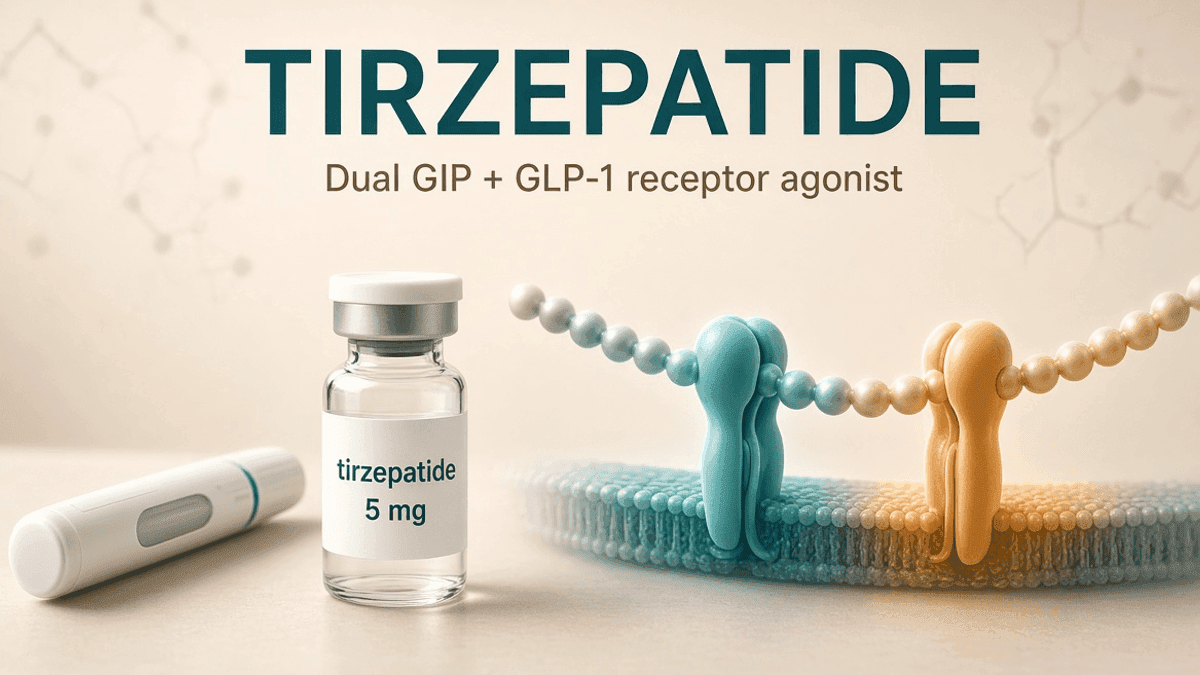
Tirzepatide activates two incretin pathways: GLP-1 (appetite and gastric emptying) and GIP (fat handling and possibly better tolerability). Retatrutide activates those same two plus glucagon. The glucagon arm is what theoretically pushes retatrutide ahead: it raises energy expenditure and drives the liver to burn fat, on top of the appetite suppression both drugs share. Our explainer on how the retatrutide triple agonist works covers why balancing glucagon is the hard part of the design.
The reason adding a receptor matters is that each pathway contributes a different mechanism rather than simply amplifying the same one. Tirzepatide's GIP component is widely credited with improving tolerability, which is part of why patients can climb to higher effective doses than they could on a GLP-1 drug alone. Retatrutide keeps that benefit and stacks glucagon-driven energy expenditure on top, which is the most plausible explanation for the extra weight loss seen in its trials. The cost of that third lever is a tighter therapeutic window: too much glucagon activity can raise blood sugar and heart rate, so the molecule is engineered to lean more heavily on GLP-1 and GIP while using glucagon as a metabolic accelerator.
How does the weight-loss data compare?
| Measure | Retatrutide | Tirzepatide |
|---|---|---|
| Receptor targets | GLP-1 + GIP + glucagon | GLP-1 + GIP |
| Key trial | TRIUMPH-1 (phase 3) | SURMOUNT-1 (phase 3) |
| Top dose | 12 mg/wk | 15 mg/wk |
| Duration | 80 wk | 72 wk |
| Mean weight loss | 28.3% | 22.5% |
| Approval status | Investigational | FDA-approved |
In TRIUMPH-1, roughly 45% of people on the top dose lost at least 30% of body weight. Tirzepatide's SURMOUNT-1 result of 22.5% remains the benchmark for an approved drug. For the approved-drug landscape, see tirzepatide for weight loss.
Are these numbers really comparable?
Not perfectly. TRIUMPH-1 and SURMOUNT-1 enrolled different patients, ran for different lengths (80 vs 72 weeks), and used each sponsor's preferred analysis. TRIUMPH-1's participants started at an average BMI of 40.0 and an average weight of 112.7 kg (248.5 lbs), a heavier group than SURMOUNT-1 enrolled. No published trial has put retatrutide head-to-head against tirzepatide in the same room. So retatrutide's roughly six-point lead is real in direction but should not be read as an exact margin. A true comparison will require a dedicated trial.
The other trap is quoting two different statistical analyses against each other. Both trials reported their headline result twice. TRIUMPH-1 gave retatrutide 12 mg as -28.3% on the efficacy estimand, which models what happens if participants stay on treatment, and -25.0% on the treatment-regimen estimand, which counts everyone regardless of whether they stopped. SURMOUNT-1's published primary result for tirzepatide 15 mg is the treatment-regimen figure, -20.9%; the 22.5% in the table above is the adherence-based analysis.
| Analysis | Retatrutide 12 mg (TRIUMPH-1, 80 wk) | Tirzepatide 15 mg (SURMOUNT-1, 72 wk) |
|---|---|---|
| Efficacy estimand (stayed on treatment) | -28.3% | -22.5% |
| Treatment-regimen estimand (dropouts included) | -25.0% | -20.9% |
Matched analysis to analysis, the distance is roughly four to six percentage points, not the seven-plus you get by putting retatrutide's best number beside tirzepatide's most conservative one. Even then it is two trials, two populations and two durations, which is not the same thing as a head-to-head result.
How do side effects and heart rate differ?
Both drugs share the class profile: nausea, vomiting, diarrhea, and constipation that peak during titration. Both also raise resting heart rate modestly. Retatrutide's glucagon activity makes dose escalation the window to monitor most carefully, and its higher potency can mean more intense appetite suppression. Our guides on retatrutide side effects and tirzepatide side effects break down each drug's profile and management.
What about dosing schedules?
Both are once-weekly subcutaneous injections that titrate upward over several months. Tirzepatide climbs from 2.5 mg toward a 15 mg ceiling; retatrutide was studied from 2 mg up to 12 mg. In both cases, holding each step for about four weeks is what keeps gut side effects manageable.
The milligram numbers are not interchangeable between the two drugs, which is a common point of confusion. A 12 mg retatrutide dose is not "less" than a 15 mg tirzepatide dose in any meaningful sense, because the molecules differ in potency and receptor activity per milligram. What matters clinically is the effective top dose each drug reaches after titration, not the raw number on the vial. That is also why anyone switching between GLP-1 class drugs restarts titration under a prescriber rather than trying to convert doses one-to-one. For the retatrutide schedule specifically, our retatrutide dosage guide details the standard escalation and the doses where most of the weight loss occurs.
Which one can you actually get right now?
Tirzepatide, clearly. It is FDA-approved, stocked at pharmacies, and available through telehealth. Retatrutide is not approved and is still completing its trial program; the only legitimate access today is through a clinical trial. Anything sold as retatrutide outside that is unregulated grey-market product. Our overview of how to get retatrutide in 2026 lays out the legitimate routes and the risks of the rest.
How do cost and access compare?
This is the most practical difference for anyone choosing today. Tirzepatide has a known list price, savings programs, and a self-pay vial option, so the cost is high but predictable and the product is pharmaceutical-grade. Retatrutide has no approved price because it has no approved product; there is no legitimate pharmacy supply, and no insurance covers it. Grey-market "retatrutide" sold as research chemical carries real risks around purity, sterility, and dosing accuracy, none of which are verified the way an FDA-reviewed drug is. In other words, the access gap is not just paperwork, it is the difference between a regulated medicine and an unregulated one.
What do reviews of retatrutide vs tirzepatide actually tell you?
The two review pools are not the same kind of evidence, and that is the first thing to sort out before reading any of them.
Tirzepatide reviews describe a pharmacy-filled product at a labeled dose. Retatrutide reviews — the "reta" logs on forums, subreddits and vendor pages — almost never do. The material is grey-market, the dose is whatever the buyer reconstituted and drew up, purity is unverified, and there is no placebo arm to separate the drug from the diet running alongside it. That is why the same molecule reads as miraculous in one thread and alarming in the next.
The closest thing to a controlled review of retatrutide is the safety data from TRIUMPH-1, where 2,339 participants were randomized to 4 mg, 9 mg, 12 mg or placebo and every complaint was collected the same way:
| Reported in TRIUMPH-1 | Reta 4 mg | Reta 9 mg | Reta 12 mg | Placebo |
|---|---|---|---|---|
| Nausea | 28.6% | 38.4% | 42.4% | 14.8% |
| Diarrhea | 25.2% | 34.1% | 32.0% | 13.5% |
| Constipation | 23.8% | 25.9% | 26.1% | 10.9% |
| Vomiting | 10.6% | 22.8% | 25.3% | 4.8% |
| Dysesthesia (odd skin sensation) | 5.1% | 12.3% | 12.5% | 0.9% |
| Stopped because of side effects | 4.1% | 6.9% | 11.3% | 4.9% |
Three things in that table change how the anecdotes should be read. First, the complaints scale with dose: the 12 mg arm stopped treatment for side effects at 11.3%, more than double placebo, while the 4 mg arm stopped at 4.1%, slightly below placebo, and still averaged 19.0% weight loss at 80 weeks. A "retatrutide is brutal" review and a "retatrutide was easy" review can both be accurate at different doses. Second, dysesthesia — a burning, tingling or crawling feeling in the skin — is the one item that is not a familiar complaint from the GLP-1 class; Lilly reported it in 12.5% of the 12 mg arm against 0.9% on placebo, described the events as generally mild to moderate, mostly resolving during treatment, with most participants continuing. Third, none of these percentages should be lined up against tirzepatide's, because they come from a different trial in a different population, and Lilly did not run the two side by side.
For the community side of the picture, and why individual logs should be discounted heavily, see our roundup of retatrutide reviews and the risks catalogued in how to get retatrutide.
Which is stronger, and which is the better choice today?
Retatrutide is stronger on the weight-loss data, with about a six-percentage-point edge across separate trials. Tirzepatide is the better practical choice in 2026 because you can actually obtain it, get a verified dose, and be monitored by a prescriber. The honest summary is that retatrutide wins the efficacy contest on paper while tirzepatide wins the only contest that affects most patients now, which is what you can safely use. If retatrutide clears its remaining trials and FDA review, it is positioned to become the most potent option, but that decision is still ahead.
References
- Eli Lilly. Retatrutide delivered powerful weight loss in pivotal Phase 3 obesity trial (TRIUMPH-1), May 2026. https://investor.lilly.com/news-releases/news-release-details/lillys-triple-agonist-retatrutide-delivered-powerful-weight-loss
- Jastreboff AM, et al. Triple-Hormone-Receptor Agonist Retatrutide for Obesity, A Phase 2 Trial. New England Journal of Medicine, 2023. https://www.nejm.org/doi/full/10.1056/NEJMoa2301972
- Jastreboff AM, et al. Tirzepatide Once Weekly for the Treatment of Obesity (SURMOUNT-1). New England Journal of Medicine, 2022. https://www.nejm.org/doi/full/10.1056/NEJMoa2206038
Frequently Asked Questions
Is retatrutide stronger than tirzepatide?
On the trial data, yes: retatrutide produced about 28.3% average weight loss in TRIUMPH-1 versus 22.5% for tirzepatide in SURMOUNT-1. The comparison is cross-trial, so the exact margin is approximate.
Can I get retatrutide instead of tirzepatide?
Not through normal prescribing. Retatrutide is investigational, so legitimate access is limited to clinical trials, while tirzepatide is FDA-approved and widely available.
Why does adding glucagon increase weight loss?
Glucagon raises energy expenditure and prompts the liver to burn fat, adding a metabolic effect on top of the appetite suppression that both drugs share through GLP-1 and GIP.
Do both raise heart rate?
Yes, both produce a modest increase in resting heart rate. It is generally mild but is one reason prescribers monitor patients during dose escalation.
Which one has better reviews, retatrutide or tirzepatide?
They are not comparable sources. Tirzepatide reviews come from people taking a pharmacy-dispensed drug at a known dose; most retatrutide reviews come from grey-market vials with no verified purity or dose. The controlled version of a retatrutide review is TRIUMPH-1, where side effects tracked dose closely: 11.3% of the 12 mg group stopped treatment because of them, against 4.9% on placebo and 4.1% at 4 mg.
This article is educational and not medical advice; treatment decisions should be made with a licensed clinician.