There is no single "best" growth hormone secretagogue, because these compounds work in two different ways and only one of them carries full FDA approval. Tesamorelin is the only growth hormone secretagogue approved as a finished drug in the United States, and it is cleared specifically for excess visceral fat in people with HIV-associated lipodystrophy. Everything else on this list, including MK-677 (ibutamoren), ipamorelin, CJC-1295, sermorelin, and the older GHRP-2 and GHRP-6, is either investigational, compounded, or sold for research use only. This guide explains how each one works, what the human evidence actually says, and how to think about the trade-offs.
What a growth hormone secretagogue actually is
A growth hormone secretagogue (GHS) does not replace growth hormone. Instead, it prompts your own pituitary gland to release more of its own GH, which in turn raises insulin-like growth factor 1 (IGF-1). This is the key distinction from exogenous recombinant human growth hormone (rhGH, such as somatropin), where you inject the hormone itself.
The advantage of the secretagogue approach is that GH release stays pulsatile and is still subject to the body's own feedback loops, so in theory the risk of the runaway IGF-1 levels seen with rhGH abuse is lower. The disadvantage is that a pituitary that cannot produce GH (for example after surgery or radiation) will not respond, and the size of the GH bump is generally smaller and harder to predict than with direct hormone replacement.
There are two mechanistic families:
- GHRH analogues mimic growth hormone-releasing hormone and bind the GHRH receptor on the pituitary. This group includes sermorelin, CJC-1295, and tesamorelin.
- Ghrelin receptor agonists (GHRPs and ghrelin mimetics) bind the growth hormone secretagogue receptor (GHS-R1a), the same receptor ghrelin uses. This group includes ipamorelin, GHRP-2, GHRP-6, and the oral non-peptide MK-677.
The two families are often combined because a GHRH analogue plus a ghrelin agonist produces a larger, synergistic GH pulse than either alone.
Quick comparison table
| Compound | Class | Route | Approx. half-life | FDA status (2026) |
|---|---|---|---|---|
| Tesamorelin (Egrifta, Egrifta WR) | GHRH analogue | Daily subcutaneous injection | ~26-38 min | Approved for HIV-associated lipodystrophy |
| Sermorelin | GHRH (1-29) analogue | Subcutaneous injection | ~10-20 min | Previously approved, now compounded only |
| CJC-1295 with DAC | GHRH analogue + albumin binder | Weekly injection | ~6-10 days | Investigational, not approved |
| CJC-1295 without DAC (mod GRF 1-29) | GHRH analogue | Injection | ~30 min | Investigational, not approved |
| Ipamorelin | GHRP / ghrelin agonist | Subcutaneous injection | ~2 hours | Investigational, not approved |
| GHRP-2 | GHRP / ghrelin agonist | Subcutaneous injection | ~15-60 min | Investigational, not approved |
| GHRP-6 | GHRP / ghrelin agonist | Subcutaneous injection | ~15-60 min | Investigational, not approved |
| MK-677 (ibutamoren) | Oral ghrelin mimetic | Oral tablet/capsule | ~4-6 hours | Investigational, not approved |
Tesamorelin: the only FDA-approved option
Tesamorelin is a synthetic growth hormone-releasing factor analogue. The FDA approved it in November 2010 under the brand name Egrifta for the reduction of excess abdominal fat in adults with HIV who have lipodystrophy. A newer, more concentrated formulation (F8, marketed as Egrifta WR) has since been approved for the same indication.
The approval rested on two clinical trials enrolling 816 HIV-positive adults, with 543 receiving tesamorelin during a 26-week placebo-controlled phase. Patients on tesamorelin showed significantly greater reductions in visceral abdominal fat measured by CT scan compared with placebo. It is given as a once-daily subcutaneous injection.
Tesamorelin is the standout for two reasons: it is the only GHS with a clear regulatory pathway and a real outcomes dataset, and it has the most robust evidence for reducing visceral fat specifically. The trade-offs are cost, daily injections, and the fact that it is approved for a narrow population. Off-label use outside HIV-associated lipodystrophy is not supported by the labeling.
Sermorelin: the GHRH analogue with the longest track record
Sermorelin is a GHRH (1-29) analogue, meaning it reproduces the first 29 amino acids of natural GHRH, the active fragment. It has the deepest regulatory history of any peptide here. The FDA approved it in 1990 as Geref Diagnostic for assessing pituitary function and again in 1997 as Geref for treating idiopathic growth hormone deficiency in children with growth failure.
The manufacturer discontinued both products in 2008 and the FDA withdrew the approvals in 2009. Critically, the Federal Register determination published in 2013 confirmed this was a business decision, not a withdrawal for safety or effectiveness reasons. That distinction is why compounding pharmacies can legally prepare sermorelin today under 503A and 503B frameworks, although compounded sermorelin is not an FDA-approved finished drug.
Sermorelin's half-life is very short, roughly 10 to 20 minutes, which keeps GH release physiological but means timing matters. It is generally dosed at night to align with the body's natural GH pulse during deep sleep.
CJC-1295: the long-acting GHRH analogue
CJC-1295 is a modified GHRH analogue that exists in two forms, and the difference between them is the single most important thing to understand:
- CJC-1295 with DAC uses a Drug Affinity Complex that binds the molecule to blood albumin, extending its half-life to an estimated 6 to 10 days. Limited human data showed it raised mean plasma GH 2- to 10-fold for 6 days or more and IGF-1 by 1.5- to 3-fold for 9 to 11 days. The downside is that this creates a sustained "bleed" of GH rather than clean pulses, which some clinicians consider less physiological.
- CJC-1295 without DAC, often called modified GRF (1-29), has a half-life of only about 30 minutes and is used for short, pulse-like stimulation, almost always paired with a GHRP.
CJC-1295 has no FDA-approved product and is classified as investigational. Short-term studies suggest a reasonable safety profile, but long-term human data are lacking. Commonly reported effects include flushing, headache, nausea, and injection-site reactions.
Ipamorelin: the "clean" GHRP
Ipamorelin is a selective GHRP that binds the GHS-R1a (ghrelin) receptor. It is popular in compounded peptide practice because it is the most selective of the ghrelin agonists. Unlike the older GHRP-2 and GHRP-6, ipamorelin generally does not cause meaningful spikes in cortisol or prolactin and does not trigger the intense hunger associated with GHRP-6.
Its half-life is around 2 hours. Because it stimulates GH through a different receptor than the GHRH analogues, ipamorelin is frequently combined with CJC-1295 (with or without DAC) so the two mechanisms reinforce each other. Like the rest of this group, ipamorelin is not FDA-approved and is sold for research purposes. If you are sourcing it, our ipamorelin for sale page covers vial specs and the COA checks worth running.
GHRP-2 and GHRP-6: the older generation
GHRP-2 and GHRP-6 are first-generation growth hormone-releasing peptides and ghrelin agonists. Both are potent GH releasers, but they carry more baggage than ipamorelin:
- GHRP-6 causes pronounced hunger because it strongly activates ghrelin signaling. That can be a feature for people trying to gain weight and a liability for everyone else.
- GHRP-2 triggers less hunger than GHRP-6 but tends to raise prolactin and cortisol more than ipamorelin does.
Neither is FDA-approved. They are largely being displaced by ipamorelin in clinical compounding because of the cleaner side-effect profile, though they still appear in research and in some legacy protocols.
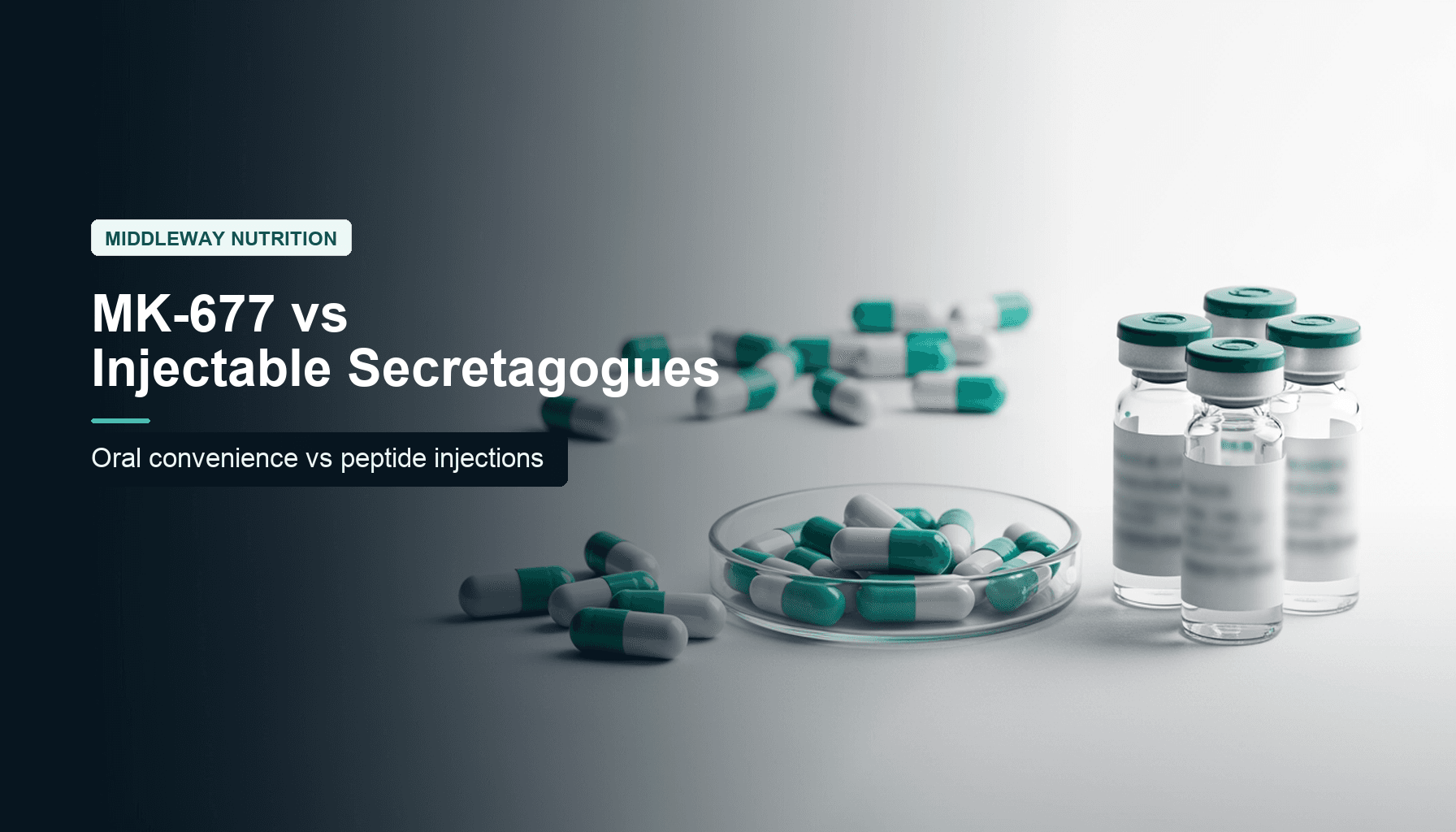
MK-677 (ibutamoren): the oral option
MK-677 is the only orally active compound on this list. It is a non-peptide ghrelin receptor agonist, so it survives digestion and works as a tablet or capsule, which is its biggest practical appeal.
The pharmacology is notable on paper. MK-677 meaningfully increases pulsatile GH secretion and raises IGF-1, and a single oral dose can keep IGF-1 elevated for close to 24 hours. Reported IGF-1 increases in human studies run from roughly 40% to 80% depending on dose, duration, and population. It has been studied for nearly three decades across growth hormone deficiency, sarcopenia, age-related frailty, and diet-induced catabolism.
Despite all that research, MK-677 has never been approved for any indication. The reasons matter:
- At least one clinical trial was stopped early over concern that it might worsen or precipitate heart failure in an at-risk elderly population.
- It raises cortisol alongside GH and IGF-1.
- It commonly causes fluid retention (edema), increased appetite, and reductions in insulin sensitivity with higher fasting glucose, which is a real concern for anyone with prediabetes or diabetes.
MK-677 is an investigational drug. It is not legal as a dietary supplement ingredient, and it is banned by the World Anti-Doping Agency and most sports bodies. If you are evaluating suppliers anyway, our guide to where to buy MK-677 covers how to vet a source and what it should cost.
How to think about choosing
There is no universal winner, but the decision framework is straightforward:
- If you have a diagnosed, on-label condition (HIV-associated lipodystrophy), tesamorelin is the evidence-backed, FDA-approved choice and should be discussed with your physician.
- If a clinician is using compounded peptides, a GHRH analogue plus a GHRP (commonly CJC-1295 plus ipamorelin) is the most common pairing because of the synergistic, pulse-preserving effect.
- If oral dosing is the priority, MK-677 is the only option, but the glucose, edema, and cardiac signals make it the one that demands the most caution and monitoring.
- If you want the longest regulatory and safety paper trail among the peptides, sermorelin has it, even though it is now compounded rather than branded.
A note on context: growth hormone secretagogues are sometimes marketed for fat loss, but their fat-reduction effects are modest compared with metabolic drugs. If your primary goal is weight or visceral fat reduction, the incretin and triple-agonist class is a different and more potent toolset. You can read our explainer on what retatrutide is and how the investigational triple agonist compares with tirzepatide for that conversation. (For the record, retatrutide remains investigational and in phase 3 trials as of 2026, and is not FDA-approved.)
Safety, monitoring, and legality
Every compound here that is not tesamorelin should be approached as either investigational or compounded. Practical points:
- Glucose and insulin. Ghrelin-receptor agonists, MK-677 in particular, can raise fasting glucose and blunt insulin sensitivity. Baseline and follow-up labs are sensible.
- Fluid retention and joint symptoms. These are classic GH-axis effects and tend to be dose-dependent.
- Sourcing. Research-use peptides are not held to pharmaceutical purity standards. Compounded products from a licensed 503A or 503B pharmacy on a valid prescription are a different and more accountable category than "research chemicals."
- Sport. All of these are prohibited in tested competition.
For comparison with the metabolic drug class, our coverage of retatrutide side effects, whether retatrutide is safe, and compounded retatrutide walks through how regulators and clinicians weigh similar trade-offs.
Frequently asked questions
What is the strongest growth hormone secretagogue?
By raw GH and IGF-1 elevation, MK-677 and CJC-1295 with DAC produce the largest and longest sustained increases. By quality of evidence and regulatory standing, tesamorelin is the strongest because it is FDA-approved with controlled-trial data. "Strongest" depends on whether you mean hormone numbers or proven outcomes.
Are growth hormone secretagogues safer than injecting HGH?
In principle they preserve the body's feedback loops and pulsatile release, which may reduce the risk of excessive IGF-1. That does not make them risk-free. Most are unapproved, long-term human safety data are thin, and MK-677 specifically carries glucose and cardiac concerns. Safer in mechanism is not the same as proven safe.
Is MK-677 legal?
MK-677 is not FDA-approved for any use and is not legal as a dietary supplement ingredient in the United States. It is sold as a research chemical, and it is banned in essentially all tested sport.
Can you stack a GHRH analogue with a GHRP?
Yes, and this is the most common compounded approach. A GHRH analogue (such as CJC-1295 or sermorelin) plus a GHRP (such as ipamorelin) hits two receptors and produces a larger combined GH pulse than either compound alone.
Do growth hormone secretagogues cause significant weight loss?
Their effect on body fat is generally modest. Tesamorelin reduces visceral fat in its approved population, but for substantial weight or fat loss the GLP-1 and triple-agonist drugs are far more potent. The two classes are not interchangeable.
This article is for informational purposes only and is not medical advice. Growth hormone secretagogues can affect blood glucose, fluid balance, and hormone levels. Talk to a qualified clinician before starting, combining, or stopping any of these compounds.
References
- Falutz J, Mamputu JC, Potvin D, et al. Effects of Tesamorelin, a Growth Hormone-Releasing Factor, in HIV-Infected Patients with Abdominal Fat Accumulation: A Randomized Placebo-Controlled Trial with a Safety Extension. J Acquir Immune Defic Syndr. 2010. PubMed
- Nass R, Pezzoli SS, Oliveri MC, et al. Effects of an Oral Ghrelin Mimetic on Body Composition and Clinical Outcomes in Healthy Older Adults: A Randomized Trial. Annals of Internal Medicine. 2008. PubMed
- Jastreboff AM, Kaplan LM, Frías JP, et al. Triple–Hormone-Receptor Agonist Retatrutide for Obesity — A Phase 2 Trial. New England Journal of Medicine. 2023. PubMed