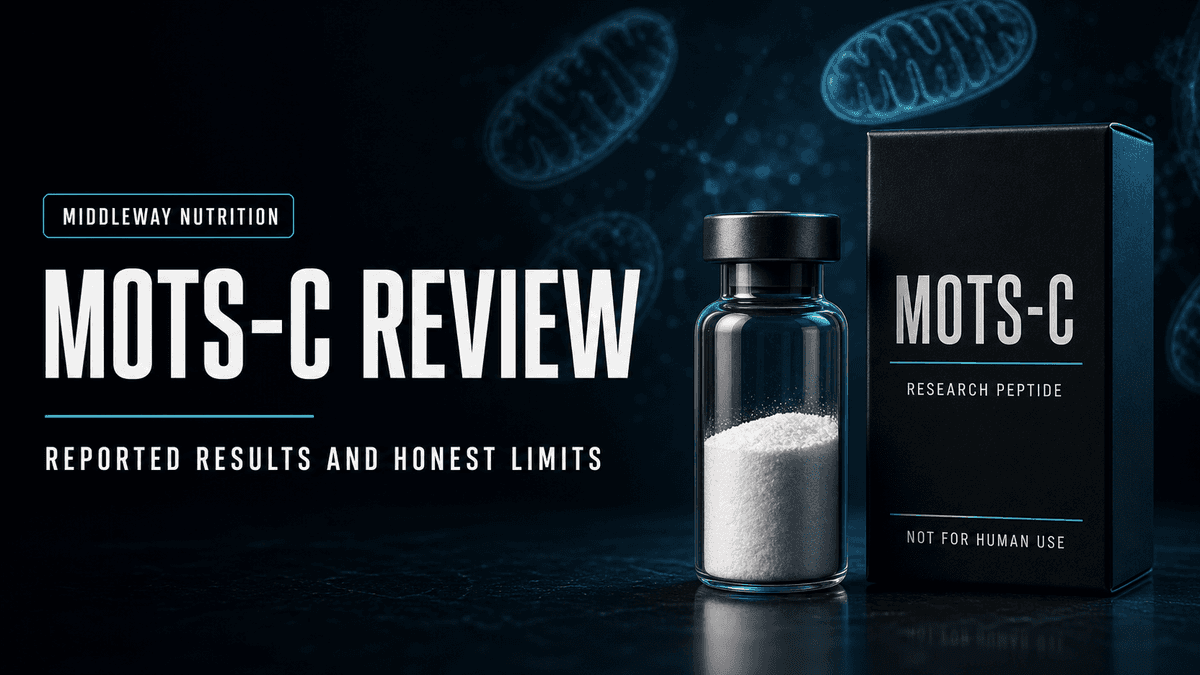
This MOTS-c review lands on a split verdict. The underlying biology is genuinely unusual and worth taking seriously: a peptide encoded in mitochondrial DNA that acts on metabolic signalling. The human evidence is early enough that anyone describing predictable results is describing hope rather than data.
MOTS-c review pages tend to fall into two camps: uncritical enthusiasm about mitochondrial rejuvenation, or blanket dismissal of anything without a phase 3 trial. Neither is useful. What follows is what the compound is, what people consistently report, and where the honest uncertainty sits.
What Makes MOTS-c Different
Nearly every peptide discussed in this space is encoded in nuclear DNA. MOTS-c is encoded in mitochondrial DNA, in a short open reading frame within a ribosomal RNA gene. That is not marketing; it is a genuinely distinct piece of biology, and it is why the compound was interesting to researchers before it was interesting to vendors.
Functionally it appears to act as a signalling molecule, influencing metabolic pathways in ways that overlap with the cellular response to exercise. Reported effects in research include improved glucose handling, greater use of fat as fuel, and better insulin sensitivity in skeletal muscle.
The framing that follows from this, that it functions as exercise in a vial, is where the overselling begins. Rodent endurance improvements are real findings and they are not a promise about human energy.
MOTS-c Review: The Evidence, Plainly
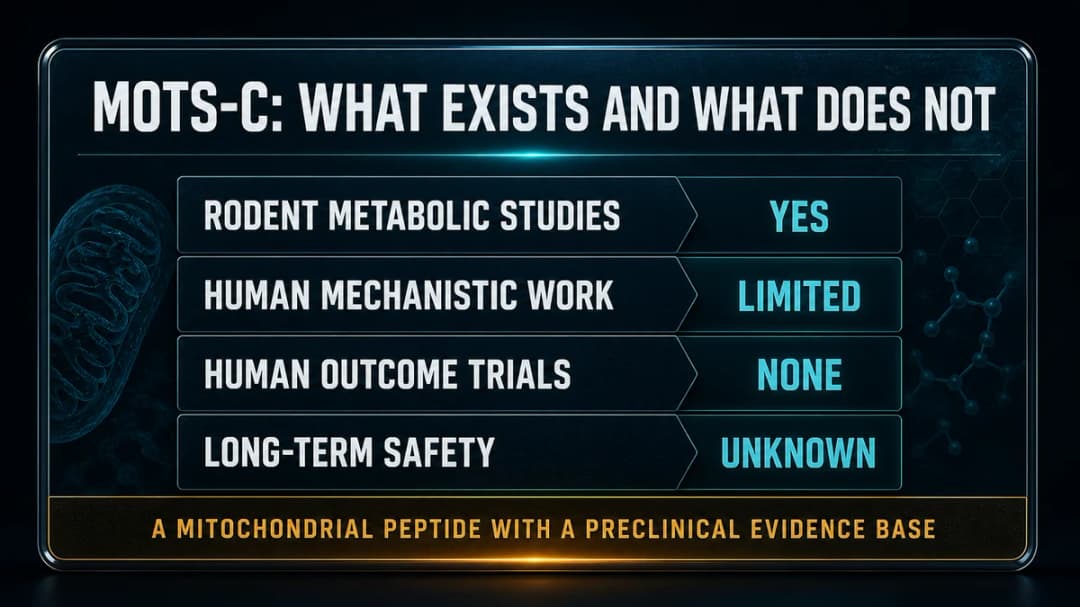
Animal work: reasonably substantial, with consistent metabolic findings.
Human work: early. Levels of the peptide have been studied in relation to metabolic health, and clinical investigation exists, but there is no body of controlled trials establishing what supplemental MOTS-c does in healthy people.
Long-term safety: unstudied. No data exists on what running this compound for a year does.
That combination puts MOTS-c in the same evidentiary tier as most of the research peptide category: plausible mechanism, animal support, unproven in humans. Where it sits above the rest of that tier is that the mechanism is unusually well characterised.
Dosing in Practice
| Parameter | Commonly reported |
|---|---|
| Dose | 5 to 10 mg subcutaneously |
| Frequency | Two to three times per week |
| Cycle length | Four to eight weeks |
| Timing | No strong convention, often morning |
These are figures from reported practice, not established dosing. A conservative approach is 5 mg twice weekly to start, which gives room to increase if it is well tolerated and is easier to interpret than starting at the top of the range.
At 5 mg twice weekly, a 10 mg vial covers a week, which makes this one of the more expensive research peptides to run per month. That is worth factoring in before ordering. Our MOTS-c guide covers the compound in more detail and where to buy MOTS-c covers sourcing.
What Users Report
The pattern across accounts, treated as directional rather than evidential:
Most commonly described: improved exercise tolerance, particularly in endurance work rather than strength. A sense of steadier energy through a day rather than a stimulant lift. Some report better recovery between sessions.
Sometimes described: modest body composition changes over a full cycle, usually alongside training.
Frequently described: nothing at all. Non-response is a common report with this compound, more so than with growth hormone secretagogues where fluid retention at least confirms something is happening.
That last point is worth dwelling on. A compound with no obvious physical marker of activity is difficult to evaluate honestly, because you cannot tell a non-responder from an inactive vial from an unrealistic expectation.
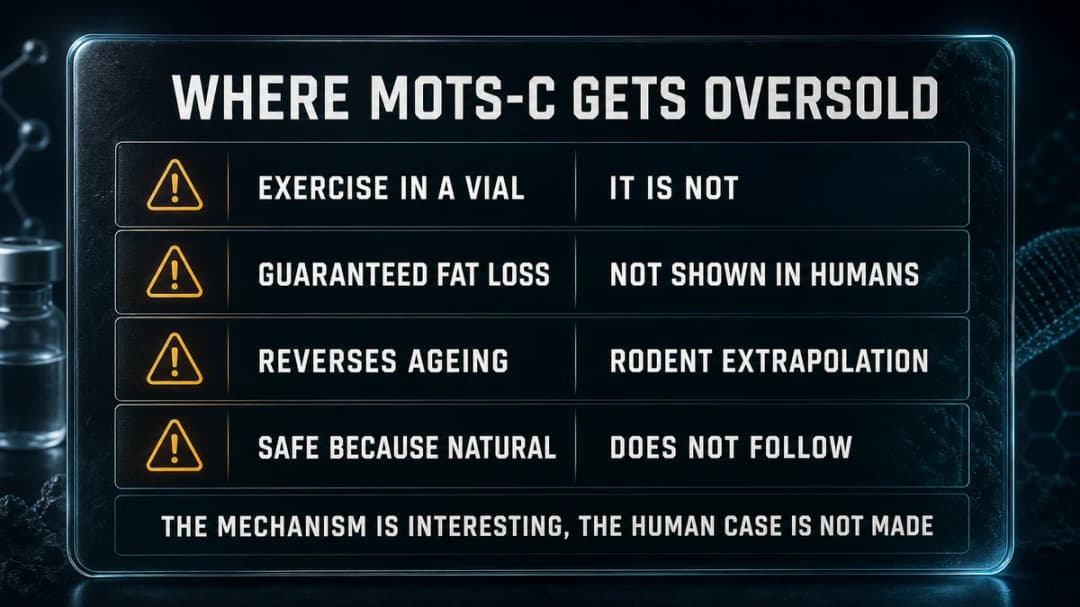
Where This Compound Gets Oversold
As a fatigue treatment. Persistent fatigue is usually caused by something diagnosable. Iron deficiency, thyroid dysfunction, sleep apnoea and depression account for most of it, and none respond to a mitochondrial peptide.
As a weight loss compound. Metabolic signalling effects are not the same as weight loss, and no human evidence supports using it that way. If fat loss is the goal, the compounds with trial evidence are elsewhere.
As an exercise substitute. The exercise mimetic framing was always a description of overlapping pathways, not a claim that it replaces training. Every reported benefit appears in people who were also training.
Practical Notes
Reconstitution follows the usual rules. A 10 mg vial with 2 mL of bacteriostatic water gives 5,000 mcg per mL, so a 5 mg dose is 100 units, which is a full insulin syringe. Using 1 mL instead gives 10,000 mcg/mL and puts 5 mg at 50 units, which is more practical.
Store reconstituted vials refrigerated and plan for a two to four week window. Because the dose is large relative to most peptides, a vial does not last long enough for stability to usually be the limiting factor.
Side effects reported are mostly local. Our MOTS-c side effects page covers them in full.
Verdict
Worth trying if you are interested in the metabolic angle, have realistic expectations, can afford a two month cycle without it mattering, and will track something measurable. The biology is more interesting than most of what is sold in this category.
Not worth trying if you are looking for an energy fix without having excluded the common medical causes, if you want fat loss and are choosing this over compounds with actual trial evidence, or if this would be your first peptide. A compound with no reliable subjective signal is a poor place to learn how to evaluate one.
FAQ
Does MOTS-c actually work?
In animal models the metabolic findings are consistent. In humans, the evidence is early and there is no controlled trial establishing what it does in healthy people. User reports are mixed, with non-response common enough to be a notable feature.
How long does MOTS-c take to work?
Reported changes, where they occur, appear over three to six weeks rather than immediately. There is no acute effect to feel, which is part of what makes the compound hard to evaluate personally.
What is a typical MOTS-c cycle?
Four to eight weeks at 5 to 10 mg, two to three times weekly, is the common pattern. There is no evidence establishing an optimal cycle length or whether breaks are necessary at all.
Is MOTS-c safe?
Reported side effects are mostly injection site reactions, and no serious adverse event pattern has emerged from user reports. That is not the same as demonstrated safety, since no long-term human study exists.
Is MOTS-c worth the cost?
At 5 to 10 mg per dose it is one of the more expensive research peptides to run. Whether that is worth it depends on your interest in the metabolic mechanism, because the evidence does not currently justify it on expected results alone.