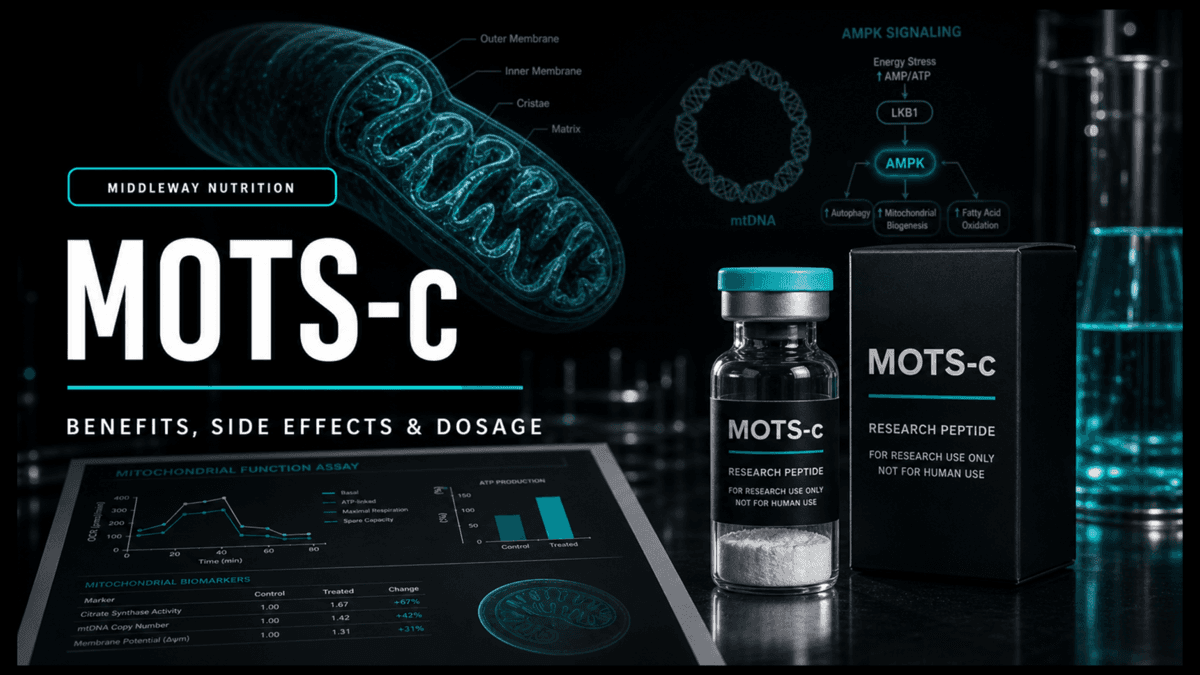
MOTS-c peptide benefits are metabolic rather than stimulant-like, its reported side effects are mostly mild and local, and research dosage sits in a narrow band. That last point deserves emphasis up front, because the gap between what the animal literature demonstrates and what gets promised on vendor product pages is wider for this compound than for almost anything else in the metabolic category.
Key Takeaways
- MOTS-c is a 16-amino-acid peptide encoded in mitochondrial DNA rather than nuclear DNA, identified in 2015 at the University of Southern California.
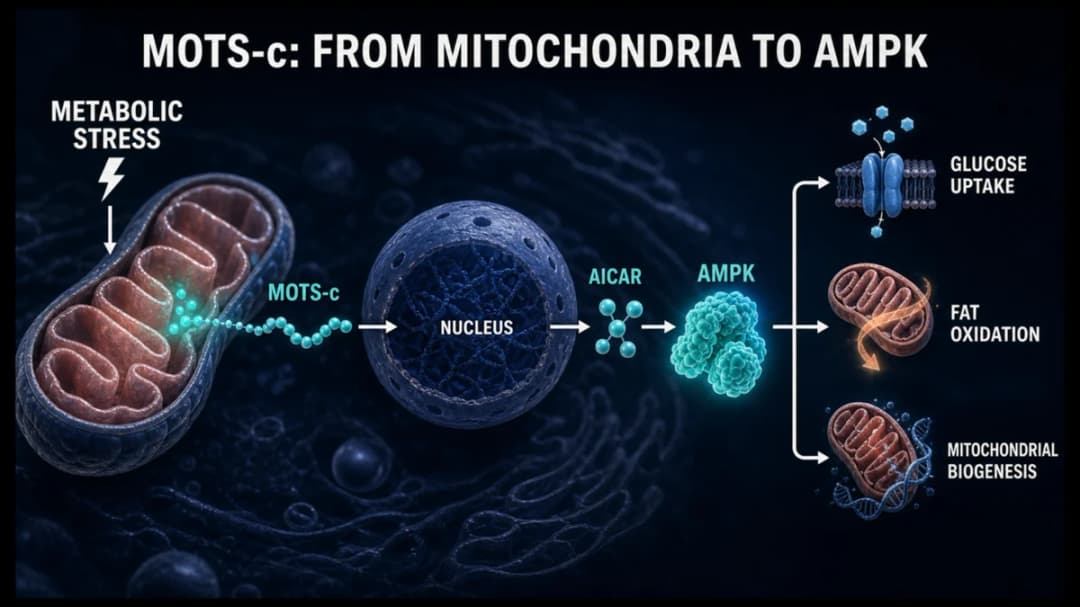
- Its primary described mechanism is AMPK activation, which pushes cells toward glucose uptake, fat oxidation, and mitochondrial biogenesis.
- The strongest evidence is rodent metabolic and exercise-capacity data. Human data is limited and largely correlational.
- A Phase 2a placebo-controlled trial of injected MOTS-c in adults with prediabetes, NCT07505745, began recruiting in February 2026. It is the only interventional trial of administered MOTS-c registered on ClinicalTrials.gov, and it has produced no results yet.
- Reported research protocols cluster at 5 to 10 mg subcutaneous, 2 to 3 times weekly, in blocks of 4 to 8 weeks.
- Because the molecule is fragile once reconstituted, cold-chain handling and verified sourcing influence outcomes more than any adjustment to the dose.
What MOTS-c Actually Is
Most peptides sold for research come from one of two families: synthetic analogs of a human hormone, or fragments engineered to hit a specific receptor. MOTS-c belongs to neither. It is a mitochondrial-derived peptide, or MDP, meaning the genetic instructions for building it sit inside the mitochondrial genome instead of the cell nucleus. Specifically it is transcribed from the 12S rRNA gene, which is where the awkward full name comes from: Mitochondrial Open Reading Frame of the 12S rRNA Type-c.
The molecule is 16 amino acids long, sequence MRWQEMGYIFYPRKLR, with a molecular weight of roughly 2,175 daltons. It ships as a white lyophilized powder. Estimated half-life in circulation is short, often cited in the four to six hour range, though that figure is unverified: no published human pharmacokinetic study supports it, and some users quote shorter values (two to four hours). Treat it as a rough working assumption rather than a measured value.
Mechanistically, MOTS-c is described as a mitokine, a signal released by mitochondria that acts on the rest of the cell and on distant tissues. Under metabolic stress it moves out of the mitochondria and into the nucleus, where it influences expression of genes tied to metabolism, stress response, and inflammatory signaling. The downstream hub is AMP-activated protein kinase, or AMPK. The proposed route involves interference with the folate-methionine cycle and de novo purine synthesis, which raises intracellular AICAR, itself a well-characterized AMPK activator.
When AMPK switches on, four things follow: glucose transport into muscle and fat tissue increases, fatty acids are routed toward oxidation instead of storage, the cell builds additional mitochondria, and low-grade inflammatory signaling quiets down. This is the same broad program aerobic exercise triggers, which is why MOTS-c gets called an exercise mimetic. That label overstates things. Endogenous MOTS-c rises after a bout of exercise, and it falls with age, but neither observation means injecting it substitutes for training.
MOTS-c is not an approved drug in any jurisdiction. It is sold for laboratory research only, and nothing below should be read as a protocol for personal use.
MOTS-c Benefits
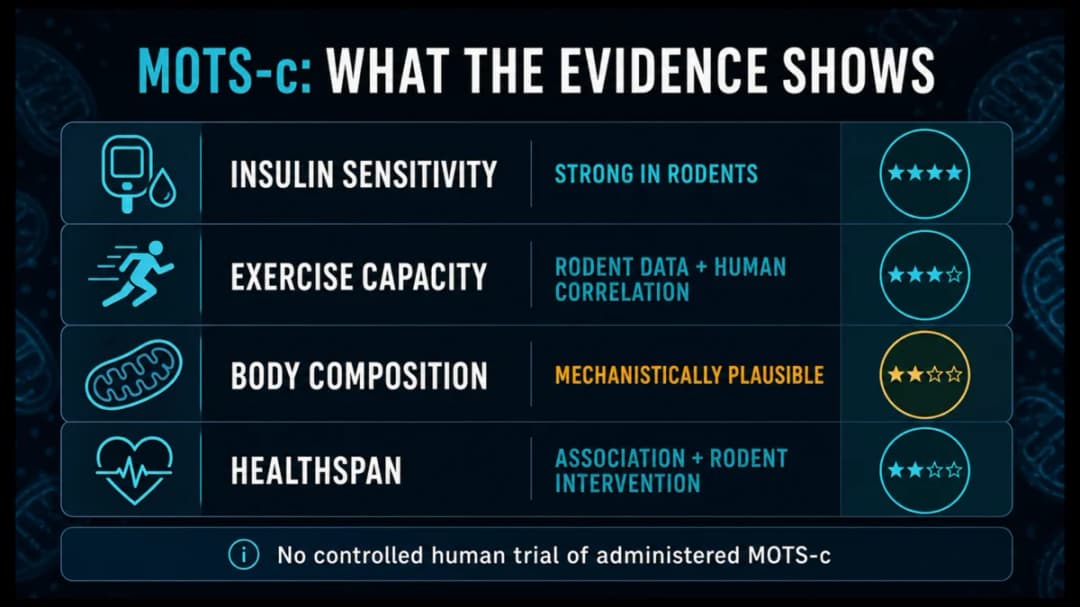
The honest way to present MOTS-c benefits is to separate what has been demonstrated in animals from what has merely been observed in humans, because the two are frequently blurred together in marketing copy. Here is the whole picture in one place before the detail.
| Claimed benefit | What the evidence actually consists of | Evidence grade |
|---|---|---|
| Insulin sensitivity and glucose handling | Reversal of diet-induced and age-related insulin resistance in mice, in some experiments without any drop in food intake | Strong in rodents, unconfirmed in controlled human trials |
| Exercise capacity | Improved running capacity in rodents across age groups; in humans, circulating levels rise after exercise and sit lower in older adults | Consistent in rodents, correlational in humans |
| Body composition | No thermogenic or appetite mechanism exists; what is plausible is support for metabolic flexibility | Mechanistically plausible, sparse direct data |
| Aging and healthspan | Levels fall with age, run higher in exceptionally long-lived people, and restoration improved metabolic markers in aged mice | Association plus rodent intervention, no human outcome data |
| Inflammation | AMPK-mediated damping of chronic low-grade inflammatory signaling | Preclinical |
| Muscle growth | Not a claimed effect and works against the mechanism, since sustained AMPK activation is catabolic by design | Contrary to mechanism |
Every row below expands one line of that table. Nothing in the right-hand column is a controlled human efficacy result.
Insulin sensitivity and glucose handling. This is the best-supported effect and the one the original characterization work was built around. In mice fed a high-fat diet, MOTS-c administration reduced fat accumulation and reversed both diet-induced and age-related insulin resistance, in some experiments without any reduction in food intake. That last detail matters: it points to a change in how fuel is processed rather than an appetite effect. Evidence grade: strong in rodents, unconfirmed by controlled human trials, though this is the specific claim a trial is now testing in people.
Exercise capacity. Rodent work has reported improved running capacity following MOTS-c administration across several age groups, along with reduced performance in animals whose MOTS-c signaling was impaired. On the human side, the picture is thinner. What exists is observational: circulating MOTS-c rises after exercise and sits lower in older adults, which suggests the peptide participates in the signaling cascade that training sets off. Whether administering it reproduces that cascade has not been tested in a controlled human trial. Evidence grade: consistent in rodents, correlational in humans.
Body composition. Nothing about the mechanism raises thermogenesis or blunts hunger, so the fat-loss framing used in most vendor copy misrepresents what the compound does. What it plausibly supports is metabolic flexibility, the ability to switch cleanly between carbohydrate and fat as fuel. In practice that reads as removing a bottleneck rather than forcing an outcome, and it would be expected to do very little when diet, sleep, and training are already disordered. Evidence grade: mechanistically plausible, sparse direct data.
Aging and healthspan. Circulating MOTS-c declines with age in both humans and animals, and elevated levels have been reported in exceptionally long-lived people. Restoring it in aged mice improved several age-related metabolic markers. This is genuinely interesting, but it is an association plus a rodent intervention, not a demonstrated longevity effect in people. Evidence grade: promising mechanism, no human outcome data.
Inflammation. Through AMPK signaling, MOTS-c appears to modulate chronic low-grade inflammatory pathways. This is not analogous to an anti-inflammatory drug acting on acute injury. Evidence grade: preclinical.
One trade-off gets omitted from most write-ups. Sustained AMPK activation is catabolic by design. It favors energy production over storage and construction, which puts it at odds with a hypertrophy phase. MOTS-c is a metabolic compound, not a mass-building one, and higher research doses lean further in that direction. If muscle accrual is the goal, 5-amino-1MQ works through NNMT inhibition and a different metabolic angle entirely.
The Only Registered Human Trial
Most writing on this compound describes a complete absence of clinical testing. That is no longer quite true. ClinicalTrials.gov lists NCT07505745, a Phase 2a study of injected MOTS-c sponsored by Hudson Biotech, which began recruiting in February 2026 and is the only interventional trial of administered MOTS-c on the registry.
| Element | As registered |
|---|---|
| Design | Randomized, double-blind, placebo-controlled, parallel group, 1:1 allocation, quadruple masked |
| Population | 120 adults aged 18 to 65 with prediabetes and overweight or obesity |
| Regimen | Fixed dose once daily by subcutaneous injection for 12 weeks, both arms receiving standardized lifestyle counseling |
| Primary endpoints | Change from baseline in OGTT-derived insulin sensitivity (Matsuda index) at 12 weeks, plus treatment-emergent adverse events through 16 weeks |
| Secondary endpoints | HbA1c, fasting glucose, 2-hour plasma glucose on a 75 g OGTT, anti-drug antibodies |
| Sites | One listed site, Peking University Shenzhen Hospital |
| Estimated primary completion | February 2027 |
Three features of that registration matter before anyone reads it as validation. It is recruiting, not reporting, so there are no results and will not be for at least a year. It is a single industry-sponsored site enrolling 120 people, which makes it a signal-finding study rather than a definitive one, and the primary efficacy endpoint is a surrogate measure of insulin sensitivity rather than a clinical outcome. And the registered regimen is a fixed dose once daily for 12 straight weeks, which bears no resemblance to the 2 to 3 times weekly administration with cycling breaks that community protocols describe. The registry does not disclose what that daily dose is. If the study reads out positive, it will have done so for a schedule almost nobody in the research peptide market is following.
MOTS-c Side Effects
MOTS-c has a reputation for tolerability, and the reputation is broadly earned relative to other metabolic compounds. It is not associated with the nausea, gastric slowing, or appetite disruption that dominates the GLP-1 category. But tolerability claims here rest on a small pool of research reports and self-reported user accounts, not on controlled safety trials, and that limitation should color everything in this section.
Documented and commonly reported:
- Injection-site reactions. Redness, tenderness, itching, or a small transient lump are by far the most frequent complaint. This is typical of subcutaneous peptides generally and is influenced by injection speed, volume, site rotation, and solution quality as much as by the peptide itself.
- Fatigue following administration. Reported more often at the upper end of the dosing range. In practice it tends to track dose size rather than appearing across the board.
- Headache. Uncommon, generally mild, and again more associated with starting at the top of the range than at the bottom.
Reported but less consistently characterized:
- Flushing, skin redness, or itching consistent with a histamine or mast cell response. Some accounts describe transient hives. This is described as a release response rather than a classical allergy, and slower injection appears to reduce it, but the underlying mechanism has not been formally established for MOTS-c.
- Mild appetite shifts in the first week.
- Muscle cramping, reported rarely.
Where the data is genuinely thin. There are no long-term human safety studies for MOTS-c. Nothing is known with confidence about chronic administration, interactions with prescribed medication, effects in people with existing metabolic disease, or safety in pregnancy. Because AMPK is a central regulatory node, systemic effects from sustained activation are theoretically plausible even though they have not been characterized. Anyone comparing this to SS-31 should note that SS-31 has actual controlled human trial data behind it, including some trials that missed their endpoints. MOTS-c has no equivalent record in either direction.
A practical point that gets underweighted: when a subtle compound seems to cause problems, degraded or mislabeled product is a common culprit. Poor sourcing produces both more irritation and less benefit, which is a confusing combination to interpret.
MOTS-c Dosage Chart
There is no established human dose for MOTS-c. What follows is a MOTS-c dosage chart summarizing ranges reported in research contexts and in published protocol discussions. It is descriptive, not prescriptive, and none of it constitutes a recommendation.
| Goal or context | Reported range | Frequency | Typical cycle |
|---|---|---|---|
| Initial tolerance assessment | 5 mg | 2x weekly | 4 weeks |
| Lower starting range (user-reported) | 0.5 to 2 mg | 2 to 3x weekly | Varies; many then step up |
| Metabolic support, steady signaling | 5 to 7.5 mg | 2 to 3x weekly | 4 to 6 weeks |
| Exercise capacity and recomposition blocks | 7.5 to 10 mg | 3x weekly | 6 to 8 weeks |
| Rodent healthspan work (reference only) | Intermittent dosing | 3x weekly | Late-life administration |
Several things about this chart are worth reading carefully. The 5 mg tolerance row is a conservative-looking figure from published protocol discussions, but it is not the lowest start people describe: beginners posting in online communities commonly report starting at 0.5 to 2 mg and increasing gradually, and several said higher amounts made little noticeable difference. That lower range is user-reported, not from a trial.
The units are milligrams, not micrograms. That sounds obvious until you compare it to peptides dosed at 100 to 500 mcg, where the same reconstitution habits produce a hundredfold error. Concentration should be calculated before anything is drawn.
Frequency appears to matter more than total weekly quantity. Given a half-life that is assumed to be measured in hours (unverified), a large infrequent dose produces a spike and then a long trough in AMPK signaling. Reported protocols that spread a smaller amount across three administrations are generally described as performing better than a larger amount given twice, even when the weekly total is lower. Steady signaling over peak concentration is the recurring theme.
Cycling on and off is standard in the reported protocols, typically 4 to 8 weeks on with a comparable break. Two reasons are given: avoiding downregulation of the response to sustained AMPK activation, and creating a clean assessment window. Because the effects described are cumulative and undramatic, an off period is the only way to separate a real change from drift.
Escalation without cause is the most common protocol error described in the literature and in user reports. More milligrams does not reliably produce more effect with this compound, and the dose-related side effects sit at the top of the range, not the bottom.
Reconstitution and Storage
MOTS-c is less stable than most peptides in common circulation, and this is the single most practical thing to get right.
Lyophilized powder is stable when kept sealed and frozen, generally cited at -20 degrees Celsius for long-term storage. Reconstitution is done with bacteriostatic water added slowly against the inside wall of the vial, allowed to dissolve without agitation. Never shake a peptide vial.
Once reconstituted, MOTS-c should be refrigerated at 2 to 8 degrees Celsius and used within a shorter window than you might expect from other peptides. Common guidance lands at roughly 14 days, with some sources allowing up to two to three weeks. It does not hold up for a month the way sturdier compounds do. Room temperature exposure and heat degrade it quickly. Reconstituting several vials in advance is a reliable way to waste product.
Working out of a 10 mg vial. Ten milligrams is the standard vial size for MOTS-c, which is why so many searches for this compound carry 10 mg attached to them. It is a vial size, not a dose. Because the reported range tops out at 10 mg per administration, a single vial is anything from one administration to a full week of them depending on where in the range a protocol sits. What you draw follows from the diluent volume. The table below assumes a 10 mg vial and a U-100 insulin syringe, on which 100 units is 1 mL.
| Bacteriostatic water added | Resulting concentration | 5 mg | 7.5 mg | 10 mg |
|---|---|---|---|---|
| 1 mL | 10 mg per mL | 0.5 mL, 50 units | 0.75 mL, 75 units | 1.0 mL, 100 units |
| 2 mL | 5 mg per mL | 1.0 mL, 100 units | 1.5 mL, 150 units | 2.0 mL, 200 units |
The 2 mL fill is the one that catches people out. At 5 mg per mL, anything above 5 mg no longer fits inside a single 1 mL syringe, so a 7.5 mg amount becomes two draws and a 10 mg amount empties the vial across two. Its advantage is finer resolution, since one unit is 0.05 mg rather than 0.1 mg. The 1 mL fill keeps every amount in the reported range inside one syringe at coarser resolution. Neither is more correct, but the arithmetic has to be done on paper before the first draw, because a milligram-scale peptide punishes the reflexes built on microgram-dosed ones.
Vial economics fall out of the same numbers. At 5 mg twice weekly, a 10 mg vial is exactly one week of dosing and is finished comfortably inside the roughly 14-day reconstituted window. At the top of the reported range it is a single administration. Reconstituting faster than that consumption rate is how product ends up degrading in the fridge.
If a protocol appears to do nothing at all, degradation is a more likely explanation than non-response. That is a distinguishing feature of this compound compared with more robust molecules.
Stacking
Genuine documentation for MOTS-c combinations is limited, and no human stacking trial exists for any of them. The pairings that make mechanistic sense are worth understanding for that reason rather than as endorsements.
The most coherent pairing on paper is with SS-31 (elamipretide), because the two act on mitochondria in complementary and non-overlapping ways. MOTS-c is a signaling molecule that changes which genes and enzymes are active. SS-31 is a four-amino-acid peptide that binds cardiolipin in the inner mitochondrial membrane and physically stabilizes the structures that generate ATP. One adjusts the instructions, the other reinforces the hardware. That logic is sound, and it is still only logic.
NAD+ precursors get combined with MOTS-c on the reasoning that both feed into mitochondrial energy metabolism from different directions, with NAD+ supporting sirtuin activity and redox balance while MOTS-c drives AMPK. Again, mechanistically compatible, clinically untested as a combination.
Stacking multiple novel compounds at once has an obvious downside: when something works or goes wrong, there is no way to attribute it.
How to Verify What You Buy
Because MOTS-c is fragile and its effects are subtle, product quality determines outcomes more than protocol design does. Look for a recent third-party certificate of analysis covering identity and purity, confirm the vial was shipped cold and arrived as intact lyophilized powder, and treat any vendor that cannot produce independent testing on request as unverified. Our MOTS-c vendor comparison covers which suppliers publish real analytical documentation, and the MOTS-c for sale page tracks current listings and pricing.
Looking for the numbers behind this guide? Our MOTS-c dosage chart sets label and trial doses beside what Reddit users report taking.
Frequently Asked Questions
What does MOTS-c peptide do?
Its role is to signal, not to act directly on a receptor the way a hormone analog does. Written into mitochondrial DNA, the peptide is released under metabolic stress and converges on AMPK, the cell's principal energy sensor. The downstream program favors fuel use over fuel storage: more glucose transport, more fatty acid oxidation, more mitochondria, and quieter inflammatory signaling. Rodent work has reported better insulin sensitivity, less fat accumulation, and improved running capacity. Human data remains observational. The one controlled trial of administered MOTS-c, NCT07505745, started recruiting in February 2026 and has not reported.
What are the benefits and side effects of MOTS-c peptide?
The benefits reported for MOTS-c are metabolic rather than stimulant-like: improved insulin sensitivity and glucose handling, better exercise capacity, support for metabolic flexibility rather than direct fat loss, and quieter low-grade inflammatory signaling. All of that rests on rodent work and mechanism, with human evidence limited to observation and one Phase 2a trial still recruiting. The side effects reported are mild and mostly local: injection-site redness or tenderness by a wide margin the most common, then dose-related fatigue and occasional headache, with flushing or itching consistent with a histamine response described less consistently. Both halves of the answer share the same limitation. There is no long-term human safety data, no information on interactions with prescribed medication, and no characterization of effects in people who already have metabolic disease.
Does 10 mg of MOTS-c do more than 5 mg?
Not reliably, and the reported experience points the other way. Ten milligrams is the standard vial size and the top of the reported range, not a stronger version of the compound. The dose-related complaints, fatigue in particular and headache after it, cluster at the top of the range rather than the bottom. Protocol reports consistently describe frequency as mattering more than the size of any single administration, because a half-life measured in hours means a large infrequent dose produces a spike followed by a long trough in AMPK signaling. Escalating without a specific reason is the most commonly described protocol error with this compound.
Is MOTS-c peptide safe?
Reported side effects are mild and mostly local, with injection-site irritation being the common one and dose-related fatigue or headache appearing less often. That is a favorable short-term picture. It is not the same as an established safety profile. There are no long-term human studies, no data on drug interactions, and no characterization of effects in people with existing metabolic conditions. Cautious framing is appropriate; confident safety claims are not supported.
How much MOTS-c is typically used?
Reported research protocols cluster at 5 to 10 mg administered subcutaneously, 2 to 3 times per week, in cycles of 4 to 8 weeks. Lower amounts given more frequently are generally described as producing steadier signaling than larger amounts given less often, given the short estimated half-life. No standardized human dose exists, and these figures describe what has been reported rather than what anyone should do.
Is MOTS-c legal?
MOTS-c has not been approved as a drug by the FDA or any comparable regulator. It is legally sold in most jurisdictions as a research chemical for laboratory use only, not for human consumption, and it cannot lawfully be marketed with therapeutic claims. It also appears on prohibited lists in tested sport, so competitive athletes should assume it is banned. Regulations differ by country and change over time, so local rules are worth checking directly.