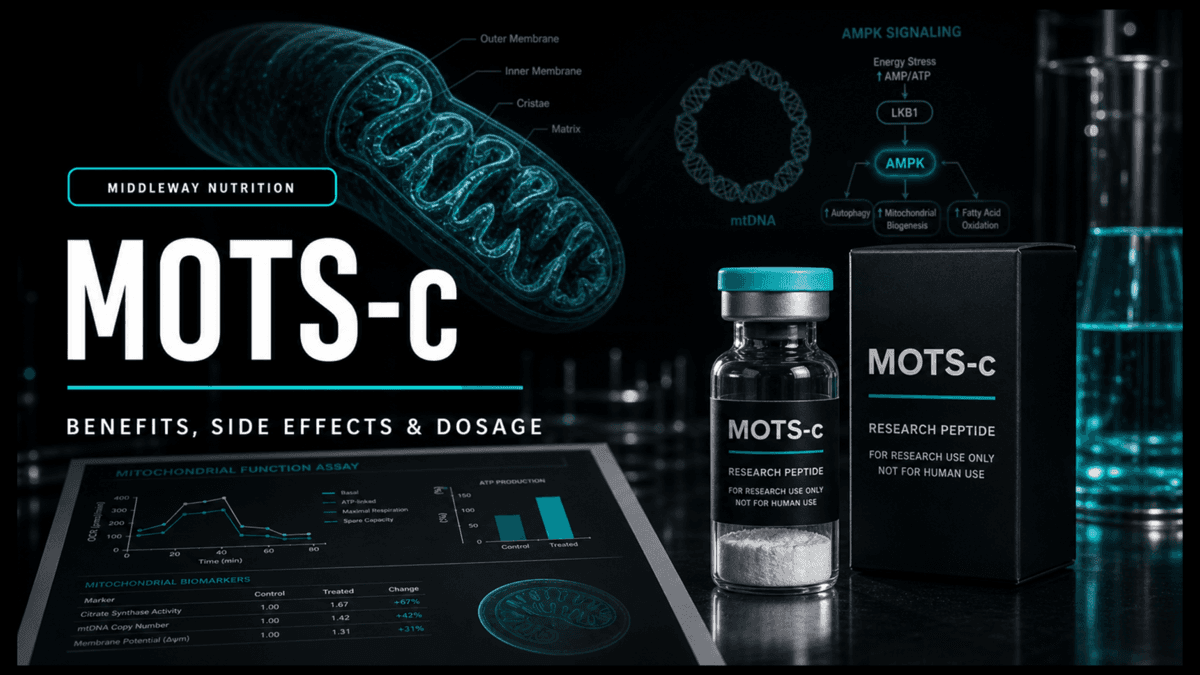
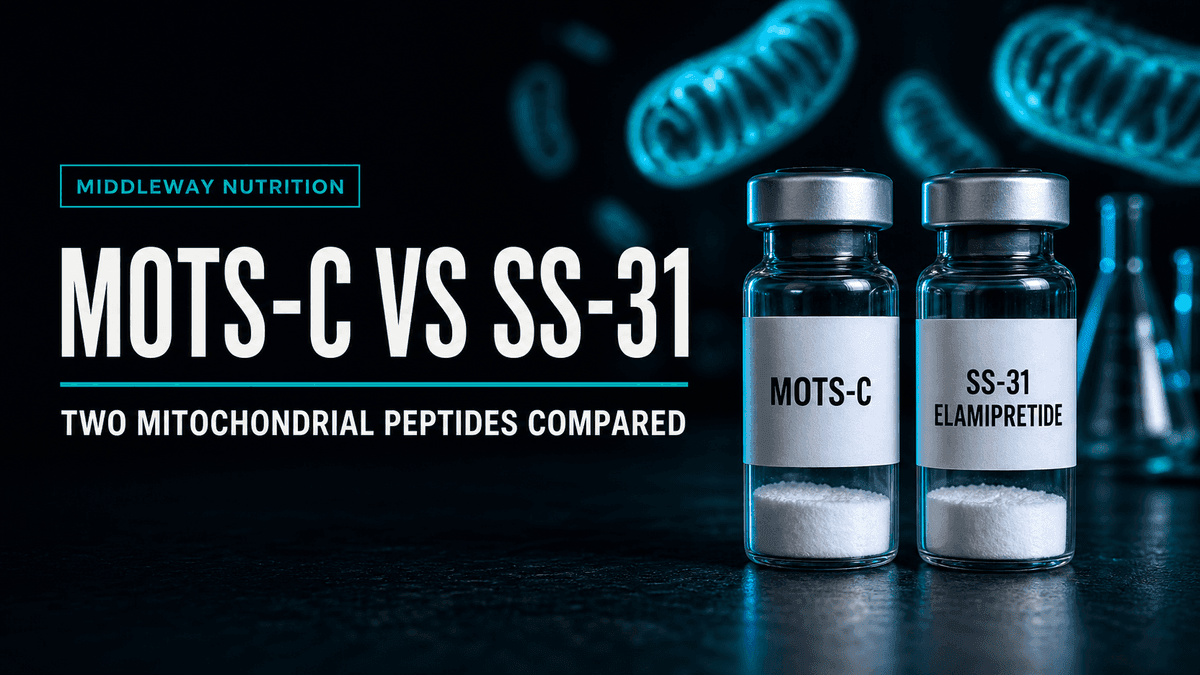
MOTS-c vs SS-31 (elamipretide) is not a close comparison once you look past the shared mitochondrial framing. SS-31 has been through a full clinical development programme and is an approved medicine for a rare genetic disease. MOTS-c is a research compound with animal data and early human work. They also act on completely different parts of mitochondrial biology.
Most pages framing MOTS-c vs SS-31 (elamipretide) present them as two options for the same job. They are better understood as a drug and a research chemical that happen to share an organelle.
MOTS-c vs SS-31 (Elamipretide): The Short Comparison
| MOTS-c | SS-31 (elamipretide) | |
|---|---|---|
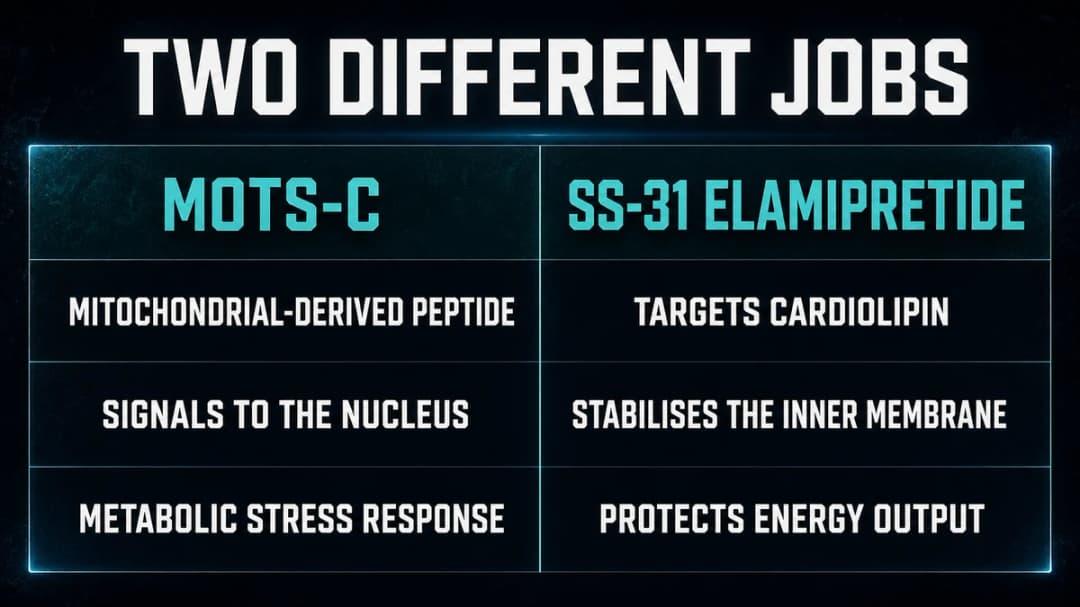
| What it is | Peptide encoded in mitochondrial DNA | Synthetic four amino acid peptide |
| Mechanism | Metabolic signalling, activates pathways overlapping with exercise | Binds and stabilises cardiolipin in the inner mitochondrial membrane |
| Where it acts | Signalling, including into the nucleus | Structural, inside the mitochondrion itself |
| Regulatory status | Research compound, not approved | Approved for Barth syndrome, sold as Forzinity |
| Human evidence | Early, limited | A full development programme, including failures |
| Typical use | Metabolic support, energy, body composition | Rare mitochondrial disease, under study elsewhere |
| Reported dosing | 5 to 10 mg subcutaneously, two to three times weekly | Once daily subcutaneous, up to 40 mg per day on the approved label |
| Cost | Moderate as a research vial | Prescription drug pricing |
What MOTS-c Actually Does
MOTS-c is unusual in that it is encoded in mitochondrial DNA rather than in the nucleus, which is part of why it attracted attention when described. It appears to act as a signalling molecule, influencing metabolic pathways in ways that overlap with the cellular response to exercise, including effects on glucose handling and fatty acid use.
That has produced the "exercise mimetic" framing, which oversells it. Rodent studies have shown improvements in metabolic markers and endurance. Human trial data is early and limited, and the leap from mouse endurance to human subjective energy is a large one.
Reported protocols run 5 to 10 mg subcutaneously, two or three times a week, in cycles of four to eight weeks. Our MOTS-c guide covers the compound in more depth.
What SS-31 Actually Does
SS-31, also known as elamipretide, works structurally rather than by signalling. It concentrates in mitochondria and binds cardiolipin, a phospholipid in the inner membrane that the electron transport chain depends on. Damaged cardiolipin means inefficient energy production and more oxidative stress. Stabilising it addresses the machinery directly.
Its development history is instructive and is the part usually left out. It has been studied across several conditions, including cardiac and renal indications, with mixed results. Some trials did not meet their endpoints. What it did achieve was approval for Barth syndrome, a rare genetic mitochondrial disorder, where the label uses once daily subcutaneous dosing up to 40 mg per day for patients above a weight threshold.
That is a meaningfully different situation from anything else in the research peptide world: a compound with a real regulatory dossier, a defined indication, and public evidence of where it did not work as well as where it did. Our SS-31 guide covers it in detail.
Which Question Are You Actually Asking
The comparison resolves differently depending on why you are asking.
If you have a diagnosed mitochondrial disease. This is not a comparison. SS-31 is an approved treatment for a specific condition and the route to it is a specialist, not a research vendor.
If you are interested in general energy or ageing. Neither has evidence supporting that use. SS-31 has more clinical history overall, but its trial record in non-rare-disease settings includes disappointments, and extrapolating from a rare mitochondrial disorder to normal mitochondria is not sound. MOTS-c has the more interesting metabolic story and much thinner data.
If the goal is metabolic and body composition support. MOTS-c is the compound people actually use for this, and it is the one with a mechanism pointed in that direction. The evidence remains early.
If you are considering both together. They act on different things, so the mechanistic argument for combining them is coherent. There is no data on the combination and it doubles an already speculative expense.
What the Evidence Gap Means in Practice
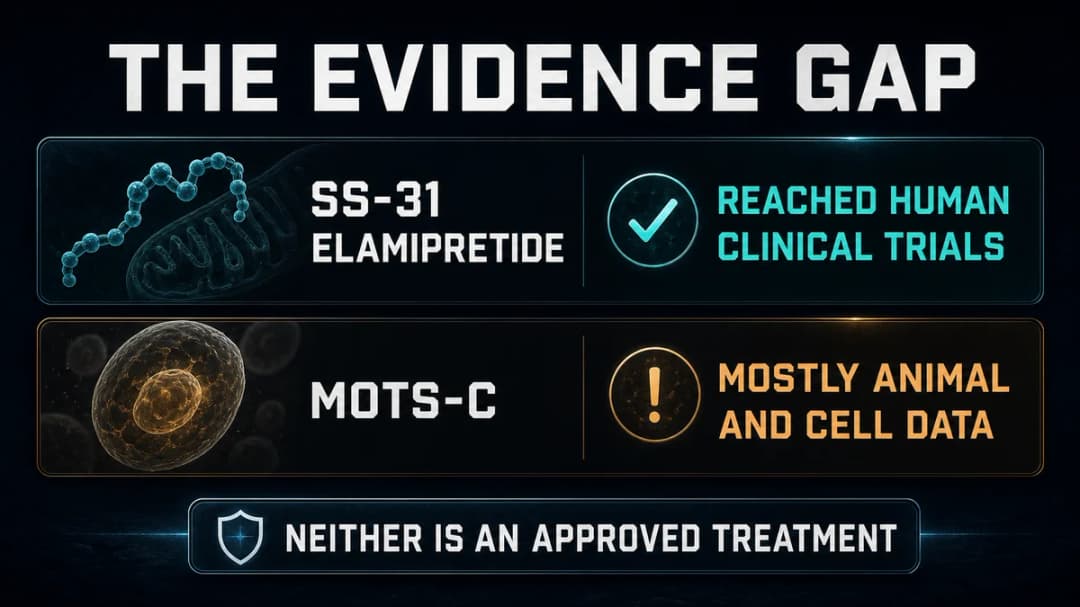
The distinction worth internalising is between a compound that has been tested and found modest, and a compound that has not been tested.
SS-31 has been through trials that did not all succeed. That is uncomfortable information and it is also more than almost any research peptide can offer, because it tells you where the compound's limits are.
MOTS-c has enthusiasm and preclinical work. The absence of negative results is not evidence of effect; it reflects the absence of trials capable of producing a negative result.
Side Effects and Practical Considerations
For MOTS-c, reported effects are mostly local: injection site reactions, occasional flushing, sometimes fatigue in the first week. There is no long-term human safety data.
For elamipretide, the adverse events documented in its trial programme were led by injection site reactions, which is what you would expect from a daily subcutaneous drug. Having that documented at all is the difference between an approved drug and a research vial.
Cost separates them sharply too. MOTS-c as a research vial sits in normal peptide pricing. Elamipretide as an approved orphan drug does not, and it is not obtainable outside a prescription pathway.
FAQ
Is SS-31 better than MOTS-c?
For a diagnosed mitochondrial disease, SS-31 is an approved treatment and MOTS-c is not, so the question does not really arise. For general energy or metabolic goals, neither has supporting evidence, and SS-31's advantage is that its limits have been measured rather than that its benefits have been proven.
Can MOTS-c and SS-31 be used together?
They act on different aspects of mitochondrial function, so combining them has a coherent rationale. No study has examined the combination, and running two speculative compounds together makes any effect unattributable as well as expensive.
Is elamipretide the same as SS-31?
Yes. SS-31 is the research designation and elamipretide is the drug name, marketed as Forzinity for Barth syndrome. Research vendors generally sell it under the SS-31 label, which is the same molecule but not the approved product.
What dose of MOTS-c do people use?
Reported protocols cluster at 5 to 10 mg subcutaneously, two to three times weekly, in four to eight week cycles. There is no approved dose, because the compound is not an approved medicine.
Which one helps with fatigue?
Neither has trial evidence for fatigue in people without a diagnosed mitochondrial disorder. Persistent fatigue is far more often explained by iron deficiency, thyroid dysfunction, sleep apnoea or depression, all of which are worth excluding before spending on either compound. Our best peptides for energy and fatigue page covers the wider picture.