Any honest Semax review has to open with the same caveat: there is no placebo controlled trial of Semax in healthy adults, so everything written about its cognitive effects, including this Semax review, is built on mechanism plus user report. What that leaves is still worth reading, because the reports are unusually consistent and the failure modes are predictable.
Semax is a synthetic heptapeptide derived from ACTH, registered as a medicine in Russia for stroke and certain neurological conditions, and sold as a research compound everywhere else.
What This Semax Review Found People Consistently Report
Across independent accounts, the description converges on a few things:
- Easier initiation of demanding work, described as reduced resistance to starting rather than increased drive
- Less mental fatigue in the second half of a long working day
- Clearer verbal recall and word finding, mentioned often enough to be notable
- A subtle effect overall, frequently missed on the first attempt
- No jitter, no appetite suppression, no crash
The equally consistent negative report is that a meaningful minority notice nothing at all. That group is underrepresented in forum threads for obvious reasons.
The subtlety is the single most common complaint. People expecting a modafinil style effect are almost always disappointed, and the comparison is misleading: Semax has no stimulant pharmacology.
What the Evidence Supports
The clinical trial base sits in Russia and concerns acute ischaemic stroke, transient ischaemic attack, post stroke cognitive impairment and optic nerve conditions. Those trials were sufficient for a national regulator and have not been independently replicated in Western studies.
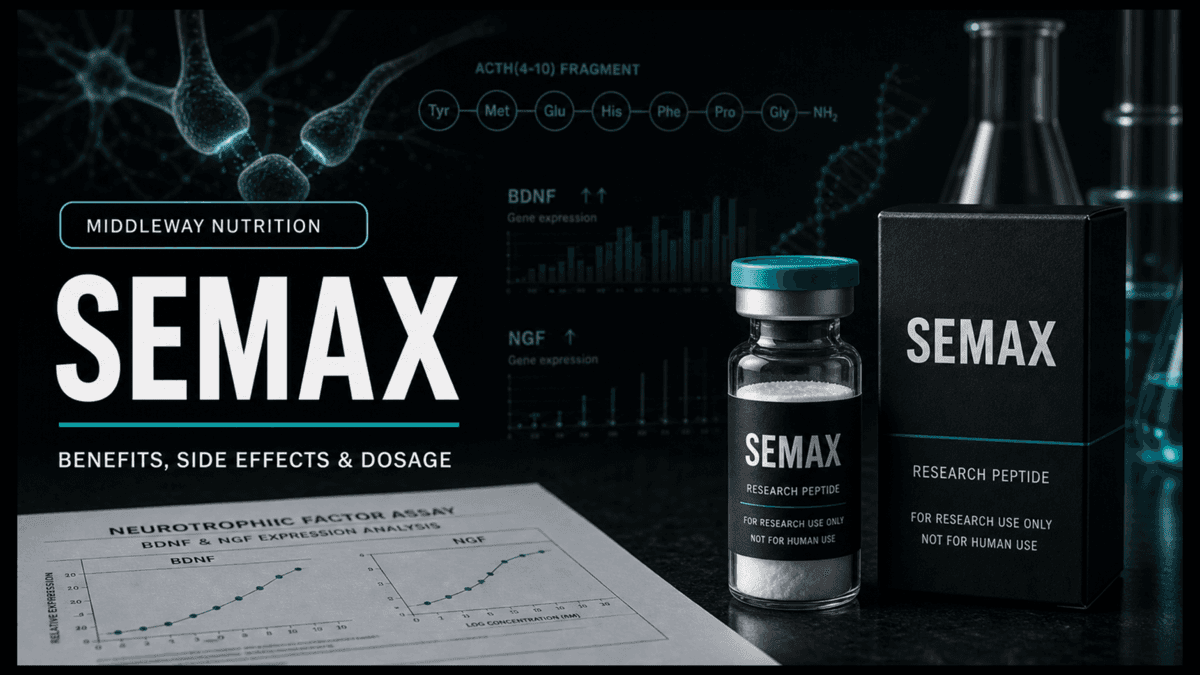
Preclinical work in rodents reports increased brain derived neurotrophic factor and TrkB receptor expression in the hippocampus, along with reduced damage markers in models of cerebral ischaemia. That is a coherent mechanistic story and a long way from a demonstrated cognitive benefit in a healthy person.
For the specific use most buyers have in mind, the evidence is user report. It should be weighed as user report.
The Practical Assessment
| Factor | Assessment |
|---|---|
| Effect size in healthy adults | Subtle at best, absent for some |
| Evidence quality for that use | Weak. No controlled trials |
| Tolerability | Generally good. Headache and nasal irritation are the usual complaints |
| Cost | Moderate. A 10 mg vial lasts a typical user several weeks |
| Sourcing risk | Meaningful. Research chemical market, quality varies |
| Regulatory position | Unapproved outside Russia. Banned in competitive sport |
| Reversibility | High. No withdrawal effects reported on stopping |
The combination that makes it interesting is low reported harm and low cost against an unproven benefit. That is a very different risk profile from, say, an unapproved injectable metabolic compound, and it is the honest reason people are willing to try it.
Where It Goes Wrong
Starting too high. Headache is the most reported side effect and is usually dose related. Beginning at the low end of reported ranges and holding there is the fix.
Stacking carelessly. Adding Semax to caffeine, nicotine and a racetam, then attributing the resulting headache to Semax, is common. Introduce one variable at a time.
Nasal technique. Repeated intranasal use with a poorly prepared solution or a reused sprayer produces irritation that people then push through. Stopping to let tissue recover is the right response.
Running it every day indefinitely. Reports of a clear effect cluster among people using it during periods of high demand rather than continuously. Whether that reflects genuine state dependence or just a better chance of noticing a change is unresolved, but continuous use has no evidence behind it and removes any baseline to compare against.
Expecting a stimulant. It is not one. If the goal is acute wakefulness, this is the wrong compound.
Our Semax side effects page covers the tolerability picture properly.
Sourcing Is the Real Variable
Semax sold online is research chemical material. Purity, correct sequence and sterility are the supplier's claims, not a regulator's requirement.
The checks worth insisting on are a batch specific certificate of analysis from a named third party laboratory, HPLC purity at or above 98 percent with the chromatogram shown, and clear storage and reconstitution guidance. Products sold pre-mixed as nasal sprays are harder to assess, because concentration and preservative content are often unstated.
See where to buy Semax for what a usable COA contains.
Who It Suits, and Who Should Skip It
Reasonable candidates are people who have already sorted sleep, training and caffeine timing, who understand they are ahead of the evidence, and who can evaluate a subtle effect honestly rather than talking themselves into one.
Skip it if you are looking for a stimulant substitute, if you have an untreated mood or attention disorder that deserves proper assessment, if you compete in a tested sport, or if you would find the absence of controlled human evidence genuinely uncomfortable. That last reason is entirely legitimate.
One more thing is worth saying about how to run the experiment if you do. The effect people describe is subtle enough that it is easy to talk yourself into, particularly having spent money. The most useful thing you can do is decide in advance what would count as a result, write it down, and check against that rather than against how you feel on the day. A specific measure, such as whether you started the difficult task before lunch, is far more informative than a general sense of clarity.
The corollary is that a null result should be treated as a result. Concluding that it did nothing for you, stopping, and saving the money is a perfectly good outcome, and it is one that almost never appears in the reports people publish. If you have already decided to buy, our guide to Semax for sale shows how to check a vial before you pay.
FAQ
Does Semax actually work?
For registered clinical indications in Russia, trials support it. For focus and cognition in healthy adults, there is no controlled evidence, and user reports are the only data. Many people report a subtle benefit and a meaningful minority report nothing.
How long before Semax has an effect?
Reports describe an acute effect within an hour of intranasal use, lasting several hours. Any cumulative benefit would follow a much slower neurotrophic timeline and has not been demonstrated.
Is Semax worth the money?
That depends entirely on how you weigh an unproven benefit against a low cost and a generally mild side effect profile. It is a defensible experiment for someone who understands the evidence position and an unreasonable purchase for someone expecting a documented cognitive drug.
Is Semax better than Selank?
They do different things. Semax is described as activating and Selank as anxiolytic. Neither has controlled evidence in healthy adults, so the comparison rests on what effect you are looking for rather than on relative efficacy.
Do you need to cycle Semax?
Cycling is convention rather than evidence. No tolerance or withdrawal pattern has been documented, but nobody has studied continuous long term use either, which is a reasonable argument for keeping cycles short by default.