
Semax vs Selank comes down to one question: is the thing limiting you mental output or mental noise? Semax is aimed at cognition, working through BDNF and the dopamine and acetylcholine systems, while Selank is aimed at anxiety, working through GABA signalling without touching the benzodiazepine site. Anyone weighing Semax vs Selank should pick based on which of those two problems is actually in the way.
Both came out of the same institute in Russia, both are usually given as nasal sprays, and both are prescription medicines there while being unapproved research compounds everywhere else. That last point shapes how much of what follows can be treated as settled.
Semax vs Selank: The Short Version
| Semax | Selank | |
|---|---|---|
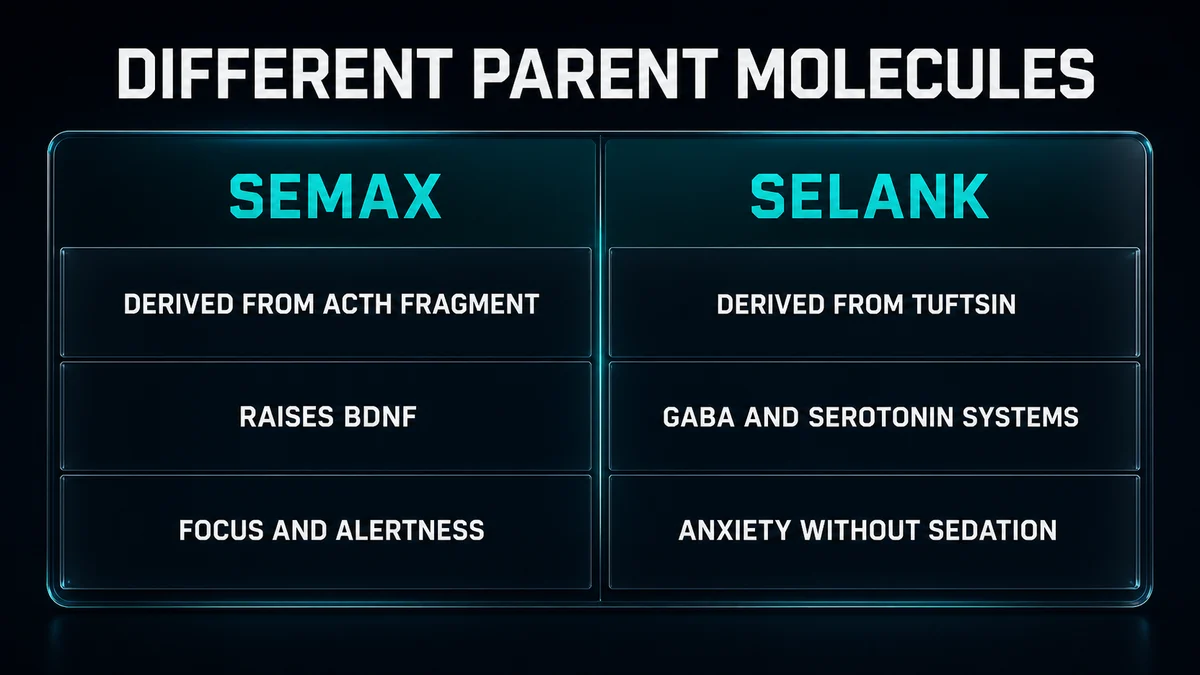
| Derived from | ACTH fragment 4-7, extended with Pro-Gly-Pro | Tuftsin, extended with Pro-Gly-Pro |
| Primary target | BDNF, dopamine, acetylcholine | GABA signalling, serotonin, cytokines |
| What it is for | Focus, memory, learning, neuroprotection | Anxiety, stress resilience, calm alertness |
| Feel | Activating, sometimes edgy | Settling, not sedating at normal doses |
| Best time of day | Morning, generally not after mid-afternoon | Flexible, including evening |
| Russian approval | Since the 1990s | Since roughly 2009 |
| Approved elsewhere | No | No |
| Dependence risk | None reported | None reported, unlike benzodiazepines |
Where They Come From, and Why That Matters
Semax is a heptapeptide built around the fragment of adrenocorticotropic hormone responsible for the brain effects, with a stabilising tripeptide tail added so it survives long enough to work. The design goal was the cognitive activity of ACTH without the hormonal effects. It has been a registered medicine in Russia since the 1990s, used for stroke recovery, optic nerve conditions and cognitive impairment.
Selank is built the same way from a different starting point: tuftsin, a short immune-signalling peptide, with the same stabilising extension attached. It was registered in Russia around 2009 as an anxiolytic.
That shared design lineage explains why the two are so often discussed together despite having almost nothing in common pharmacologically.
Here is the caveat that most comparisons leave out. Nearly all the clinical evidence for both compounds is Russian, much of it decades old, and it has not been replicated in Western trials with modern methodology. That does not make it wrong. It does mean the confidence you should place in specific effect sizes is lower than the number of citations suggests.
How Semax Works
BDNF. The best documented mechanism. Semax raises brain derived neurotrophic factor in the hippocampus and frontal cortex. BDNF supports neuronal survival and synaptic plasticity, and it is the mechanism most of the memory and learning claims rest on.
Dopamine and serotonin modulation. Semax influences both systems, which is the usual explanation for the reported combination of sharper focus and lifted mood. It is not a stimulant and does not feel like one, though at higher doses some people describe an edgy quality.
Acetylcholine. Increased turnover in regions involved in encoding and retrieving memory.
Neuroprotection. The basis for its clinical use in stroke in Russia, and the reason interest persists for brain injury and post-viral cognitive complaints. Interest is not the same as evidence, and the Western literature here is thin.
How Selank Works
GABA signalling. Selank enhances the brain's main inhibitory system, which is what quietens the circuits producing racing thoughts and physical anxiety. Crucially it does this without binding the benzodiazepine site. That structural difference is the reason it does not produce sedation, cognitive blunting, tolerance or dependence the way benzodiazepines do.
Serotonin and enkephalin systems. Effects on gene expression relating to serotonin metabolism, plus activity in the endogenous opioid system, both linked to mood stability.
BDNF, secondarily. Selank also raises BDNF, which likely explains the mild memory effects some users report. It is a smaller part of the picture than it is for Semax.
Immune modulation. Selank influences cytokine expression, including interleukin-6. This is a genuine difference from Semax and is sometimes offered as an explanation for its stress-protective profile, though the link between the two is inferred rather than demonstrated.
Effects, Side by Side
| Domain | Semax | Selank |
|---|---|---|
| Focus and concentration | Direct effect, the main reason people use it | Indirect, by removing anxious distraction |
| Anxiety | Minor, sometimes worsened at high doses | Direct, the main reason people use it |
| Memory encoding | Reported as its strongest cognitive effect | Moderate, mostly by restoring stress-impaired function |
| Mood | Lifted, driven | Even, settled |
| Mental energy | Noticeably increased | Little to none, it is not stimulating |
| Sleep | Can interfere if taken late in the day | Often improved |
| Dependence | None reported | None reported |
Reported Dosing
Neither compound has an approved dose outside Russia. What follows is what appears in user protocols.
| Starting range | Typical range | Timing | |
|---|---|---|---|
| Semax | 200 mcg intranasal | 200 to 600 mcg daily, split | Morning, and generally not after mid-afternoon |
| Selank | 250 mcg intranasal | 250 to 750 mcg daily, split | Flexible, including before stressful events |
Both degrade at room temperature and both need refrigeration between uses. Semax is the less stable of the two. Cycles of a few weeks with a break are the convention for both, more out of a preference for deliberate use than because withdrawal is expected.
Amidated variants of each, sold with an Na prefix and an amidate suffix, are structurally modified to resist enzyme breakdown and are reported to be considerably more potent per microgram, meaning much smaller doses. The specific potency multipliers circulating online are not backed by published comparative data, so treat them as claims rather than figures, and treat the variants as something to approach only after establishing a response to the standard versions.

Side Effects
Semax. Overstimulation, irritability and difficulty sleeping if dosed late are the most common complaints, all dose related. Nasal irritation from the spray itself is common with frequent use.
Selank. Mild sedation and a soft, slightly detached feeling if the dose is too high, plus the same nasal irritation. Both resolve on lowering the dose. See our page on Selank side effects for detail.
Neither is well characterised for interactions, and neither has meaningful long-term human safety data outside Russian clinical use. Anyone taking psychiatric medication should treat that as a reason for medical input rather than a footnote, because both compounds act on systems those medicines already target.
Stacking Them
The rationale is straightforward: Semax provides the cognitive push, Selank smooths the edges it can create. The common approach separates them, Semax in the morning and Selank later, so the activating and calming effects do not overlap. Some people run both in the morning at lower doses instead.
The sensible sequence is to establish what each does on its own first, over a couple of weeks each, before combining. Starting with both makes it impossible to know which one is doing anything.
For more on the individual compounds, see our Selank peptide guide and Semax peptide guide.
Which One to Choose
Semax if the bottleneck is output: focus, memory, processing speed, mental stamina, or recovery from a neurological event. It is the wrong choice for someone whose anxiety is already high, where an activating compound tends to make things worse. We compare suppliers in our guide to where to buy Semax.
Selank if the bottleneck is noise: anxiety, stress reactivity, or the specific problem of being cognitively capable but too wound up to use it. It is the wrong choice for someone looking for raw cognitive enhancement, since its cognitive benefit is a side effect of removing an obstacle rather than a direct push. Vial sizes and vendor checks are covered in our guide to buying Selank.
FAQ
Can Semax and Selank be used together?
Yes, and the combination is popular because the two compounds address different problems. Separating them by time of day is the usual approach, with the activating one in the morning. Establish a response to each individually first.
Which one is stronger?
Neither, because they do different things. Semax is more noticeable in the sense that its effects are activating and therefore easier to feel. Selank works by removing something rather than adding something, which makes it subtler and easier to underrate.
Are they legal?
Both are prescription medicines in Russia and approved nowhere else. Elsewhere they are sold as research compounds, and legality of personal purchase varies by country. Nothing regulates the quality of what is sold.
Do either cause dependence?
Neither has a reported dependence or tolerance profile. For Selank this is the central selling point, since it enhances GABA signalling without acting at the benzodiazepine site, which is where the dependence problem with benzodiazepines originates.
Why nasal spray rather than injection?
The intranasal route allows access to the brain along the olfactory pathway, which matters for compounds whose target is central rather than peripheral. It also means nasal tissue irritation is the most common practical complaint with both.
How good is the evidence really?
Better than for most research peptides, because both are approved medicines somewhere and have clinical use behind them. Weaker than the citation count implies, because that evidence is almost entirely Russian, largely older, and has not been replicated in independent Western trials.