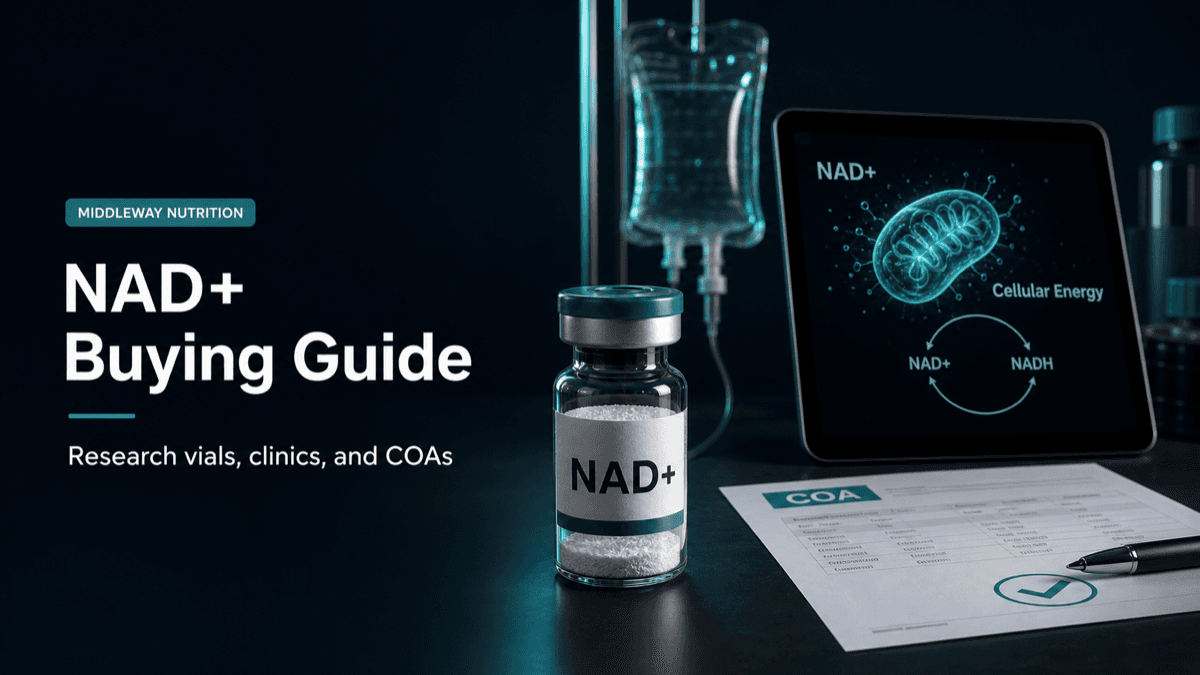
NAD+ sits in nearly every cell you have, runs your energy metabolism, and drops steadily as you age. That biology is real. The market that grew up around it is a different story, full of vague "complexes," pre-filled syringes, and 1000mg vials priced like they cost nothing to make.
If you've been searching where to buy NAD+, this guide skips the wellness-blog filler and tells you what legitimate sourcing actually looks like in 2026: which forms exist, what a real Certificate of Analysis should show, what you should expect to pay, and the red flags that most affiliate roundups quietly leave out because flagging them would cost a commission.
Key Takeaways
- NAD+ is not an FDA-approved drug. Injectable NAD+ is sold either as a research-use-only compound or as an off-label compounded prescription. There is no over-the-counter injectable pathway.
- Ascension Peptides is our top-rated research vendor: every batch independently tested by a third-party lab, certificates showing >98% HPLC purity, and 85 batch-specific certificates in a public library. New customers get 50% off with code PEPTIDEDECK.
- Always demand a batch-specific COA tied to the lot on your vial, not a generic product certificate. Purity should read ≥98% by HPLC.
- Technically NAD+ isn't a peptide. It's a dinucleotide coenzyme. Vendors group it with research peptides because it ships and reconstitutes the same way.
- Oral NAD+ is largely wasted by digestion. Most research interest in the injectable form is about getting the intact molecule past the gut.
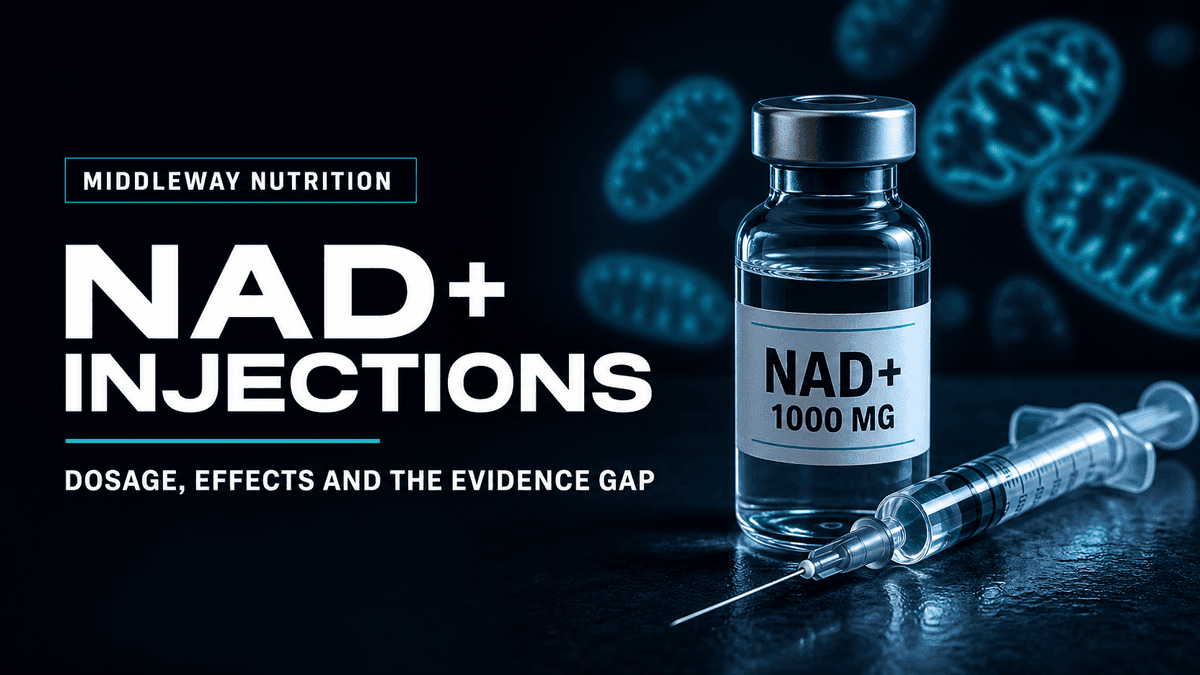
Buying NAD+ in 2026 means choosing between three very different lanes: research-grade lyophilized vials from peptide vendors (no prescription, research-use-only, roughly $70–$200 for 1000mg), compounded NAD+ injections through a 503A pharmacy and a telehealth script (legal, off-label, often $190+/month), or IV drips at a wellness clinic ($200–$1,200 per session). They are not the same product class, and the honest answer to "where to buy NAD+" depends on which of those lanes fits your risk tolerance and your budget. Here is what you actually need to know before spending a dollar.
What NAD+ Actually Is (and Isn't)
NAD+ stands for nicotinamide adenine dinucleotide. It is a coenzyme found in every living cell, central to the redox reactions that turn food into usable energy across glycolysis, the citric acid cycle, and oxidative phosphorylation. It is also the substrate that enzymes like the sirtuins, PARPs, and CD38 consume during DNA repair and cellular signaling. Cellular NAD+ levels are well documented to decline with age, which is the entire reason the longevity field cares about it.
A few honest clarifications the supplement aisle blurs:
- It is not a peptide. NAD+ is a dinucleotide, molecular formula C21H27N7O14P2, molecular weight about 663 g/mol. It only lives in the "research peptide" market because it ships as a lyophilized powder and is reconstituted the same way.
- It is not the same as NMN or NR. Those are precursors your body converts toward NAD+. A vial labeled "NAD+ complex" without a clear molecule is a label to avoid.
- It is not FDA-approved for human use in injectable form. Claims that it treats, cures, or reverses anything are marketing, not regulatory reality.
Research use is the honest framing. Vendors sell it for laboratory and in-vitro work, not for human consumption.
Where to Buy NAD+ in 2026
There is no pharmacy-counter NAD+ injection you can grab without paperwork. Every legitimate route is one of these three.
Research Vendors: Where Most Self-Directed Buyers Go
The bulk of people sourcing injectable NAD+ buy lyophilized research vials from peptide vendors. No prescription. Sold strictly for research use. Quality ranges from genuinely excellent to outright garbage, and the spread is enormous. The good operators send every batch to an independent lab, publish a COA you can match to your vial's lot number, and never tell you how to dose it for human use. The bad ones recycle a single generic certificate across every run and compete entirely on price. Vendor selection is the whole game here, which is the part of the "where to buy NAD+" question that actually decides whether you get something real.
Compounded NAD+: The Legal, Prescription Route
A 503A compounding pharmacy such as Empower prepares NAD+ injection as a 500mg lyophilized vial for a specific patient who has a prescription. This is the legal lane. It requires a licensed provider, usually via a telehealth platform, and it is dispensed off-label since the formulation itself is not FDA-evaluated. Telehealth services that bundle the consult and the compound run around $190 a month. You trade higher cost and a gatekeeper for pharmacy-grade preparation and a real chain of custody.
IV Clinics: Convenient and Expensive
Longevity and wellness clinics run NAD+ as a slow IV infusion. Highest bioavailability, fully administered for you, and by far the priciest per milligram. A 250mg session typically runs $200–$400; high-dose 1000mg infusions can reach $600–$1,200. Good if you want supervision and zero handling. Bad if you are cost-sensitive or want to run anything regularly.
Best Place to Buy NAD+: Ascension Peptides
Ascension Peptides is the research vendor we recommend — not because of commissions, but because they do the verification work most of this market skips.
Batch testing you can check yourself. Every batch is independently tested by a third-party lab (currently Kovera Labs; older batches by MZ Biolabs in Tucson), and 85 batch-specific certificates are published in a public COA library, so you are matching your own lot rather than trusting a generic PDF from a different synthesis run. We checked one Kovera report against the lab's own records, and it matched.
Purity that holds up. The certificate pass mark is >98% by HPLC, recent batches have tested between 98.9% and 99.9%, and the certificates also cover LC-MS identity, net content per vial, endotoxin, a rapid sterility screen and heavy metals. Plenty of cheaper vials hover lower, and that gap matters for any controlled work.
A full 1,000mg vial, US shipping. Their NAD+ comes as a 1,000mg vial at $104.00 USD, which works out to about 10.4 cents per mg. Shipping is free over $250 and is within the United States only.
Honest sourcing, straight terms. No "pharmaceutical grade" hand-waving with zero documents behind it. All sales are final, though damaged or incorrect items are replaced if reported quickly, and buying 3, 5 or 10 vials saves 3%, 5% or 10%. Check current pricing and availability at Ascension Peptides.
How to Verify NAD+ Quality: The COA Deep-Dive
Most guides tell you to "look for third-party testing" and stop there. Here is what actually separates a real certificate from theater.
Batch-Specific vs. Product-Level COAs
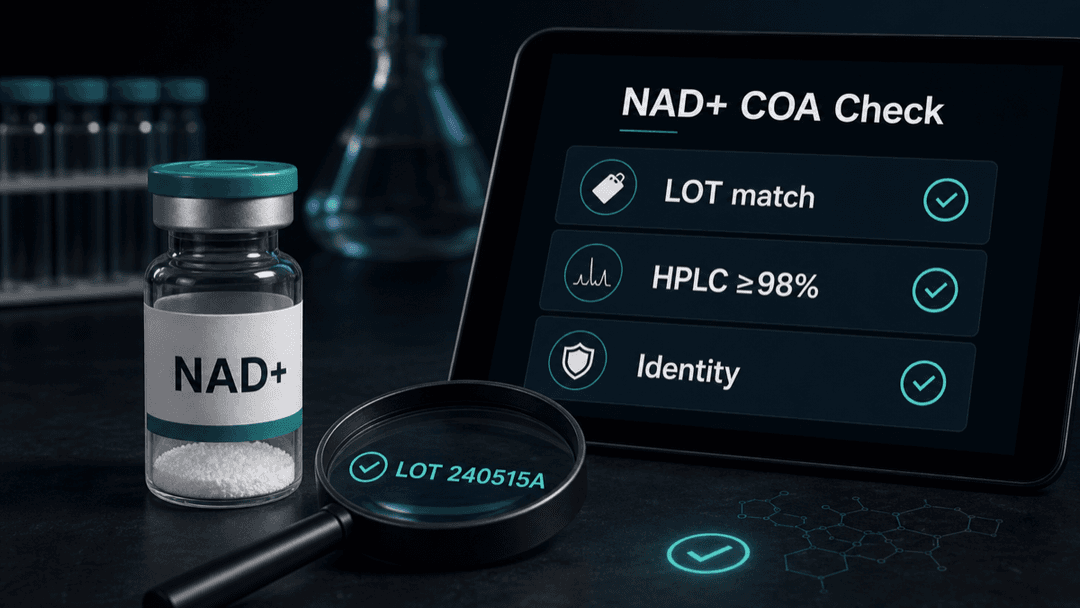
A product-level COA covers a product line and could have been run six months ago on a completely different batch. Some vendors recycle one forever. A batch-specific COA references the exact lot number printed on your vial, with a testing date and matching results. The lot on the vial should match the lot on the certificate. If it doesn't, or the vendor can't produce it, that's a no-sale.
What the Numbers Should Say
- HPLC purity ≥98%. This is the percentage of the sample that is actually NAD+. 95% is borderline; below that is a red flag.
- Mass spec identity confirmation. HPLC can show "high purity" of the wrong molecule, so an MS confirmation of identity matters.
- Verifiable lab. Names like Janoshik and MZ Biolabs run peptide and research-compound panels and have records you can cross-reference. A "lab" with no website is not a lab.
- Bonus on injectables: sterility and endotoxin (LPS). The better vendors test these too, which is meaningful for anything reconstituted.
If a COA has no lot number, a testing date older than six months, or a lab you can't find online, treat it as unverified.
What Does NAD+ Cost in 2026?
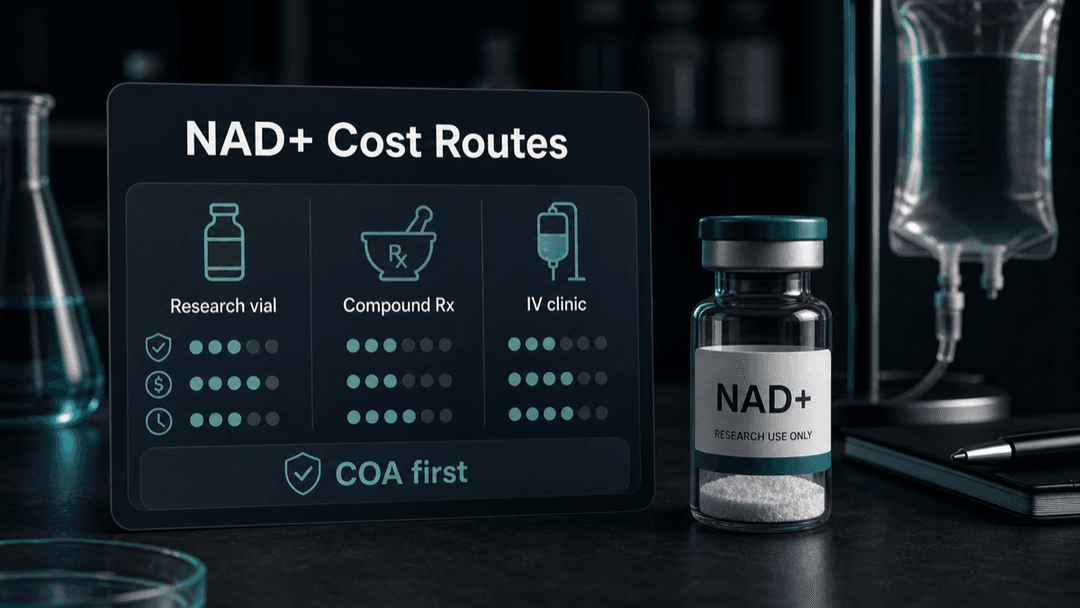
Price moves with form, size, and vendor tier. Rough ranges:
- Oral capsules (30-day): $25–$70. Cheap, but the molecule is poorly absorbed; most buyers chasing real exposure use precursors or injectables instead.
- 500mg research vial: $80–$180.
- 1000mg research vial: $120–$200, with some sale pricing dipping toward $70. Suspiciously low pricing usually means testing was the corner that got cut.
- Compounded injection (telehealth): roughly $190+/month including the consult.
- IV session: $200–$400 for 250mg, up to $600–$1,200 for high-dose infusions.
Across the research-vial tier, spending the extra $20–$40 for a vendor that publishes a real batch COA is almost always the right call. Cheap product is the single most common way people end up with underdosed or mislabeled vials. Vendor pricing moves often, so cross-checking a second where to buy NAD+ roundup before you commit is worth the five minutes.
Red Flags to Avoid
- Vague labeling. "NAD+ complex" with no molecule named, or no distinction from NMN/NR.
- Generic or missing COA. No batch-specific certificate means no verifiable quality. Full stop.
- Pre-filled syringes shipped direct-to-consumer. Legitimate research material ships as a sealed lyophilized powder, not a ready-to-inject syringe.
- Prices that are too good. 1000mg for under $50 with free shipping means something in the supply chain got skipped.
- "FDA-approved" claims. Injectable NAD+ is not FDA-approved. Anyone saying otherwise is lying or careless.
- No storage instructions. Lyophilized NAD+ needs cool, dark, dry storage; a vendor that doesn't mention it probably doesn't handle it well.
- No reviews anywhere. Check community boards. A vendor with zero footprint, good or bad, deserves caution.
How to Get NAD+
For the research-vial route, there's no prescription and no gatekeeper: you order from a vetted vendor online, and it arrives as a sealed lyophilized powder, usually with an ice pack. For the compounded route, you book a telehealth consult, get a script, and a 503A pharmacy ships the vial.
Either way, the powder must be reconstituted before any research use. Add bacteriostatic water slowly down the inside wall of the vial, swirl gently rather than shaking, and refrigerate at 2–8°C. Reconstituted NAD+ is less stable than many peptides; plan to use it within roughly 2–3 weeks and keep it out of light. As a rough yardstick, a 1000mg vial run at 50mg per use covers about 20 uses.
None of that is a dosing recommendation for humans. It's handling context for material sold for research use.
Vendor Comparison Table
Top Vendors
Ranked by purity, third-party testing, COA availability, and price.
>98% HPLC · Independent lab (Kovera Labs)
99% · Janoshik
99.3% HPLC · MZ Biolabs
>99% · Per-size COA
Listed (LC/MS) · Claimed
Pharmacy-grade · 503A pharmacy
Prices are approximate and change frequently. Always verify current pricing and COA availability before purchasing.
Related Buying Guides
Use these next if you are comparing adjacent research-peptide sourcing decisions:
- Where to buy MOTS-C
- Where to buy SS-31
- Where to buy Epithalon
- Where to buy 5-Amino-1MQ
- Where to buy Selank
Frequently Asked Questions
Where can I buy NAD+?
For research-use vials, reputable peptide vendors are the main channel; Ascension Peptides is our top pick for independent third-party testing of every batch, certificates showing >98% HPLC purity, and a public library of batch-specific COAs. For a prescription pathway, a telehealth provider plus a 503A compounding pharmacy (such as Empower) supplies compounded NAD+ injection off-label. For zero handling, longevity and IV clinics administer it as a drip.
Is NAD+ legal to buy?
Yes, with caveats. NAD+ itself is not a scheduled or controlled substance. Research vendors sell it legally for laboratory and research use only, not for human consumption. Compounded NAD+ injection is legal when prescribed by a licensed provider and prepared by a 503A pharmacy, though it is dispensed off-label because the formulation is not FDA-approved. Oral NAD+ is sold legally as a dietary supplement.
How much does NAD+ cost?
Research vials run roughly $80–$180 for 500mg and $120–$200 for 1000mg, with occasional sale pricing lower. Oral capsules are $25–$70 a month but poorly absorbed. Compounded injections via telehealth typically start around $190/month. IV clinic sessions range from $200–$400 for 250mg up to $600–$1,200 for high-dose infusions.
How do I know NAD+ is real and high purity?
Demand a batch-specific COA whose lot number matches your vial. It should show ≥98% purity by HPLC, ideally with mass-spec identity confirmation, from a verifiable lab such as Janoshik or MZ Biolabs. For injectable material, sterility and endotoxin (LPS) testing is a strong sign of a serious vendor. No lot number, an old testing date, or an unfindable lab means treat it as unverified.
Do I need a prescription for NAD+?
Not for research-use vials, which are sold without one for laboratory use only. You do need a prescription for compounded NAD+ injection from a 503A pharmacy, and clinics require an intake before an IV. Oral supplements need no prescription at all.
Is NAD+ a peptide?
No. NAD+ is a dinucleotide coenzyme, not a chain of amino acids. It gets lumped in with research peptides because it's sold as a lyophilized powder and reconstituted the same way, but chemically it's a different class of molecule.
Can you take NAD+ orally instead of injecting it?
You can, but absorption is poor. NAD+ is a large, charged molecule that is largely broken down in the gut, which is exactly why the injectable and IV forms exist and why oral protocols usually rely on precursors like NMN or NR instead.
The Bottom Line on Where to Buy NAD+
If you came here to figure out where to buy NAD+, the framework is simple. The molecule is genuinely central to how your cells make energy and repair themselves, and the age-related decline is real science. The market around it is the problem: vague labels, recycled certificates, and prices that only make sense if someone skipped the testing.
Your priorities should be COA first, vendor reputation second, price last. Ascension Peptides clears all three: batch-specific certificates from an independent lab, >98% HPLC purity, and a 1,000mg vial at $104.00 USD. If you want the legal, supervised route instead, a telehealth script into a 503A compounding pharmacy is the cleaner path, just at a higher cost.
Decide which lane fits you, verify the paperwork before you pay, and don't let a $30 saving talk you into a vial you can't trust.
Medical Disclaimer: The information in this article is for informational purposes only and does not constitute medical advice. NAD+ in injectable form is not FDA-approved and is not intended to diagnose, treat, cure, or prevent any disease. Research-use compounds are sold for laboratory and in-vitro use only and are not for human consumption. Always consult a qualified healthcare provider before beginning any new compound or protocol. The purchase and use of research compounds carries legal and health risks that vary by jurisdiction and individual circumstances.