Most NAD+ side effects are mild, transient and closely tied to dose and route: flushing, nausea, headache and a burning sensation at the injection site. The NAD+ side effects worth knowing about before you start are the ones specific to infusion, which are uncomfortable but manageable if the rate is controlled, and the long term unknowns, which are simply unmeasured.
The form matters more than most articles admit. Niacin, nicotinamide, nicotinamide riboside, NMN and injectable NAD+ share a destination but not a side effect profile.
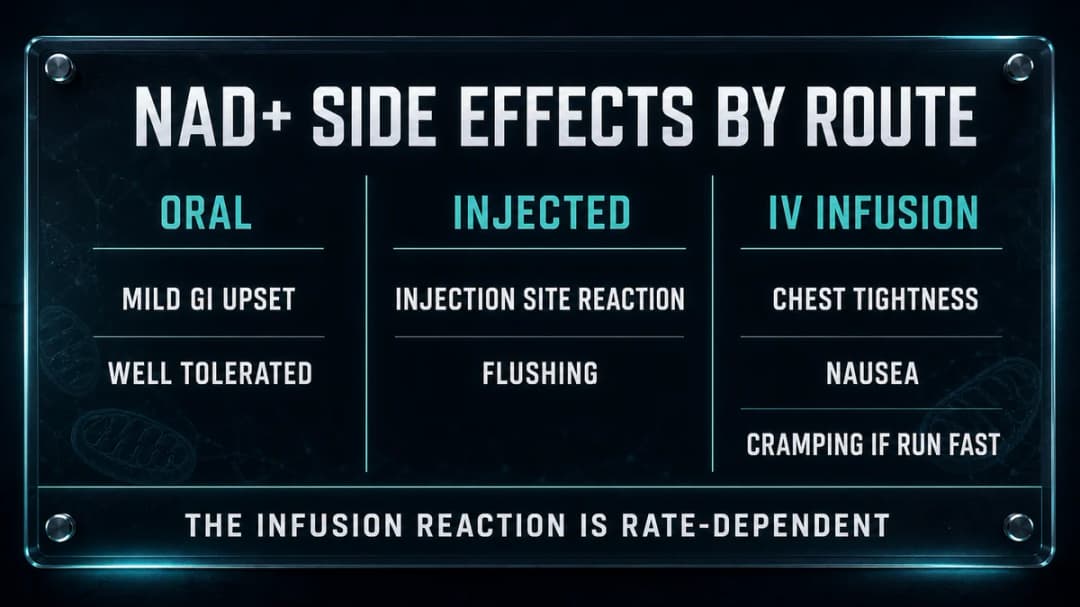
NAD+ Side Effects by Form and Route
| Form | Commonly reported | Notes |
|---|---|---|
| Niacin (nicotinic acid) | Pronounced flushing, itching, warmth | The flush is a prostaglandin mediated effect, not an allergy |
| Nicotinamide | Generally well tolerated at ordinary doses | Liver enzyme elevation has been reported at multi gram daily intakes |
| Nicotinamide riboside | Mild nausea, headache, occasional GI upset | The best studied precursor by trial count |
| NMN | Mild nausea, headache, flushing occasionally | Short trials only, generally uneventful |
| NAD+ subcutaneous | Burning at the site, flushing, transient fatigue | The sting is the most consistent complaint |
| NAD+ intravenous | Flushing, chest tightness, nausea, abdominal cramping during infusion | Rate dependent. Slowing the drip usually resolves it |
The Infusion Reaction
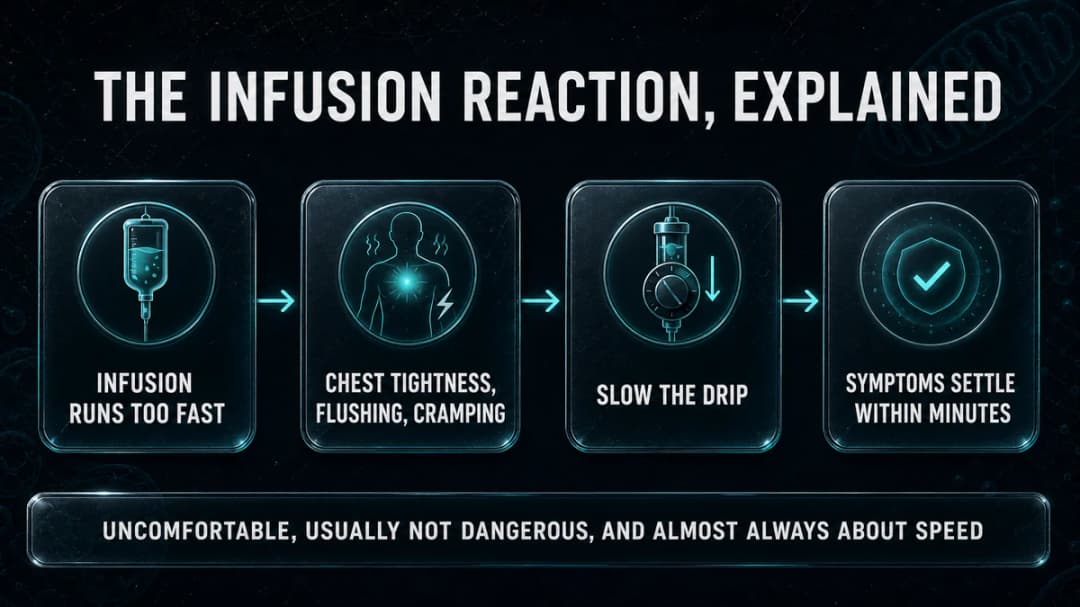
This is the one people are least prepared for. During a fast NAD+ infusion many people experience a wave of chest pressure, flushing, nausea and abdominal cramping that builds over a minute or two.
It is not an allergic reaction and it is not cardiac in origin in most cases, but it is unpleasant enough that people stop mid session. The standard response is to slow the infusion rate substantially, which typically resolves it within minutes. A well run clinic will start slow and titrate up rather than the reverse.
Chest pain that does not settle when the infusion is slowed and stopped needs assessment, not reassurance. Anyone with known cardiac disease should not be receiving NAD+ infusions outside a supervised medical setting.
Injection Site Reactions
Subcutaneous NAD+ stings. The burning tends to scale with the concentration and the volume delivered, and it is the single most consistent report from home injectors.
Practical mitigations reported to help include diluting to a lower concentration, injecting more slowly, allowing the solution to reach room temperature first, and rotating sites. Redness and a small lump at the site are common and usually settle within a day. Spreading redness, warmth, or fever after an injection points toward infection and needs medical attention.
Where the Serious Risks Actually Sit
High dose nicotinamide and the liver. Nicotinamide taken at multi gram daily doses has been associated with raised liver enzymes in the older literature. Ordinary supplement doses are far below that range, but people stacking several NAD supporting products can arrive at a larger total intake than they realise.
Existing cancer. This concern is theoretical and should be described as such. Many tumours are metabolically dependent on NAD, and preclinical work has raised the question of whether raising NAD availability could support tumour cell survival. There is no human evidence that NAD supplementation causes or accelerates cancer. Given the uncertainty, anyone with active malignancy or on chemotherapy should not use these products without oncology input.
Blood pressure and glucose. Both niacin and, at higher doses, other NAD precursors can affect blood pressure and glycaemic control. Anyone on antihypertensives or diabetes medicines should treat this as a reason to monitor rather than a reason to panic.
Product quality on the injectable side. Vials sold for research use are not made to injectable drug standards. Contamination, endotoxin and mislabelled content are real failure modes and they do not appear as side effects of NAD+ so much as side effects of the supplier. See where to buy NAD+ for what a usable certificate of analysis contains.
Interactions Worth Raising with a Prescriber
- Diabetes medicines, because of possible additive glucose effects
- Blood pressure medicines, because of possible additive lowering
- Anticoagulants, where high dose niacin has been flagged for platelet effects
- Chemotherapy agents, given the tumour metabolism question
- Any medicine with a narrow therapeutic index, simply because the interaction data here is sparse rather than reassuring
The honest position is that the interaction literature for NAD precursors is thin. Absence of reported interactions is not the same as evidence of safety in combination.
Who Should Avoid It
- Anyone pregnant or breastfeeding, since no safety data exists
- Anyone with active cancer or receiving cancer treatment, without specialist agreement
- Anyone with significant liver disease, particularly with high dose nicotinamide
- Anyone with known cardiac disease considering IV infusion outside a clinical setting
- Children and adolescents, for whom there is no data at all
When to Stop and Seek Advice
Stop and get medical advice for chest pain that persists after an infusion ends, spreading redness or fever at an injection site, yellowing of the skin or eyes, dark urine, unexplained bruising, or any reaction involving breathing difficulty or facial swelling.
Mild flushing, a short lived headache, or a stinging injection site are not emergencies and usually settle with a lower dose or a slower delivery.
The more general principle is worth stating. Because none of these products is regulated as a medicine, there is no pharmacovigilance system collecting adverse events, no label listing known reactions, and no mechanism by which a pattern of harm would become visible. What exists instead is forum reports and clinic observations, which pick up dramatic events and miss slow ones entirely. That is a reason for a low threshold to stop and ask, not a reason for reassurance.
If you are weighing formats, our NAD+ injections guide covers the practical side and NAD+ vs NMN covers why the oral precursor route has both the better evidence and the milder profile.
FAQ
Does NAD+ cause anxiety or a racing heart?
Some people report palpitations and a jittery feeling, most often during or shortly after an infusion. It usually settles when the rate is reduced. Persistent palpitations should be assessed rather than assumed to be the supplement.
Why does the NAD+ injection burn so much?
The sting appears to relate to concentration and pH of the reconstituted solution rather than an adverse reaction. Lower concentrations, slower delivery and room temperature solution are the mitigations people report as most helpful.
Can NAD+ damage your liver?
Ordinary precursor doses are not associated with liver injury. Nicotinamide in the multi gram daily range has been associated with liver enzyme elevation, so total intake across stacked products is worth adding up. Existing liver disease is a reason to involve a clinician.
Are NAD+ side effects worse with IV than injections?
They are different rather than uniformly worse. IV produces the flushing and chest pressure reaction during administration but no injection site burn. Subcutaneous injection produces the burn but rarely the systemic reaction. Both are dose related.
How long do NAD+ side effects last?
Infusion reactions resolve within minutes of slowing or stopping. Flushing and headache typically settle within a few hours. Injection site soreness usually clears within a day. Anything lasting longer than that is worth reviewing with a clinician.