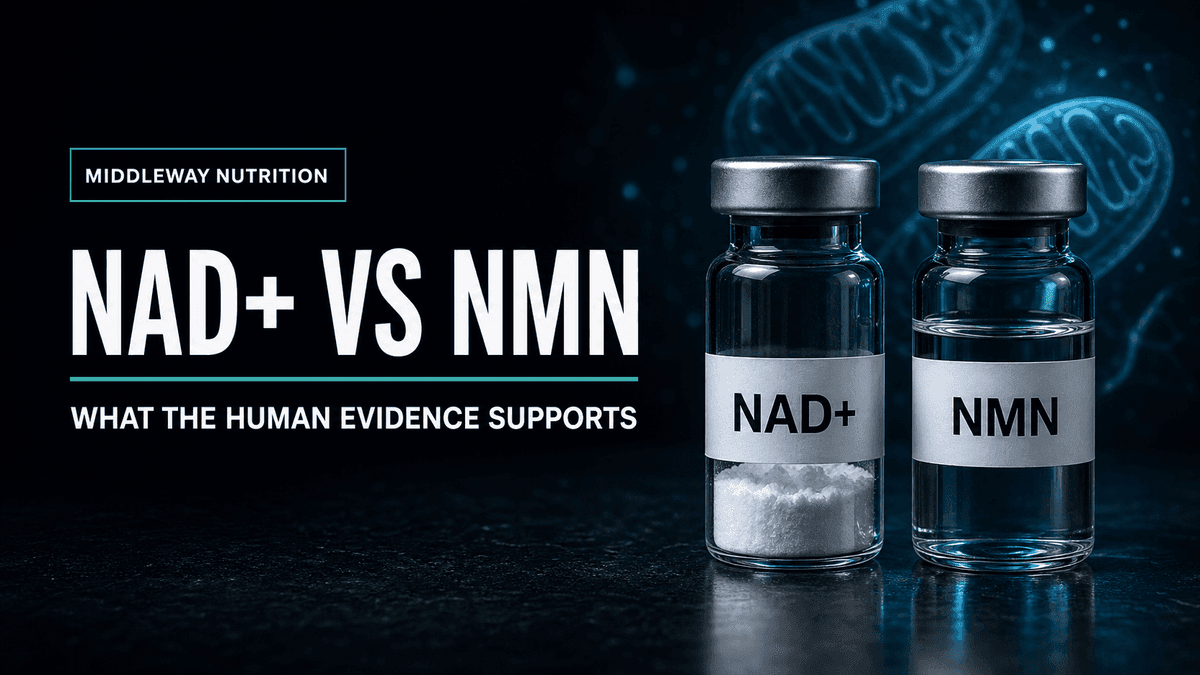
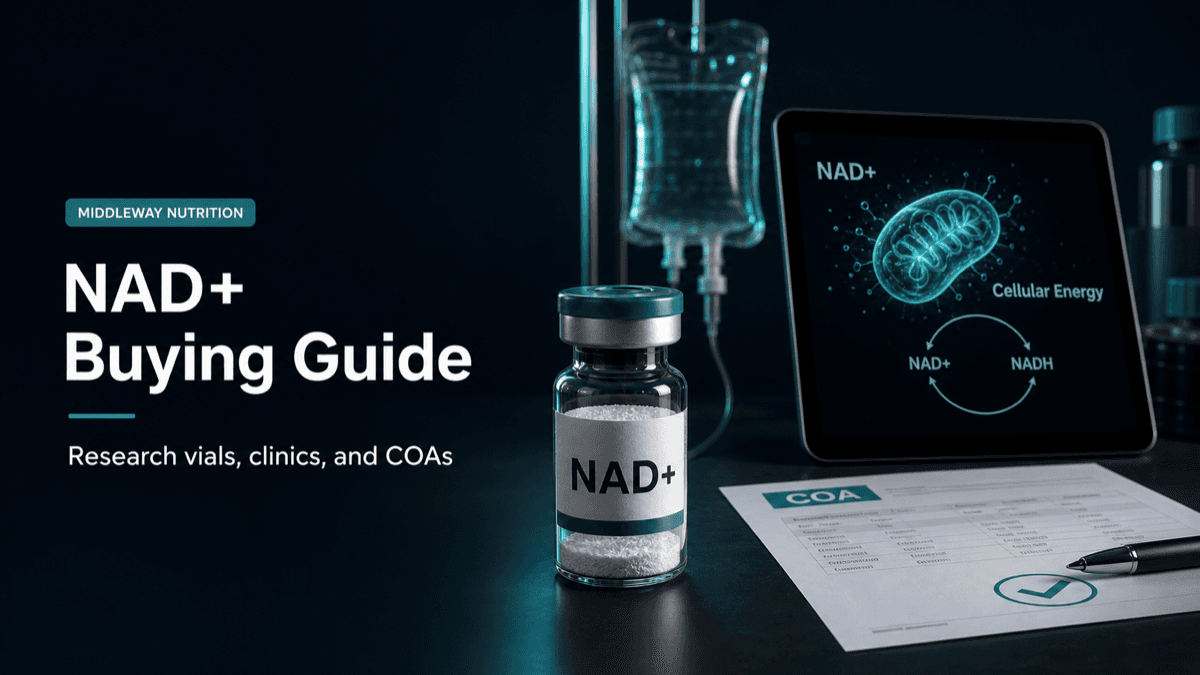
NAD+ for sale currently runs $104.00 for a 1,000mg vial, about $0.10/mg, and the only thing separating a real vial from a cheaper lookalike is a batch-specific certificate you can actually match to the lot code in your hand. This compound is unusually easy to fake. NAD+ has close relatives on the same catalog shelf: NADH, NMN, nicotinamide riboside, plain nicotinamide. All white lyophilized powders, all cheaper, and nicotinamide is what NAD+ degrades into when handled badly. A vial can be genuinely pure and still be the wrong molecule.
For sellers lined up side by side, our where to buy NAD+ guide handles vendor comparison. This page covers price, specs, and how to confirm what arrived.
Key Takeaways
- Current best price is $104.00 for 1,000mg, roughly $0.10/mg, against a wider market band of $0.25 to $0.50/mg at smaller sizes.
- NAD+ is not a peptide. It is a dinucleotide coenzyme: C21H27N7O14P2, 663.43 g/mol, CAS 53-84-9. Those are your reference values on any certificate.
- A COA only counts if its lot number matches the code on your vial. Product-level PDFs prove nothing about your batch.
- The most useful identity check is UV: NAD+ absorbs near 260 nm and barely at all at 340 nm, while NADH absorbs strongly at 340 nm.
- Salt form matters: a gram of disodium salt holds less NAD+ than a gram of free acid.
NAD+ Price and Specs
Ascension Peptides pricing, verified 27 September 2026. Prices move.
| Spec | Detail |
|---|---|
| Size | 1,000mg |
| Price | $104.00 USD |
| Per mg | $0.10/mg |
| Purity | >98% HPLC certificate pass mark, every batch third-party tested |
| Batch COAs | Batch-specific, published in a public certificate library |
| Form | Lyophilized powder, sealed glass vial |
| Ships | United States only, free over $250 |
Current listing: Ascension Peptides NAD+ 1,000mg. What earns the recommendation is the paperwork: batch-specific certificates from an independent lab (currently Kovera Labs), published in a public library, rather than one recycled product PDF. New customers get 50% off with code PEPTIDEDECK.
Pricing Sanity Check
Because NAD+ ships in far larger quantities than peptides, price per milligram is the only comparison that means anything. Across US-facing research sellers the field generally lands somewhere around $0.25 to $0.50 per mg, with the rate falling as vial size climbs. That is why gram vials tend to price below the band while small vials sit well above it.
An outlier low price is the most reliable early warning you get. Nicotinamide costs a fraction of what NAD+ costs, and independent testing adds a fixed per-batch charge, making it the first line item a lazy supplier deletes.
One trap specific to this compound: check the salt form before comparing. The disodium salt weighs about 7% more per molecule than the free acid, so a 1,000mg vial of salt holds less actual NAD+. Vendors rarely say which they sell. Ask.
What You Are Actually Buying
NAD+ stands for nicotinamide adenine dinucleotide, a coenzyme in every cell you have. It carries electrons through the reactions that turn food into energy and is consumed as a substrate by enzymes involved in DNA repair and cellular signaling. Cellular levels decline with age, which is why the longevity market cares.
One category error to be blunt about: NAD+ is sold alongside research peptides and labeled "NAD+ peptide". It is not a peptide and contains no amino acids; it landed in that market because it lyophilizes like one. A vendor listing "NADH" as a synonym is copying text, not describing a compound.
A website listing NAD+ for sale is also not a pharmacy. Read the footers: sold for research or laboratory use only, not for human or animal consumption. So there is no over-the-counter injectable pathway, nobody inspects what ships, and the vendor's own testing is the entire quality system.
How to Read a NAD+ COA
Most buyers see a large percentage next to the word purity and stop reading. Here is the order the checks should happen in.
Match the lot number and date first. Your vial carries a batch code and the certificate should reference that exact code, dated near the production run. No lot number, a different one, or a report from years before your order means the document describes material you did not receive. Recycling one PDF across every batch is the commonest shortcut in this market. This is why a vendor that can produce a lot-matched report ID on request is telling you something a purity percentage never can.
Demand the chromatogram, not the headline figure. A real HPLC report shows the trace: a main peak with its retention time, plus impurity peaks and their percentages. A purity figure typed into a text box takes seconds to fake, and a vial can be 99% pure by HPLC and still be underfilled or the wrong species entirely.
Find the mass spec. HPLC tells you how pure the sample is; mass spectrometry tells you what it is. For NAD+ you want an observed mass near 663 g/mol for the free acid, or 707 for the disodium salt. A number near neither is a problem.
Read the UV data, and ask if it is missing. This is the check almost nobody performs and the one best suited to this compound. NAD+ absorbs strongly near 260 nm and negligibly at 340 nm; NADH absorbs strongly at 340 nm. That difference underpins decades of standard enzyme assays. Meaningful 340 nm absorbance in material sold as NAD+ means the reduced form is present or storage went wrong.
Look for the nicotinamide peak. NAD+ hydrolyzes over time into nicotinamide and ADP-ribose. A thorough certificate accounts for those related substances instead of presenting the compound as one perfect species. Small quantities are normal chemistry; total absence usually means nobody looked.
Third-Party Testing, or It Does Not Count
In-house testing is a vendor grading its own homework: the party with a financial interest in a passing result is the party producing it. Third-party means an independent lab with no stake in whether your vial sells, named on the certificate alongside a report ID, the method and a date. Some sellers publish the lab openly. Hold the rest to that standard.
Two dodges recur: a lab that turns out to be a subsidiary of the manufacturer, and a cropped chromatogram with the header removed, which hides lot number, date and lab identity at once.
What Actually Arrives
A sealed glass vial holding lyophilized powder as a white to off-white cake, crimp-sealed and labeled with compound name, quantity and a lot number matching your paperwork. Unlike a small peptide vial, which often looks empty, a gram NAD+ vial holds a visible amount of material. If one sold as 1,000mg looks nearly empty, take that seriously.
NAD+ powder is hygroscopic and absorbed water accelerates hydrolysis, so keep the vial sealed until use. Reconstituted material is a short-term refrigerated proposition, not a stockpile. Anything arriving pre-mixed as liquid is a problem: you cannot tell what the powder weighed, and the degradation clock started when the seller mixed it.
Red Flags That Mean Walk Away
- No lot number on the vial, or one COA reused across every batch with no dates or chromatogram.
- Purity claimed with no chromatogram. A number in a box is not data.
- "NAD+; NADH" listed as synonyms, or NMN and NR used interchangeably with NAD+.
- CAS number "available upon request." It is 53-84-9. A seller who will not print it either does not know or does not want you checking.
- Pre-mixed liquid vials sold as ready to use.
- Dosing protocols or human results in the product copy.
- Price far below the field with no explanation.
Quick Pre-Purchase Checklist
- Is there a real, dated, lot-specific COA, and does that lot match the vial?
- Is purity shown with a chromatogram rather than asserted as a number?
- Does a mass spec result appear near 663 g/mol, or 707 for the disodium salt?
- Is the testing lab independent and named, with a report ID?
- Is the salt form stated, so you know what you pay per milligram?
- Does the price make sense per mg for the size you are buying?
- Does it ship as sealed lyophilized powder, framed as research use with no dosing advice?
Legal and Safety Reality
NAD+ is not FDA-approved for treating any condition, and no approved injectable NAD+ drug product exists. Buying it framed as a research chemical is generally legal; marketing it for human use is not, and vendors who blur that line take a regulatory risk on your behalf. Human evidence for injected NAD+ is limited and long-term data is thin, so treat any seller who speaks with certainty as one who has not read the literature.
Frequently Asked Questions
How much does NAD+ cost?
A 1,000mg vial currently sells for $104.00, about $0.10/mg, and gram vials generally fall lower per mg than smaller sizes. Smaller vials run far higher per mg across the market. Well below the field usually means skipped testing, an underfilled vial, or a cheaper substitute.
Is NAD+ legal to buy?
In the US, research suppliers sell NAD+ as a research chemical for laboratory use rather than as a drug, and buying it in that framing is generally legal. No approved injectable NAD+ drug product exists, and marketing it for human consumption is not permitted. Rules vary by country.
How do I know NAD+ is real?
Verify the batch, not the brand. Match the vial's lot number to a dated certificate from a named lab, confirm purity with a visible chromatogram rather than a typed figure, and check the mass spec identity near 663 g/mol. Published UV data should show strong absorbance near 260 nm and essentially none at 340 nm, which separates NAD+ from NADH.
Do I need a prescription for NAD+?
Not from a research supplier, since that material is sold for laboratory use and no prescription pathway applies. Compounded injectable NAD+ from a pharmacy does require one. Two products, two sets of rules.
Is NAD+ the same as NMN or NR?
No. Both are precursors the body converts along the pathway toward NAD+, with different molecular weights and different prices. A vial labeled "NAD+ complex" without naming the actual compound is a label to avoid.
Where to Buy With Confidence
If you have worked the checklist and want a source that already clears it, Ascension Peptides is where we send people for NAD+: 1,000mg vials at $104.00 USD, every batch third-party tested with certificates showing >98% HPLC purity, LC-MS identity, net content, endotoxin, a rapid sterility screen and heavy metals, 85 batch-specific certificates in a public library, free shipping over $250 within the United States (it does not ship abroad), and copy that stays honest about what the compound is.
Verify before the money moves. With this compound the certificate is the product.
Medical disclaimer. NAD+ sold by research suppliers is intended for research and laboratory use only. It is not approved by the FDA for the treatment of any condition, and nothing on this page is medical advice or a recommendation for human use. Consult a qualified healthcare professional about any health decision.