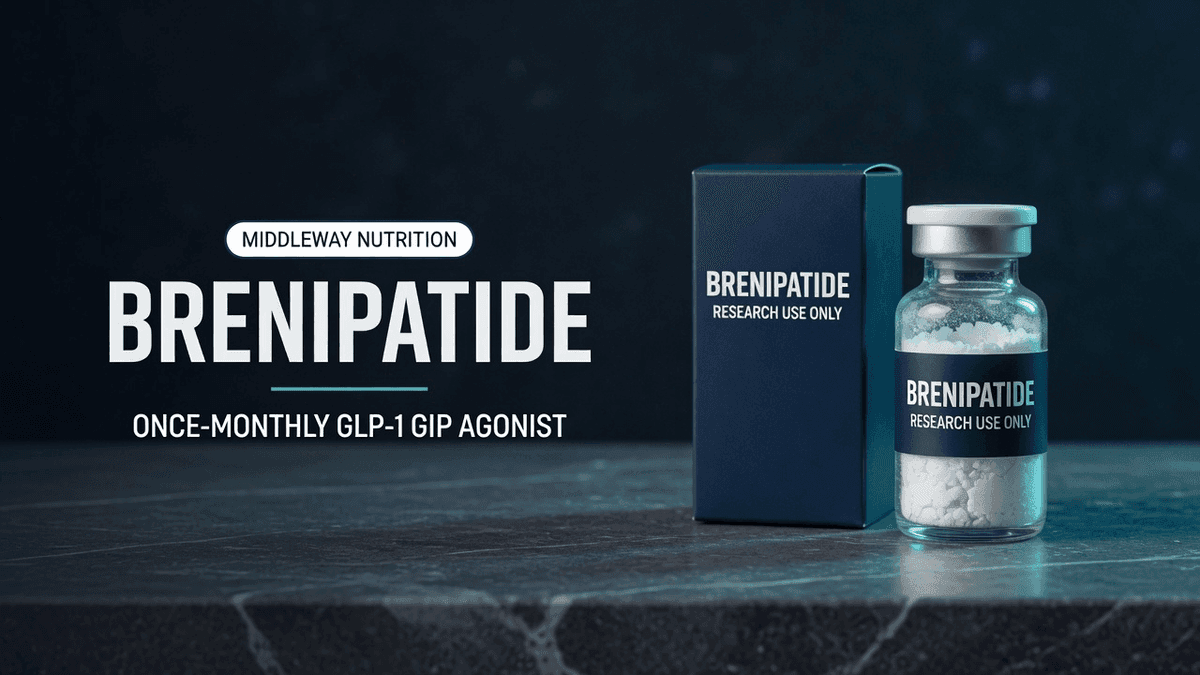
Brenipatide is an investigational once-monthly GLP-1 and GIP receptor agonist from Eli Lilly, and the thing that makes it unusual is that it was not developed as a weight loss drug. The stated focus for brenipatide is addiction and psychiatric conditions, which is a genuinely different strategic bet from every other compound in this class.
Before anything else: no efficacy results have been published for it. Everything below describes a development programme and a rationale, not demonstrated outcomes, and pipeline status changes frequently enough that anyone seriously interested should check the clinical trials registry directly rather than relying on any article.
What Brenipatide Is
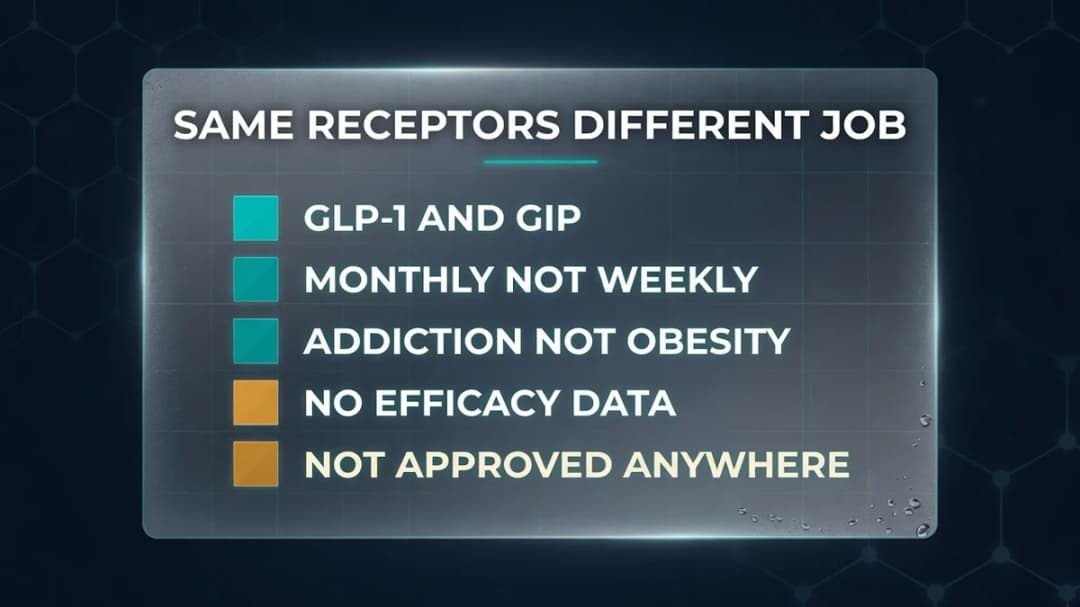
Brenipatide, carrying the development code LY-3537031, is a synthetic peptide that activates two receptors: GLP-1 and GIP. Those are the same two targets as tirzepatide, the molecule in Mounjaro and Zepbound.
The engineering difference is duration. Brenipatide is designed for once-monthly subcutaneous injection, against weekly dosing for tirzepatide and semaglutide, which requires a substantially longer elimination half-life.
Same receptors, different pharmacokinetics, and a completely different clinical target list.
Why the Monthly Dosing Is the Point
It is tempting to read monthly dosing as a convenience feature. In the populations this drug is aimed at, it is closer to a design requirement.
Treatment discontinuation in addiction medicine is high, and it happens early. A medicine that requires a correct decision every week from someone in active alcohol or opioid dependence is fighting the condition it treats. Serious psychiatric illness carries similar adherence challenges, for reasons that have nothing to do with willingness.
A single monthly injection administered in a clinic changes that arithmetic. One decision a month, made in a supported setting, is a very different proposition from four unsupervised ones.
That is the actual argument for the molecule, and it is a reasonable one independent of how well the drug turns out to work.


Why Target Addiction With a GLP-1 Drug
The interest here did not come from a laboratory hypothesis. It came from patients.
People taking GLP-1 drugs for diabetes and obesity began reporting reduced desire for alcohol, and in some cases for nicotine and other substances. Those reports were frequent and consistent enough to prompt formal investigation, and observational analyses have since supported a signal worth studying properly.
The mechanistic explanation involves the brain rather than the gut. GLP-1 receptors are expressed in regions involved in reward processing, and the working hypothesis is that these drugs modulate reward signalling in a way that reduces the drive toward substances as well as toward food. The same reasoning underlies the term food noise that GLP-1 users often use.
That hypothesis is plausible and incomplete. Our article on GLP-1 drugs and addiction covers the current state of that evidence in more detail.
The Development Programme
Lilly's disclosed programme for brenipatide spans a notably wide set of indications: substance use disorders including alcohol, mood and psychotic disorders, and a set of earlier-stage metabolic and cardiovascular indications.
That breadth is itself informative. A company running a molecule across this many conditions is testing a general hypothesis about reward and appetite signalling rather than pursuing one indication.
What is not available is efficacy data. Nothing has been published showing what brenipatide does in any of these conditions, and until phase 3 results appear the honest answer to whether it works is that nobody knows.
What Monthly Dosing Changes Pharmacologically
A longer dosing interval is not a free convenience upgrade, and it is worth understanding the trade.
Weekly drugs in this class are titrated upward in small steps precisely because gastrointestinal side effects cluster around dose increases. With a monthly interval, that fine-grained escalation is harder: each step commits the patient to a month at the new level, and an intolerable dose cannot be walked back quickly.
There is also the question of what happens between injections. A drug engineered to last a month will have a different concentration profile across that month than a weekly drug does across a week, and appetite and nausea effects tend to track concentration.
None of this is unmanageable, and long-acting injectables are well established in psychiatry for exactly the adherence reasons described above. It does mean the tolerability picture for a monthly incretin drug is genuinely unknown rather than predictable from what weekly drugs do.
What This Is Not
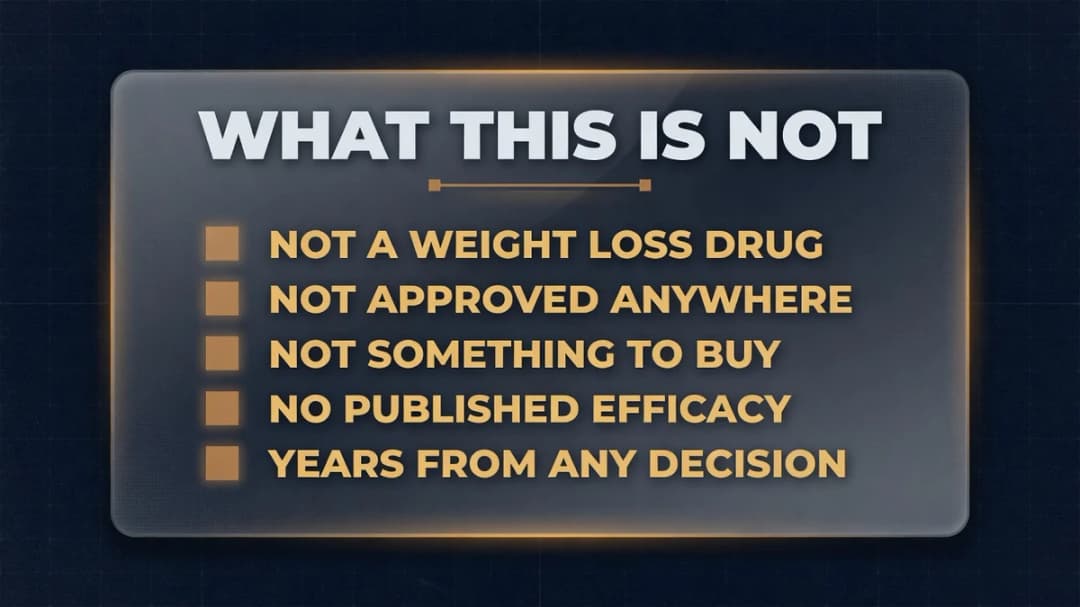
Not a weight loss drug you will be prescribed. Obesity indications sit at the earliest stage of the programme, well behind the psychiatric and addiction work.
Not available. It is investigational, with no approval anywhere. Realistic timelines put an earliest possible regulatory decision several years out, and that assumes trials succeed.
Not something to buy. Any product sold online as brenipatide is not the investigational compound. Molecules in active clinical development do not reach research chemical vendors through legitimate routes, and what arrives in the vial is unknown.
How It Fits the Wider Class
| Semaglutide | Tirzepatide | Retatrutide | Brenipatide | |
|---|---|---|---|---|
| Receptors | GLP-1 | GLP-1, GIP | GLP-1, GIP, glucagon | GLP-1, GIP |
| Dosing | Weekly | Weekly | Weekly | Monthly, investigational |
| Primary target | Diabetes, obesity | Diabetes, obesity | Obesity | Addiction and psychiatric conditions |
| Status | Approved | Approved | In development | In development |
The pattern across the class has been to add receptors in pursuit of greater metabolic effect. Brenipatide breaks from that: it keeps the established dual-receptor mechanism and changes the duration and the destination instead.
For related reading, see our overview of new GLP-1 drugs in development, the Eli Lilly product line, and our article on GLP-1 effects on the brain.
Frequently Asked Questions
What is brenipatide used for?
It is investigational and not approved for anything. The development programme is focused on addiction, including alcohol use disorder, and psychiatric conditions, with metabolic indications at a much earlier stage. It is not being developed primarily as a weight loss drug.
How is brenipatide different from tirzepatide?
It targets the same two receptors, GLP-1 and GIP, but is engineered for once-monthly rather than weekly dosing and is aimed at a different set of conditions. Tirzepatide was optimised for metabolic effect; brenipatide was optimised for duration and for populations where weekly adherence is a genuine barrier.
When will brenipatide be available?
Not for several years at the earliest, and only if trials succeed. Compounds in this stage of development commonly take years to reach a regulatory decision, and many do not get there at all. Anyone tracking it should follow the clinical trials registry rather than news coverage.
Does brenipatide cause weight loss?
It activates the same receptors as tirzepatide, so weight loss would be expected as a pharmacological effect, but no efficacy data has been published for brenipatide in any indication. The magnitude at monthly dosing is unknown.
Can you buy brenipatide?
No. It is an investigational compound in active clinical development and is not legitimately available outside trials. Anything sold online under that name is of unknown identity and should not be used.