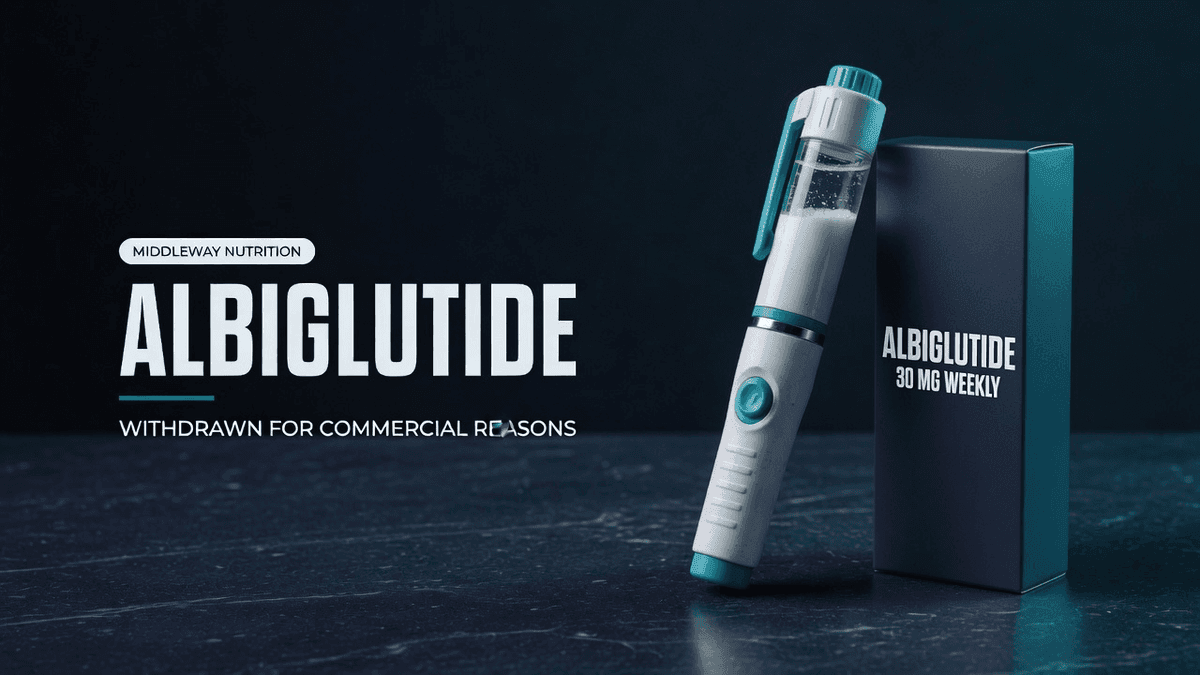
Albiglutide (Tanzeum) was a once-weekly GLP-1 receptor agonist for type 2 diabetes, approved in 2014 and pulled from the market by GSK in 2017 for commercial reasons rather than safety ones. The story of albiglutide (Tanzeum) is unusual in that the drug was not withdrawn because it failed. It was withdrawn because it worked slightly less well than its competitors on the measures that turned out to matter most, and in a crowded class that was enough.
It has one further twist: after the withdrawal decision, a large outcomes trial reported that it reduced cardiovascular events.
What albiglutide (Tanzeum) was
Albiglutide was a long-acting GLP-1 receptor agonist built by fusing two modified GLP-1 peptides to recombinant human albumin. That albumin tail was the engineering solution to a basic problem: native GLP-1 has a half-life measured in a couple of minutes, which makes it useless as a drug. Attached to albumin, albiglutide cleared with a half-life of roughly five days, allowing once-weekly injection at a time when the alternative was twice-daily exenatide.
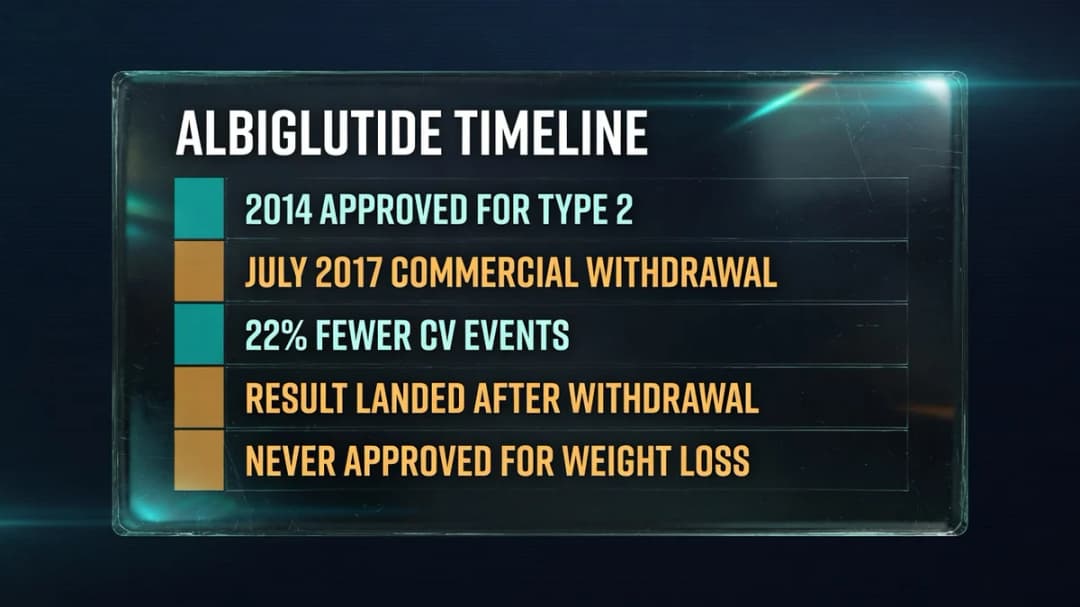
The FDA approved it in April 2014 as Tanzeum. The European Medicines Agency approved it the same year as Eperzan. Both approvals covered type 2 diabetes in adults alongside diet and exercise. It was never approved for weight loss and was never indicated in type 1 diabetes.
How it worked
The mechanism was standard for the class. Albiglutide bound the GLP-1 receptor on pancreatic beta cells and prompted glucose-dependent insulin release, meaning insulin came out when blood sugar was high and the effect quietened when it was not. That glucose dependence is why GLP-1 drugs used alone carry low hypoglycaemia risk. It also suppressed glucagon, slowed gastric emptying, and acted on appetite signalling.
The albumin fusion did something else, though, and this is the part that explains the drug's commercial fate. A large molecule does not readily reach the central nervous system, and the appetite-suppressing effects of GLP-1 drugs depend substantially on central action. Albiglutide was, in effect, engineered for duration in a way that blunted the very effect that would later become the class's main selling point.
Dosing
Simple by the standards of the class.
| Albiglutide | |
|---|---|
| Starting dose | 30 mg subcutaneously once weekly |
| Higher dose | 50 mg once weekly if glycaemic control was inadequate |
| Half-life | Around 5 days |
| Titration | Effectively a single step |
| Indication | Type 2 diabetes in adults |
Compared with the multi-step titrations of semaglutide or tirzepatide, this was refreshingly uncomplicated, and reflects a drug developed when glucose control rather than weight loss was the target.
Why it was withdrawn
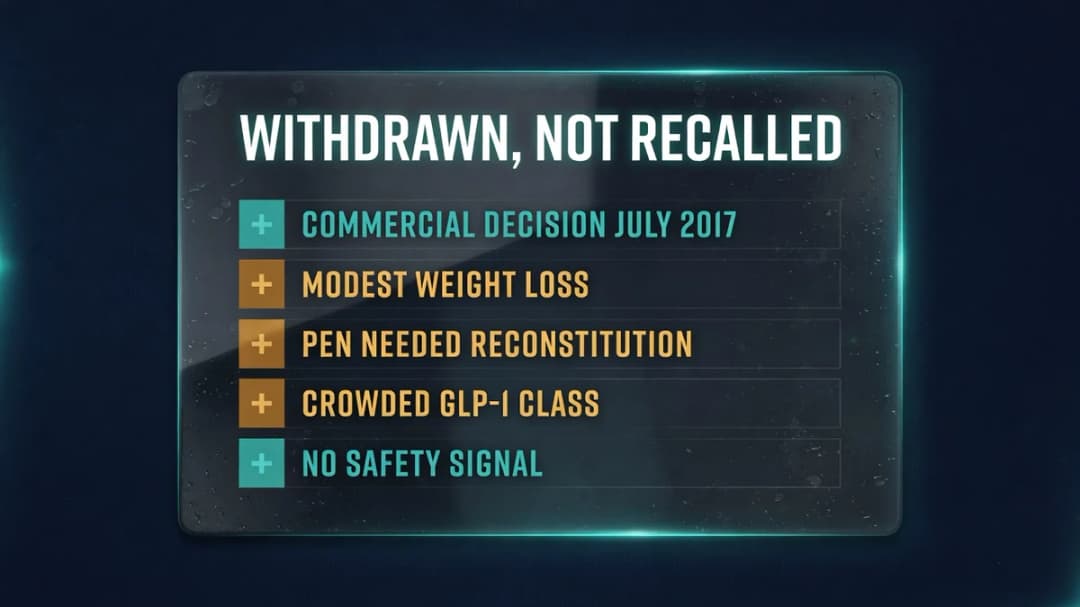
GSK announced the discontinuation in July 2017, three years after launch, and was explicit that the decision was commercial.
Three things worked against it.
Weight loss was modest. Dulaglutide and liraglutide produced more, and semaglutide, arriving in the same period, produced substantially more. By the mid-2010s prescribers and patients were increasingly choosing GLP-1 drugs partly for weight effects, and albiglutide's albumin fusion had capped exactly that.
The device was awkward. The pen required reconstitution before injection, which is a meaningful usability difference from a competitor's ready-to-use pen. Small frictions matter a great deal for a weekly self-injected drug.
The class got crowded fast. Trulicity launched in the same window with better efficacy and an easier device. There was no obvious patient for whom albiglutide was the best answer.
None of that is a safety story. The drug was not recalled, no signal emerged, and patients on it were transitioned to alternatives in an orderly way.
The cardiovascular result that arrived too late
The HARMONY Outcomes trial tested albiglutide in people with type 2 diabetes and established cardiovascular disease, and reported a roughly 22% relative reduction in major adverse cardiovascular events compared with placebo.
That is a genuinely good result and it landed after the commercial decision had been made. It did not bring the drug back, and its main significance now is as evidence for the class: cardiovascular benefit turned out to be a fairly general property of GLP-1 receptor agonists rather than something unique to one molecule.
What replaced it
Anyone who was on Tanzeum before 2017 was moved to something else, and the modern options are considerably better.
| Drug | Dosing | Notes |
|---|---|---|
| Semaglutide (Ozempic) | Weekly injection | Stronger glucose and weight effects, cardiovascular outcome data |
| Dulaglutide (Trulicity) | Weekly injection | The direct competitor that outsold it, simple device |
| Tirzepatide (Mounjaro) | Weekly injection | Dual GIP and GLP-1, larger effects on both glucose and weight |
| Oral semaglutide (Rybelsus) | Daily tablet | For people who will not inject |
Our GLP-1 drug list covers the current class, and the semaglutide guide and Trulicity guide cover the two most common replacements.
Why the story is worth knowing
Albiglutide is a useful reminder that a drug being withdrawn tells you very little on its own. Withdrawals happen for safety reasons and they happen because a product loses a commercial race, and the two are frequently confused.
It is also a case study in how a design choice can quietly decide a drug's fate. The albumin fusion solved the duration problem elegantly and, in doing so, limited the effect that the market ended up valuing most. Nobody could have known in advance that appetite would matter more than convenience.
FAQ
Why was Tanzeum discontinued?
GSK withdrew it in July 2017 for commercial reasons. It produced less weight loss than competing GLP-1 drugs, its pen required reconstitution before injection, and the class had become crowded. There was no safety problem and no recall.
Is albiglutide still available anywhere?
No. It was discontinued globally, marketed as Tanzeum in the US and Eperzan in Europe. There is no generic version, since the barriers to producing an albumin-fusion biologic are substantial and there is no commercial reason to try.
Was albiglutide unsafe?
No. Its withdrawal was commercial. Its side effect profile was typical for the class, dominated by gastrointestinal effects, and injection site reactions were somewhat more common than with some competitors.
Did albiglutide cause weight loss?
Some, but noticeably less than dulaglutide, liraglutide or semaglutide. The albumin fusion made the molecule large enough that it did not readily reach the brain regions where GLP-1 drugs exert most of their appetite effect.
What was the HARMONY Outcomes trial?
A cardiovascular outcomes trial in people with type 2 diabetes and established cardiovascular disease, which reported roughly a 22% relative reduction in major cardiovascular events with albiglutide against placebo. It reported after the withdrawal decision and now stands mainly as evidence for the class as a whole.
What should someone take instead of albiglutide?
That is a decision for a prescriber, but the usual modern alternatives are semaglutide, dulaglutide or tirzepatide, all once-weekly injections with stronger glucose and weight effects, or oral semaglutide for someone who will not inject.