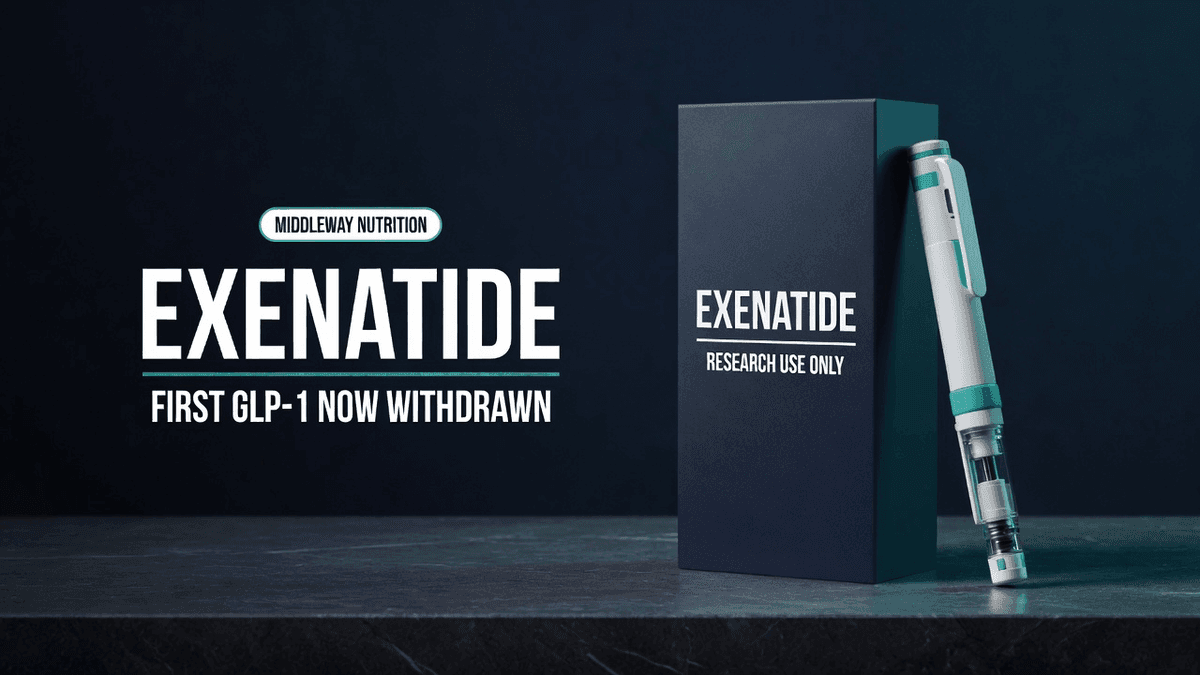
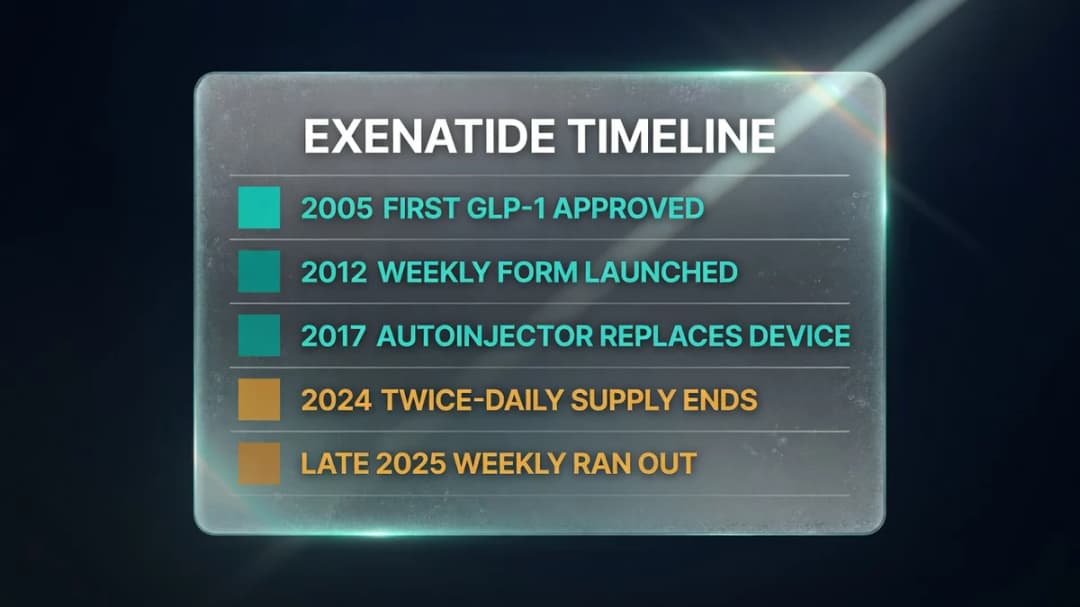
Exenatide (Byetta, Bydureon) was the first GLP-1 receptor agonist ever brought to market, and it is now being withdrawn. Anyone who has been prescribed exenatide (Byetta, Bydureon) and arrived looking for current information needs one fact first: both the twice-daily and once-weekly products have been discontinued across the UK and other major markets, with Byetta supply ending in 2024 and Bydureon supply running out following a formal supply notification in late 2025.
Availability has unwound market by market rather than all at once, so anyone still holding a prescription should confirm the position locally with their pharmacy or prescriber. The direction of travel is not in doubt.
What Exenatide Is
The origin story is genuinely unusual. Exenatide is a synthetic 39 amino acid peptide based on exendin-4, a molecule found in the saliva of the Gila monster, a venomous desert lizard.
Researchers were interested in how the animal could go months without eating and then handle an enormous meal without its blood glucose collapsing. The peptide responsible shares roughly half its sequence with human GLP-1, but with one decisive difference: it resists breakdown by DPP-4, the enzyme that destroys natural GLP-1 within a couple of minutes. That resistance is what made an injectable GLP-1 drug practical at all.
Byetta reached the US market in 2005, the first drug of its class. Bydureon, the once-weekly formulation, followed in 2012, and the BCise autoinjector replaced the original device in 2017.
Two Products, Same Molecule
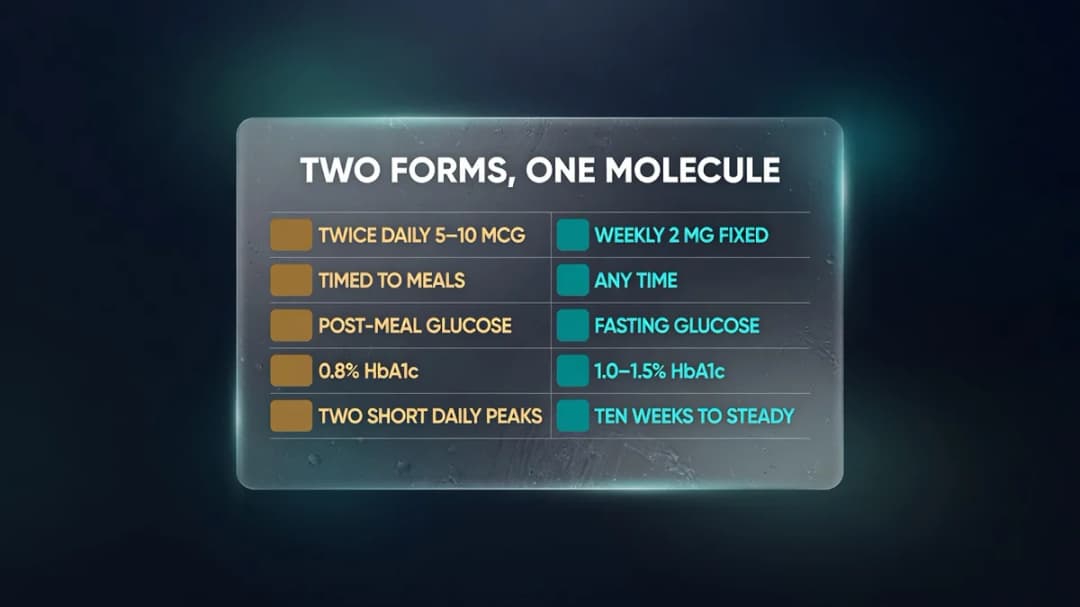
| Feature | Byetta, immediate release | Bydureon BCise, extended release |
|---|---|---|
| Frequency | Twice daily | Once weekly |
| Dose | 5 mcg, then 10 mcg | 2 mg, fixed |
| Timing | Within 60 minutes before morning and evening meals | Any day, any time, with or without food |
| Device | Multi-dose pen | Single-dose autoinjector |
| Formulation | Aqueous solution | Peptide encapsulated in biodegradable microspheres |
| Strongest effect on | Post-meal glucose spikes | Fasting glucose |
| Typical HbA1c reduction | Around 0.8 percent | Around 1.0 to 1.5 percent |
The extended release version used a clever piece of formulation. The peptide is trapped inside tiny biodegradable polymer microspheres, which slowly hydrolyse after injection and release their contents over the following week. That produces a continuous low-level signal rather than the two short daily peaks of the twice-daily product.

The consequence is a genuine trade-off. Byetta, timed to meals, worked better on post-meal glucose. Bydureon, providing constant exposure, worked better on fasting glucose and lowered HbA1c more overall. It also took roughly ten weeks of weekly dosing to reach steady state, so patients starting it saw little for the first month or two.
Exenatide (Byetta, Bydureon) Results in the Trials
Glucose control. Meaningful but modest by modern standards. Around 0.8 percent HbA1c reduction with the twice-daily form and roughly 1 to 1.5 percent with the weekly one. Semaglutide and tirzepatide both do considerably better.
Weight. Weight loss on exenatide was real but small, generally in the range of a couple of kilograms. It was a diabetes drug that also reduced weight slightly, not a weight loss drug in the sense the term is used now.
Cardiovascular outcomes. The EXSCEL trial enrolled 14,752 people with type 2 diabetes and tested weekly exenatide against placebo. The result was non-inferiority: exenatide did not increase cardiovascular risk, but it did not demonstrate the clear reduction that later trials showed for liraglutide, semaglutide and dulaglutide.
That last result matters for understanding why exenatide faded. When drugs in the same class started showing cardiovascular benefit rather than just cardiovascular safety, guidelines followed them, and a drug that had proved only safety was no longer a first choice.
Why It Was Discontinued
Not for a safety reason, which is the question most people ask first.
Exenatide was overtaken. Newer drugs in the same class control glucose better, produce far more weight loss, and in several cases carry demonstrated cardiovascular benefit. The twice-daily version also required injections timed to meals, which is a substantial adherence burden compared with a weekly injection or a daily tablet.
As prescribing shifted, the commercial case for maintaining two products with complex manufacturing weakened, and the manufacturer withdrew them. That is what has happened here: a first-generation drug reaching the end of its useful commercial life, not a withdrawal for harm.
What People Switch To
Exenatide has no direct equivalent, so the substitution depends on what the person needs.
| If the priority is | Common alternatives |
|---|---|
| Better glucose control on a weekly injection | Semaglutide, dulaglutide |
| Substantial weight loss alongside glucose control | Semaglutide, tirzepatide |
| Cardiovascular risk reduction with evidence behind it | Semaglutide, dulaglutide, liraglutide |
| Avoiding injections entirely | Oral semaglutide |
Switching is not a matter of matching doses, since the drugs differ in potency and titration schedule, and every one of them starts at a low dose and steps up to limit nausea. That is a prescriber's job rather than a calculation to do at home.
See our guides to GLP-1 medications, GLP-1 diabetes drugs and the history of GLP-1 drugs.
Side Effects, for Anyone Still Taking It
The profile is the familiar one for this class, though generally milder than the newer and more potent drugs.
- Nausea, the most common, worst early and settling with time
- Vomiting and diarrhoea, less common
- Injection site nodules, notably more common with the extended release form because of the microsphere formulation. These can persist for weeks
- Hypoglycaemia, mainly in combination with insulin or a sulfonylurea, where those doses may need reducing
- Pancreatitis, uncommon but on the label across this class
- Thyroid C-cell tumours, a boxed warning on the extended release product based on rodent data, contraindicating it in anyone with a personal or family history of medullary thyroid carcinoma or multiple endocrine neoplasia type 2
Exenatide is also cleared renally, which made it unsuitable at low kidney function. That is a genuine difference from some newer agents in the class.
Its Place in the Story
It is easy to be dismissive of a first-generation drug once better ones exist. That misreads what happened.
Exenatide proved that the GLP-1 pathway could be drugged at all. Natural GLP-1 is destroyed within minutes, which made it useless as a medicine, and the whole class exists because a lizard peptide happened to resist that breakdown. Every drug that followed, including the ones now producing 20 percent weight loss, descends from that observation.
FAQ
Is exenatide discontinued?
Yes, in the UK and other major markets. Byetta supply ended in 2024 and Bydureon supply ran out following a formal supply notification in late 2025. Timing has varied by country, so confirm the current position locally.
Why was it discontinued?
Commercial rather than safety reasons. Newer drugs in the same class control glucose better, produce much more weight loss, and several have demonstrated cardiovascular benefit that exenatide did not.
What is the difference between Byetta and Bydureon?
Same molecule, different formulation. Byetta is twice daily, timed to meals, and works mainly on post-meal glucose. Bydureon is weekly, released slowly from biodegradable microspheres, and works better on fasting glucose with a larger HbA1c reduction.
Does exenatide cause weight loss?
Some, but modest, generally a couple of kilograms. It was never a weight loss drug in the way semaglutide and tirzepatide are, and anyone comparing them will find the difference substantial.
What should someone switch to?
That depends on whether the priority is glucose control, weight, cardiovascular risk or avoiding injections, and it is a prescriber's decision. Doses do not translate directly between drugs in this class, and every switch involves starting low and titrating up.
Was exenatide really made from lizard saliva?
The template was. Exendin-4 was identified in Gila monster saliva, and exenatide is a synthetic copy of it. The manufactured drug has nothing to do with lizards beyond the sequence.