GLP-1 medications are prescription drugs that copy or trigger glucagon-like peptide-1, a hormone your gut releases after a meal. They prompt insulin release when blood sugar is high, blunt glucagon, slow how fast the stomach empties, and turn down appetite signalling in the brain. In 2026 the class spans daily tablets and weekly injections, and the differences between them decide far more about your outcome than the brand name on the box.
Most pages on this topic hand you a roster and stop. The harder question is which member of the class you should be asking a prescriber about, and that turns on four things: which condition ends up on the prescription, what your plan will cover, how much weight loss you are actually aiming for, and whether a weekly injection fits your life. This guide is organised around those four. If you want the roster instead, our GLP-1 products reference lists every approved option by brand, maker and form.
For a single cross-reference of the whole class, including agents still working through trials, PeptideDeck's list of GLP-1 medications is the widest comparison we have found. What follows is the shorter, decision-shaped version.
Key Takeaways
- A handful of molecules carry the class. Semaglutide, tirzepatide, liraglutide, dulaglutide and the oral small molecule orforglipron account for almost every prescription written in 2026. Every brand name is one of those molecules in different packaging
- Tirzepatide is not a pure GLP-1. It activates the GIP receptor as well, and it produced the largest mean weight loss of any approved agent in its trial programme
- The label decides your access. The same molecule sold under a diabetes label and a weight-management label is covered, priced and prior-authorised differently
- Semaglutide carries the deepest outcome evidence, including a reduction in major cardiovascular events in the SELECT trial and kidney benefit in FLOW
- Side effects are mostly gastrointestinal and cluster around dose increases. Titration speed is the main lever you control
- Oral options now exist, which changes the conversation for anyone who will not inject
- Nothing here is medical advice. Every drug named is prescription only, and the choice belongs to you and a prescribing clinician
What Counts as a GLP-1 Medication
Your gut releases GLP-1 from intestinal L-cells within minutes of food arriving. Natural GLP-1 is then broken down almost immediately by the enzyme DPP-4, which is why the hormone itself was never a usable drug. Every medication in this class is an engineering answer to that problem: change the peptide so DPP-4 cannot cut it, or attach it to something that keeps it in circulation, or skip the peptide entirely and build a small molecule that fits the same receptor.
Four effects follow from activating that receptor:
- Glucose-dependent insulin release. Insulin goes up when blood sugar is high and largely stands down when it is not, which is why these drugs carry low hypoglycaemia risk on their own
- Glucagon suppression, reducing the liver's output of stored glucose
- Slower gastric emptying, so a meal stays in the stomach longer and fullness lasts
- Central appetite signalling, the effect most users describe as the food noise going quiet
The class has widened past pure GLP-1. Tirzepatide adds GIP receptor activity. Newer combinations in development add amylin or glucagon activity. Patients and prescribers still treat them as one family, so this guide does too. For the receptor biology in more depth, see our explainer on what GLP-1 does.
The GLP-1 Medications You Can Actually Be Prescribed
| Molecule | Brand names | Receptors | Schedule | Primary label |
|---|---|---|---|---|
| Semaglutide (injection) | Ozempic, Wegovy | GLP-1 | Weekly | Ozempic: type 2 diabetes. Wegovy: weight management |
| Semaglutide (oral) | Rybelsus, Wegovy pill | GLP-1 | Daily tablet | Rybelsus: type 2 diabetes. Wegovy pill: weight management |
| Tirzepatide | Mounjaro, Zepbound | GIP and GLP-1 | Weekly | Mounjaro: type 2 diabetes. Zepbound: weight management, obstructive sleep apnea |
| Liraglutide | Victoza, Saxenda | GLP-1 | Daily injection | Victoza: type 2 diabetes. Saxenda: weight management, ages 12 and up |
| Dulaglutide | Trulicity | GLP-1 | Weekly | Type 2 diabetes |
| Orforglipron | Foundayo | GLP-1 (non-peptide) | Daily tablet | Weight management |
| Insulin plus GLP-1 combinations | Soliqua, Xultophy | GLP-1 with basal insulin | Daily injection | Type 2 diabetes |
Two things in that table cause most of the confusion at the pharmacy counter.
Same molecule, two boxes. Ozempic and Wegovy are both semaglutide. Mounjaro and Zepbound are both tirzepatide. The difference is the approved indication and the dose ceiling, not the drug. That distinction is invisible pharmacologically and decisive commercially, because a plan that excludes weight-management drugs will cover one box and refuse the other.
Exenatide has effectively left the conversation. It was the first agent in the class and it built the evidence base, but twice-daily and weekly exenatide have been overtaken by drugs with better tolerability and far better weight results. If you read an older comparison that leads with it, the page is out of date.
Match the Goal to the Medicine
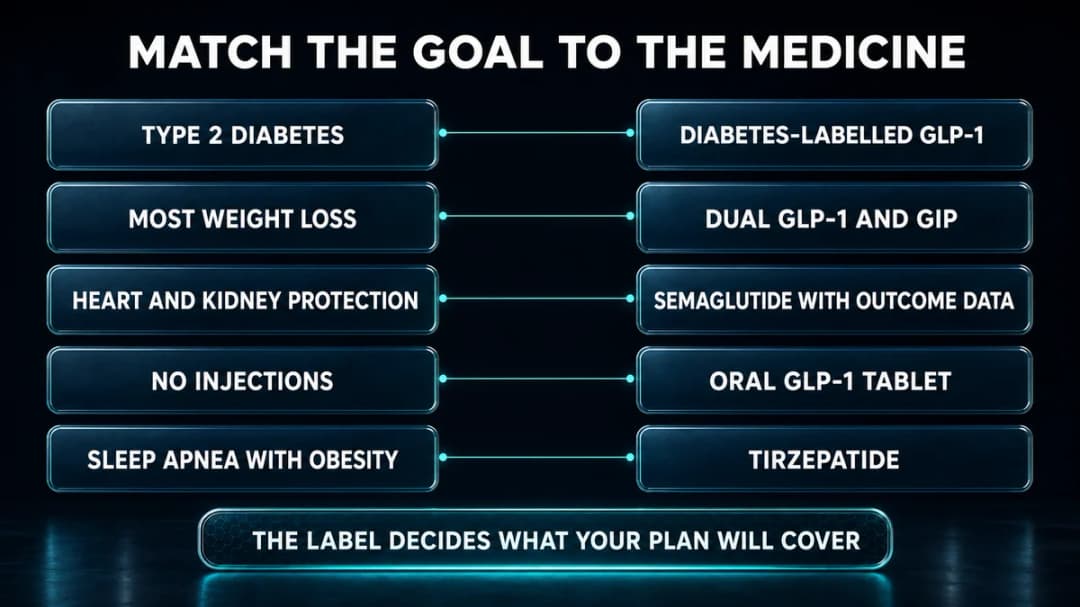
This is the part that is worth printing. Start from what you are trying to achieve, not from the drug you saw advertised.
| What you are trying to do | The medication conversation to have | Why |
|---|---|---|
| Manage type 2 diabetes | A diabetes-labelled GLP-1: Ozempic, Mounjaro, Trulicity, Victoza or Rybelsus | Coverage is far easier under a diabetes label, and A1c reduction is the endpoint these versions were dosed for |
| Lose the most weight possible | Tirzepatide, as Zepbound | It delivered the largest mean weight loss of any approved agent, and beat semaglutide in the one direct head-to-head |
| Protect the heart or kidneys | Semaglutide, as Wegovy or Ozempic | It is the agent with cardiovascular and kidney outcome trials behind it, not just weight data |
| Avoid injections entirely | Oral semaglutide, or orforglipron | Both reach the same receptor as a daily tablet |
| Treat obstructive sleep apnea alongside obesity | Tirzepatide, as Zepbound | It is the only agent in the class carrying that specific indication |
| Get a teenager treated | Liraglutide as Saxenda, or a weight-management agent with adolescent data | Age ranges on these labels differ, and the daily agent has the longest paediatric record |
| Spend the least, legally | The route, not the molecule, decides this | Savings cards, self-pay programmes and plan coverage move the number far more than which drug you pick. See our GLP-1 price comparison |
If you are choosing between the two big weekly injections specifically, our tirzepatide vs semaglutide comparison runs it dose by dose, and which GLP-1 is best for weight loss covers the trade-offs when the answer is not obvious.
What the Trials Actually Measured
Weight-loss percentages get quoted with no context constantly. Three things worth holding on to before you compare any two numbers.
The trials ran for 56 to 72 weeks. Mean weight loss in these studies is the result at the end of a long titration plus a maintenance period, in people who also received lifestyle counselling. It is not what month three looks like.
Most comparisons are not head-to-head. Reading a percentage from one drug's trial against a percentage from another drug's trial is not a fair fight, because the populations, durations and endpoints differ. The exception is SURMOUNT-5, which compared tirzepatide directly against semaglutide and found tirzepatide produced greater weight loss.
Weight is not the only endpoint that matters. Semaglutide's SELECT trial reported roughly a 20 percent reduction in major adverse cardiovascular events in adults with overweight or obesity and established cardiovascular disease, without diabetes. The FLOW trial reported kidney benefit in type 2 diabetes with chronic kidney disease. Liraglutide, dulaglutide and semaglutide all have cardiovascular outcome trials in type 2 diabetes behind them. Tirzepatide's weight results are larger, and its long-term outcome evidence is still being built. If you have established heart or kidney disease, that difference can outrank a few percentage points on the scale, which is a conversation to have with your prescriber rather than a rule. Our GLP-1 heart benefits guide goes through the cardiovascular data in detail.
Headline figures worth knowing, all from each drug's own pivotal programme rather than from a comparison: tirzepatide reached roughly 21 percent mean weight loss at its top dose over 72 weeks in SURMOUNT-1, semaglutide 2.4 mg reached roughly 15 percent over 68 weeks in STEP 1, and liraglutide 3 mg reached roughly 8 percent over 56 weeks in SCALE.
What Actually Decides What You Pay
Prices in this category move quarterly, so treat any specific figure you read anywhere, including here, as something to re-check at the source. What does not move is the list of things that set your number:
- Which label is on the script. Diabetes-labelled versions are covered by far more plans than weight-management versions, which many employer plans still exclude outright
- Whether you have commercial insurance. Manufacturer savings cards can cut a covered copay dramatically, and they exclude anyone on Medicare, Medicaid, TRICARE or VA benefits
- Whether you are paying cash. Both manufacturers now run direct self-pay programmes at prices well below list, usually with strength tiers and expiry dates attached
- Which strength you are prescribed. Self-pay ladders are set per strength, so the same drug can cost noticeably more at a higher dose
- Approved versus compounded. Compounded semaglutide and tirzepatide are cheaper and are not FDA-approved, which means the finished product has not been reviewed for safety, potency or manufacturing consistency
- The care wrapper. Telehealth subscriptions, labs and follow-up visits sit on top of the medication cost and are easy to leave out of a monthly comparison
Our cheapest GLP-1 ranking prices each route with the eligibility gate attached, which is the only way these comparisons are meaningful.
Side Effects, and the One Lever You Control
Every drug in this class shares a gastrointestinal profile: nausea, constipation, diarrhoea, vomiting, reflux and burping are the common complaints, and they concentrate in the first weeks after each dose increase rather than spreading evenly across treatment. Most people find they settle at a stable dose.
The serious warnings are consistent across the class and belong in a conversation with your prescriber, not a blog: pancreatitis, gallbladder disease, and the boxed warning about thyroid C-cell tumours that rules these drugs out for anyone with a personal or family history of medullary thyroid carcinoma or MEN 2. Muscle loss alongside fat loss is a real concern at these rates of weight reduction, which is why protein intake and resistance training keep coming up.
The lever you control is titration speed. Going up on schedule when you are still struggling with the current dose is the most common self-inflicted problem in this category. Our GLP-1 side effects guide covers management for each symptom, and what to eat on GLP-1 covers the food side.
Questions to Take to Your Prescriber
Print this. Appointments for these drugs are short and the wrong five minutes gets spent on the wrong things.
- Which label fits my situation, diabetes or weight management? This decides everything downstream about coverage
- Does my plan cover it, and does it need prior authorisation? Ask for the formulary status before you leave, not after the pharmacy calls
- What is the titration schedule, and what do I do if I cannot tolerate a step up? Get the fallback plan in writing
- What is the target maintenance dose, and how long until I reach it?
- Do I have any of the contraindications? Thyroid cancer history, MEN 2, pancreatitis, and current pregnancy or pregnancy plans all change the answer
- What are we monitoring, and how often? See GLP-1 labs to monitor for what usually goes on that list
- What happens if I stop? Weight regain after discontinuation is well documented, and it is better discussed at the start than at the end
Frequently Asked Questions
What are GLP-1 medications?
They are prescription drugs that activate the GLP-1 receptor, copying a gut hormone released after eating. That lowers blood sugar in a glucose-dependent way, slows stomach emptying, and reduces appetite. The class includes semaglutide, tirzepatide, liraglutide, dulaglutide and the oral small molecule orforglipron, sold under brand names including Ozempic, Wegovy, Mounjaro, Zepbound, Trulicity and Saxenda.
Which GLP-1 medication causes the most weight loss?
Tirzepatide, sold as Zepbound for weight management. It reached roughly 21 percent mean weight loss at its top dose over 72 weeks in SURMOUNT-1, and in SURMOUNT-5, the one direct head-to-head against semaglutide, it produced greater weight loss than semaglutide over the same period.
Are Ozempic and Wegovy the same drug?
Yes. Both are semaglutide from Novo Nordisk. Ozempic is labelled for type 2 diabetes and Wegovy for weight management at a higher maximum dose. The molecule is identical, and the difference in indication drives the difference in coverage and price.
Is there a GLP-1 medication you can take as a pill?
Yes. Oral semaglutide is available both as Rybelsus for type 2 diabetes and as a weight-management tablet, and orforglipron is a daily oral small molecule that reaches the same receptor without being a peptide. Absorption requirements differ from injections, so the dosing instructions matter more.
Do GLP-1 medications work without diet changes?
They reduce appetite, which usually reduces intake on its own, and every pivotal trial paired the drug with lifestyle counselling. Protein intake and resistance training matter specifically because weight lost at this rate includes lean mass, not only fat.
Can you get GLP-1 medications without a prescription?
No. Every legitimate GLP-1 medication is prescription only in the United States. Anything sold without a prescriber is either counterfeit or research-labelled material with no assurance of identity or purity. Our guide on how to get a GLP-1 prescription covers the legitimate routes.
What happens if you stop taking a GLP-1 medication?
Appetite suppression fades within weeks and weight regain is common, which is why these are generally framed as long-term treatments rather than courses. If stopping is the plan, it is worth structuring rather than improvising. See how to stop GLP-1 without regaining weight.
Sources
- Drugs@FDA label database for approved indications and boxed warnings on every product named here
- NIDDK: prescription medications to treat overweight and obesity
- Pivotal trial programmes referenced by name: STEP (semaglutide), SURMOUNT (tirzepatide), SCALE (liraglutide), SELECT and FLOW (semaglutide outcomes)
Medical disclaimer: this article is general information, not medical advice. GLP-1 medications are prescription drugs with real contraindications. Talk to a prescribing clinician about your own history before starting, changing or stopping any of them.