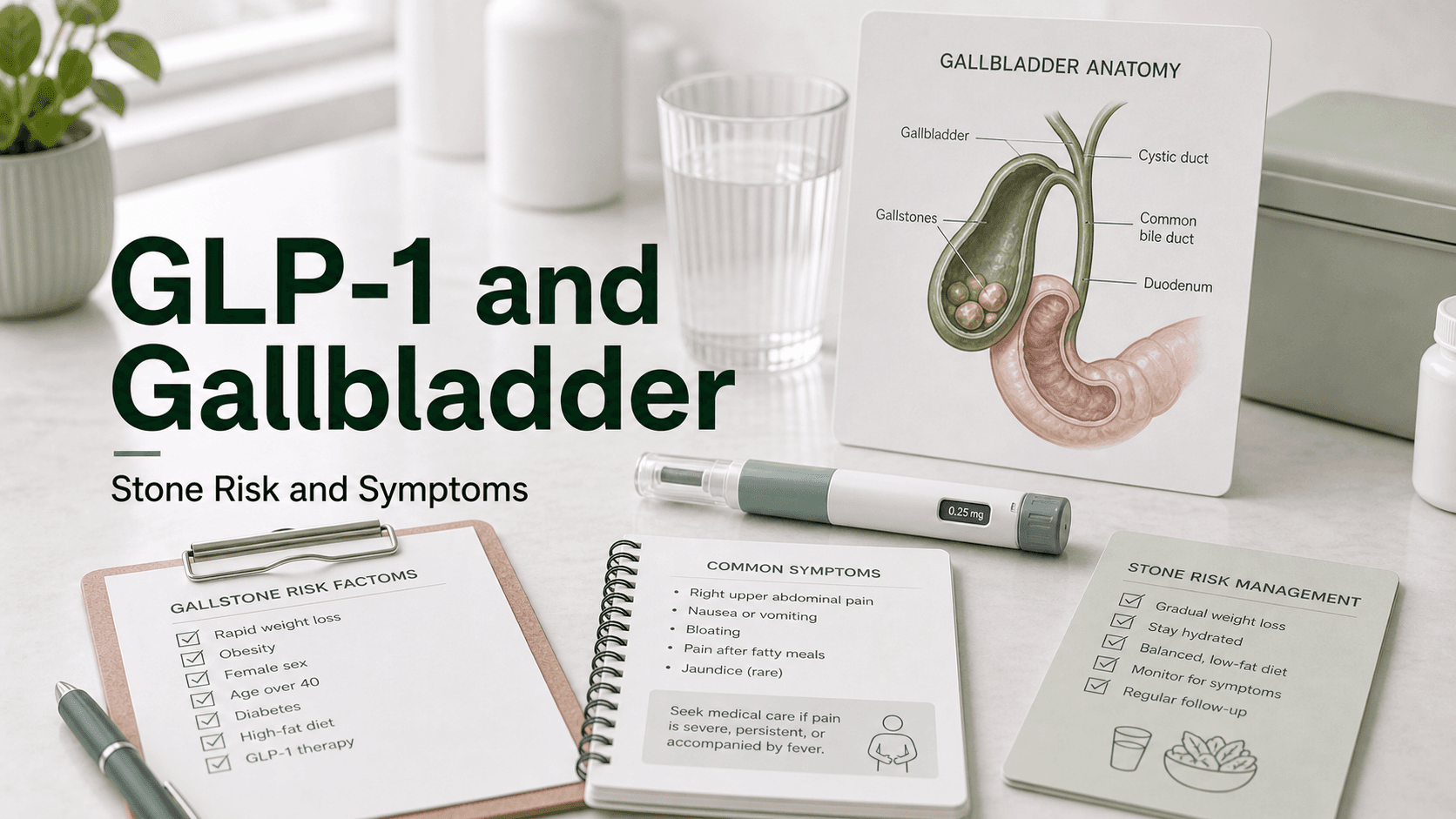
The gallbladder is the small pear-shaped reservoir that stores bile between meals and squeezes it into the small intestine when fat arrives. GLP-1 drugs disturb that rhythm in two ways at once, and they also drive the kind of fast weight loss that has been linked to gallstones for decades. The result is a small but real increase in gallbladder events that shows up in every major trial — and a second, less-discussed question for the millions of people who already had their gallbladder removed and want to know if they can still take a GLP-1.
Direct answer: GLP-1 receptor agonists increase the risk of gallbladder and biliary disease. The 2022 JAMA Internal Medicine meta-analysis of 76 randomized trials found a relative risk of 1.37 overall — and 2.29 in trials using weight-loss doses, versus 1.27 in diabetes trials. Absolute rates are still low: semaglutide 2.4 mg (Wegovy) reports gallbladder disorders in ~2.6% of patients vs 1.2% on placebo, liraglutide about 0.8% cholelithiasis and 0.5% cholecystitis, and tirzepatide ≤0.6% acute gallbladder events in diabetes trials (Mounjaro) and around 1.1% cholelithiasis and 0.7% cholecystitis in weight-management trials (Zepbound). Mechanism: GLP-1 slows gallbladder emptying via suppressed cholecystokinin signaling, plus rapid weight loss supersaturates bile with cholesterol. If you have no gallbladder, GLP-1s are not contraindicated and most patients tolerate them, but bile-related GI side effects (fat intolerance, urgency, diarrhea) can be more prominent.
Why GLP-1s Affect the Gallbladder
The gallbladder is more than a passive bag. It contracts roughly every time a fatty meal hits the duodenum, propelled by cholecystokinin (CCK) released from intestinal cells. GLP-1 drugs interfere with that loop on multiple levels:
1. Delayed Gallbladder Emptying
GLP-1 receptor activation suppresses CCK release and reduces the gallbladder's contractile response to meals. Bile sits in the gallbladder longer, gets more concentrated, and is more likely to form sludge and cholesterol crystals — the seed of stones.
2. Altered Bile Acid Signaling
GLP-1s shift activity at the FXR and TGR5 bile acid receptors and the intestinal hormones (GLP-2, FGF19) that govern bile recycling. The downstream effect: less efficient bile turnover and a bile chemistry that favors cholesterol crystallization.
3. Rapid Weight Loss
Independent of any drug, losing weight quickly raises gallstone risk. Adipose tissue releases stored cholesterol into bile during a sustained energy deficit, bile cholesterol saturation rises, and gallbladder stasis goes up. Very-low-calorie diets and bariatric surgery both produce the same effect; GLP-1s reproduce it pharmacologically.
4. Reduced Mealtime Fat
GLP-1 users eat less, often much less fat, which means fewer CCK-triggered contractions per day. Paradoxically, chronically low fat intake worsens gallstone risk because the gallbladder rarely fully empties. A modest amount of dietary fat per meal helps prevent bile stagnation.
Specific Rates by Drug
These are absolute rates from the manufacturer-conducted phase 3 trials (FDA labels) plus the JAMA meta-analysis pooled data.
| Drug | Gallbladder event | Drug rate | Placebo rate |
|---|---|---|---|
| Liraglutide (Saxenda 3.0 mg) | Cholelithiasis | ~0.8% | ~0.4% |
| Liraglutide (Saxenda 3.0 mg) | Cholecystitis | ~0.5% | ~0.1% |
| Semaglutide (Wegovy 2.4 mg) | All gallbladder disorders | ~2.6% | ~1.2% |
| Semaglutide (Wegovy injection, adult trials) | Cholelithiasis | 1.6% | 0.7% |
| Semaglutide (Wegovy injection, adult trials) | Cholecystitis | 0.6% | 0.2% |
| Semaglutide (Wegovy tablets) | Cholelithiasis | 2.5% | 1.0% |
| Semaglutide (Ozempic 0.5–1 mg) | Cholelithiasis | 1.5% / 0.4% | — |
| Tirzepatide (Mounjaro) | Acute gallbladder disease | 0.6% | 0% |
| Tirzepatide (Zepbound) | Cholelithiasis | 1.1% | 1.0% |
| Tirzepatide (Zepbound) | Cholecystitis | 0.7% | 0.2% |
| Tirzepatide (Zepbound) | Cholecystectomy | 0.2% | 0% |
Three patterns repeat across every trial:
- Higher dose, higher risk. The JAMA meta-analysis showed RR 1.56 at high doses vs RR 0.99 at low doses (P = .006 for interaction).
- Longer duration, higher risk. Treatment >26 weeks: RR 1.40. Treatment ≤26 weeks: RR 0.79 (P = .03 for interaction).
- Weight-loss indication > diabetes indication. RR 2.29 for weight loss vs RR 1.27 for diabetes (P <.001 for interaction). This is the rapid-weight-loss signal showing through.
In absolute terms the JAMA group calculated about 27 additional gallbladder events per 10,000 patients per year of GLP-1 therapy.
The current Wegovy label breaks the older "gallbladder disorders" pooled figure into its parts and adds two data points worth knowing. Oral semaglutide is not gentler: cholelithiasis was reported in 2.5% of patients on Wegovy tablets versus 1% on placebo tablets, against 1.6% versus 0.7% for the injection. And adolescents fared worse than adults — in the trial of patients aged 12 and older, cholelithiasis hit 3.8% on Wegovy and 0% on placebo.
The two manufacturers also read their own data differently, and that difference answers the question most people are actually asking. Lilly's Zepbound label states that "acute gallbladder events were associated with weight reduction." Novo Nordisk's Wegovy label goes further: substantial or rapid weight loss can increase the risk of cholelithiasis, "however, the incidence of acute gallbladder disease was greater in WEGOVY-treated patients than in placebo-treated patients, even after accounting for the degree of weight loss." So the honest answer to whether a GLP-1 causes gallstones or merely causes the weight loss that causes gallstones is: both, and the label says the drug effect survives the adjustment.
Symptoms To Watch For
Most gallstones are silent. The ones that cause trouble usually produce a recognizable pattern:
- Sudden, sharp pain in the upper right abdomen or center of the upper abdomen, often 30 minutes to a few hours after a fatty meal
- Pain that radiates to the right shoulder blade or back
- Nausea or vomiting out of proportion to your usual GLP-1 nausea
- Fever or chills (suggests cholecystitis — inflammation)
- Jaundice (yellow skin or eyes) — suggests a duct stone
- Dark urine, pale clay-colored stools
- Episodes that last more than a few hours, especially recurring
A garden-variety GLP-1 stomach upset comes and goes within hours and isn't focal. Gallbladder pain is right-sided, intense, and often colicky — it builds, plateaus, and slowly resolves over hours.
If You Already Have Gallstones
Stones are common and mostly quiet. Roughly 10 to 20 percent of adults in Western countries have gallstones, 50 to 70 percent are asymptomatic when they are found — usually incidentally, on a scan ordered for something else — and only 10 to 25 percent of silent stones ever turn symptomatic. Complications almost never arrive without at least one warning episode of biliary pain first.
Known stones are also not a contraindication. The Contraindications section of the Wegovy label runs to two items: a personal or family history of medullary thyroid carcinoma or MEN 2, and a prior serious hypersensitivity reaction. Zepbound's list is the same two. Gallbladder disease turns up one section later as a Warning and Precaution, with an instruction aimed at the prescriber rather than the patient — if cholelithiasis is suspected, gallbladder studies and appropriate clinical follow-up are indicated.
What is real is the collision between the way you end up eating on a GLP-1 and what keeps existing stones quiet.
| What a GLP-1 does to your eating | Why it matters when stones are already there | The counter |
|---|---|---|
| Kills appetite, so meals get skipped and the gaps get long | NIDDK: "When you don't eat for a long period of time or you lose weight quickly, your liver releases extra cholesterol into the bile" | Eat on a clock rather than on hunger — three small meals beats one at 9 p.m. |
| Pushes fat intake toward zero | No fat means no CCK, no CCK means the gallbladder never fully empties, and stagnant bile is how stones grow | 7–10 g of fat in every meal, every day |
| Produces fast weight loss | NIDDK: diets that cause fast weight loss are more likely to lead to gallstone problems than ones that produce slower loss | Hold a dose step instead of chasing the scale |
| Sets up the occasional heavy fatty meal after weeks of near-zero fat | A forceful contraction against a stone parked in the neck of the gallbladder is what a gallbladder attack is | Spread fat across the day rather than loading it into one meal |
Two things worth raising with a prescriber before you start, if you already know you have stones:
- Ursodiol. NIDDK states plainly that ursodiol "can help prevent gallstones in people who lose weight rapidly through very low-calorie diets or weight-loss surgery." GLP-1 therapy is not the studied setting, so this stays off-label — but the physiology being prevented is the same one.
- Whether the stones have already spoken. If you have had an episode of biliary colic, the conversation usually runs surgery first, GLP-1 second. Not because the drug is barred, but because starting a drug that raises event rates in a gallbladder that has already announced itself is a poor sequence.
Can You Take a GLP-1 Without a Gallbladder?
Yes. No FDA label for semaglutide, liraglutide, or tirzepatide lists prior cholecystectomy as a contraindication or precaution, and GLP-1s act on receptors throughout the body, not on the gallbladder for absorption. People who have had their gallbladder removed can and do use Wegovy, Ozempic, Mounjaro, and Zepbound without issue.
Does the Drug Still Work After Gallbladder Removal?
Yes, and there is no mechanism by which it would not. Injected semaglutide, liraglutide, and tirzepatide are peptides absorbed from subcutaneous tissue — there is no bile-dependent step anywhere in the path from the syringe to the receptor. Even the oral route sidesteps the biliary system: Wegovy tablets are co-formulated with the absorption enhancer SNAC, and per the label, "the absorption of semaglutide predominantly occurs in the stomach."
What you will not find is a trial number. The phase 3 programs did not report weight loss separately for patients without a gallbladder, so anyone quoting you a specific percentage for post-cholecystectomy patients is inventing it. Cholecystectomy appears in these labels in exactly one place — as an adverse event, 0.2% on Zepbound versus 0% on placebo — never as a contraindication, a precaution, or a reason to adjust the dose.
There are three practical differences:
Bile-Related GI Side Effects Can Be Louder
Without a gallbladder, bile drips continuously into the small intestine instead of being stored and released in pulses with meals. Add a GLP-1's gastric-emptying delay and you can get more pronounced:
- Fat intolerance — bloating, urgency, or diarrhea after fatty meals
- Bile acid diarrhea — yellow, oily, or floating stools, often unpredictable
- Loose stools or steatorrhea when meals exceed what your continuous bile flow can handle
This is usually manageable by keeping individual meals modest in fat (rather than zero fat) and spreading fat across the day.
How common this is depends entirely on who is counting. Post-cholecystectomy diarrhea has been reported in anywhere from 2.1% to 57.2% of patients across studies, and not all of it is true bile acid diarrhea. A five-center UK audit of 9,439 laparoscopic cholecystectomies found that only 2.1% of patients were ever investigated for diarrhea with a SeHCAT retention scan — and among those who were, 62.8% were diagnosed with bile acid diarrhea, at a median of 672 days after surgery. The practical reading: it is under-tested and diagnosed late, so if you start a GLP-1 somewhere in that gap, the drug collects the blame.
Sorting the two apart is mostly a matter of timing:
| Clue | Points to the GLP-1 | Points to bile acid diarrhea |
|---|---|---|
| Relationship to dose steps | Starts or worsens within days of an increase, settles while you hold | Indifferent to dose steps; the pattern dates back to the surgery |
| Relationship to meals | Any time of day, often paired with nausea | 30 minutes to 2 hours after eating, worst after fat |
| Stool character | Loose, sometimes alternating with constipation | Yellow, greasy, urgent, occasionally floating |
| What changes it | Holding the dose, smaller meals, more fluid | A prescriber-directed trial of a bile acid binder |
The distinction is worth pressing for, because the two problems have different fixes and one of them is treatable in a way the other is not.
You Can Still Get Biliary Disease
Cholecystectomy removes the gallbladder, not the entire biliary system. Stones can still form in the bile ducts (choledocholithiasis), and sphincter of Oddi dysfunction is more common after gallbladder removal. New right-upper-quadrant pain, jaundice, or fever still warrants evaluation.
Titration Often Needs To Be Slower
Many post-cholecystectomy patients tolerate GLP-1s better when each dose step is held a week or two longer than the standard label schedule. Start low, stay low until your gut is stable, then advance.
After Cholecystectomy: Practical Adjustments
- Keep individual meals to roughly 15–25 g of fat rather than 0 g or 40+ g
- Favor monounsaturated fats (olive oil, avocado, nuts) over heavy saturated loads
- Consider bile acid binders (cholestyramine, colesevelam) only if your prescriber identifies bile acid diarrhea
- Have fat-soluble vitamins (A, D, E, K) checked once a year if you're losing significant weight; combined reduced intake plus altered bile flow raises a theoretical deficiency risk
- Stay hydrated — GLP-1 thirst suppression plus loose stools dehydrate quickly
Prevention With an Intact Gallbladder
Whether you have any gallbladder symptoms yet, several things measurably lower stone risk:
1. Slow the Rate of Loss
Aim for 0.5–1% of body weight per week. The JAMA meta-analysis showed weight-loss doses doubled relative risk vs diabetes doses, and rapid loss is the strongest driver. Hold doses longer if you're losing more than 2 lb/week.
2. Don't Eat Fat-Free
A meal with at least 7–10 g of fat triggers gallbladder contraction. Eating one or two modestly fatty meals a day prevents the bile stagnation that promotes stones. Counterintuitively, ultra-low-fat dieting raises gallstone risk.
3. Stay Hydrated
GLP-1s blunt thirst. Dehydration concentrates bile. Aim for roughly half your body weight (lb) in ounces of fluid daily.
4. Move After Meals
A 10–15 minute walk after eating supports gallbladder emptying and overall biliary flow.
5. Maintain Adequate Protein and Lean Mass
1.2–1.6 g protein/kg/day, plus 2–3× weekly strength training. Loss of lean mass is associated with worse metabolic adaptation and faster bile turnover changes.
6. Ask About Ursodiol If You're High Risk
For patients with a history of stones, very rapid weight loss, or bariatric surgery, ursodeoxycholic acid (ursodiol) at 500–600 mg/day during peak weight loss reduces stone formation by roughly 60–80% in the bariatric literature. Off-label for GLP-1 use, but a conversation worth having.
When To Call a Doctor
Call promptly if you have:
- New, severe right-upper-quadrant or epigastric pain lasting more than a couple of hours
- Pain plus fever, chills, or vomiting
- Yellowing of skin or eyes
- Dark urine and pale stools
- Pain that wakes you at night repeatedly
Go to the emergency department if you have severe pain plus fever, persistent vomiting, or jaundice — those can signal acute cholecystitis or cholangitis, which need imaging and often surgical or endoscopic management within hours.
What People Get Wrong
- "GLP-1s are safe for the gallbladder because the rates are low." The rates are low in absolute terms but roughly 1.4× to 2.3× placebo, and high-dose / long-duration use compounds the signal.
- "I have no gallbladder, so I have no risk." Duct stones and sphincter dysfunction still occur, and post-cholecystectomy GI side effects can mimic — or mask — biliary problems.
- "Eating zero fat will protect my gallbladder." It does the opposite. Some dietary fat per meal is what keeps bile flowing.
- "Pain on Ozempic is just normal nausea." GLP-1 nausea is diffuse and crampy. Right-upper-quadrant pain that lasts hours, especially after a fatty meal, is not.
- "I should stop the medication at the first twinge." Most stomach upset on a GLP-1 is not gallbladder-related. Get imaging before changing therapy.
- "Tirzepatide is gentler than semaglutide on the gallbladder." Diabetes trials of tirzepatide showed lower rates, but in weight-management trials (Zepbound) cholelithiasis and cholecystitis rates are similar to other class members.
Frequently Asked Questions
Do GLP-1 drugs cause gallstones directly? They contribute to gallstone formation through two mechanisms — slowed gallbladder emptying and rapid weight loss — rather than dissolving or creating stones on their own.
How quickly can gallstones form on a GLP-1? Stones can develop within the first few months of rapid weight loss. The risk peaks during the steepest weight-loss phase (months 2–9) and tapers as weight stabilizes.
Is the risk higher on Wegovy than Ozempic? Yes — at 2.4 mg, Wegovy has a higher gallbladder disorder rate (~2.6%) than lower doses of Ozempic for diabetes (~1.5% at 0.5 mg, 0.4% at 1 mg in the SUSTAIN trials). Higher dose, faster weight loss, more risk.
Can I take Ozempic, Wegovy, Mounjaro, or Zepbound if I have no gallbladder? Yes. There's no contraindication. You may have more pronounced bile-related GI symptoms; slower titration and modest dietary fat per meal usually solve it.
Does removing my gallbladder mean I can't have gallbladder pain on a GLP-1? You can't have gallbladder pain because the organ is gone, but you can still have bile duct stones or sphincter of Oddi dysfunction with similar symptoms.
Should I get an ultrasound before starting a GLP-1? Not routinely. Reasonable if you have a history of biliary disease, prior stones, or upper-abdominal pain pattern.
Does ursodiol help prevent stones on GLP-1? It's well-studied for rapid weight loss after bariatric surgery (60–80% reduction). Use during GLP-1 therapy is off-label but increasingly discussed for high-risk patients.
Will gallstones go away if I stop the GLP-1? Stones don't dissolve on their own. Symptoms may settle if stones become quiescent again. Symptomatic stones usually require cholecystectomy.
Can I drink coffee or alcohol on a GLP-1 if I'm worried about my gallbladder? Moderate coffee is associated with slightly lower gallstone risk in observational studies. Heavy alcohol use raises pancreatitis risk on GLP-1s — a separate concern.
Can I start a GLP-1 if I already have gallstones? Existing gallstones are not a contraindication in any GLP-1 label — the Contraindications sections list medullary thyroid carcinoma or MEN 2 history and serious hypersensitivity, and nothing else. Gallbladder disease sits in Warnings and Precautions instead. The practical questions are whether the stones have ever caused pain (if yes, the surgical conversation usually comes first), how fast you plan to lose weight, and whether ursodiol belongs in the plan. Silent stones found incidentally are managed by watching, not by cancelling the prescription.
What if I have a porcelain gallbladder? A porcelain gallbladder is one whose wall has calcified after years of chronic inflammation, and it travels with stones — over 60% of cases have them. No GLP-1 trial or label addresses it, so there is no drug-specific answer to give you, and anyone offering one is guessing. It is a surgical decision made on cancer risk: recent reviews put the association with gallbladder cancer somewhere in the 5% to 22% range and argue the older literature badly overstated it, so prophylactic cholecystectomy is no longer routinely recommended for patients without symptoms — the call turns on symptoms, the calcification pattern, and age. Two practical points if you are starting a GLP-1: settle the surgical question first rather than afterward, and do not let new right-upper-quadrant pain get filed under GLP-1 nausea.
Are Wegovy tablets safer for the gallbladder than the injection? No. In the adult weight-reduction trials behind the current label, cholelithiasis was reported in 2.5% of patients on Wegovy tablets versus 1% on placebo tablets, compared with 1.6% versus 0.7% for the injection. Swallowing the drug does not spare the gallbladder, because the mechanism runs through delayed emptying and rapid weight loss, not through the route of administration.
Last reviewed: May 13, 2026
Sources
- Association of GLP-1 Receptor Agonist Use With Risk of Gallbladder and Biliary Diseases — JAMA Internal Medicine
- GLP-1 Receptor Agonists and Gallbladder Disease Risk: Molecular Mechanisms — PMC
- Acute Cholecystitis Associated With the Use of GLP-1 Receptor Agonists — JAMA Internal Medicine
- Ozempic — FDA Prescribing Information
- Mounjaro — FDA Prescribing Information
- Zepbound — FDA Prescribing Information
- GLP-1s and Your Gallbladder: What You Need to Know — CommonSpirit Health
- Dieting & Gallstones — NIDDK
- Gallbladder Motility and Gallstone Formation in Obese Patients Following Very Low Calorie Diets — PubMed
- Safety Issues of Tirzepatide: Pancreatitis and Gallbladder — PMC
- Wegovy (semaglutide) — FDA Prescribing Information (DailyMed)
- Asymptomatic Cholelithiasis: Is Cholecystectomy Really Needed? — Digestive Diseases and Sciences via PubMed
- Rates of Bile Acid Diarrhoea After Cholecystectomy: A Multicentre Audit — World Journal of Surgery via PubMed
- Management of Porcelain Gallbladder, Its Risk Factors, and Complications: A Review — Diagnostics via PubMed
- Porcelain Gallbladder Revisited — Journal of Ultrasound via PubMed