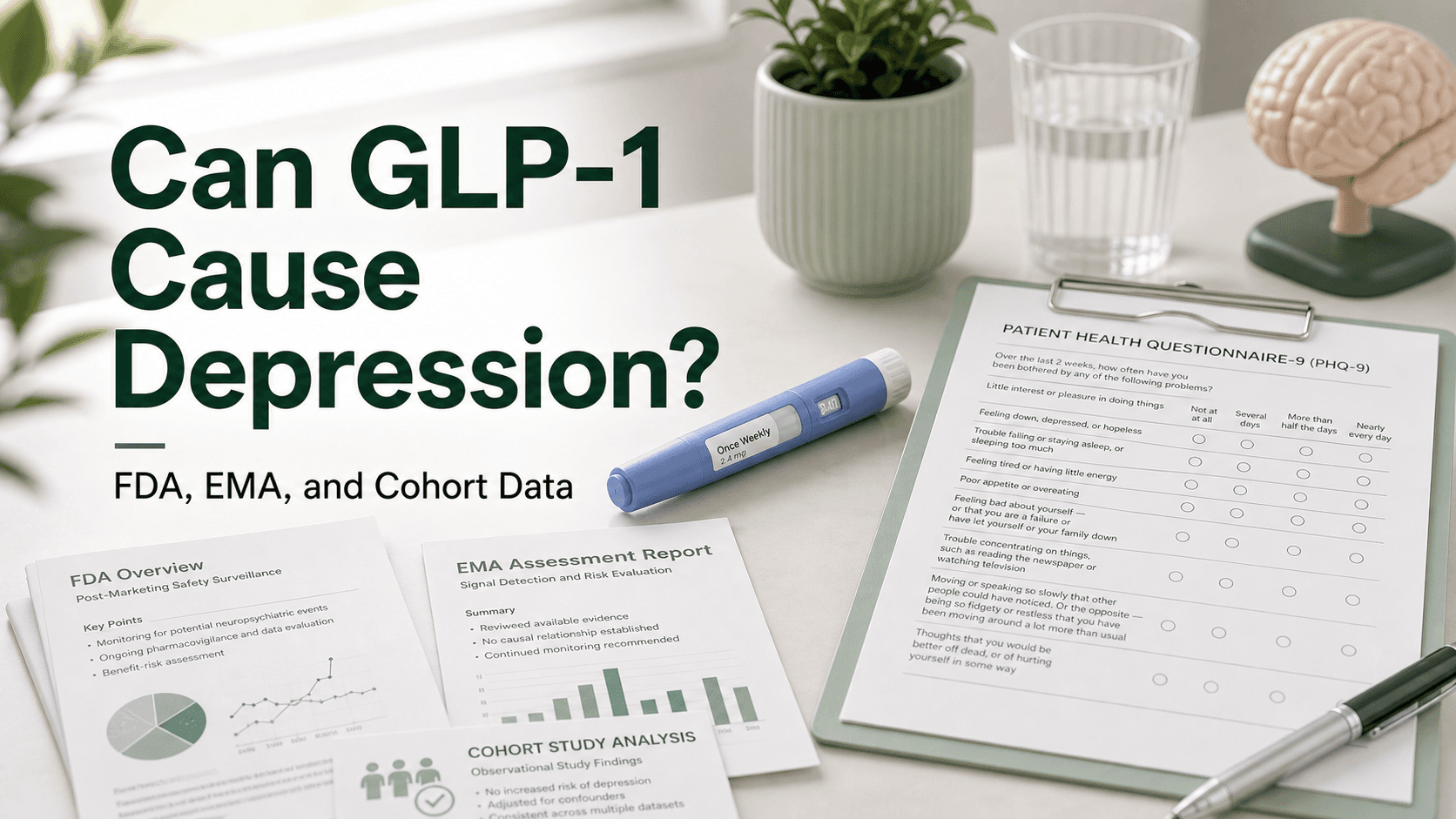
Can GLP-1 Cause Depression?
The "GLP-1 and depression" question has had three lives. First, a July 2023 European signal of suicidal thoughts in patients on semaglutide and liraglutide that made global headlines. Second, a wave of large cohort and pharmacovigilance studies that mostly failed to confirm the signal — and in several cases pointed the other direction. Third, the regulatory closure: the EMA's PRAC in April 2024 and the FDA in 2024–2025 both concluded the evidence did not support a causal link, with the FDA eventually requesting removal of the suicidal-ideation warning from Wegovy, Saxenda, and Zepbound labels. None of that means mood changes on GLP-1s are imaginary. They happen. But the population-level data tell a calmer story than the early signal suggested.
Direct answer: There is no confirmed causal link between GLP-1 receptor agonists and depression or suicidal ideation based on randomized trials and the largest cohort studies. The EMA reviewed ~150 case reports starting July 2023 and concluded in April 2024 that the evidence "does not support a causal association." A 240,000-patient electronic-health-record study from Case Western, published in Nature Medicine in January 2024, found semaglutide was associated with lower suicidal ideation incidence than non-GLP-1 anti-obesity drugs (HR 0.27, 95% CI 0.20–0.36). The FDA reached the same conclusion and in 2025 requested manufacturers remove the suicidal-ideation warning from labels. A separate August 2024 JAMA Network Open analysis of WHO pharmacovigilance data did find a disproportionality signal, and emerging genetics work suggests subgroups with low baseline dopamine function may be more vulnerable. Mood should be monitored — especially during titration and rapid weight loss — but the weight of evidence does not support a generalized depression risk.
The Initial Signal — EMA July 2023
The story starts in Iceland. Three patients on liraglutide (Saxenda) or semaglutide (Ozempic, Wegovy) reported suicidal thoughts or self-injury. Icelandic authorities flagged the cases to the European Medicines Agency, and on July 3, 2023 the EMA's Pharmacovigilance Risk Assessment Committee (PRAC) opened a "signal procedure" — a formal review of a new potential adverse event.


The review widened quickly. The PRAC identified roughly 150 reports of suicidal ideation, self-injury, or related psychiatric events across the GLP-1 class for analysis. Media coverage went global. Search terms like "Ozempic depression" spiked more than 300% in the months that followed.
Crucially, a signal procedure is not a finding. It is a question: does the underlying data support the hypothesis? In November 2023 the EMA asked manufacturers for additional safety data. The investigation pulled in case reports, manufacturer pharmacovigilance, clinical trial records, post-marketing data, and at least two large independent electronic health record analyses.
What the Case Western Nature Medicine Study Found
The most-cited counterweight to the signal was a January 2024 paper in Nature Medicine from a Case Western Reserve University group, led by William Wang and including the National Institute on Drug Abuse's Nora Volkow. It used the TriNetX electronic health record network — covering tens of millions of US patients — to compare suicidal ideation incidence between semaglutide and other anti-obesity or anti-diabetes drugs.
Two propensity-matched cohorts:
| Cohort | Sample (per arm) | Outcome | Hazard ratio (95% CI) |
|---|---|---|---|
| Overweight/obesity (vs naltrexone, bupropion, orlistat, topiramate, phentermine) | 52,783 | Incident suicidal ideation | 0.27 (0.20–0.36) |
| Overweight/obesity | 52,783 | Recurrent suicidal ideation | 0.44 (0.32–0.60) |
| Type 2 diabetes (vs insulin, metformin, sulfonylureas, DPP-4i, SGLT2i) | 27,726 | Incident suicidal ideation | 0.36 (0.25–0.53) |
| Type 2 diabetes | 27,726 | Recurrent SI at 6 months | 0.51 (0.31–0.83) |
In plain language: in matched real-world patients, those who started semaglutide were roughly one-third to half as likely to develop new suicidal ideation as those who started a comparator drug. The recurrence numbers in patients with prior SI were also favorable.
This is observational data and carries the usual cautions — confounding by indication, prescription channel, surveillance bias. But the direction and the magnitude were striking, and it has been replicated in at least three independent analyses since.
The EMA's April 2024 Conclusion
After ten months of review, the PRAC closed the case on April 11, 2024. The official wording: "the available evidence does not support a causal association" between GLP-1 receptor agonists and suicidal or self-injurious thoughts and actions. No update to product information was deemed warranted.
The agents covered:
- Semaglutide (Ozempic, Rybelsus, Wegovy)
- Liraglutide (Victoza, Saxenda, Xultophy)
- Exenatide (Byetta, Bydureon)
- Lixisenatide (Lyxumia, Suliqua)
- Dulaglutide (Trulicity)
The conclusion drew on non-clinical studies, clinical trial data, post-marketing surveillance, the Case Western EHR study, and a parallel EMA-conducted EHR analysis of diabetic patients that "did not support a causal association" between GLP-1 RAs and suicide-related or self-injury events.
The FDA's Position
The FDA ran a parallel review. In its January 2024 update, the agency stated its preliminary evaluation "has not found evidence" that GLP-1 RAs cause suicidal thoughts or actions. After integrating cohort data, clinical trial results, and FAERS reports, the FDA reached the same conclusion as the EMA.
The agency then went further. In 2025 the FDA requested that manufacturers remove the suicidal behavior and ideation warning from the labels of Saxenda (liraglutide), Wegovy (semaglutide), and Zepbound (tirzepatide). The FDA framed this as the appropriate response to a comprehensive review that found "no increased risk of SI/B associated with the use of GLP-1 RA medications." The diabetes labels (Ozempic, Mounjaro, Trulicity) did not carry the same warning to begin with.
The FDA still advises clinicians to monitor patients for mood changes — the position is that there is no signal warranting a black-box-style warning, not that mood changes never happen.
Where the Conflicting Evidence Comes From
The picture is not unanimous. A few studies cut the other way:
- August 2024 JAMA Network Open (WHO VigiBase disproportionality analysis): reports of suicidal ideation were ~45% more frequent for semaglutide than for the database average, and higher than for several diabetes/obesity comparators. Disproportionality analyses are signal-detection tools, not causal designs — they are vulnerable to reporting bias (when a drug is in the news, more events are reported), but the signal cannot be dismissed outright.
- A 2024 Scientific Reports obesity cohort described slightly elevated anxiety and suicidal behavior and nearly double the risk of major depression vs controls — a finding that conflicts with the TriNetX and EMA cohort analyses.
- A 2025 systematic review in Journal of Psychiatric Research aggregating 38 neuropsychiatric studies reported a small but significant reduction in depression rating scales overall (n=2,071), but flagged inconsistent anxiety findings — increased risk in obesity cohorts, decreased in diabetes cohorts.
How can both be true? Several plausible reasons:
- Designs differ. Disproportionality signals are not cohort effect estimates.
- Populations differ. Patients prescribed semaglutide for diabetes look very different from those prescribed it for weight loss — baseline mood, motivation, and BMI are different.
- Indication confounds. Obesity is itself a depression risk factor, and depressive symptoms can predate prescription.
- Subgroups exist. A 2025 analysis suggested patients with a genetic predisposition to low dopamine function may respond differently.
Mechanism — Why GLP-1s Could Affect Mood Either Way
GLP-1 receptors are not just in the pancreas and gut. They are expressed throughout brain regions that handle mood, reward, and stress, including:
- Ventral tegmental area (VTA) — dopamine origin
- Nucleus accumbens — reward and motivation
- Amygdala — fear and emotional salience
- Hippocampus — memory and mood regulation
- Hypothalamus — HPA-axis (stress hormone) control
That receptor distribution gives GLP-1 agonists biological access to mood circuitry. The direction of effect depends on baseline state, dose, weight-loss trajectory, and probably genetics.
Why Some Patients Report Mood Improvement
A non-trivial fraction of patients describe mood improvement on a GLP-1, sometimes substantial. Plausible drivers:
- Weight loss itself. Multiple meta-analyses show clinically meaningful weight loss reduces depressive symptoms.
- Reduction in "food noise." For people with binge-eating-disorder features, quieting the obsessive food preoccupation can feel like relief from a low-grade mental burden.
- Glycemic stability in diabetes — fewer hypoglycemic and hyperglycemic excursions, which are themselves mood-destabilizing.
- Cardiovascular and inflammation benefits, both of which interact with depression biology.
- Direct CNS effects on reward circuits — some preclinical evidence suggests antidepressant-like signaling.
Why Some Patients Report Mood Worsening
It is also real for a subset. Patterns reported:
- Rapid weight loss with under-eating. A persistent calorie deficit produces low energy, sleep disruption, irritability, and depressed affect — independent of the drug's pharmacology.
- Loss of food as a coping mechanism. Eating is, for many people, an emotional regulator. Removing it can unmask anxiety, grief, or trauma.
- Loss of reward. Some patients describe a flattened response not just to food but to other previously pleasurable activities — an "anhedonia-light." Psychologists call this flat affect; whether it is dopamine-related or simply low-calorie related is unresolved.
- GI side effects driving fatigue and isolation. Daily nausea is depressogenic.
- Identity changes. Rapid body change can be psychologically disorienting, especially without therapeutic support.
Who Should Be Monitored More Carefully
Talk explicitly with your prescriber about mood monitoring if you have:
- A personal history of major depression, bipolar disorder, or suicidal ideation
- An active eating disorder (anorexia, bulimia, or binge eating disorder)
- Concurrent antidepressant or benzodiazepine use
- A history of substance use disorder
- Recent psychiatric hospitalization or self-harm
- A first-degree family history of completed suicide
- Severe untreated sleep apnea (independent depression risk factor)
These are not contraindications — many of these patients still benefit from GLP-1s — but the threshold for early intervention should be lower.
Practical Monitoring During Titration
Most mood changes on GLP-1s appear in the first 8–12 weeks, often coincident with the dose-escalation period and the steepest part of weight loss. A reasonable monitoring approach:
- Baseline mood screen (PHQ-9 or PHQ-2) before starting, especially for patients on weight-loss indications
- Repeat at week 4 and week 12
- Track sleep, energy, and anhedonia, not just sadness
- Maintain protein intake (1.4–2.0 g/kg) and electrolytes — both modulate mood
- Avoid extreme deficits. A 500–750 kcal deficit is usually adequate; 1,500+ kcal deficits drive fatigue and mood drop
- Do not isolate. Social engagement is a protective factor that often slips during rapid weight loss
What People Get Wrong About GLP-1 and Depression
- "Ozempic causes depression." The largest cohort and EHR studies, plus FDA and EMA reviews, do not support a causal link.
- "The EMA was wrong to investigate." A 150-case signal warranted a serious review. Closing it after data is a sign the system worked.
- "The JAMA pharmacovigilance signal proves causation." Disproportionality analyses detect possible signals, not causal relationships, and are biased by media attention.
- "If the FDA removed the warning, mood changes are impossible." Removal reflects population-level data. Individual patients can still have mood changes that warrant attention.
- "All GLP-1s carry identical psychiatric risk." Liraglutide, semaglutide, dulaglutide, and tirzepatide have somewhat different receptor profiles and pharmacokinetics; head-to-head psychiatric data are limited.
What to Do If Mood Worsens
- Tell the prescriber early. Most clinicians can adjust dose, slow titration, or pause.
- Screen for under-eating. Below ~1,200 kcal/day, mood reliably drops. Add protein and complex carbs.
- Rule out sleep disruption — GLP-1s can shift sleep architecture and worsen reflux.
- Check labs. Iron, ferritin, B12, vitamin D, and TSH are mood-modulating and can shift on a rapid-loss diet.
- Engage mental-health support if symptoms persist past 2 weeks, sleep or appetite is significantly disrupted, or any thoughts of self-harm appear.
- Do not stop abruptly for cardiometabolic GLP-1s without medical guidance — abrupt discontinuation has its own metabolic and psychological consequences.
If suicidal thoughts emerge, contact 988 (Suicide and Crisis Lifeline) in the US or your local emergency line immediately. This is true on any medication and regardless of cause.
Frequently Asked Questions
Does Ozempic cause depression? The weight of the evidence — including the EMA's April 2024 review, the FDA's 2024–2025 review, and large EHR cohort studies — does not support a causal link between semaglutide and depression or suicidal ideation. Mood changes can occur and should be monitored.
Why was there an EMA investigation if there is no risk? A signal procedure is opened when adverse event reports cluster in a way that warrants investigation. The EMA's review of ~150 reports concluded no causal association existed. That is how pharmacovigilance is supposed to work.
Does semaglutide reduce suicidal ideation risk? The Case Western Nature Medicine analysis found roughly 73% lower incident suicidal ideation on semaglutide vs other anti-obesity drugs (HR 0.27) and similar reductions in diabetes. Causation cannot be inferred from observational data, but the direction is favorable.
Should I avoid GLP-1s if I have a history of depression? A history of depression is not a contraindication. It is a reason for closer mood monitoring during titration and weight loss, and for keeping your psychiatric team in the loop.
Is tirzepatide safer for mood than semaglutide? Head-to-head psychiatric comparisons are limited. Both the FDA and EMA reviews covered tirzepatide and did not identify class-specific mood risks. The FDA's 2025 label-warning removal explicitly included Zepbound.
What if I feel emotionally flat on a GLP-1? "Flat affect" or anhedonia is reported by some patients. Causes range from rapid weight loss and under-eating to direct effects on reward circuitry. Tell your prescriber — dose reduction, slower titration, or pausing the drug usually helps.
Does the FDA label still mention suicidal ideation? Diabetes-indication GLP-1s never carried that warning. For weight-loss-indication products (Saxenda, Wegovy, Zepbound), the FDA in 2025 requested the warning be removed based on the comprehensive safety review.
Last reviewed: May 13, 2026
Sources
- FDA Requests Removal of Suicidal Behavior and Ideation Warning from GLP-1 RA Medications
- Meeting highlights from the EMA Pharmacovigilance Risk Assessment Committee (PRAC) 8–11 April 2024 — European Medicines Agency
- Association of semaglutide with risk of suicidal ideation in a real-world cohort — Nature Medicine (Case Western, 2024)
- EMA finds no link between GLP-1 receptor agonists and suicidal thoughts — The Pharmaceutical Journal
- EMA Investigating Suicidal Thinking With GLP-1 Drugs — tctmd
- GLP-1 drugs and suicidal ideation: conflicting studies — STAT News (Aug 2024)
- Psychiatric effects of GLP-1 receptor agonists: A systematic review of emerging evidence — PMC
- A new era of weight loss: Mental health effects of GLP-1 drugs — APA Monitor