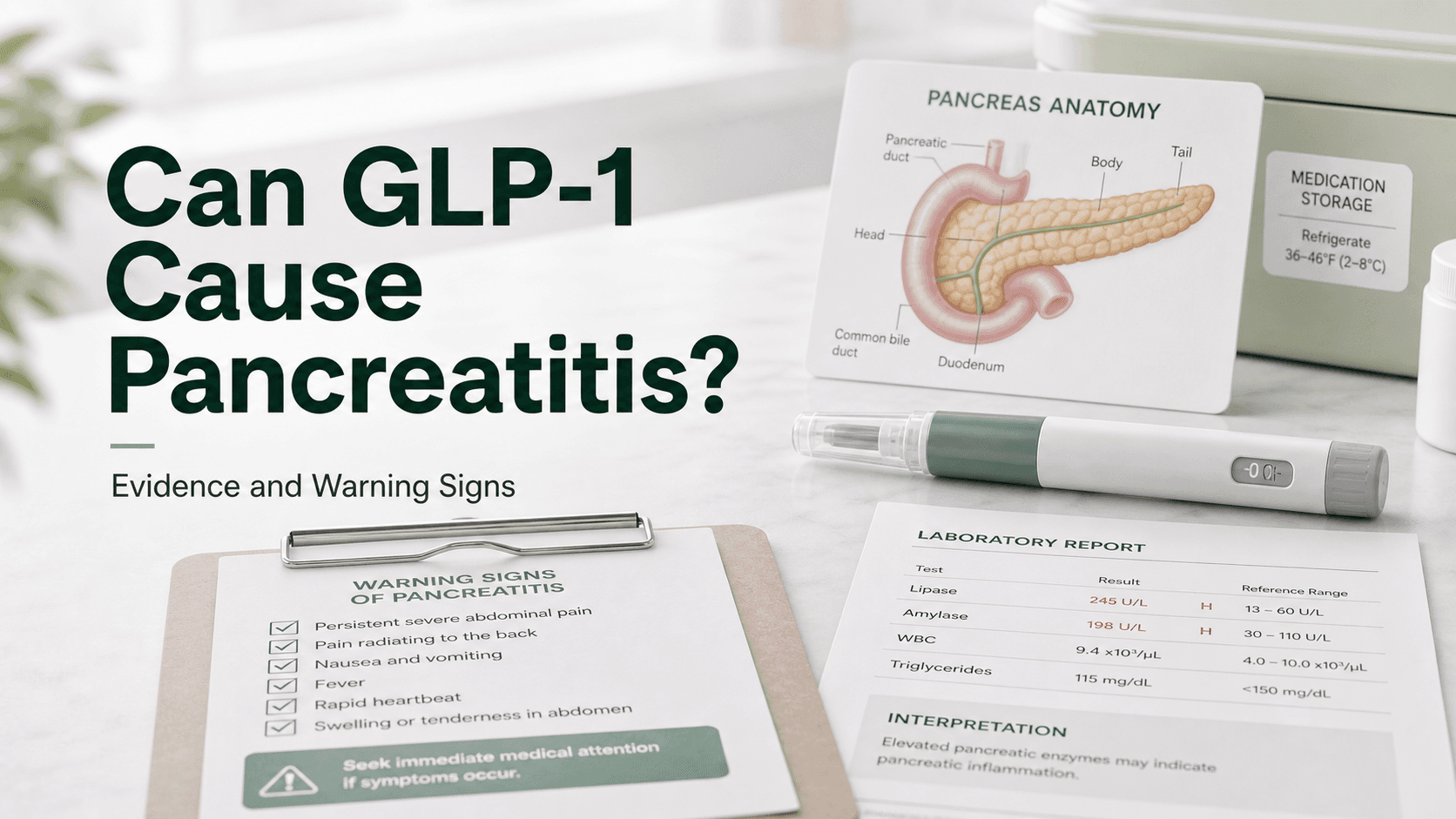
"Pancreatitis" is one of the most-Googled side effects of GLP-1 medications. Every GLP-1 drug label — semaglutide, liraglutide, tirzepatide, dulaglutide — carries a postmarketing warning that acute pancreatitis has been reported. Class-action ads treat the link as settled science. The published data tells a more cautious story: a small, inconsistent signal that varies by drug, population, and analytical method. In some trials, pancreatitis rates were lower on GLP-1 than placebo; in others, modestly higher and concentrated in patients with gallstones or rapid weight loss.
Direct answer: GLP-1 medications can be associated with acute pancreatitis, but absolute risk is low — roughly 0.2–0.4% of patients in randomized trials, and in most large meta-analyses the rate is not statistically different from placebo. Some real-world analyses show a 1.4–1.5× signal; others find no increase, or even a lower lifetime pancreatitis risk on GLP-1s. Cases are usually mild, often tied to gallstones from rapid weight loss, and rarely fatal. Patients with prior pancreatitis, severe hypertriglyceridemia (>500 mg/dL), heavy alcohol use, or active gallstone disease deserve a careful pre-treatment conversation. Severe upper abdominal pain radiating to the back, with nausea or vomiting, requires same-day evaluation.
What Acute Pancreatitis Is
Acute pancreatitis is sudden inflammation of the pancreas. Hallmarks:
- Severe upper abdominal pain that often radiates through to the back
- Persistent nausea and vomiting
- Pain that worsens after eating, especially fatty meals
- Elevated lipase (the most specific lab marker) — typically 3× the upper limit of normal or higher
In the general population, the most common causes are gallstones (~40%) and alcohol (~30%). Other triggers include very high triglycerides, certain medications, and post-ERCP. Most episodes are mild and resolve with bowel rest, IV fluids, and pain control over a few days; 15–20% become severe, with necrosis, organ failure, or systemic inflammatory response.
The Per-Drug Trial Picture
Liraglutide (Saxenda, Victoza)
This is the GLP-1 with the most worrying-looking numbers, and the most informative ones.
- LEADER trial (1.8 mg liraglutide, 9,340 type 2 diabetes patients, median 3.84 years): 18 confirmed acute pancreatitis cases on liraglutide (0.4%) vs 23 on placebo (0.5%). No excess risk.
- SCALE program (3.0 mg liraglutide, non-diabetic obesity): 10 cases of acute pancreatitis in the liraglutide group (~0.4%) vs 1 case in placebo (<0.1%). Of those 10 cases, 9 were mild and 5 had gallstones evident at presentation.
The SCALE pattern is the most consistent fingerprint across the GLP-1 class: pancreatitis events cluster in patients with rapid weight loss and concurrent gallstone disease, not in a uniform drug-toxic pattern.
Semaglutide (Ozempic, Wegovy, Rybelsus)
Across the SUSTAIN, PIONEER, and STEP programs:
- SUSTAIN-6 cardiovascular trial: 9 cases on semaglutide vs 12 on placebo.
- PIONEER-6: 1 case on oral semaglutide vs 3 on placebo.
- STEP weight-loss program: 3 mild acute pancreatitis cases in semaglutide groups. All three patients had prior pancreatitis or gallstones. All recovered.
A 2024 updated meta-analysis of semaglutide across formulations and doses produced an odds ratio of 0.7 (95% CI 0.5–1.2) vs placebo — numerically lower, not statistically different.
Tirzepatide (Mounjaro, Zepbound)
A dual GIP/GLP-1 agonist, and the cleanest pancreatitis data so far:
- SURMOUNT-1 (72-week obesity trial): 4 adjudication-confirmed pancreatitis cases, evenly distributed across all three tirzepatide doses and placebo. None severe.
- SURMOUNT-3: 0.3% on tirzepatide vs 0.3% on placebo.
- Lilly's pooled SURPASS/SURMOUNT data: 0.2% on tirzepatide vs 0.2% on placebo.
Tirzepatide's pancreatitis rate, across multiple programs, is functionally indistinguishable from placebo.
What the Meta-Analyses Show
Trial-level data is reassuring on its own, but pancreatitis is rare enough that you need pooled data to detect a small signal. Multiple 2023–2026 meta-analyses converge on a narrow range:
| Analysis | Comparator | Result | P-value |
|---|---|---|---|
| Cao et al., 7 CVOTs, n=56,004 | GLP-1 vs placebo | OR 1.05 (0.78–1.40) | 0.76 — not significant |
| 43-trial meta-analysis (2023) | GLP-1 vs placebo | OR 1.24 (0.94–1.64) | 0.13 — not significant |
| Network meta-analysis, n=102,257 | GLP-1 vs placebo | RR 0.96 — neutral | not significant |
| Routine-care cohort, 16 studies, >6M patients | GLP-1 vs non-users | aHR 1.11 | not significant |
| Real-world propensity-matched (FAERS-derived) | GLP-1 vs comparators | Modest signal, RR ~1.44 in some subgroups | mixed |
The honest summary: across randomized trials, there is no statistically significant increase in acute pancreatitis on GLP-1s as a class. Some real-world analyses pick up a 1.4–1.5× signal in selected subgroups, which is what you would expect if pancreatitis events cluster in patients with confounding risk factors (rapid weight loss, gallstones, smoking, advanced CKD). The 2025 propensity-matched comorbidity-free analysis even found lower lifetime pancreatitis on GLP-1s, likely because better glycemic control and weight loss reduce baseline risk.
Why the Signal Exists at All — Mechanism
If the trial data is mostly null, why does pancreatitis show up on every label? Three plausible drivers:
- Rapid weight loss causes gallstones. Losing more than ~1.5 kg per week roughly triples gallstone risk, and biliary stones are the single most common trigger of acute pancreatitis. This is not drug-specific — it happens with bariatric surgery and very-low-calorie diets too.
- Direct pancreatic enzyme effects. GLP-1 activation modestly increases acinar enzyme synthesis, showing up as low-grade lipase elevations early in treatment. In LEADER and other trials, these enzyme bumps did not predict subsequent clinical pancreatitis.
- Reduced gallbladder motility. GLP-1s slow gallbladder emptying, favoring biliary sludge. Combined with low-fat eating during the nausea phase, this loads the dice toward biliary events.
The dominant pathway is gallstones from rapid weight loss, not direct pancreatic toxicity. That is why liraglutide 3.0 mg, with its faster early weight-loss curve, produces more gallstone-mediated pancreatitis than tirzepatide titrated more slowly.
Who Is at Higher Risk
A 2,245-patient real-world analysis presented at ACG 2022 found three factors independently raised pancreatitis risk after GLP-1 initiation:
- Type 2 diabetes (adjusted OR 2.0)
- Tobacco use (adjusted OR 3.3)
- Advanced chronic kidney disease, stage III or higher (adjusted OR 2.3)
Counter-intuitively, that study did not find an increased post-GLP-1 pancreatitis risk in patients with prior pancreatitis, prior gallstones, or alcohol use — though these remain the most important baseline risk factors for pancreatitis in general. Most clinicians still flag the classic triad:
- Personal history of acute pancreatitis (recurrence risk in general is ~10% per year independent of GLP-1)
- Active gallstone disease or recent biliary colic
- Severe hypertriglyceridemia (>500 mg/dL, and especially >1,000 mg/dL)
- Heavy alcohol use
- Smoking
- Advanced CKD
A history of pancreatitis is no longer considered an absolute contraindication to GLP-1 therapy. A 2024 cohort of 161 patients with prior pancreatitis who restarted GLP-1s found 10% had a recurrence — and only 38% of those recurrences were considered drug-attributable, the rest tied to ongoing alcohol use, gallstones, or other causes.
Red-Flag Symptoms
Stop the medication and seek same-day medical attention if you experience:
- Severe upper abdominal pain that radiates to the back
- Persistent nausea and vomiting out of proportion to your usual GLP-1 side effects
- Pain that worsens after eating, especially fatty meals
- Fever, fast heart rate, lightheadedness along with abdominal pain
- Yellowing of the skin or eyes (jaundice), or pale stools and dark urine
Lipase is the most specific lab test; ultrasound or CT confirms the picture. Do not assume bad GLP-1 nausea — true pancreatitis pain is distinctively severe, central or left-upper, and back-radiating.
Who Should Avoid or Approach Cautiously
Per current label language and most clinical guidelines:
- History of pancreatitis: not an absolute contraindication, but warrants a baseline discussion, slower dose titration, and a low threshold to discontinue at the first sign of recurrent symptoms.
- Severe hypertriglyceridemia (>500 mg/dL): address the triglycerides first. Fenofibrate, omega-3s, or weight loss before scaling GLP-1 dose.
- Active gallstone disease: consider ultrasound before initiation in patients with risk factors; slower titration and (in some clinics) prophylactic ursodeoxycholic acid during rapid weight-loss phases.
- Heavy active alcohol use: address first.
- Multiple endocrine neoplasia type 2 and personal/family history of medullary thyroid carcinoma: absolute contraindication to GLP-1 — but for thyroid, not pancreas, reasons.
MDL-3094 and the Litigation Context
The federal Multidistrict Litigation for GLP-1 medications is MDL-3094 — In re: Glucagon-like Peptide-1 Receptor Agonists (GLP-1 RAs) Products Liability Litigation — in the Eastern District of Pennsylvania before Judge Karen Marston. As of May 2026, more than 3,600 lawsuits are pending.
Clarifying points:
- The MDL's primary qualifying injuries are gastrointestinal: gastroparesis, intestinal blockage/ileus, and cyclic vomiting. Pancreatitis claims are included in the broader GI bucket but are not the headline injury driving the MDL.
- Plaintiffs allege Novo Nordisk and Eli Lilly failed to adequately warn about severe GI risks. A 2023 JAMA analysis cited in briefing reported a roughly 9× pancreatitis signal in real-world data — much higher than randomized-trial data and disputed on methodologic grounds.
- The MDL has not established general causation. Bellwether trial selection is expected in late 2026 or 2027.
A rare event in tens of millions of users still produces a lot of plaintiffs, even when the population-level signal is small.
What People Get Wrong About GLP-1 and Pancreatitis
- "GLP-1s cause pancreatitis." Randomized trial evidence is largely null. Real-world data shows a small signal that is mostly explained by gallstones and confounders.
- "A history of pancreatitis means I can never take a GLP-1." This is no longer the consensus. Most clinicians will consider GLP-1 therapy in patients with remote, single-episode pancreatitis where the cause was reversible — with a slower titration and clear stop rules.
- "Tirzepatide is just as risky as Ozempic for pancreatitis." Per published data, tirzepatide rates are indistinguishable from placebo. The drug-by-drug pattern is not uniform.
- "Elevated lipase on a routine blood test means I have pancreatitis." Mild lipase or amylase elevations are common on GLP-1s and do not, on their own, indicate clinical pancreatitis. Symptoms drive the diagnosis.
- "The lawsuits prove the drugs cause pancreatitis." MDL-3094 is examining whether warnings were adequate. General causation has not been established by the court.
Frequently Asked Questions
Can Ozempic cause pancreatitis? Acute pancreatitis has been reported with semaglutide in postmarketing surveillance, but in randomized trials the rate is similar to or lower than placebo (odds ratio 0.7, not statistically different). The risk is small in absolute terms.
What is the pancreatitis rate on tirzepatide? About 0.2–0.4% in SURMOUNT trials — essentially the same as placebo. Cases were evenly distributed across drug and placebo arms.
Does liraglutide cause pancreatitis more than other GLP-1s? The SCALE trial showed 10 cases on liraglutide 3.0 mg vs 1 on placebo, with 5 of the 10 gallstone-related. That points to rapid weight loss rather than direct toxicity. The LEADER trial at 1.8 mg showed no excess.
What are the symptoms of pancreatitis? Severe upper abdominal pain radiating to the back, often with nausea and vomiting and worse after fatty meals. Seek same-day care.
Should I stop my GLP-1 if I have pancreatitis symptoms? Yes. Stop the medication and seek medical evaluation. A lipase level and imaging will clarify the diagnosis.
Can I take a GLP-1 if I had pancreatitis in the past? In many cases, yes, after a careful discussion about cause, current risk factors, and a clear plan for early discontinuation if symptoms recur.
Does the MDL-3094 lawsuit mean GLP-1s cause pancreatitis? No. The MDL is examining whether manufacturers warned about GI risks (including pancreatitis) adequately. Causation has not been adjudicated.
Last reviewed: May 13, 2026
Sources
- GLP-1 Receptor Agonists and Pancreatitis: A Reconcilable Divorce — Cleveland Clinic Journal of Medicine
- Reconciling GLP-1s and Pancreatitis — Cleveland Clinic Consult QD
- Factors That Increase Pancreatitis Risk With GLP-1 Initiation — US Pharmacist
- Amylase, Lipase, and Acute Pancreatitis in the LEADER Trial — Diabetes Care
- Impact of Liraglutide on Pancreatitis in the SCALE Program — Diabetes Care
- Evaluating Pancreatitis Rates Among GLP-1 RAs: Systematic Review and Meta-Analysis — PMC
- Pancreatitis Risk Associated with GLP-1 RAs: Propensity-Matched Analysis — PMC
- MDL 3094 In Re: GLP-1 RAs Products Liability Litigation — US District Court Eastern District of Pennsylvania
- Pancreatic Safety of Tirzepatide: Systematic Review and Meta-Analysis — PMC