GLP-1 and Thyroid Cancer: The Boxed Warning in 2026
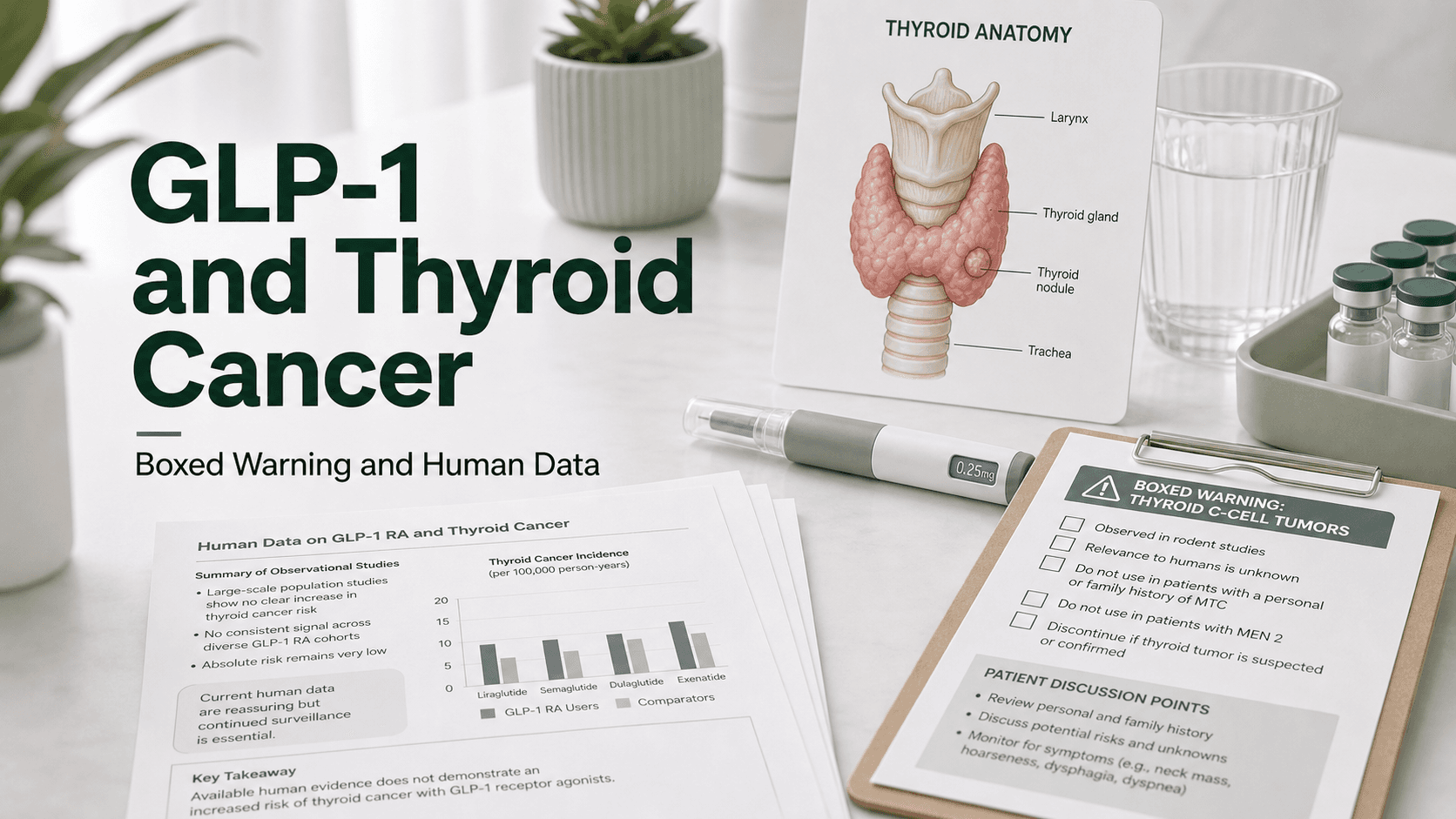
Every GLP-1 receptor agonist sold in the United States — semaglutide, tirzepatide, liraglutide, dulaglutide, exenatide — carries the same FDA boxed warning at the top of its label: do not use in patients with a personal or family history of medullary thyroid carcinoma (MTC) or multiple endocrine neoplasia type 2 (MEN2). The warning came almost entirely from a single set of rat studies done more than a decade ago. The largest human cohort study to date — 92,497 GLP-1 users compared with 2,484,408 matched controls across six countries — found no increased risk of thyroid cancer. Both of those statements are true at the same time, and that is what makes this topic confusing.
Direct answer: The boxed warning is based on rat carcinogenicity studies in which GLP-1 receptor agonists produced dose-dependent C-cell hyperplasia and thyroid C-cell tumors. No human study has confirmed a true elevation in MTC risk. Large database analyses — including a six-country cohort published in Thyroid in January 2025 and Mayo Clinic surveillance work — show what appears to be a short-term diagnostic spike driven by detection bias (more imaging, more clinical encounters), not true cancer induction. Absolute contraindications: personal or family history of MTC, or any MEN2 syndrome. Not contraindicated: simple thyroid nodules, treated papillary thyroid cancer, Hashimoto's, or a benign goiter. Routine calcitonin monitoring is not recommended; a baseline value above roughly 100 pg/mL warrants endocrinology evaluation before starting.
What MTC Is — and Why It Is Different From "Thyroid Cancer" in General
When most people say "thyroid cancer" they mean papillary or follicular thyroid cancer — the differentiated thyroid cancers that arise from the follicular cells that make thyroid hormone. Those make up roughly 95–97% of all thyroid cancers. They are usually slow-growing, highly treatable, and have excellent long-term survival.


Medullary thyroid carcinoma is a different disease. Key features:
- Arises from parafollicular C-cells, not from the hormone-producing follicular cells
- C-cells secrete calcitonin, which becomes the disease's tumor marker
- Accounts for only about 1–4% of all thyroid cancers (~3% in most US series)
- More aggressive than differentiated thyroid cancer; spreads to lymph nodes early
- Hereditary in roughly 25% of cases (the rest are sporadic)
- Five-year survival is excellent for stage I (>95%) but falls sharply with distant metastasis (~25%)
The FDA boxed warning is specifically about MTC, because that is the cancer that arises from the cell type the rats developed tumors in. The warning is not about papillary, follicular, or oncocytic (Hürthle cell) thyroid cancer.
What MEN2 Is
Multiple endocrine neoplasia type 2 is a hereditary syndrome caused by germline mutations in the RET proto-oncogene. Carriers develop MTC at very high rates — often near 100% over a lifetime — frequently in childhood or young adulthood. There are two main subtypes:
- MEN2A — MTC plus pheochromocytoma and primary hyperparathyroidism
- MEN2B — MTC (very early, often before age 5), pheochromocytoma, mucosal neuromas, marfanoid habitus
MEN2 is rare — roughly 1 in 30,000 people — but a known RET mutation or a first-degree relative with MTC/MEN2 is an absolute contraindication to every GLP-1 on the market. Patients with MEN2 should not be on these medications under any circumstances, and a careful family history is the standard pre-prescription screen.
The Rat Study That Started Everything
The boxed warning traces back to a 2-year Sprague Dawley rat carcinogenicity program required for any new chronic-use drug. In the pivotal liraglutide and semaglutide studies:
- Rats received subcutaneous doses spanning 0.0025 to 0.1 mg/kg/day for two years (a full rodent lifetime)
- Statistically significant increases in thyroid C-cell adenomas in both sexes at all dose levels
- Statistically significant increases in C-cell carcinomas in males at higher doses
- Concurrent rise in serum calcitonin and microscopic C-cell hyperplasia as a precursor lesion
- Effect was reproduced in mice and abolished in GLP-1 receptor knockout animals — proving the GLP-1 receptor pathway is the mechanism in rodents
Mechanism studies confirmed the same finding for exenatide and liraglutide. The signal is real, reproducible, and on-target.
Why this matters less in humans: rodent C-cells express the GLP-1 receptor at very high density. Human C-cells express the receptor at substantially lower levels, and downstream calcitonin release in human studies has not been consistently shown. The biology that produces tumors in rats may not produce them in people — but the FDA was not willing to wait the 20–30 years a human carcinogenicity signal would take to confirm.
Human Evidence — What the Big Database Studies Show
Since the boxed warning was issued in 2010, multiple very large studies have looked for a true human signal.
| Study | Population | Comparator | Result |
|---|---|---|---|
| Bezin et al. (France, 2022) | ~45,000 GLP-1 users | Non-users | Modest increased thyroid cancer risk after 1–3 years (HR ~1.6) — widely interpreted as detection bias |
| Pasternak / Baxter et al. (six countries, Thyroid Jan 2025) | 92,497 GLP-1 users vs 2,484,408 DPP-4i users | DPP-4 inhibitors | HR 0.81 (95% CI 0.59–1.12) — no increased thyroid cancer risk |
| Mayo Clinic (2024–2025 surveillance work) | Real-world Mayo records | Other diabetes drugs | HR ~1.85 in year 1, 1.27 in years 1–2, 0.78 in subsequent years — strongly suggests early surveillance effect |
| Multiple FDA AERS pharmacovigilance reviews | Spontaneous adverse-event reports | Background reporting | Elevated reporting odds ratios, but flagged as media- and label-driven, not incidence-based |
The pattern across these studies is consistent:
- A small early "bump" in thyroid cancer diagnoses in the first 6–12 months of GLP-1 use.
- That bump disappears or reverses with longer follow-up.
- GLP-1 users get more thyroid ultrasounds in the first year (driven by both label-mandated counseling and weight loss work-ups).
- Most "extra" cancers found are early-stage papillary lesions — not MTC.
That signature — early spike, late washout, more imaging, and the wrong cancer type — is the textbook signature of detection bias, not a true carcinogenic effect.
Why the FDA Boxed Warning Persists Anyway
If the human data are reassuring, why is the boxed warning still on every label? Several reasons:
- The rodent data are unambiguous. The signal is mechanistic, dose-dependent, and replicated in two species. Regulators cannot ignore that.
- MTC is rare and slow. A signal in the low single digits per 100,000 patient-years might still be invisible after 2–4 years of follow-up in even the largest cohorts.
- The cost of being wrong is high. Removing a warning that turns out to have been protective is far worse than keeping a warning that turns out to be conservative.
- The boxed warning is narrow. It bars MTC and MEN2 — a very small fraction of patients — and adds a counseling requirement. It does not restrict the drug for the typical patient.
- No upside to revising. Unlike active safety signals, there is no patient advocacy or industry pressure to relax the warning.
In short: the warning persists because regulators are appropriately cautious, not because new human evidence has flipped against the drugs.
Who Absolutely Cannot Take a GLP-1
These groups should not start (or should stop) a GLP-1 medication:
- Personal history of medullary thyroid carcinoma — at any stage, treated or not
- First-degree relative with MTC (parent, sibling, child) — even without genetic testing
- Any MEN2 diagnosis (MEN2A or MEN2B), confirmed clinically or genetically
- Known pathogenic RET mutation, even if asymptomatic
- Children with suspected hereditary MTC syndrome under endocrinology evaluation
The contraindication applies to every approved GLP-1 receptor agonist — semaglutide (Ozempic, Wegovy, Rybelsus), tirzepatide (Mounjaro, Zepbound), liraglutide (Victoza, Saxenda), dulaglutide (Trulicity), and exenatide (Byetta, Bydureon). It also applies to compounded semaglutide and tirzepatide.
What Is Not a Contraindication
The most common misconception is that any thyroid issue rules out a GLP-1. It does not.
- Simple thyroid nodules are present in roughly 50–70% of adults by age 60. They are not a contraindication.
- A history of papillary or follicular thyroid cancer, treated and in remission, is not a contraindication. The biology is unrelated to the C-cell signal.
- Hashimoto's thyroiditis, hypothyroidism on levothyroxine, or Graves' disease in remission do not preclude GLP-1 therapy.
- A benign multinodular goiter is not a contraindication.
- A family history of papillary thyroid cancer (not MTC) is not a contraindication.
If you do not know which type of thyroid cancer ran in your family, ask. The distinction is the difference between absolute disqualification and standard care.
Calcitonin Monitoring — What the Guidelines Actually Say
This is where prescribers diverge. The official position of the American Diabetes Association, the Endocrine Society, and the FDA label is:
- Routine baseline or serial calcitonin testing is not recommended for patients starting a GLP-1.
- Routine thyroid ultrasound is not recommended either.
- Both screens would generate enormous false-positive rates given how rare MTC is in the general population.
The exceptions where calcitonin is appropriate:
- Strong family history of thyroid cancer where the type is unclear
- An incidentally found thyroid nodule that has features warranting work-up by standard ATA criteria
- Persistent hoarseness, neck mass, or unexplained dysphagia while on therapy
Interpreting calcitonin values:
- <10 pg/mL is reassuring in most assays
- 10–100 pg/mL is an indeterminate range — many non-MTC causes (renal disease, PPI use, smoking, hypercalcemia, C-cell hyperplasia, sex)
- >100 pg/mL warrants formal thyroid evaluation, including ultrasound and endocrinology referral, before continuing or starting therapy
- >500 pg/mL is suspicious for MTC and requires urgent work-up
Calcitonin assays vary between labs. A single elevated value is rarely diagnostic on its own; a trend matters more than a single number.
What to Do If a Thyroid Nodule Is Found on a GLP-1
This is increasingly common simply because patients on GLP-1s get imaged more — sometimes for unrelated reasons (carotid ultrasound, neck CT, weight-loss work-up). The standard pathway is the same as for any nodule:
- Don't stop the GLP-1 reflexively. A nodule does not equal cancer; ~90% of nodules are benign.
- Thyroid ultrasound with TI-RADS scoring to characterize size and suspicious features.
- Calcitonin if any feature suggests possible MTC or if the patient has a relevant family history.
- Fine-needle aspiration biopsy for nodules that meet size/feature thresholds per ATA criteria.
- Continue the GLP-1 unless MTC is diagnosed. Benign and indeterminate biopsies are not stop indications.
The Clayman Thyroid Center — one of the largest dedicated centers in the country, treating about 2,000 patients with thyroid cancer annually — has publicly stated they have not observed a clinical association between GLP-1 exposure and MTC in their practice.
What People Get Wrong About GLP-1 and Thyroid Cancer
- "GLP-1s cause thyroid cancer." The available human evidence does not support that. The boxed warning is about a single rare cancer type (MTC), based on rat data, and the largest human studies have not confirmed a signal.
- "I have nodules, so I can't take Ozempic." Simple nodules are not a contraindication. Roughly half of adults have them.
- "I had thyroid cancer years ago, so I'm out." If the cancer was papillary, follicular, or oncocytic — most thyroid cancers — the contraindication does not apply.
- "I should get a calcitonin level before starting." Routine baseline calcitonin is not recommended. It produces more confusion than clarity in low-risk patients.
- "Tirzepatide is safer for the thyroid." The boxed warning is identical for tirzepatide. The rodent C-cell signal also exists for tirzepatide. There is no clinically meaningful difference between the major GLP-1s on this specific point.
- "My TSH is normal, so I have no thyroid risk." TSH measures follicular cell function. It says nothing about C-cells or MTC.
Frequently Asked Questions
Can Ozempic cause thyroid cancer? In rats, yes — at lifetime exposures, it produces C-cell tumors. In humans, the largest cohort studies to date (>2.5 million person-years) have not shown an elevated risk. The FDA boxed warning persists because of the unresolved animal data, not because human harm has been confirmed.
What is MTC? Medullary thyroid carcinoma — a rare, aggressive thyroid cancer arising from calcitonin-producing C-cells. It accounts for roughly 1–4% of thyroid cancers and is hereditary in about 25% of cases.
Who can absolutely not take a GLP-1? Anyone with a personal or family history of MTC, anyone with MEN2A or MEN2B, and anyone with a known pathogenic RET mutation.
Are thyroid nodules a contraindication? No. Simple nodules — found in 50–70% of adults by age 60 — are not a reason to avoid GLP-1 therapy. They should be evaluated by standard ATA criteria.
Should I get a calcitonin level before starting? Not routinely. Major guidelines do not recommend baseline calcitonin in average-risk patients. It is appropriate if family history is unclear or a suspicious nodule is already known.
Does past papillary thyroid cancer disqualify me? No. The boxed warning applies only to MTC and MEN2. Treated papillary, follicular, or oncocytic thyroid cancer is not a contraindication.
Is tirzepatide safer than semaglutide for thyroid? The boxed warning and the underlying rodent C-cell signal are essentially the same for both drugs. There is no evidence one is meaningfully safer than the other for thyroid endpoints.
What symptoms should make me call my doctor? A new neck lump, persistent hoarseness lasting more than two weeks, trouble swallowing or breathing, or noticeable neck swelling — same red flags as any thyroid evaluation.
Last reviewed: May 13, 2026
Sources
- Thyroid Cancer Risk with GLP-1 Receptor Agonists: Evidence, Knowledge Gaps, and the Path Forward — PMC
- Risk of Thyroid Cancer Among GLP1-RA Users — American Thyroid Association
- GLP-1RA and Thyroid Cancer: Detection Bias, Not Causation — Mayo Clinic
- WEGOVY (semaglutide) Prescribing Information — FDA accessdata
- OZEMPIC (semaglutide) Prescribing Information — FDA accessdata
- MOUNJARO (tirzepatide) Prescribing Information — FDA accessdata
- GLP-1 Receptor Agonists and the Thyroid: C-Cell Effects in Mice — PMC
- Evaluating Thyroid Cancer Risk After GLP-1 Receptor Agonist Administration — CancerNetwork
- GLP-1 Drugs and Thyroid Cancer: 2026 Evidence Review — ThyroidCancer.com
- Appropriate and Mindful Measurement of Serum Calcitonin in Patients with Thyroid Nodules — Endocrine