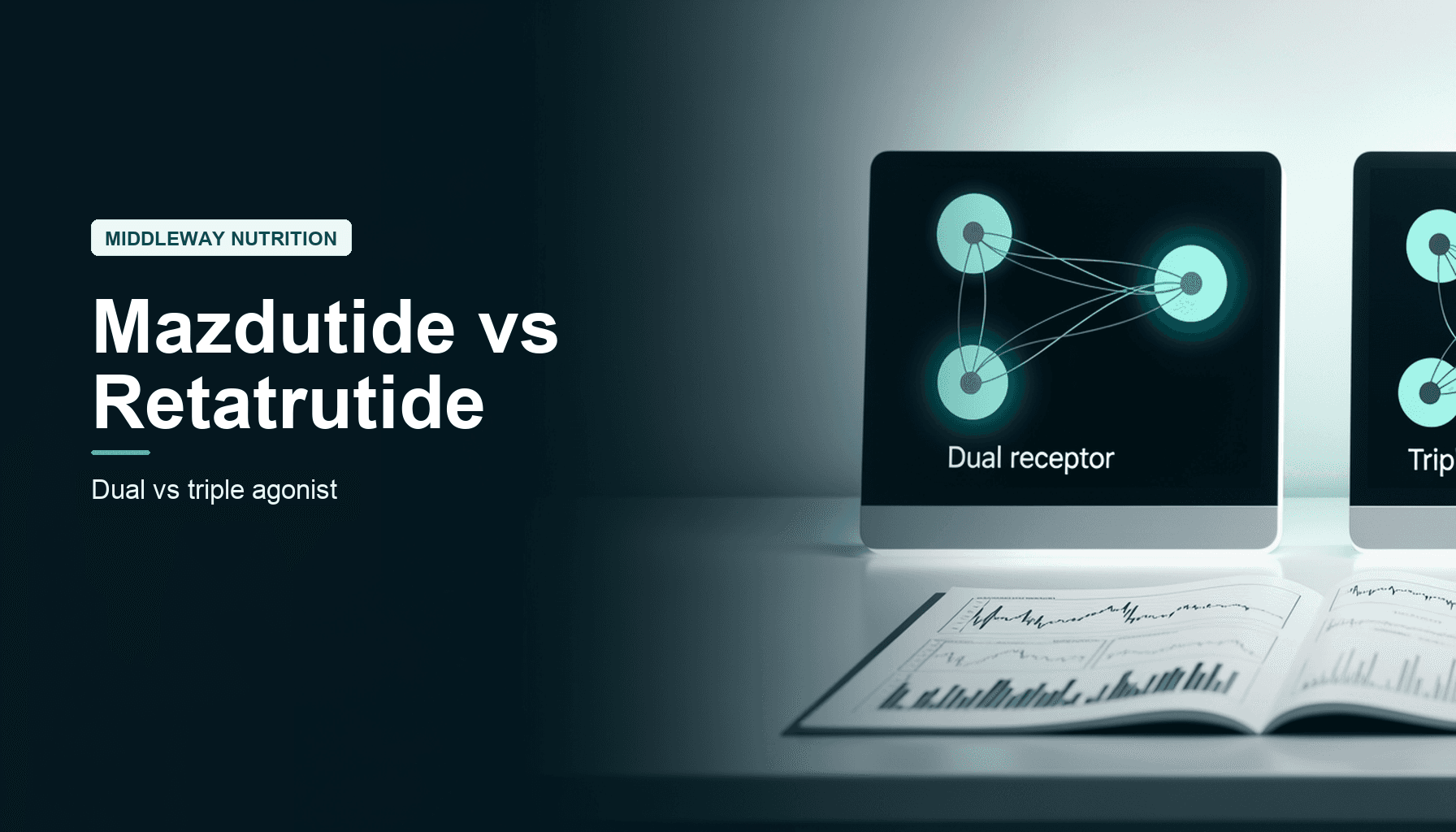
Mazdutide is a GLP-1/glucagon dual receptor agonist that is approved and marketed in China, where it produced roughly 12 to 20 percent weight loss across the GLORY phase 3 trials. Retatrutide is an investigational GIP/GLP-1/glucagon triple receptor agonist from Eli Lilly that produced up to 28.3 percent mean weight loss at 80 weeks (12 mg dose) in the phase 3 TRIUMPH-1 trial and remains unapproved anywhere as of June 2026. The short version: retatrutide hits one more receptor and posted larger trial weight loss, but mazdutide is the one you can actually get a prescription for, and only in China.
This comparison covers exactly how the two molecules differ at the receptor level, what the head-to-head trial numbers show, the side effect picture, and which markets each drug serves.
Quick comparison table
| Feature | Mazdutide | Retatrutide |
|---|---|---|
| Drug class | Dual agonist (GLP-1 + glucagon) | Triple agonist (GIP + GLP-1 + glucagon) |
| Developer | Innovent Biologics (licensed from Eli Lilly) | Eli Lilly |
| Research codes | IBI362, LY3305677 | LY3437943 |
| Dosing | Once weekly subcutaneous | Once weekly subcutaneous |
| Trial doses | 4 mg, 6 mg, 9 mg | 4 mg, 9 mg, 12 mg |
| Peak trial weight loss | ~18.6% (9 mg, 60 wk, GLORY-2) | ~28.3% (12 mg, 80 wk, TRIUMPH-1) |
| Pivotal program | GLORY (GLORY-1, GLORY-2) | TRIUMPH (TRIUMPH-1 and others) |
| Approval status | Approved in China (NMPA) | Investigational, not approved anywhere |
| Available markets | China | None (clinical and research only) |
Mechanism: dual vs triple agonist
Both drugs are engineered peptides that mimic gut and pancreatic hormones, but they activate a different set of receptors.
Mazdutide binds two targets:
- GLP-1 receptor: suppresses appetite, slows gastric emptying, and improves blood sugar control. This is the same pathway used by semaglutide.
- Glucagon receptor: increases energy expenditure and drives hepatic fat metabolism. Glucagon agonism is why mazdutide produced large drops in liver fat in its trials.
Retatrutide binds three targets:
- GIP receptor: glucose-dependent insulinotropic polypeptide activity, which complements GLP-1 on appetite and insulin response.
- GLP-1 receptor: the same appetite and glycemic pathway as above.
- Glucagon receptor: the same energy expenditure and liver fat pathway as mazdutide.
The practical takeaway is that mazdutide and retatrutide share two of three pathways. The difference is GIP. Retatrutide adds GIP receptor agonism on top of the GLP-1/glucagon backbone, which is the same logic that separates tirzepatide (GIP + GLP-1) from semaglutide (GLP-1 only). If you want the detailed pharmacology, see our breakdown of the retatrutide mechanism of action and the overview of what retatrutide is.
Glucagon is the shared wildcard here. On its own, glucagon raises blood sugar, which sounds counterproductive for a metabolic drug. But when paired with strong GLP-1 (and GIP) activity that controls glucose, the glucagon component instead boosts calorie burn and pulls fat out of the liver. Both mazdutide and retatrutide lean on this balance.
Trial weight loss: GLORY vs TRIUMPH
Cross-trial comparisons are imperfect because the study populations, durations, and dose ladders differ. Mazdutide was tested in Chinese adults; retatrutide was tested in a broader population. Read the numbers as directional, not as a controlled head-to-head.
Mazdutide GLORY data
The GLORY-1 phase 3 trial enrolled 610 Chinese adults with obesity or overweight plus a comorbidity. Mean baseline weight was 87.2 kg and mean BMI was 31.1 kg/m². At week 48:
- 4 mg: mean weight reduction of 12.05 percent
- 6 mg: mean weight reduction of 14.84 percent
- Placebo: 0.47 percent
At the 6 mg dose, 82.8 percent of participants lost at least 5 percent of body weight and 50.6 percent lost at least 15 percent. Waist circumference dropped about 11 cm at 6 mg, and liver fat fell roughly 73 percent in participants who started with elevated liver fat. Blood pressure, lipids, and uric acid all improved. GLORY-1 was published in the New England Journal of Medicine in May 2025.
GLORY-2 pushed the dose higher. It enrolled 462 adults with a BMI of 30 kg/m² or above (mean BMI 34.3), randomized 2:1 to mazdutide 9 mg or placebo over a 60-week double-blind period with two-step titration:
- 9 mg, overall population: 18.55 percent mean weight reduction
- 9 mg, participants without type 2 diabetes: 20.08 percent mean reduction
- Placebo: about 3 percent
Liver fat dropped about 72 percent versus a small increase in the placebo group, and all key secondary endpoints (waist, systolic blood pressure, triglycerides, non-HDL and LDL cholesterol, uric acid) were met.
Retatrutide TRIUMPH-1 data
TRIUMPH-1 was a randomized, double-blind, placebo-controlled phase 3 trial in 2,339 adults with obesity or overweight and at least one weight-related comorbidity. At 80 weeks:
- 4 mg: 19.0 percent mean weight loss
- 9 mg: 25.9 percent mean weight loss
- 12 mg: 28.3 percent mean weight loss
- Placebo: 2.2 percent
At 12 mg, 45.3 percent of participants achieved at least 30 percent weight loss, a threshold often associated with bariatric surgery. Participants with a baseline BMI of 35 or higher who stayed on 12 mg through 104 weeks of total treatment lost an average of about 30 percent (30.3 percent) of their body weight. Topline results were announced in May 2026. For the full clinical picture, see our retatrutide clinical trial summary and retatrutide before and after results.
How the numbers line up
| Metric | Mazdutide (best dose) | Retatrutide (best dose) |
|---|---|---|
| Top trial dose | 9 mg | 12 mg |
| Mean weight loss | ~18.6% (60 wk) | ~28.3% (80 wk) |
| Non-diabetic subgroup | ~20.1% | not separately reported here |
| Trial length | 48 to 60 weeks | 80 weeks (104 wk extension) |
| Population | Chinese adults | broad obesity/overweight cohort |
Retatrutide posted the larger peak number (about 28 percent), and it did so over a longer treatment window, which matters because weight loss curves with these drugs keep climbing past one year. Mazdutide's results are strong for a dual agonist and competitive with semaglutide-class outcomes, but on raw efficacy the triple agonist is ahead in the data published so far.
Side effects and tolerability
Both drugs share the gastrointestinal profile typical of incretin therapies. Nausea, diarrhea, and vomiting were the most common adverse events for each, mostly mild to moderate and concentrated during dose escalation.
For mazdutide in GLORY, the most frequent events were nausea, diarrhea, and vomiting, with a modest heart rate increase of about 2.6 bpm at week 48 and no new cardiovascular safety signals.
For retatrutide at the 12 mg dose in TRIUMPH-1:
- Nausea: 42.4 percent
- Diarrhea: 32.0 percent
- Constipation: 26.1 percent
- Vomiting: 25.3 percent
- Discontinuation due to adverse events: 11.3 percent at 12 mg versus 4.1 percent at 4 mg and 4.9 percent on placebo
The pattern is dose dependent. Higher doses buy more weight loss but raise the rate of GI events and dropouts. The glucagon component in both drugs can also nudge heart rate up and, at least transiently, affect glucose, which is why titration is slow. Our guides on retatrutide side effects and whether retatrutide is safe go deeper on the triple agonist specifically.
Approval status and markets
This is where the two drugs diverge most.
Mazdutide is approved by China's National Medical Products Administration (NMPA) and is commercially available there for weight management, with co-development tied to Eli Lilly and Innovent leading the China program. It is not approved by the FDA or the EMA, so it is not legally marketed in the United States or Europe.
Retatrutide is investigational. As of June 2026 it is not approved in any market, and analysts do not anticipate approval before 2027 pending completion of the TRIUMPH program and regulatory review. It remains a Lilly pipeline asset. For timeline detail, see when retatrutide will be available and our notes on retatrutide and Eli Lilly.
Because retatrutide is unapproved, there is no legitimate retail supply. Products marketed as "research" retatrutide fall outside the regulated supply chain, a topic we cover in compounded retatrutide and retatrutide without a prescription. Neither drug should be sourced or dosed without clinical oversight.
Which one is "better"?
It depends on what you mean by better.
- On peak efficacy in reported trials, retatrutide is ahead, with up to 28 percent at 80 weeks versus mazdutide's roughly 18 to 20 percent at 60 weeks.
- On availability, mazdutide wins outright, because it is an approved, prescribable drug in China while retatrutide is still in trials.
- On liver and metabolic markers, both perform strongly thanks to shared glucagon agonism, with mazdutide showing standout liver fat reductions.
- On global relevance, retatrutide is the molecule most of the Western market is waiting on, given Lilly's distribution reach and the FDA pathway.
If you are comparing retatrutide against drugs you can get today, our retatrutide vs tirzepatide and retatrutide vs semaglutide breakdowns are more directly actionable, and survodutide vs retatrutide covers another glucagon-containing competitor.
FAQ
Is mazdutide stronger than retatrutide?
No. In reported phase 3 data, retatrutide produced larger weight loss (up to about 28 percent at 80 weeks at 12 mg) than mazdutide (about 18 to 20 percent at 60 weeks at 9 mg). Mazdutide is a strong dual agonist, but the triple agonist posted higher peak numbers. These are separate trials, not a head-to-head study, so treat the gap as directional.
What is the difference between a dual and triple agonist?
A dual agonist activates two hormone receptors; mazdutide hits GLP-1 and glucagon. A triple agonist activates three; retatrutide hits GIP, GLP-1, and glucagon. The extra GIP receptor is the main mechanistic difference between them.
Is mazdutide available in the United States?
No. Mazdutide is approved by China's NMPA and marketed in China only. It is not FDA approved, so it is not legally available in the United States.
Is retatrutide FDA approved yet?
No. As of June 2026, retatrutide is investigational and not approved in any market. Approval is not expected before 2027 pending the full TRIUMPH program. See our retatrutide cost and retatrutide dosage chart pages for what is known so far.
Which has more side effects, mazdutide or retatrutide?
Both cause the same broad pattern of gastrointestinal effects, so the more useful comparison is dose intensity rather than the molecule itself. In TRIUMPH-1, roughly 11 percent of participants on the 12 mg retatrutide dose stopped treatment because of adverse events, compared with about 4 percent at the lowest dose. Mazdutide in the GLORY program had a low discontinuation rate (under 3 percent in GLORY-2). The higher you titrate either drug, the more nausea, diarrhea, and vomiting you should expect, which is why both use slow dose escalation. Tolerability varies by person, so this is a discussion to have with your prescriber.
Do mazdutide and retatrutide share any pathways?
Yes. Both activate the GLP-1 receptor (appetite and glucose control) and the glucagon receptor (energy expenditure and liver fat). Retatrutide adds GIP receptor activity on top of that shared backbone.
This article is for informational purposes only and is not medical advice. Talk to a qualified clinician before starting, stopping, or changing any medication.
References
- Ji L, Jiang H, et al. Once-Weekly Mazdutide in Chinese Adults with Obesity or Overweight (GLORY-1). New England Journal of Medicine. 2025. PubMed 40421736
- Jastreboff AM, Kaplan LM, Frias JP, et al. Triple-Hormone-Receptor Agonist Retatrutide for Obesity - A Phase 2 Trial. New England Journal of Medicine. 2023. PubMed 37366315