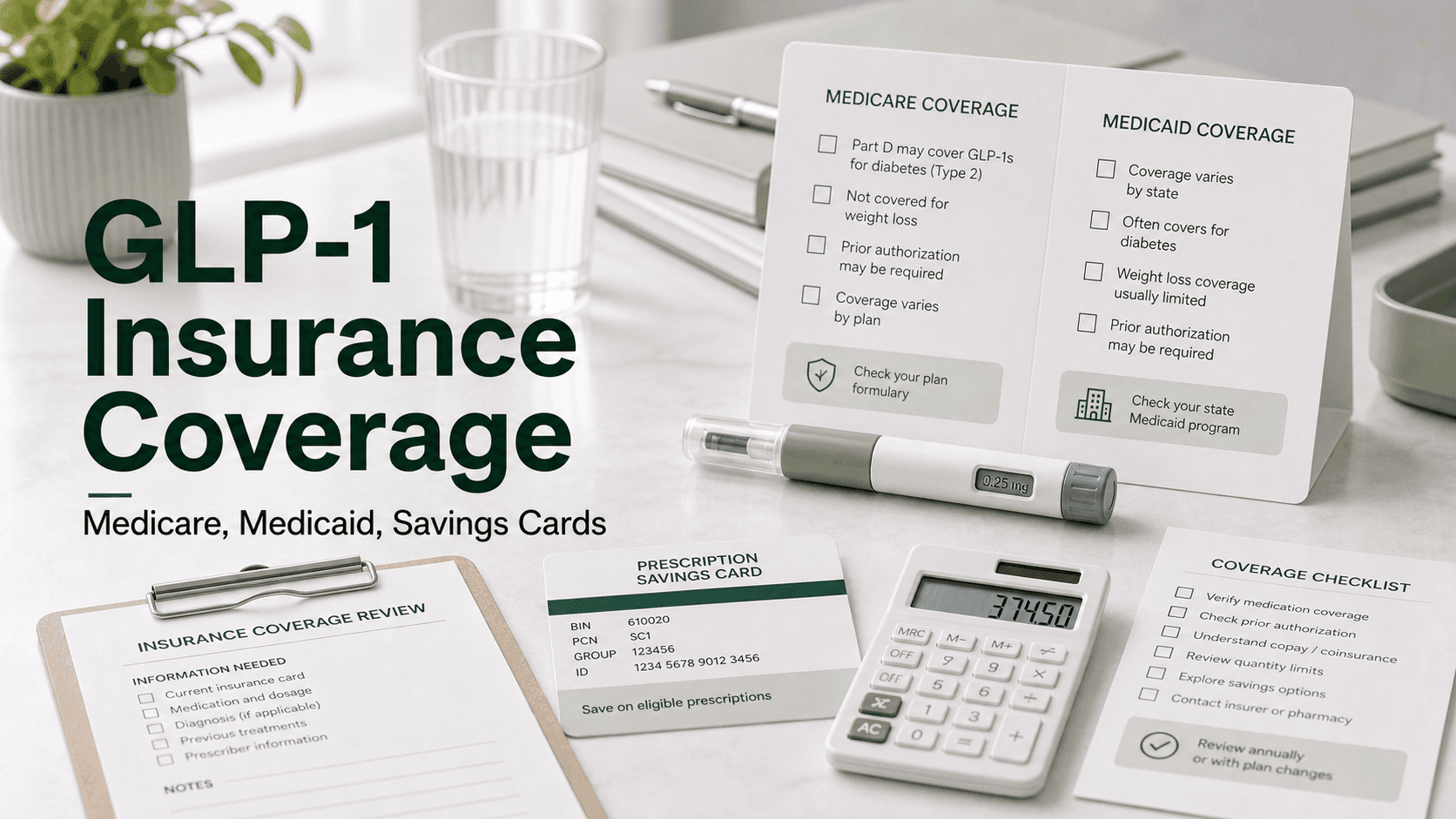

Medicare GLP-1 coverage runs on one rule with a growing list of exceptions. The rule, written into the law that created Part D: Medicare may not pay for drugs used for weight loss. The exceptions: every other thing GLP-1s treat — type 2 diabetes, cardiovascular risk, obstructive sleep apnea, liver disease — is coverable. And as of July 1, 2026, a federal demonstration program pays for weight loss itself, $50 a month, for the first time in Medicare's history.
Direct answer: In 2026, Medicare Part D covers GLP-1s prescribed for type 2 diabetes (Ozempic, Mounjaro, Rybelsus, Trulicity, Victoza), Wegovy for cardiovascular risk reduction in adults with heart disease plus overweight/obesity, Zepbound for moderate-to-severe obstructive sleep apnea, and Wegovy for noncirrhotic MASH. It does not cover any GLP-1 prescribed purely for weight loss — that statutory exclusion has stood since Part D launched in 2006. The carve-out arrived July 1, 2026: the Medicare GLP-1 Bridge, a demonstration running through December 31, 2027, covers Wegovy, the Zepbound KwikPen, and Foundayo for weight management at a flat $50/month for beneficiaries meeting BMI criteria. Coverage of everything else still varies plan by plan, with prior authorization nearly everywhere.
The scale explains the fight over all this: Medicare processed 21.8 million GLP-1 claims totaling $27.5 billion in gross spending in 2024 — before covering weight loss at all.
Medicare GLP-1 Coverage at a Glance (2026)
Medicare publishes no national list of approved GLP-1 drugs — every plan writes its own formulary. The chart below is what all of them build from: the FDA indications that decide whether a GLP-1 is payable at all.
| Drug | Indication Medicare pays under | Covered? | How |
|---|---|---|---|
| Ozempic (semaglutide) | Type 2 diabetes | Yes | Part D |
| Mounjaro (tirzepatide) | Type 2 diabetes | Yes | Part D |
| Rybelsus (oral semaglutide) | Type 2 diabetes | Yes | Part D |
| Trulicity (dulaglutide) | Type 2 diabetes | Yes | Part D |
| Wegovy (semaglutide 2.4) | Cardiovascular risk reduction | Yes | Part D |
| Wegovy | Noncirrhotic MASH | Yes | Part D |
| Zepbound (tirzepatide) | Obstructive sleep apnea + obesity | Yes | Part D |
| Wegovy / Zepbound KwikPen / Foundayo | Weight loss | From July 1, 2026 | GLP-1 Bridge, $50/month |
| Any GLP-1 | Weight loss, via regular Part D | No | Statutory exclusion |
| Saxenda (liraglutide) | Weight loss | No | Not in the Bridge either |
GLP-1 Drugs Medicare Part D Covers for Type 2 Diabetes
This is the unglamorous bulk of Medicare GLP-1 coverage. Every diabetes-labeled GLP-1 is coverable under Part D, and most plans carry at least Ozempic, Mounjaro, Rybelsus, and Trulicity — typically on a preferred or non-preferred brand tier with prior authorization confirming a type 2 diabetes diagnosis. What you pay depends on your plan's tiers and where you are in the benefit year, but two systemwide protections apply in 2026:
- The $2,100 out-of-pocket cap. Once your total Part D out-of-pocket spending hits $2,100, you pay $0 for covered drugs the rest of the year.
- Negotiated prices are coming. Semaglutide (Ozempic, Rybelsus, Wegovy) was selected in the second round of Medicare drug price negotiation; a CMS fact sheet from November 2025 set the negotiated price at $274/month, effective 2027 — down from a list price near $1,000.
One quirk worth knowing: Medicare covers the indication, not the molecule. Tirzepatide is covered as Mounjaro for diabetes but was not covered as Zepbound for weight loss — same drug, different label, opposite coverage. More background in our GLP-1 insurance coverage guide.
Why Medicare Excludes Weight-Loss Drugs (and Always Has)
When Congress wrote the Part D statute, it imported a list of excludable drug categories from Medicaid law — cosmetic drugs, fertility drugs, and "agents when used for anorexia, weight loss, or weight gain." That made the exclusion statutory: no Part D plan could cover Wegovy for obesity even if it wanted to, and no CMS regulation could change it. A proposed Biden-era rule to reinterpret obesity as a disease (rather than "weight loss" use) was never finalized.
That's why everything that's happened since 2024 has come through side doors: new FDA indications that aren't "weight loss," and now a demonstration program that operates outside Part D entirely.
Medicare and GLP-1 Coverage 2026: The Carve-Out Indications
Three FDA label expansions turned weight-loss drugs into Part D-coverable drugs for specific patients:
| Carve-out | FDA approval | Who qualifies | Status in Part D |
|---|---|---|---|
| Wegovy — cardiovascular risk reduction | March 2024 | Established heart disease + overweight or obesity | Coverable; plan formularies and prior auth vary |
| Zepbound — obstructive sleep apnea | December 2024 | Moderate-to-severe OSA + obesity (sleep study required) | Coverable; see our full Zepbound Medicare guide |
| Wegovy — noncirrhotic MASH | 2025 | Metabolic dysfunction-associated steatohepatitis | Coverable; newest and least consistently adopted |
These pathways share a pattern: coverage is legally possible but operationally narrow. Plans demand documentation of the qualifying diagnosis, and the prescription must be written for that indication. CMS explicitly requires plans to run formulary-exception processes for these drugs rather than steering patients elsewhere.
The Medicare GLP-1 Bridge: $50/Month Weight-Loss Coverage From July 2026
The genuinely new piece of Medicare GLP-1 coverage in 2026, and the thing most people mean when they ask about "the Medicare GLP-1 program." Born from the November 6, 2025 White House pricing deal with Novo Nordisk and Eli Lilly, the Bridge is a CMS-run demonstration — outside Part D — that covers Foundayo (all forms), Wegovy (all forms), and the Zepbound KwikPen for weight management at a flat $50/month copay, with manufacturers supplying drugs at a $245 negotiated net price. It runs July 1, 2026 through December 31, 2027.
The compressed version: you must be 18+, in an eligible Part D or Medicare Advantage drug plan, and meet a BMI tier (≥35 alone; ≥30 with certain heart/kidney conditions; ≥27 with pre-diabetes or established vascular disease) measured at the time you started GLP-1 therapy. Your doctor files prior authorization with a CMS central processor — no beneficiary sign-up. The $50 never counts toward your deductible or the $2,100 cap, and Extra Help doesn't reduce it. People whose GLP-1 indication is Part D-coverable (diabetes, OSA, MASH, CV) are excluded. Once your prior authorization is approved it holds through December 31, 2027 — refills and dose increases included — unless you switch to a different GLP-1.
Full eligibility tables, drug list, and enrollment steps: Medicare GLP-1 Bridge program guide.
Does Medicare Cover GLP-1s for Sleep Apnea?
Yes — one drug, one route. Zepbound (tirzepatide) is the only GLP-1 the FDA has approved for moderate-to-severe obstructive sleep apnea in adults with obesity, cleared in December 2024 on the SURMOUNT-OSA trial. That label is what pulls an OSA prescription out of the weight-loss exclusion and into ordinary Part D coverage.
| Drug | FDA-approved for OSA? | What Medicare does with an OSA prescription |
|---|---|---|
| Zepbound (tirzepatide) | Yes — moderate-to-severe OSA in adults with obesity | Coverable under Part D, with prior authorization |
| Wegovy (semaglutide) | No — labeled for cardiovascular risk reduction, weight reduction, and noncirrhotic MASH with F2-F3 fibrosis | No OSA indication for a plan to approve it against |
| Ozempic, Mounjaro, Rybelsus, Trulicity | No — type 2 diabetes labels | Covered for type 2 diabetes only |
| GLP-1 Bridge ($50/month) | Not applicable — the Bridge is weight management only | Moderate-to-severe sleep apnea makes you ineligible |
That last row is the one people trip on. Medicare.gov states it directly: you are not eligible for the GLP-1 Bridge if you have type 2 diabetes, moderate-to-severe sleep apnea, or fatty liver disease, because your Part D plan should be covering the GLP-1 for that condition already. A diagnosed OSA case isn't a bonus route on top of the $50 program — it replaces it.
What gets an OSA prescription approved: a sleep study documenting moderate-to-severe disease, a documented obesity diagnosis, and a prescription written for the apnea rather than the scale. The paperwork walkthrough is in our Zepbound Medicare guide.
Medicare GLP-1 Coverage Varies Plan by Plan
Even for fully coverable indications, whether Medicare ends up paying for your GLP-1 depends on your specific PDP or Medicare Advantage drug plan:
- Formulary inclusion — a plan may cover Ozempic but not Mounjaro, or carry Zepbound for OSA while a competitor doesn't.
- Tier placement — preferred vs. non-preferred brand tiers can mean a 25% vs. 40%+ coinsurance difference before the cap.
- Prior authorization and step therapy — nearly universal for GLP-1s; some plans require trying metformin or documenting A1C first.
- Annual changes — formularies reset every January; a covered drug can be dropped or re-tiered. Check during open enrollment (October 15 - December 7) using Medicare's plan finder.
Medicare Plans That Cover GLP-1s (and How to Check Yours)
There is no national Medicare drug list. Each Part D plan writes its own formulary and CMS approves it, under a federal rule (42 CFR 423.120) requiring at least two drugs in every therapeutic category and class. That rule is why GLP-1s appear on formularies at all. It is not a promise that your GLP-1 is one of the two.
Plan type decides which door you're standing at:
| Your Medicare coverage | Can cover a GLP-1 for a Part D indication | Eligible for the $50 GLP-1 Bridge |
|---|---|---|
| Standalone Part D drug plan (PDP) | Yes | Yes |
| Medicare Advantage coordinated care plan with drug coverage — HMO, HMO-POS, local or regional PPO (MA-PD) | Yes | Yes |
| Special Needs Plan (SNP) | Yes | Yes |
| Employer or union group waiver plan (EGWP) | Yes | Yes |
| Limited Income Newly Eligible Transition (LI NET) | Yes | Yes |
| Medicare Advantage with no drug benefit, or Original Medicare with no Part D | No | No |
| Medigap (Medicare Supplement) | No — Medigap pays your share of Part A and Part B costs, not retail pharmacy drugs | No |
The insurer's name tells you almost nothing. The same carrier can cover Ozempic on one PDP and leave it off another in the same state, and formularies reset every January. Check the plan, not the brand:
- Run the exact product through Medicare's Plan Finder at medicare.gov/plan-compare — enter "Ozempic 1 mg" or "Zepbound 7.5 mg", not "semaglutide" or "tirzepatide". Product and dose change the answer.
- Read the restriction codes next to the drug. PA is prior authorization, ST is step therapy, QL is a quantity limit. A GLP-1 listed with none of the three is unusual.
- If you're switching plans mid-treatment, use the transition fill. Federal rule guarantees a temporary supply during your first 90 days in a new plan: a one-time fill of at least a month's supply of a drug that is off-formulary or stuck behind prior authorization, with written notice within three business days. It buys time to file the exception — it is not a year of coverage.
How to Appeal a Medicare GLP-1 Denial
If your prescription is for a coverable indication and the plan says no:
- Request a coverage determination (and a formulary exception if the drug isn't listed), with a supporting statement from your prescriber tying the prescription to the FDA-approved indication.
- File a redetermination — the first-level appeal — within 65 days of a denial.
- Escalate to the Independent Review Entity (IRE) if the plan upholds its denial; further levels (ALJ hearing and beyond) exist for high-cost disputes.
Appeals succeed most often when the paperwork makes the qualifying diagnosis impossible to miss: the diabetes diagnosis code, the sleep study, the cardiac history. A prescription that looks like weight-loss treatment in disguise will lose.
If Medicare Won't Cover Your GLP-1
If you miss the Bridge's BMI tiers, sit in an ineligible plan type, or hold a diagnosis that routes you back to Part D — your realistic options are cash programs, since manufacturer savings cards exclude all government beneficiaries. LillyDirect and NovoCare sell direct: Foundayo and oral Wegovy from $149/month, Zepbound KwikPens $299-$449, Wegovy pens from $349. Comparison shopping lives in our cheapest GLP-1, Wegovy coupon, and Zepbound coupon guides. The Foundayo side of that list gets its own breakdown in our Foundayo coupon guide.
On Medicare but locked out of the Bridge — or not eligible at all? Pallas Health — a 100% online visit reviewed by a US-licensed clinician, who prescribes only when it is clinically appropriate. FDA-approved options, or compounded medication prepared by US-licensed pharmacies. Ships free if you are eligible, with no membership or platform fees. (Partner link: we may earn a commission. Compounded medications are not FDA-approved and are not generic versions of brand-name drugs.)
Frequently Asked Questions
Does Medicare cover GLP-1 drugs in 2026? Yes, for specific indications: type 2 diabetes (Ozempic, Mounjaro, Rybelsus, Trulicity), cardiovascular risk reduction (Wegovy), obstructive sleep apnea (Zepbound), and noncirrhotic MASH (Wegovy). For weight loss alone, only through the GLP-1 Bridge demonstration starting July 1, 2026.
Does Medicare cover Ozempic? Yes — for type 2 diabetes, through Part D, on most plan formularies with prior authorization. Not for weight loss, and Ozempic is not one of the three Bridge program drugs.
Which semaglutide does Medicare cover? Ozempic and Rybelsus for type 2 diabetes, and Wegovy for cardiovascular risk reduction or noncirrhotic MASH — all through Part D, all with prior authorization. Wegovy in both forms, injection and tablets, is also the semaglutide covered for weight loss at $50/month under the GLP-1 Bridge. Compounded semaglutide is never covered: Part D pays only for FDA-approved products.
Does Medicare cover Wegovy in 2026? Through Part D only for cardiovascular risk reduction or MASH. For weight loss, Wegovy (pen and tablets) is covered at $50/month under the GLP-1 Bridge from July 1, 2026 — wegovy.com confirms the $50 Medicare price for all doses.
Does Medicare cover Wegovy for sleep apnea? No. Wegovy's FDA label covers cardiovascular risk reduction, weight reduction, and noncirrhotic MASH — sleep apnea isn't on it. Zepbound is the only GLP-1 approved for moderate-to-severe obstructive sleep apnea in adults with obesity, and it's the one an OSA prescription should be written for.
Why doesn't Medicare cover weight-loss drugs? The Part D statute imported Medicaid's excludable-drug categories, which include agents used for weight loss. Changing it permanently requires Congress; the Bridge sidesteps it temporarily as a demonstration program ending December 31, 2027.
Will GLP-1 prices on Medicare come down? They already are: the November 2025 deal set a $245 Medicare net price for the Bridge drugs, and negotiated semaglutide prices ($274/month per the November 2025 CMS fact sheet) take effect in Part D in 2027.
Does Medicare Advantage cover GLP-1s differently than Part D? The same indication rules apply — MA drug coverage is Part D coverage. The main differences are formulary and prior-auth strictness, and Bridge eligibility: among MA plans, only coordinated care plans with drug coverage — HMO, HMO-POS, and local or regional PPO — qualify, alongside standalone PDPs, Special Needs Plans, employer or union group waiver plans, and LI NET. A Medicare Advantage plan with no drug benefit qualifies for neither Part D GLP-1 coverage nor the Bridge.
Is there a list of Medicare-approved GLP-1 drugs? Not a national one. Medicare approves each plan's formulary instead of publishing a single drug list, so "Medicare-approved" means whatever your plan's 2026 formulary says. The FDA indications in the chart above are the fixed part; the brand-by-brand answer comes from Plan Finder.
Does Medi-Share pay for GLP-1s? Medi-Share is not Medicare and not insurance — it's a healthcare sharing ministry, and its own guidelines say so in those words. Under those guidelines, prescriptions are eligible for sharing for six months from the date of diagnosis per new condition, and "the cost of prescription medications for pre-existing conditions is never eligible for sharing." Members who qualify for Medicare Parts A and B must move to Medi-Share 65+, where Medicare pays first and sharing applies to the remainder. An open-ended GLP-1 for obesity fits that structure poorly; confirm with Medi-Share before assuming anything is shared.
I'm 63 — can Medicare cover a GLP-1 for weight loss? Only if you already have Medicare. Eligibility starts at 65, or earlier after 24 months of Social Security disability benefits, immediately with ALS, or through End-Stage Renal Disease. Without one of those routes, none of these rules reach you yet — you're on commercial, marketplace, or cash pricing. Once you're enrolled, the rules don't bend for age or sex: a 63-year-old on disability Medicare faces the same BMI tiers and the same statutory exclusion as a 75-year-old.
Last reviewed: August 20, 2026
Sources
- Medicare GLP-1 Bridge: Information for Medicare Beneficiaries — CMS
- Coming Soon: CMS to Provide $50 Monthly Access to GLP-1 Medications for Medicare Beneficiaries — CMS Newsroom
- What to Know About the BALANCE Model for GLP-1s in Medicare and Medicaid and the Medicare GLP-1 Bridge — KFF
- What Medicare's Temporary Program Covering GLP-1s for Obesity Means for Beneficiaries — KFF
- Does Medicare Cover Zepbound for Sleep Apnea? — SleepApnea.org
- White House Strikes GLP-1 Pricing Deal With Lilly, Novo — BioSpace
- What Medicare Drug Price Negotiation Means for You — GoodRx
- Save on Wegovy — wegovy.com
- Zepbound Coverage and Savings — zepbound.lilly.com
- Weight Loss Drugs: Medicare GLP-1 Bridge Coverage, Eligibility and Costs — Medicare.gov
- 42 CFR 423.120 — Access to Covered Part D Drugs (formulary requirements and transition process) — eCFR
- FDA Approves Zepbound (tirzepatide) for Moderate-to-Severe Obstructive Sleep Apnea in Adults With Obesity — Eli Lilly
- Wegovy (semaglutide) Prescribing Information — Novo Nordisk
- Original Medicare (Part A and B) Eligibility and Enrollment — CMS
- Medi-Share Program Guidelines — Christian Care Ministry