The same molecule costs roughly $25 a month through one provider and roughly $1,200 through another. Dose barely moves that number. What moves it is which kind of provider writes the prescription, so this page is organised by provider type rather than by milligram.
Five routes are realistically available: a telehealth compounding clinic, Eli Lilly's own self-pay pharmacy, a retail pharmacy run through commercial insurance, a retail pharmacy paid in cash, and a bricks-and-mortar weight-loss clinic. Each prices differently, bundles different things in, and hides its extra costs somewhere different. Every figure below was checked against the provider's own page on 2026-07-29, and where we could not confirm a price first-hand we leave the number out rather than estimating it. For the breakdown by dose and insurance status instead, see tirzepatide cost.
Key Takeaways
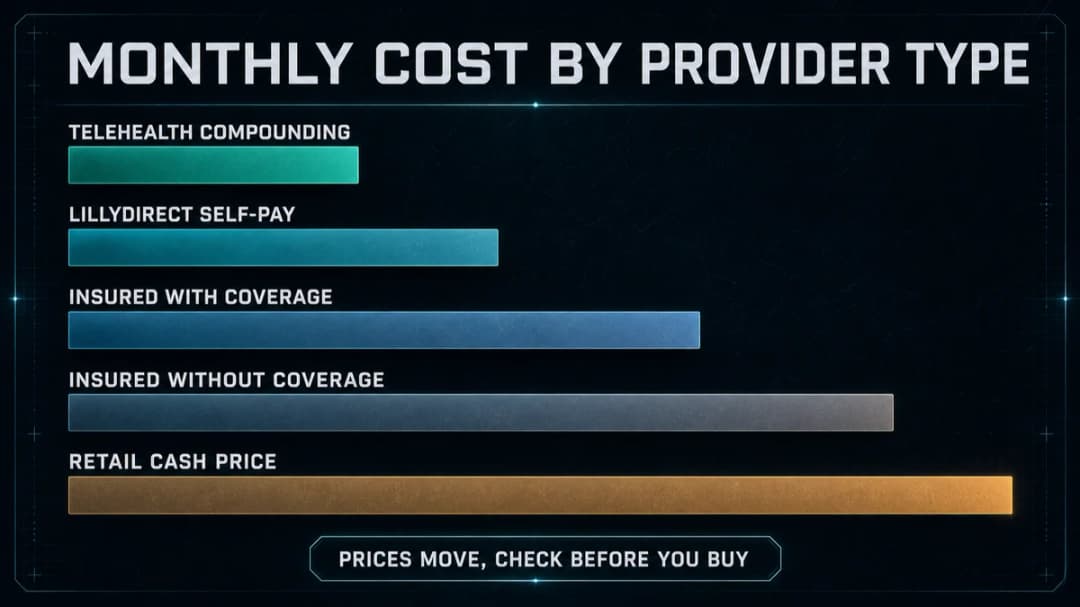
- Provider type, not dose, is the main cost variable. On 2026-07-29 the spread ran from as little as $25 a month with covered commercial insurance to roughly $1,000 to $1,300 at retail cash with nothing applied
- Brand tirzepatide through LillyDirect self-pay is now genuinely price-competitive with compounded telehealth at $299, $399 and $449 by dose. That undercuts the usual "compounded is the cheap route" framing, and anyone selling compounded product who does not mention it is not giving you the full picture
- Telehealth compounding clinics generally price compounded injectable tirzepatide between roughly $250 and $350 a month, with provider review, pharmacy fulfilment and shipping included. SkinnyRx is the provider we partner with, and we earn a commission if you use our link
- Treat "as low as" figures with suspicion. Telehealth sites headline an entry price under a weight-loss heading that covers both molecules, making it a category figure rather than a tirzepatide price
- Compounded tirzepatide is not FDA-approved. The shortage was declared resolved in December 2024, enforcement discretion ended in 2025, and in April 2026 FDA proposed excluding tirzepatide from the 503B bulk substances list. Confirm the current position before prepaying
The Five Provider Types, Priced Side by Side
| Provider type | What you pay per month | What that price includes |
|---|---|---|
| Telehealth compounding clinic | Roughly $250 to $350; several publish no price at all | Provider review, prescription, pharmacy fulfilment, shipping, portal support |
| LillyDirect self-pay | $299, $399 or $449 by dose | Brand Zepbound, shipped, no membership fee |
| Retail pharmacy with commercial insurance | As little as $25 with a manufacturer savings card | The drug only |
| Retail pharmacy, cash, no program | Roughly $1,000 to $1,300 | The drug only |
| Medical weight-loss clinic | Not verifiable nationally, these are local businesses | Usually visits, weigh-ins and some labs |
Figures checked 2026-07-29. All of them can move, and the manufacturer programs carry stated expiry dates.
Telehealth Compounding Clinics
This is the route most people mean when they search for a tirzepatide provider. You complete an online intake, a licensed clinician reviews it, and if treatment is appropriate a pharmacy ships a compounded vial to your door. The price generally covers the review, the prescription, the medication, shipping and some messaging support. That bundling is the genuine advantage: no separate consultation fee, dispensing fee and shipping fee.
Two things to check before believing any headline number. First, whether the advertised figure applies to tirzepatide or to the clinic's cheapest product overall. Semaglutide is usually cheaper, so a homepage "from" price frequently belongs to semaglutide while sitting next to a tirzepatide photograph. Second, whether it is the single-month rate or the rate on a prepaid three-month or six-month plan. The prepaid one hurts if you stop early.
Two other large names here are Ro and Hims. Both sell GLP-1 weight-loss programs and both layer a membership fee on top of medication cost. We are deliberately quoting no figure for either: their sites returned HTTP 403 to our requests on 2026-07-29, and third-party blog numbers disagreed with each other by an order of magnitude. Their pricing is unverified by us, so get it from them directly.
Affiliate disclosure, placed next to the recommendation rather than in a footer
Middleway Nutrition earns a commission if you start treatment through the SkinnyRx link below. It is the only monetised link on this page. LillyDirect, the manufacturer savings cards, retail pharmacies and every clinic named here pay us nothing, and a later section argues that LillyDirect is price-competitive with the option we earn money from. We would rather you read that and choose against us than take a recommendation we had shaded.
The telehealth route we partner with: SkinnyRx
SkinnyRx runs the medical intake online, and a licensed provider reviews it and decides whether prescription treatment is appropriate. It offers compounded tirzepatide and compounded semaglutide, each as a once-weekly injection or a once-daily tablet, and FDA-approved options, including Wegovy and Foundayo (orforglipron), through the SkinnyRx Membership. Pricing is shown on their own site after the intake rather than quoted here.
Care is clinician-guided, with digital tools for ongoing support. Confirm exactly what the quoted price covers before you commit, using the questions later on this page.
One honesty note that applies to the whole category. Telehealth sites routinely headline an "as low as" figure beneath a weight-loss heading covering both tirzepatide and semaglutide. That is a category entry price, and anyone quoting it as the cost of tirzepatide is quoting the wrong product. Check the figure against the specific molecule before budgeting from it. This confusion is the most common pricing error in GLP-1 content, including in older material on this site.
SkinnyRx's own disclaimer states plainly that compounded drugs are not FDA-approved or evaluated for safety, effectiveness or quality by the FDA. That is correct, it is to their credit that they say it themselves, and it is the most important sentence there.
See if you are eligible with SkinnyRx (affiliate link).
LillyDirect Self-Pay: Brand Tirzepatide From the Manufacturer
Eli Lilly sells Zepbound directly to cash-paying patients through its own pharmacy channel. On zepbound.lilly.com, verified 2026-07-29, the self-pay prices are $299 a month for 2.5 mg, $399 for 5 mg, and $449 for 7.5 mg through 15 mg.
Read that last number carefully, because it is where people get caught. The undiscounted self-pay price for 7.5 mg and above is $699. The $449 figure requires the self-pay savings card, and the site states that continued eligibility depends on completing your refill purchase within 45 days of the delivery date. Miss the window and you pay the higher price until you re-establish the offer.
What the price does not include is a clinician. LillyDirect connects patients to independent telehealth prescribers, but the drug price is a drug price: no bundled consultation, no labs, no coaching, no dose-escalation guidance. If you need those you are paying someone separately, and that separate payment is the real difference between this route and the telehealth one. Full breakdown at LillyDirect Zepbound cost.
Retail Pharmacy With Commercial Insurance
If your commercial plan covers tirzepatide, this is the cheapest route available and nothing else is close.
For Mounjaro, verified on mounjaro.lilly.com on 2026-07-29, the savings card lets eligible patients whose commercial insurance covers Mounjaro pay as little as $25 per fill, with savings capped at $150, $300 and $450 for one, two and three-month fills and an annual maximum of $1,950. The card is stated to expire 31 December 2026. Zepbound's equivalent card also lands covered patients at as little as $25, annual maximum $1,300.
Two disqualifiers matter more than the numbers. Anyone on Medicare, Medicaid, TRICARE or another government-funded program is excluded from these cards entirely, which removes a large share of the patients who most need the discount. And coverage for obesity is not the same as coverage for type 2 diabetes; plans routinely cover one and not the other. Confirm which before assuming a $25 month, starting at GLP-1 insurance coverage.
There is a second tier for commercially insured patients whose plan does not cover the drug. Lilly's Mounjaro card states such patients can pay as low as $499 for a one-month fill of the single-dose pen, savings capped at $647 monthly. That is a real reduction from cash price, but more expensive than LillyDirect self-pay at every dose, so check it against that rather than defaulting to it. See Mounjaro cost without insurance.
Retail Pharmacy, Cash, No Program Applied
This is the baseline everything else is measured against, and almost nobody should end up here.
Zepbound's manufacturer list price is $1,086.37 for a 28-day supply, and Mounjaro's sits in the same territory at roughly $1,070 to $1,112. Counter prices land above list often enough that roughly $1,000 to $1,300 a month is the honest range to plan around when no savings card, manufacturer channel or insurance is applied. Discount cards shave a modest amount off that, generally single-digit to low-double-digit percentages, leaving you paying two to four times what the same molecule costs through LillyDirect.
The only reason to be in this column is not knowing the others exist. Cheapest tirzepatide walks through the ladder in order.
Medical Weight-Loss Clinics
Bricks-and-mortar weight-loss and metabolic clinics are the hardest category to price honestly, and we will say why rather than invent a number. These are local businesses. Pricing is set per clinic, frequently unpublished, and often quoted only after a paid consultation. We could not verify a representative national figure from any primary source, so we are not printing one.
The structure is consistent even when the numbers are not. Clinic billing usually separates into three streams: an enrolment or consultation fee, recurring visit fees tied to weigh-ins or in-office injections, and the medication itself, which may be dispensed by the clinic, routed to a compounding pharmacy, or written as a prescription you fill elsewhere. A clinic quoting a monthly figure may be quoting the program only, with the drug on top.
The genuine value here is in-person clinical contact, which the online routes cannot match. Get all three streams quoted in writing before enrolling, and ask whether the medication is brand or compounded, because the answer changes both the price and the regulatory picture.
The Comparison Nobody Selling You Something Wants to Make
Here is the finding that matters most, stated plainly even though we earn money from one side of it.
Brand-name tirzepatide through LillyDirect self-pay, at $299 to $449 a month, is now in the same price band as compounded tirzepatide through telehealth. It is not the "expensive option" any more. At 2.5 mg LillyDirect is $299, at 5 mg $399, and at 7.5 mg and above $449, while telehealth compounded pricing typically does not rise with dose, so the gap only opens up as you titrate.
That convergence turns the decision from a cost question into a trade-off:
- LillyDirect gives you an FDA-approved product with a known manufacturing chain, concentration and label. No compounded preparation can offer that.
- Telehealth compounding gives you a bundled service at a flat rate, with the clinician, escalation support and shipping inside the price rather than alongside it.
- LillyDirect prices rise with dose; telehealth pricing generally does not. Over a titration year that narrows LillyDirect's advantage at low doses and widens telehealth's at high ones.
If FDA approval is what you care about most, go to LillyDirect and we earn nothing. That is the correct recommendation for a lot of readers and we are not going to bury it.
Where the Hidden Costs Actually Live
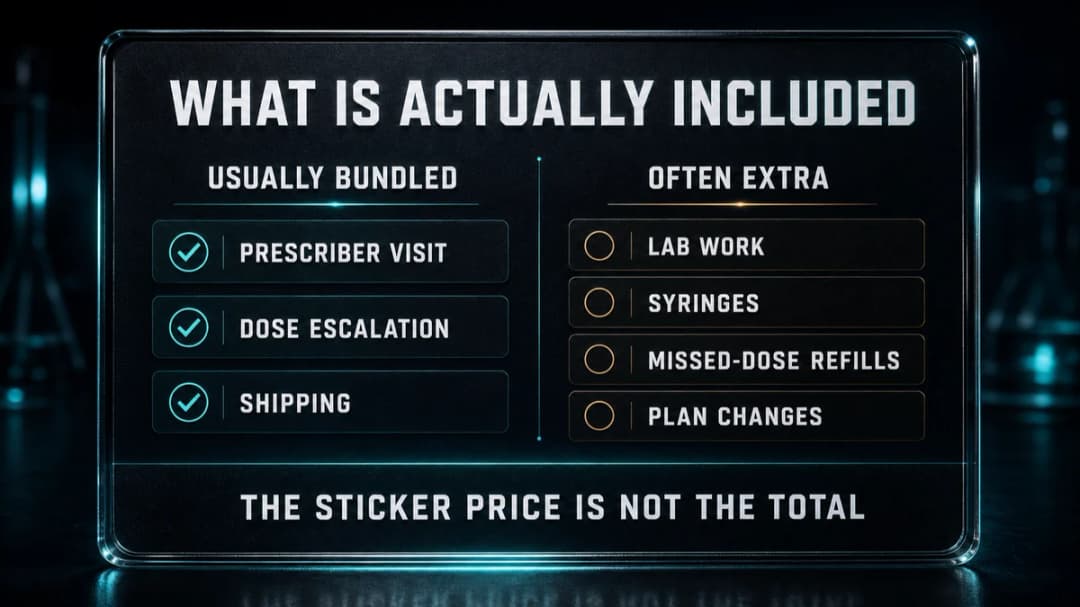
Each provider type hides its extra cost somewhere different, and knowing where to look is worth more than any single quoted price.
- Telehealth clinics hide it in the commitment. The attractive per-month rate is often a prepaid multi-month plan. Ask for the single-month rate and the refund position if you stop at week six.
- LillyDirect hides it in the refill clock. The 45-day condition is an operational requirement, not fine print. A delayed reorder is a price increase.
- Insurance hides it in the deductible and the renewal. A $25 copay applies after the deductible is met, and obesity coverage is among the first things employers drop at renewal.
- Clinics hide it in the unbundling. Visit fees, program fees and medication are three separate lines.
- Every route hides it in dose escalation. Price the route at the dose you expect in six months, not the one you start at.
What Compounding's Legal Position Means for Your Quote
If you are choosing a compounding telehealth provider, the regulatory position is a pricing risk as much as a safety one, so it belongs in a cost article.
The sequence, in general terms: FDA declared the tirzepatide shortage resolved in December 2024. The enforcement discretion that had allowed compounders to make copies during the shortage ended in 2025, in February for 503A pharmacies and in March for 503B outsourcing facilities. Litigation and appeals from compounding industry groups continued after that. Then on 30 April 2026, FDA proposed excluding semaglutide, tirzepatide and liraglutide from the 503B bulk drug substances list on a finding of no clinical need, with comments closing at the end of June 2026. That proposal is proposed, not final.
Practically, compounded tirzepatide is not FDA-approved and sits in a space regulators have been actively narrowing. A clinic's supply arrangement, and therefore its price, can change on a timeline you do not control. Ask which pharmacy fills your prescription and under what authority, confirm the current position with your own pharmacist, and be cautious about prepaying six months for something under open rulemaking. See compounded tirzepatide.
Frequently Asked Questions
Which tirzepatide provider is cheapest?
If your commercial insurance covers tirzepatide, a retail pharmacy with a manufacturer savings card wins by a wide margin, at as little as $25 a month as of 2026-07-29. If not, the contest is between LillyDirect self-pay at $299 to $449 by dose and telehealth compounding clinics, which generally sit between roughly $250 and $350. Retail cash is always the worst price.
Is compounded tirzepatide still cheaper than brand tirzepatide?
Somewhat, but far less than it used to be. At the starting dose LillyDirect's $299 is close to typical telehealth compounded pricing. The compounded advantage widens at higher doses because telehealth pricing usually does not rise with dose while LillyDirect's does. Anyone claiming compounded is dramatically cheaper is working from 2024 numbers.
What is actually included in a telehealth tirzepatide price?
Generally the clinical intake and provider review, the prescription, the medication, pharmacy fulfilment, shipping and portal-based messaging support. A telehealth plan price generally includes all of those. Laboratory work usually is not included, and no telehealth clinic bills insurance for you.
Does my monthly cost go up when my dose goes up?
Through LillyDirect it does: $299 at 2.5 mg, $399 at 5 mg, $449 from 7.5 mg upward. Through most telehealth compounding clinics it does not, which is why the two routes cross over as you titrate. With insurance and a savings card the copay is generally dose-independent up to the card's caps.
Can I use a manufacturer savings card at a telehealth compounding clinic?
No. Lilly's savings cards apply to Lilly's branded products dispensed through a pharmacy, not to compounded preparations. Choosing a compounded route means giving up those cards entirely.
Is compounded tirzepatide FDA-approved?
No, and it never has been. FDA does not review compounded drugs for safety, effectiveness or manufacturing quality before they reach patients. Reputable clinics state this on their own product pages, and a provider that implies otherwise has told you something important about itself.
What happens to my cost if I stop and restart treatment?
It depends on the provider type, and it is the question people ask last and regret asking last. LillyDirect's discounted pricing is tied to a 45-day refill window, telehealth clinics on prepaid plans may not refund unused months, and insurance may require a fresh prior authorisation.
How do I check a provider's real monthly cost before committing?
Get four numbers in writing: the single-month price with no prepayment, the price at the highest dose you might reach, anything billed separately from the medication, and the refund position if you stop mid-plan. Then ask whether the product is brand or compounded. A provider that will not answer those five in writing has answered them.