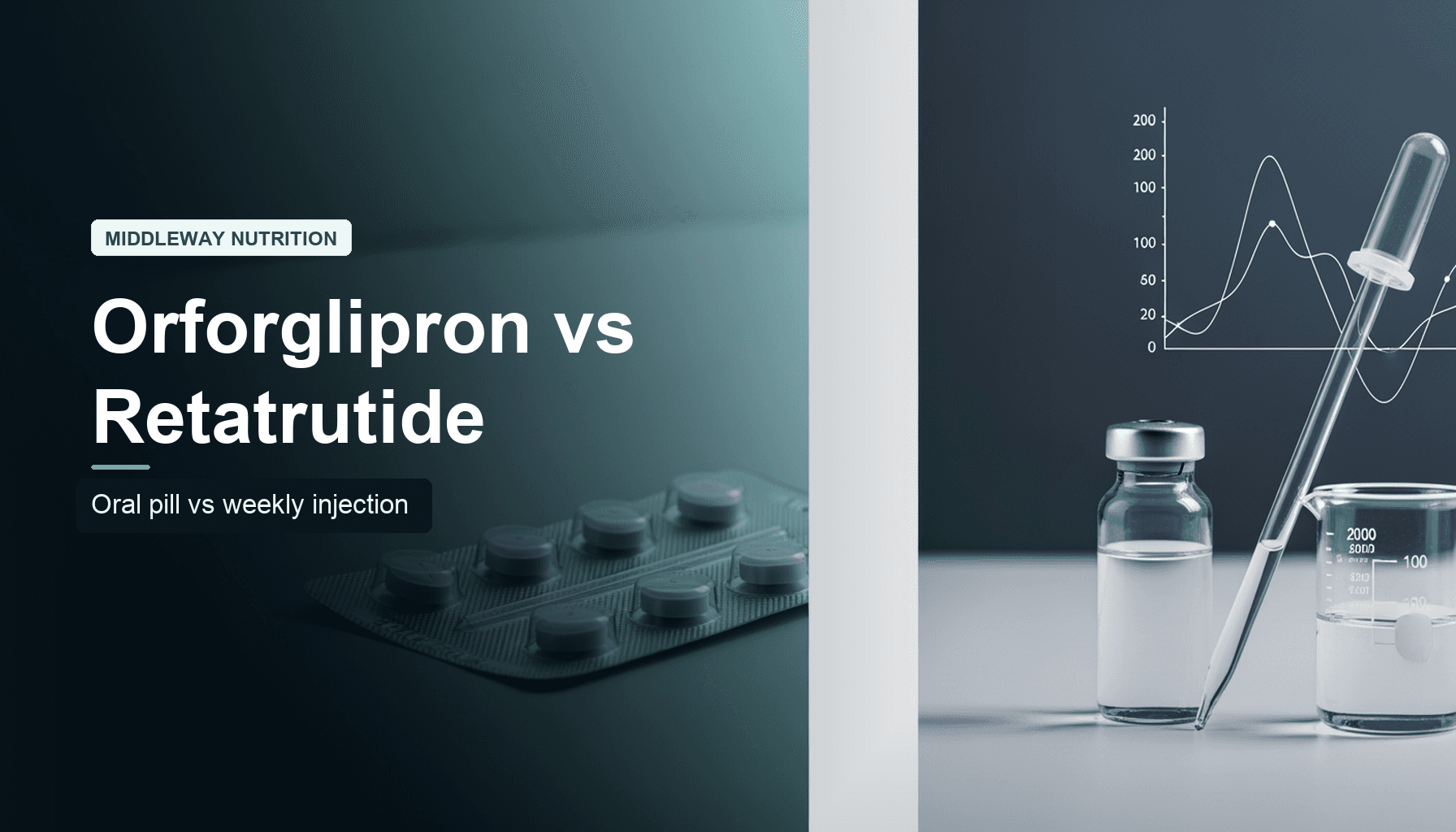
Orforglipron and retatrutide sit at opposite ends of the next-generation obesity drug spectrum. Orforglipron is a once-daily oral pill (an FDA-approved small-molecule GLP-1 receptor agonist marketed as Foundayo) that delivered about 12.4% average weight loss at its highest dose in phase 3. Retatrutide is an investigational once-weekly injectable triple agonist that reached roughly 24% weight loss in its phase 2 trial but is not yet approved. The core trade-off is simple: orforglipron offers pill convenience and current availability, while retatrutide promises larger weight loss through a needle and is still in clinical testing.
If you want raw magnitude, retatrutide leads on the data published so far. If you want something you can actually fill at a pharmacy today, swallow without food or water, and skip injections entirely, orforglipron wins. Below is the detailed comparison.
Quick comparison table
| Feature | Orforglipron (Foundayo) | Retatrutide |
|---|---|---|
| Drug class | Small-molecule (non-peptide) GLP-1 receptor agonist | GIP / GLP-1 / glucagon triple agonist (peptide) |
| Form | Oral tablet | Subcutaneous injection |
| Frequency | Once daily | Once weekly |
| Maker | Eli Lilly | Eli Lilly |
| Status (June 2026) | FDA-approved for chronic weight management | Investigational, phase 3 ongoing, not approved |
| Peak weight loss in trials | ~12.4% (about 27.3 lb) at week 72, highest dose | ~24.2% at week 48, 12 mg dose (phase 2) |
| Food/water/timing rules | None; take any time | N/A (injection); titration schedule used |
| Receptors targeted | 1 (GLP-1) | 3 (GLP-1, GIP, glucagon) |
| Main side effects | GI (nausea, constipation, diarrhea, vomiting) | GI plus modest heart rate increase |
What is orforglipron?
Orforglipron is a once-daily oral GLP-1 receptor agonist. The important word is "small-molecule." Most GLP-1 drugs you have heard of (semaglutide, tirzepatide, retatrutide) are peptides, which the gut breaks down, so they are usually injected or require strict oral dosing rules. Orforglipron is a non-peptide chemical compound, which is why it survives digestion and can be taken as a plain pill at any time of day, with or without food or water.
The FDA approved orforglipron under the brand name Foundayo on April 1, 2026, for chronic weight management in adults with obesity, or in adults who are overweight and have at least one weight-related condition, alongside a reduced-calorie diet and increased physical activity. It is the first oral GLP-1 for weight loss that carries no food, water, or timing restrictions.
Efficacy comes from the phase 3 ATTAIN program:
- ATTAIN-1 (3,127 adults with obesity, no diabetes): the highest dose produced an average weight reduction of about 12.4% (roughly 27.3 lb) at 72 weeks, versus about 0.9% (2.2 lb) with placebo. All three trial doses (6 mg, 12 mg, and 36 mg) beat placebo.
- ATTAIN-2 (1,613 adults with type 2 diabetes): weight loss ranged from about 5.1% to 9.6% versus 2.5% with placebo, plus meaningful HbA1c improvements. Weight loss tends to run lower in people with type 2 diabetes, a pattern seen across the GLP-1 class.
Reported side effects are mostly gastrointestinal: nausea, constipation, diarrhea, vomiting, indigestion, and abdominal pain, with headache and fatigue also noted. These tend to appear during dose escalation.
What is retatrutide?
Retatrutide is a once-weekly injectable peptide and the most aggressive mechanism in this comparison. There is no approved oral version yet, though some vendors market oral retatrutide drops and pills. It is a "triple agonist," meaning it activates three gut and metabolic hormone receptors at once instead of one. For a deeper breakdown, see our guides on what retatrutide is and its mechanism of action.
The three targets:
- GLP-1: boosts insulin response, suppresses appetite, and slows stomach emptying.
- GIP: supports insulin sensitivity and fat metabolism.
- Glucagon: this is the addition that distinguishes retatrutide from tirzepatide. Glucagon receptor activity is thought to raise energy expenditure and increase fat breakdown, which may explain the larger weight loss numbers.
In the phase 2 NEJM trial (published June 2023) in adults with obesity, results at 48 weeks were dose-dependent and unusually large:
| Retatrutide dose | Mean weight loss at 48 weeks |
|---|---|
| Placebo | ~2.1% |
| 1 mg | ~8.7% |
| 4 mg | ~17.1% |
| 8 mg | ~22.8% |
| 12 mg | ~24.2% |
A notable detail from that trial: the weight-loss curve had not flattened by week 48, suggesting participants might have kept losing weight had dosing continued. That is part of why retatrutide draws so much attention. Side effects were again mostly gastrointestinal (nausea, vomiting, diarrhea, constipation), with modest increases in resting heart rate at higher doses. For more, read our pages on retatrutide side effects and is retatrutide safe.
Crucially, retatrutide is still investigational. As of June 2026 it is in phase 3 trials and is not approved by the FDA. You can track expected timing in our when will retatrutide be available explainer, and review the trial design in our retatrutide clinical trial overview.
Efficacy: magnitude versus the fine print
On paper, retatrutide's ~24.2% (12 mg, 48 weeks) roughly doubles orforglipron's ~12.4% (highest dose, 72 weeks). That gap is real, but read it carefully before drawing conclusions:
- Different trial phases. Retatrutide's headline number comes from a phase 2 study. Orforglipron's comes from large phase 3 trials, which are the rigorous, registration-grade studies. Phase 2 results sometimes shrink when repeated at scale.
- Different timepoints. Retatrutide's 24.2% was measured at 48 weeks while still climbing. Orforglipron's 12.4% was measured at 72 weeks.
- Different populations. Both ATTAIN trials and the retatrutide phase 2 enrolled people with obesity, but exact entry criteria, baseline weights, and diabetes status differ, so direct head-to-head conclusions are not valid.
The honest takeaway: retatrutide's mechanism appears more powerful, and early data is striking, but we will not have phase 3 confirmation until those trials report. Orforglipron's efficacy is locked in and approved. For mechanism-level context, retatrutide also tends to outperform tirzepatide and semaglutide in early data, and it competes closely with survodutide.
Convenience: pill versus needle
This is where orforglipron flips the script.
- Administration. Orforglipron is a tablet. Retatrutide is a subcutaneous injection. For people who fear needles or dislike weekly self-injection, that alone can be decisive.
- Schedule. Orforglipron is once daily; retatrutide is once weekly. Weekly dosing is less frequent, but each dose involves a shot.
- Lifestyle rules. Orforglipron has none. No fasting window, no plain-water-only rule, no waiting before eating. You take it whenever fits your day. This is a genuine advantage over older oral peptide approaches.
- Storage and travel. Pills travel more easily than injectables, which can require refrigeration and careful handling.
- Availability. Orforglipron can be prescribed now. Retatrutide cannot be legally prescribed as an approved product, so any "retatrutide" sold today comes from compounding or unregulated channels, which carry real quality and safety risks. See our notes on compounded retatrutide and retatrutide without a prescription.
Mechanism: one receptor versus three
Orforglipron acts on a single receptor (GLP-1). It mimics how peptide GLP-1 drugs work but does so as a small molecule, which is the chemistry breakthrough that makes a true no-restriction pill possible.
Retatrutide acts on three receptors (GLP-1, GIP, and glucagon). More targets is the leading explanation for its larger weight-loss numbers, since glucagon activity may add an energy-expenditure effect on top of appetite suppression. The trade-off is that glucagon agonism also nudges heart rate and liver glucose output upward, which is one reason phase 3 safety data matters before any approval.
If you want to go deeper on retatrutide's pharmacology, see retatrutide dosing schedule, the retatrutide dosage chart, and retatrutide half-life.
Cost and access
Orforglipron (Foundayo) launched with manufacturer pricing that starts around $149/month self-pay for the lowest dose and as low as $25/month with a commercial insurance savings card, with a separate program for eligible Medicare Part D members planned. Because it is approved, it can route through normal pharmacy and insurance channels.
Retatrutide has no list price because it is not approved and not commercially sold. Pricing estimates floating around online refer to compounded or gray-market products, which are not FDA-sanctioned. For what is known, see our retatrutide cost and retatrutide where to buy pages. The manufacturer behind both drugs is the same, which you can read about in our retatrutide and Eli Lilly overview.
Who each one suits
Orforglipron may fit you if you:
- Want an approved, prescribable option available now.
- Strongly prefer a pill over injections.
- Value flexible dosing with no food, water, or timing rules.
- Are targeting moderate, clinically meaningful weight loss (low double digits) rather than the maximum possible.
- Have type 2 diabetes and want combined weight and glucose benefits.
Retatrutide may appeal to you (once available) if you:
- Are seeking the largest weight-loss magnitude reported so far.
- Are comfortable with weekly injections.
- Have not reached your goal on a dual agonist like tirzepatide.
- Can wait for phase 3 results and formal approval rather than using unregulated sources.
For real-world context on retatrutide progress, browse our before and after and week by week resources, and the microdosing discussion.
FAQ
Is orforglipron the same as a peptide GLP-1 like semaglutide? No. Orforglipron is a non-peptide small molecule. That chemistry is why it can be taken as a regular pill at any time without food or water, unlike oral semaglutide, which has strict fasting and dosing rules.
Which produces more weight loss, orforglipron or retatrutide? In the data published so far, retatrutide produced more: about 24.2% at 48 weeks (12 mg, phase 2) versus about 12.4% at 72 weeks for orforglipron's highest dose (phase 3). But retatrutide's number is earlier-stage and not yet confirmed in phase 3.
Can I buy retatrutide now? Not as an approved drug. Retatrutide is investigational and not FDA-approved as of June 2026. Any product sold as retatrutide currently comes from compounding pharmacies or unregulated sources, which carry quality and safety concerns.
Is orforglipron approved by the FDA? Yes. The FDA approved orforglipron as Foundayo on April 1, 2026, for chronic weight management in adults with obesity, or adults who are overweight with at least one weight-related condition.
Are the side effects different? Both are dominated by gastrointestinal effects (nausea, vomiting, diarrhea, constipation), most common during dose escalation. Retatrutide additionally showed modest increases in resting heart rate at higher doses, linked to its glucagon activity.
This article is for informational purposes only and is not medical advice; talk to a qualified clinician before starting, stopping, or changing any medication.
Sources
- Eli Lilly / PR Newswire, FDA approval of Foundayo (orforglipron), April 1, 2026.
- HFSA / Eli Lilly, ATTAIN-1 phase 3 results (NEJM, EASD 2025).
- The Lancet, ATTAIN-2 phase 3 trial in type 2 diabetes (2025).
- New England Journal of Medicine, "Triple-Hormone-Receptor Agonist Retatrutide for Obesity, A Phase 2 Trial" (2023).