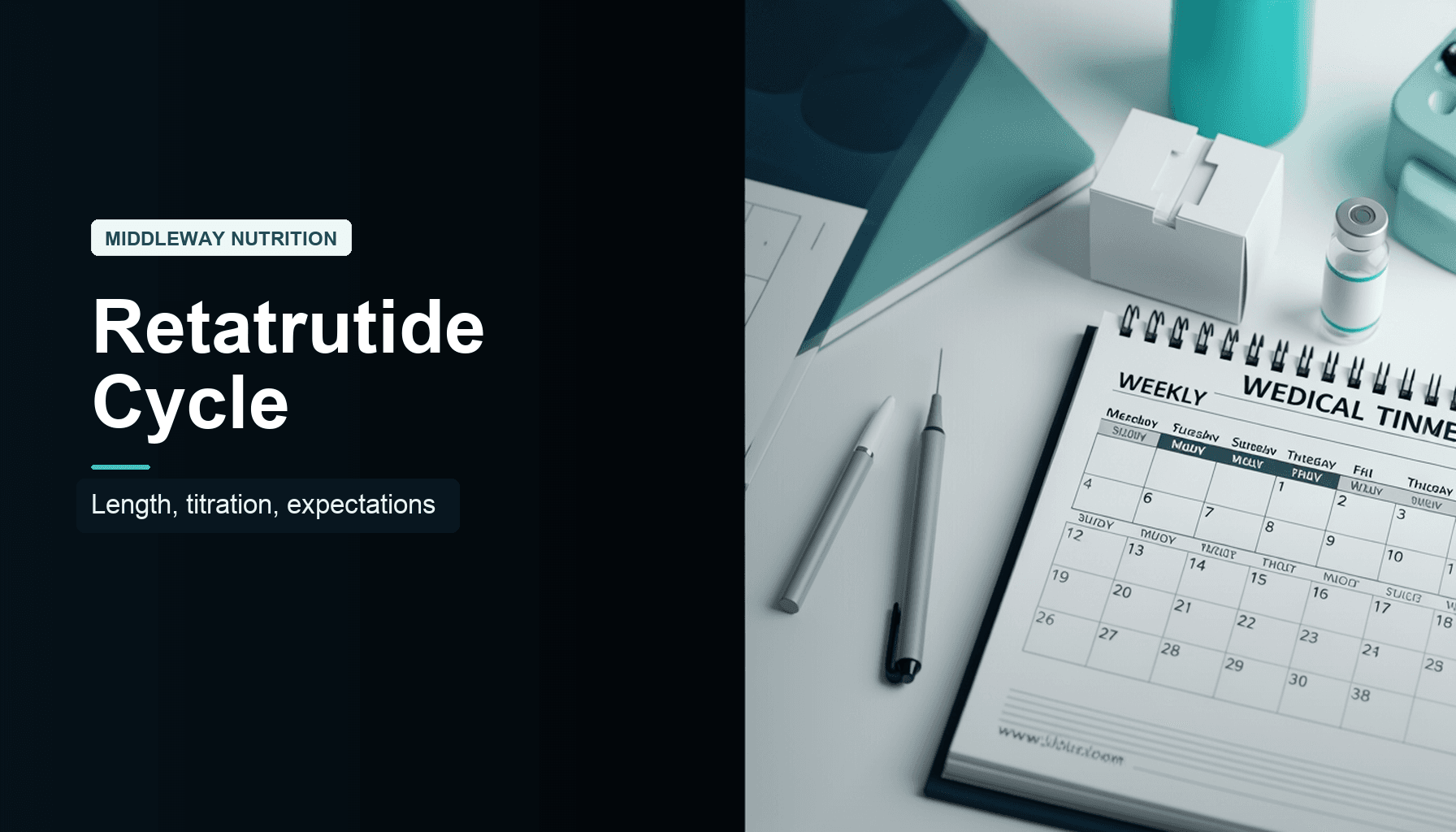
A retatrutide cycle is the full arc of treatment from your first low dose through gradual escalation, a maintenance phase, and eventually stopping. In the clinical trials, that arc started at 2 mg once weekly, stepped up every 4 weeks until reaching a target dose, then held that dose for the rest of the study. There is no fixed "cycle length" for retatrutide the way bodybuilding forums use the term. The honest framing is that obesity is chronic, the drug works while you take it, and weight tends to return once you stop. This article walks through the titration schedules used in the actual trials, what maintenance looks like, the taper question, and the regain reality.
One thing to settle first: retatrutide is investigational. As of mid-2026 it is not approved by the FDA, the EMA, or any major regulator. It is legally available only to participants in Eli Lilly's clinical trials. Anything described here reflects trial protocols, not a prescribing label, because no approved label exists yet. See what is retatrutide for the full background.
What "cycle" actually means for retatrutide
In steroid and peptide subculture, "cycling" means running a compound for a set number of weeks, then deliberately coming off to let the body recover, often on a fixed on/off calendar. That model does not apply to incretin therapies. Retatrutide is a triple agonist that activates the GLP-1, GIP, and glucagon receptors (more in retatrutide mechanism of action). It changes appetite signaling and energy use only for as long as it is in your system.
So a more accurate way to think about a retatrutide "cycle" is a single continuous course with three distinct phases:
- Titration (roughly weeks 1 to 16): slow dose increases to build tolerance and limit nausea.
- Maintenance: holding your effective dose to keep losing weight and then to hold the loss.
- Discontinuation: stopping, whether planned or not, and managing what happens next.
There is no evidence that scheduled off periods improve results, and stopping mid-course typically reverses progress. The "cycle" language is borrowed; the clinical reality is closer to chronic disease management.
The trial titration schedule
Retatrutide's dosing logic comes straight from its trial design. The slow ramp exists because the most common side effects (nausea, vomiting, diarrhea, constipation) cluster during dose escalation and are usually mild to moderate.
Phase 2 (NEJM, 2023)
The 48-week phase 2 trial randomized 338 adults with obesity or overweight to 1 mg, 4 mg, 8 mg, 12 mg, or placebo, injected subcutaneously once weekly. For the 4 mg and higher groups, treatment began at either 2 mg or 4 mg, with escalation every 4 weeks for up to 12 weeks. A key finding: starting at 2 mg produced fewer gastrointestinal side effects than starting at 4 mg, while reaching the same weight loss by week 48. That is why a 2 mg start became the standard.
Phase 3 (TRIUMPH-1)
The pivotal TRIUMPH-1 obesity trial randomized 2,339 adults across 4 mg, 9 mg, 12 mg, and placebo, dosed weekly over 80 weeks. The titration steps were:
| Target dose | Escalation path | Steps | Approx. time to target |
|---|---|---|---|
| 4 mg | 2 → 4 mg | 1 step | ~4 weeks |
| 9 mg | 2 → 4 → 6 → 9 mg | 3 steps | ~12 weeks |
| 12 mg | 2 → 4 → 6 → 9 → 12 mg | 4 steps | ~16 weeks |
Every step was spaced about 4 weeks apart. The pattern is consistent: start low at 2 mg, raise the dose only after the body has had roughly a month to adjust, and stop escalating once you reach your target or hit a dose you tolerate well. For a deeper breakdown see the retatrutide dosing schedule and full retatrutide dosage guide.
A practical note on tolerance: if a step triggers significant nausea, the trial-style approach is to hold the current dose longer rather than push through, and only advance when symptoms settle. Not everyone needs to reach 12 mg. Many people see strong results at 4 mg or 6 mg, and the right target is the lowest dose that delivers the result you need with side effects you can live with. Some people experiment with smaller increments, covered in retatrutide microdosing.
What to expect month by month
Weight loss with retatrutide is progressive and, notably, did not clearly plateau even at the longest trial timepoints. Rough expectations, anchored to trial averages:
- Months 1 to 3 (titration): modest loss as the dose climbs. Appetite suppression builds. This is when GI side effects are most likely.
- Months 4 to 6: the steepest part of the curve for most people once on maintenance dose.
- Months 6 to 12+: continued loss. In phase 2, the 12 mg group reached about 17.5% mean loss at 24 weeks and 24.2% at 48 weeks, showing the trajectory was still heading down at a year.
The half-life supports once-weekly dosing; details in retatrutide half-life. For a more granular timeline, see retatrutide week by week and real-world before and after context.
Weight loss by dose: the numbers
These are least-squares mean changes in body weight versus baseline. Phase 2 figures are at 48 weeks; phase 3 (TRIUMPH-1) figures are at 80 weeks.
| Dose | Phase 2, 48 wk | Phase 3 (TRIUMPH-1), 80 wk |
|---|---|---|
| Placebo | -2.1% | -2.2% |
| 1 mg | -8.7% | not tested |
| 4 mg | -17.1% | -19.0% |
| 8 mg | -22.8% | not tested |
| 9 mg | not tested | -25.9% |
| 12 mg | -24.2% | -28.3% |
In TRIUMPH-1, the 12 mg arm averaged about 70 lb of loss, and 45.3% of participants on 12 mg reached 30% or more weight loss, a threshold historically linked to bariatric surgery. A separate phase 3 readout (TRIUMPH-4) reported up to 28.7% mean loss at 68 weeks. These are averages; individual results vary widely. For how retatrutide stacks up against approved drugs, see retatrutide vs tirzepatide, retatrutide vs semaglutide, and survodutide vs retatrutide.
Maintenance: the part most people skip over
Once you reach a dose that holds your target weight, maintenance means staying on it. In the trials there was no "graduation" off the drug. Weight loss was sustained because dosing continued. TRIUMPH-1 even extended a subgroup to 104 weeks, where the 12 mg arm reached about 30.3% loss among people with a baseline BMI of 35 or higher, reinforcing that longer treatment produced more, not less, benefit.
The open clinical question is whether maintenance can use a lower dose than the one that drove the loss. That is plausible and is how some clinicians already manage approved GLP-1 drugs, but retatrutide has no published dose-reduction maintenance data and no approved protocol. Treat any "maintenance microdose" plan as unproven.
Tapering versus stopping cold
There are two reasons people consider ending a cycle: side effects they cannot tolerate, or a belief that they have "finished." For the first, talk to a clinician; dose reduction or pausing is reasonable. For the second, understand that the trials did not treat any timepoint as a finish line.
Is tapering necessary? Retatrutide is not a drug with a dangerous physical withdrawal syndrome the way some medications are, so an abrupt stop is not acutely hazardous. The reason a gradual step-down can still make sense is practical: appetite returns as drug levels fall, and ramping down may make the rebound in hunger feel less abrupt. There is no validated taper schedule, so this is judgment, not protocol.
The off-cycle regain reality
This is the part that matters most and gets glossed over. Retatrutide works on appetite and metabolism only while it is active. When you stop, those signals revert, hunger climbs, and weight tends to come back.
Retatrutide does not yet have its own published withdrawal study, but the broader incretin class makes the pattern clear:
- In the semaglutide STEP 1 extension, participants regained about two-thirds of their lost weight within a year of stopping.
- In the tirzepatide SURMOUNT-4 withdrawal trial, people switched to placebo regained substantial weight, while those who stayed on the drug kept losing.
There is no biological reason retatrutide would behave differently. The realistic expectations:
- Stopping = regain for most people, unless you have built durable diet, activity, sleep, and behavioral changes, and even then expect some rebound.
- Faster, larger losses can mean faster, larger regain if nothing else changed.
- Lean mass matters. Rapid loss includes muscle; resistance training and adequate protein during the cycle help protect metabolic rate for whenever you do come off.
Plan the exit before you plan the start. Decide in advance whether your goal is indefinite maintenance or a defined course with an aggressive lifestyle plan to hold the result.
Cost, sourcing, and safety caveats
Because retatrutide is not approved, there is no pharmacy product and no insurance coverage. What circulates online as "retatrutide" is unregulated. Compounded retatrutide and gray-market sources are not quality-assured. Buying it without a prescription carries real risks: wrong dose, contamination, and no clinical oversight during titration, which is exactly when side effects peak. For context on pricing and timelines, see retatrutide cost. On the safety question generally, see is retatrutide safe and the full retatrutide side effects rundown.
FAQ
How long is a retatrutide cycle?
There is no set length. The trials ran 48, 68, 80, and even 104 weeks of continuous weekly dosing, with no planned stop. Titration alone takes about 4 to 16 weeks depending on target dose, followed by open-ended maintenance.
Do you need to cycle off retatrutide?
No clinical evidence supports scheduled off periods. Obesity is chronic, and the drug only works while taken. People stop for side effects or cost, not because a "cycle" ended. Discuss any stop with a clinician.
Will I regain weight after stopping retatrutide?
Most people will regain a meaningful share of the weight. Class data from semaglutide and tirzepatide show roughly two-thirds regain within a year of stopping. Strong lifestyle habits reduce, but rarely eliminate, the rebound.
How fast do you titrate retatrutide?
In the phase 3 trials, the dose increased about every 4 weeks: 2 mg, then 4, 6, 9, and 12 mg. Reaching the top 12 mg dose took roughly 16 weeks. Slower escalation lowers nausea risk.
What is the maintenance dose for retatrutide?
There is no official maintenance dose because the drug is not approved. In trials, people held their target dose (commonly 4, 8, 9, or 12 mg) indefinitely. Whether a lower maintenance dose preserves results is untested. Note that retatrutide is made by Eli Lilly.
This article is for general information only and is not medical advice. Retatrutide is investigational and not FDA-approved. Talk to a qualified clinician before making any decision about it.
References
- Triple-Hormone-Receptor Agonist Retatrutide for Obesity — A Phase 2 Trial (NEJM 2023) — PubMed
- Lilly's triple agonist retatrutide delivered powerful weight loss in pivotal Phase 3 TRIUMPH-1 obesity trial — Eli Lilly
- Weight regain and cardiometabolic effects after withdrawal of semaglutide: the STEP 1 trial extension (Wilding et al., 2022) — PubMed