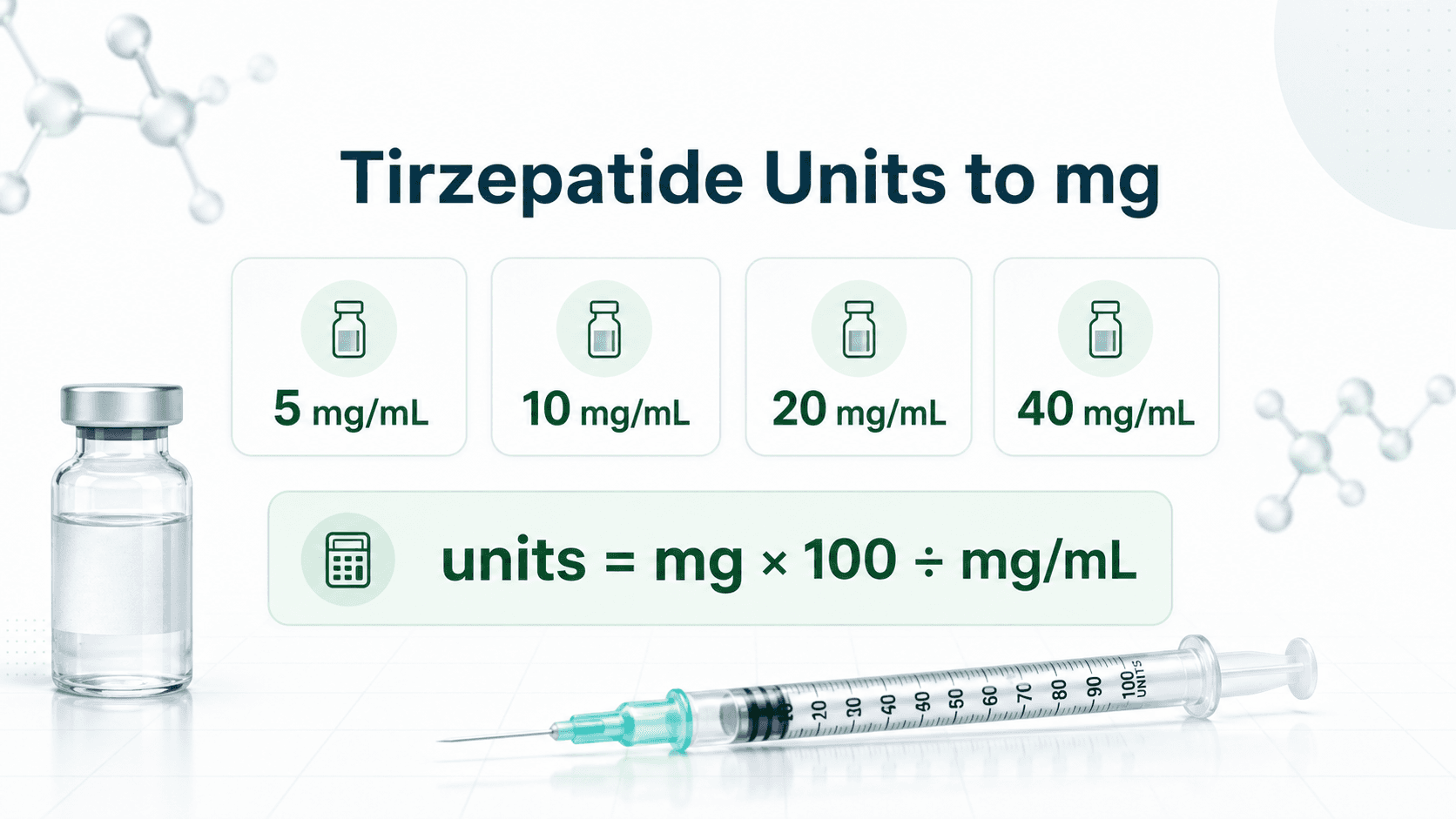
Tirzepatide units convert to mg only after you know the concentration of the liquid. A U-100 syringe measures volume: 100 units equals 1 mL. The mg amount depends on how many milligrams of tirzepatide are dissolved in each milliliter.
The core formula is:
units = target mg dose × 100 ÷ concentration in mg/mL
To convert a syringe mark back into medication amount:
mg = units × concentration in mg/mL ÷ 100
This guide explains the math behind common tirzepatide unit charts. It is not a personal dosing plan. Tirzepatide is a prescription medication when used as Mounjaro (FDA-approved for type 2 diabetes) or Zepbound (FDA-approved for chronic weight management), and compounded products require especially careful label verification.
Quick answer
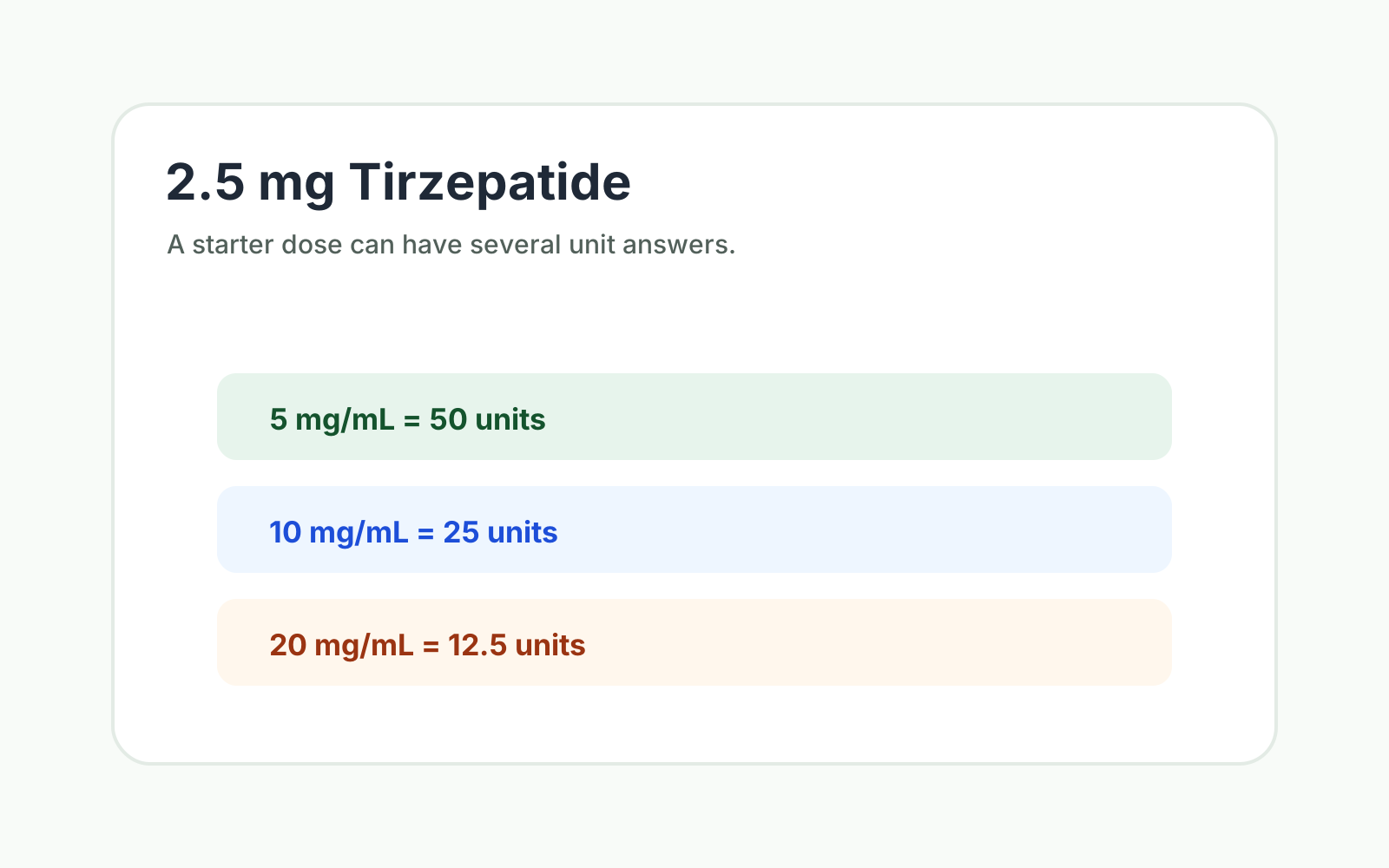
If tirzepatide is 10 mg/mL, then 2.5 mg equals 25 units on a U-100 syringe. If tirzepatide is 20 mg/mL, that same 2.5 mg equals 12.5 units. The dose did not change; the concentration did.
Tirzepatide units vs mg is not a conversion between two measurements of the same thing. Units measure the volume sitting in the barrel. Milligrams measure how much drug is dissolved in that volume. The concentration is the only thing that connects them.
The chart below assumes a U-100 syringe, where 100 units is 1 mL, and a vial already in liquid form at the stated concentration.
| Target dose | At 5 mg/mL | At 10 mg/mL | At 20 mg/mL | At 40 mg/mL |
|---|---|---|---|---|
| 2.5 mg | 50 units | 25 units | 12.5 units | 6.25 units |
| 5 mg | 100 units | 50 units | 25 units | 12.5 units |
| 7.5 mg | 150 units | 75 units | 37.5 units | 18.75 units |
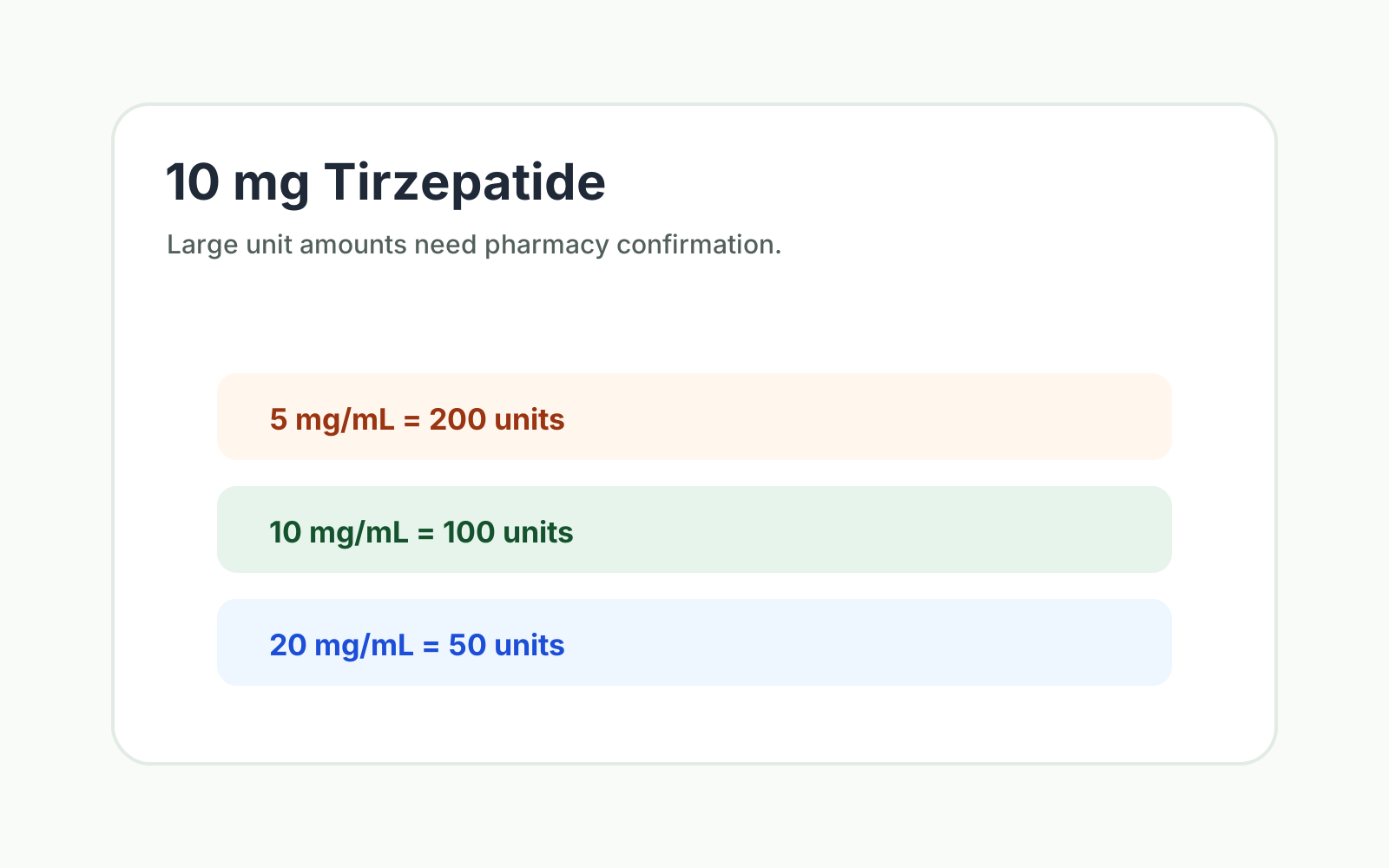
| 10 mg | 200 units | 100 units | 50 units | 25 units |
| 12.5 mg | 250 units | 125 units | 62.5 units | 31.25 units |
| 15 mg | 300 units | 150 units | 75 units | 37.5 units |
A calculated draw above 100 units is more than 1 mL on a standard U-100 syringe. That can be awkward, inaccurate, or incompatible with the syringe supplied. Clarify with the pharmacy instead of improvising. For a worked single-dose example, see how many units 10 mg of tirzepatide is.
Why tirzepatide conversion pages focus on units
Mounjaro and Zepbound pens are designed around labeled doses, not user-calculated syringe units. Search demand for units usually comes from compounded tirzepatide vials — shortened to "tirz" in most forum posts — where a person may receive a label with concentration and syringe instructions.
That creates a common problem: people see a dose in mg, a syringe in units, and a vial concentration in mg/mL. The conversion is simple once all three pieces are visible, but unsafe if one is guessed.
For a broader medication overview, see the tirzepatide guide. For schedule context, use the tirzepatide dosage chart.
What Mounjaro and Zepbound actually contain
The branded products do have concentrations. They are just printed as a dose over a volume instead of as mg/mL. Mounjaro and Zepbound are supplied in identical strengths, and knowing those numbers is what makes a units question answerable.
Both tables below assume the manufacturer's ready-to-use solution with no reconstitution, and a U-100 insulin syringe where 100 units is 1 mL for the unit column.
| Single-dose pen or vial | Concentration | Volume per dose | Same volume on a U-100 syringe |
|---|---|---|---|
| 2.5 mg/0.5 mL | 5 mg/mL | 0.5 mL | 50 units |
| 5 mg/0.5 mL | 10 mg/mL | 0.5 mL | 50 units |
| 7.5 mg/0.5 mL | 15 mg/mL | 0.5 mL | 50 units |
| 10 mg/0.5 mL | 20 mg/mL | 0.5 mL | 50 units |
| 12.5 mg/0.5 mL | 25 mg/mL | 0.5 mL | 50 units |
| 15 mg/0.5 mL | 30 mg/mL | 0.5 mL | 50 units |
Every single-dose vial holds 0.5 mL, whichever strength it is. Lilly's instructions for the single-dose vial tell the patient to use a 1 mL syringe and pull the plunger to the 0.5 mL line, which is the 50-unit mark on a U-100 insulin syringe. That is precisely why "50 units of tirzepatide" has no fixed mg answer: the identical 50-unit draw is 2.5 mg from one vial and 15 mg from another sitting next to it in the fridge.
| Multi-dose vial or KwikPen | Concentration | Dose per injection | Volume per dose | Same volume on a U-100 syringe |
|---|---|---|---|---|
| 10 mg/2.4 mL | 4.17 mg/mL | 2.5 mg | 0.6 mL | 60 units |
| 20 mg/2.4 mL | 8.33 mg/mL | 5 mg | 0.6 mL | 60 units |
| 30 mg/2.4 mL | 12.5 mg/mL | 7.5 mg | 0.6 mL | 60 units |
| 40 mg/2.4 mL | 16.7 mg/mL | 10 mg | 0.6 mL | 60 units |
| 50 mg/2.4 mL | 20.8 mg/mL | 12.5 mg | 0.6 mL | 60 units |
| 60 mg/2.4 mL | 25 mg/mL | 15 mg | 0.6 mL | 60 units |
Notice the design. The manufacturer holds the volume constant — 0.5 mL for every single-dose presentation, 0.6 mL for every multi-dose one — and moves the concentration instead. A compounded vial does the opposite: the concentration is whatever the pharmacy made, and the volume you draw has to move to match it. That is the whole reason unit math exists for compounded product and barely exists for branded product.
The U-100 syringe rule
U-100 means:
| Syringe mark | Volume |
|---|---|
| 10 units | 0.1 mL |
| 25 units | 0.25 mL |
| 50 units | 0.5 mL |
| 75 units | 0.75 mL |
| 100 units | 1 mL |
The syringe measures volume. It does not know the strength of your vial. A 25-unit draw could be 1.25 mg, 2.5 mg, 5 mg, or 10 mg depending on concentration.
How to calculate tirzepatide units from a vial
Step 1: Find concentration
If the label gives mg/mL directly, use that number. If the label gives total mg and total mL, divide total mg by total mL.
Example: 20 mg in 2 mL = 10 mg/mL.
Step 2: Use the formula
units = target mg × 100 ÷ mg/mL
Example: 5 mg target dose at 10 mg/mL:
5 × 100 ÷ 10 = 50 units.
Step 3: Check volume practicality
If the unit number is too high for the syringe or too tiny to measure accurately, do not guess. Ask the pharmacy or clinician whether the concentration or syringe instructions are correct.
Worked examples
2.5 mg at 10 mg/mL
2.5 × 100 ÷ 10 = 25 units.
5 mg at 20 mg/mL
5 × 100 ÷ 20 = 25 units.
7.5 mg at 10 mg/mL
7.5 × 100 ÷ 10 = 75 units.
10 mg at 40 mg/mL
10 × 100 ÷ 40 = 25 units.
These examples show why the syringe mark alone is not enough. Twenty-five units can represent 2.5 mg, 5 mg, or 10 mg depending on vial strength.
Converting units back to mg
This is the tirzepatide dose chart people mean when they search units to mg. If you only know the syringe mark and concentration, use:
mg = units × mg/mL ÷ 100
| Units drawn | 5 mg/mL | 10 mg/mL | 20 mg/mL | 40 mg/mL |
|---|---|---|---|---|
| 10 units | 0.5 mg | 1 mg | 2 mg | 4 mg |
| 25 units | 1.25 mg | 2.5 mg | 5 mg | 10 mg |
| 50 units | 2.5 mg | 5 mg | 10 mg | 20 mg |
| 75 units | 3.75 mg | 7.5 mg | 15 mg | 30 mg |
| 100 units | 5 mg | 10 mg | 20 mg | 40 mg |
This reverse chart is useful for checking labels, but it should not override your prescription.
What 50 units of tirzepatide is in mg
Fifty units is the single most searched mark on the syringe. On a U-100 syringe it is 0.5 mL, and that is all it is until a concentration is attached to it.
This table assumes a U-100 insulin syringe where 100 units is 1 mL, so 50 units is 0.5 mL. Each row is 0.5 mL multiplied by the concentration in that row.
| Concentration | Where that concentration comes from | 50 units delivers |
|---|---|---|
| 4.17 mg/mL | Mounjaro or Zepbound 10 mg/2.4 mL multi-dose vial | 2.08 mg |
| 5 mg/mL | 2.5 mg/0.5 mL single-dose pen or vial | 2.5 mg |
| 8.33 mg/mL | 20 mg/2.4 mL multi-dose vial | 4.17 mg |
| 10 mg/mL | common compounded strength | 5 mg |
| 12.5 mg/mL | 30 mg/2.4 mL multi-dose vial | 6.25 mg |
| 15 mg/mL | 7.5 mg/0.5 mL single-dose pen or vial | 7.5 mg |
| 16.7 mg/mL | 40 mg/2.4 mL multi-dose vial | 8.33 mg |
| 20 mg/mL | 10 mg/0.5 mL single-dose vial, and a common compounded strength | 10 mg |
| 20.8 mg/mL | 50 mg/2.4 mL multi-dose vial | 10.42 mg |
| 25 mg/mL | 12.5 mg/0.5 mL single-dose vial, and the 60 mg/2.4 mL multi-dose vial | 12.5 mg |
| 30 mg/mL | 15 mg/0.5 mL single-dose pen or vial | 15 mg |
| 40 mg/mL | highly concentrated compounded vial | 20 mg |
Two rows need a footnote. The 16.7 and 20.8 mg/mL figures are the rounded values Lilly prints on the label; the mg column is worked from the exact vial strength, 40 mg divided by 2.4 mL and 50 mg divided by 2.4 mL, which is why 8.33 mg and 10.42 mg do not match the rounded concentration to the final decimal.
Read the spread rather than any one row. The same 50-unit draw is worth anywhere from 2.08 mg to 20 mg, a tenfold range, and every value in between is a real product someone is holding. A unit number copied from a forum post is not information about a dose.
Reconstituted vials: same powder, different answer
Compounded and research-market tirzepatide often arrives as a lyophilized powder labeled only by total mg. The concentration does not exist until bacteriostatic water goes in, and the amount of water is what sets every unit number afterward. Which of those sources you can legally buy from is a separate question, covered in what is actually legal to buy.
This table assumes a powder vial labeled by total mg, fully dissolved in the stated volume of bacteriostatic water, and a U-100 syringe where 100 units is 1 mL. Concentration is total mg divided by the water volume.
| Vial label | Bacteriostatic water added | Concentration | Units for a 5 mg dose | What 50 units delivers |
|---|---|---|---|---|
| 10 mg | 1 mL | 10 mg/mL | 50 units | 5 mg |
| 10 mg | 2 mL | 5 mg/mL | 100 units | 2.5 mg |
| 20 mg | 1 mL | 20 mg/mL | 25 units | 10 mg |
| 30 mg | 1.5 mL | 20 mg/mL | 25 units | 10 mg |
| 30 mg | 3 mL | 10 mg/mL | 50 units | 5 mg |
| 60 mg | 2 mL | 30 mg/mL | 16.7 units | 15 mg |
The first two rows are the same vial. One extra millilitre of water halves the concentration and doubles every unit number, and nothing printed on the powder label changes to warn you. The mixing ratios shown here are arithmetic examples, not recommendations; use the ratio your pharmacy or clinician specified and recalculate from that.
Common concentration scenarios
| Concentration | What it tends to mean practically |
|---|---|
| 5 mg/mL | Easier small-dose measurement, but higher doses require large volumes |
| 10 mg/mL | Common middle ground for many dose levels |
| 20 mg/mL | Lower injection volume, but small dose changes require more precision |
| 40 mg/mL | Very concentrated; small syringe differences can represent large mg changes |
Highly concentrated tirzepatide can make tiny dosing errors more meaningful. If your calculated draw is a fraction of a unit or hard to see on the syringe, get clarification.
Mistakes to avoid
Using someone else’s chart without matching concentration
A chart built for 10 mg/mL will be wrong for 20 mg/mL.
Assuming 25 units means 2.5 mg
That is true only at 10 mg/mL. At 20 mg/mL, 25 units is 5 mg. At 40 mg/mL, it is 10 mg.
Mixing up tirzepatide and semaglutide schedules
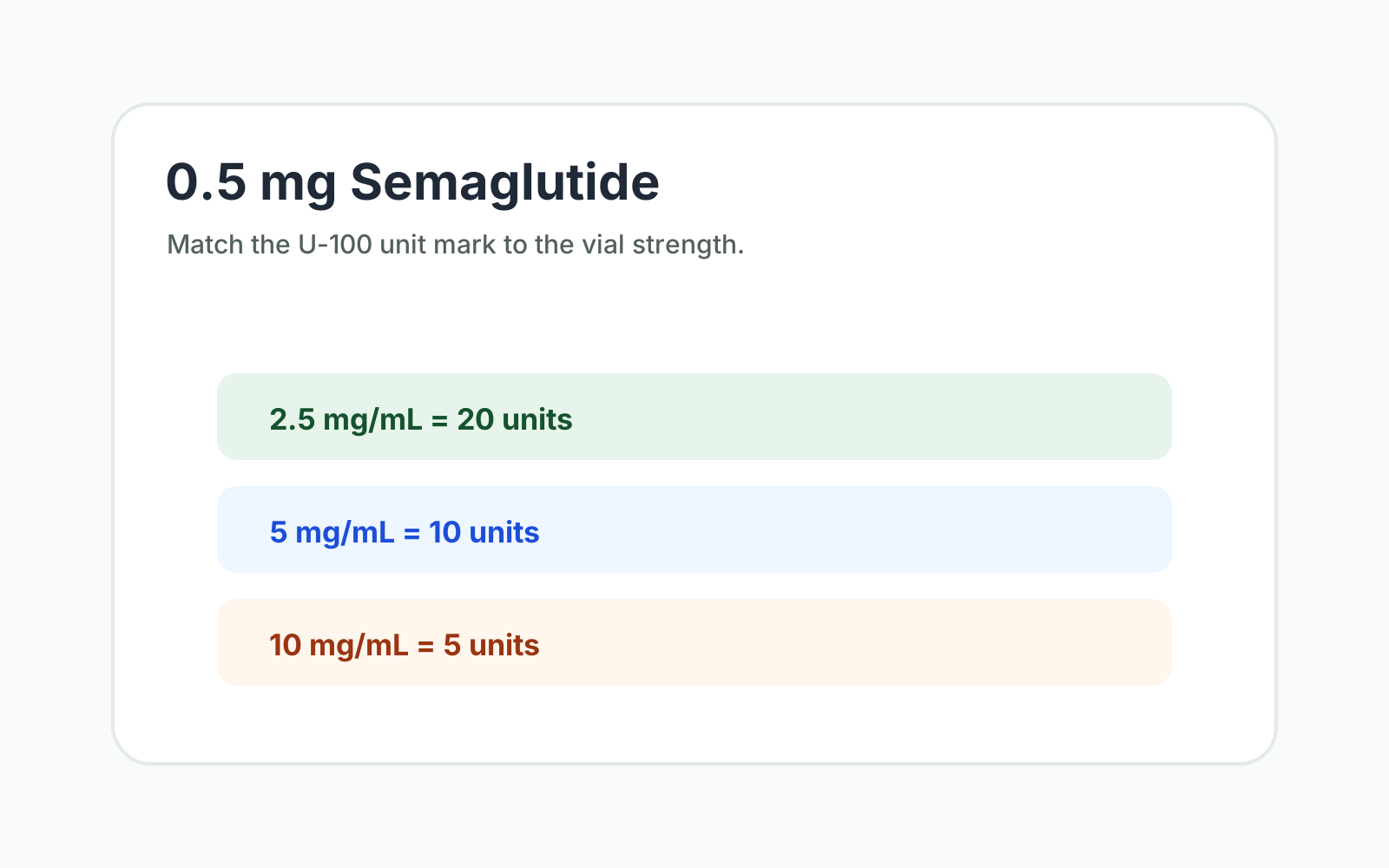
The drugs are not interchangeable, and the dose numbers are not equivalent. A semaglutide dose chart should not be used to dose tirzepatide.
Reconstituting without recalculating
If powder is mixed with a different amount of bacteriostatic water, the units change even though the total vial mg stays the same. For more on that workflow, see how to reconstitute tirzepatide.
Safety context
Tirzepatide dosing errors can cause severe nausea, vomiting, dehydration, dizziness, low blood sugar risk in some diabetes-medication combinations, and difficulty eating enough protein or fluids. Call your clinician or pharmacy if you cannot clearly identify medication name, concentration, syringe type, and target dose in mg.
Seek urgent medical help for severe or persistent vomiting, severe abdominal pain, signs of dehydration, symptoms of pancreatitis or gallbladder trouble, allergic reaction symptoms, or severe hypoglycemia symptoms.
FAQ
How many units is 2.5 mg of tirzepatide?
At 10 mg/mL, 2.5 mg is 25 units. At 20 mg/mL, it is 12.5 units. At 5 mg/mL, it is 50 units.
How many units is 5 mg of tirzepatide?
At 10 mg/mL, 5 mg is 50 units. At 20 mg/mL, it is 25 units. At 40 mg/mL, it is 12.5 units.
How many mg is 50 units of tirzepatide?
Fifty units is 0.5 mL on a U-100 syringe. At 5 mg/mL that is 2.5 mg, at 10 mg/mL it is 5 mg, at 20 mg/mL it is 10 mg, at 25 mg/mL it is 12.5 mg, and at 30 mg/mL it is 15 mg. Every Mounjaro and Zepbound single-dose vial holds exactly 0.5 mL, so a 50-unit draw from one of those is the whole labeled dose — which is 2.5 mg, 5 mg, 7.5 mg, 10 mg, 12.5 mg or 15 mg depending only on which vial you are holding. Identify the concentration before treating 50 units as a dose.
Is 50 units always 5 mg?
No. Fifty units is 0.5 mL on a U-100 syringe. It equals 5 mg only if the concentration is 10 mg/mL.
Why do calculators give decimals like 12.5 units?
Because the math may land between syringe marks. If your syringe does not allow accurate measurement of that value, ask your pharmacy for instructions rather than rounding on your own.
Bottom line
Tirzepatide unit conversion is not a universal chart. First verify concentration. Then use units = mg × 100 ÷ mg/mL. The most important safety rule is simple: never use a unit number unless you can tie it back to the medication name, concentration, syringe type, and prescribed mg dose.
References
- Tirzepatide Dosage Guide (available strengths and titration) — Drugs.com
- FDA Approves New Medication for Chronic Weight Management (Zepbound) — U.S. Food and Drug Administration
- Tirzepatide — StatPearls, NCBI Bookshelf (NIH)
- Jastreboff AM, et al. Tirzepatide Once Weekly for the Treatment of Obesity (SURMOUNT-1). N Engl J Med. 2022 — PubMed
- ZEPBOUND (tirzepatide) injection — Prescribing Information and single-dose vial Instructions for Use, Eli Lilly and Company (DailyMed)
- MOUNJARO (tirzepatide) injection and KwikPen — Prescribing Information, Eli Lilly and Company (DailyMed)