Semaglutide Dosage Chart: mg by Week, Titration, and Ozempic vs Wegovy Dose Differences
Direct answer: Weekly injectable semaglutide begins at 0.25 mg once weekly and escalates every 4 weeks through 0.5 mg, 1 mg, 1.7 mg, and 2.4 mg for weight management (Wegovy path), or through 0.5 mg, 1 mg, and 2 mg for type 2 diabetes (Ozempic path). Oral semaglutide runs on two separate charts: Rybelsus at 3 mg → 7 mg → 14 mg daily, and Wegovy tablets at 1.5 mg → 4 mg → 9 mg → 25 mg daily. The starting dose is a tolerance-building step, not the maintenance target.
| Quick reference | Details |
|---|---|
| Starting injection dose | 0.25 mg once weekly — tolerance step, not the main dose |
| Ozempic titration path | 0.25 mg → 0.5 mg → 1 mg → 2 mg |
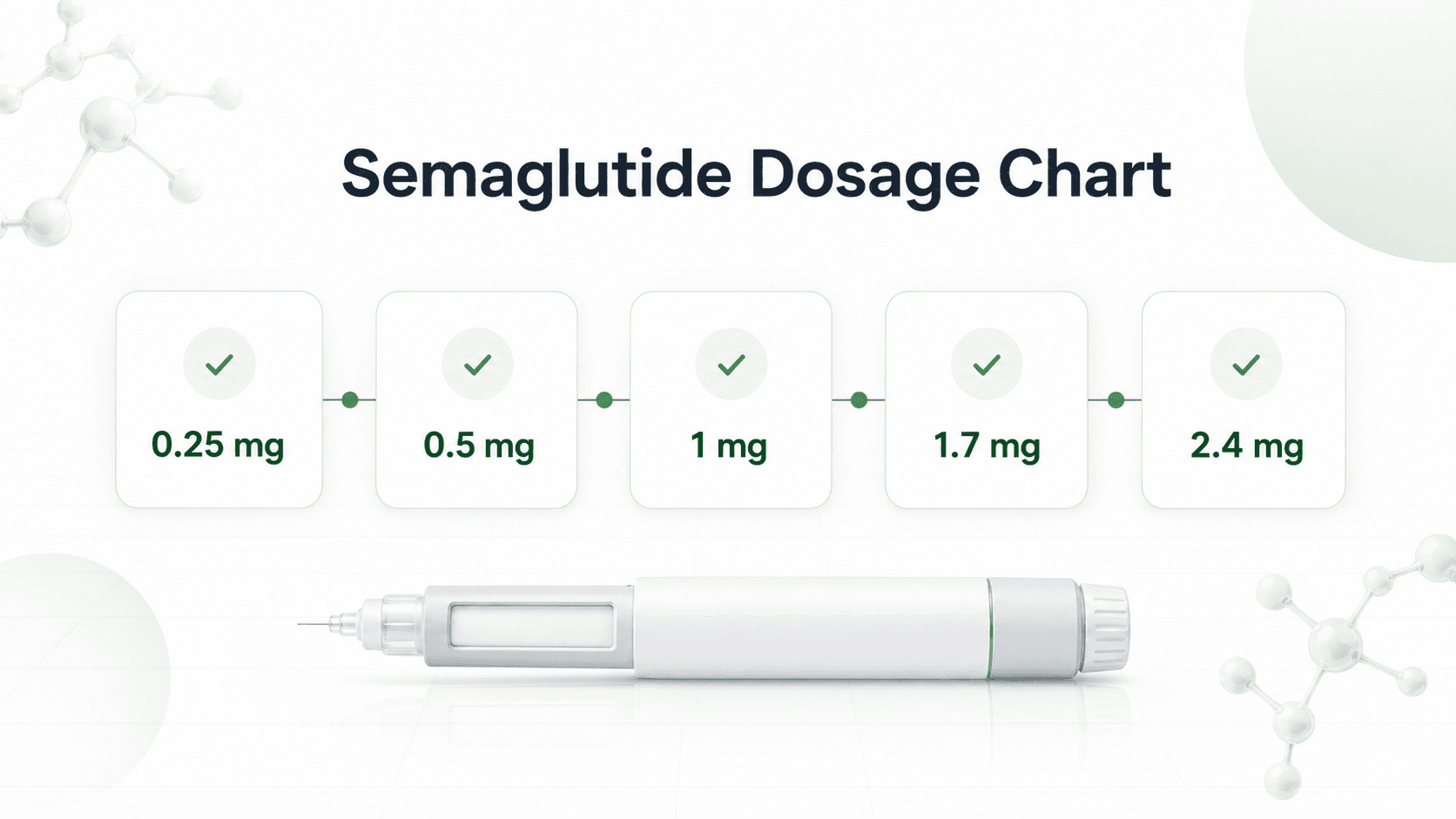
| Wegovy titration path | 0.25 mg → 0.5 mg → 1 mg → 1.7 mg → 2.4 mg |
| Oral semaglutide path (Rybelsus) | 3 mg daily → 7 mg daily → 14 mg daily |
| Oral semaglutide path (Wegovy tablets) | 1.5 mg → 4 mg → 9 mg → 25 mg once daily |
| Maintenance dose, weight management | 2.4 mg weekly by injection, or 25 mg daily by tablet |
| Syringe size rule (compounded) | Syringe size in units depends on vial concentration — units are not universal |
This page is a reference chart, not personal dosing advice. Semaglutide dose escalation should be managed by a licensed clinician because the appropriate dose depends on the product, indication, side effects, other medications, and medical history.
Semaglutide titration chart by product
Semaglutide is the active ingredient across several products, but the titration schedule and dose escalation path differ meaningfully by product. Ozempic, Wegovy, Rybelsus, and compounded semaglutide are not used on the same schedule.
| Product | Form | Titration path (mg) | Main use context |
|---|---|---|---|
| Ozempic | Weekly injection | 0.25 → 0.5 → 1 → 2 mg | Type 2 diabetes and blood-sugar control |
| Wegovy | Weekly injection | 0.25 → 0.5 → 1 → 1.7 → 2.4 mg | Chronic weight management |
| Rybelsus | Daily oral tablet | 3 → 7 → 14 mg | Oral semaglutide for type 2 diabetes |
| Wegovy tablets | Daily oral tablet | 1.5 → 4 → 9 → 25 mg | Oral semaglutide for chronic weight management |
| Compounded semaglutide | Vial and syringe | Prescriber-determined; concentration varies | Syringe size must be calculated from concentration |
Semaglutide doses are written in milligrams. Compounded vial instructions often express doses in syringe units, which creates conversion confusion covered in detail below.
Wegovy semaglutide dosage chart: mg by week
Wegovy-style dose escalation follows a 4-week step-up schedule. Each phase allows the GI system to adapt before the next increase.
| Weeks | Dose | Phase purpose |
|---|---|---|
| Weeks 1–4 | 0.25 mg once weekly | Tolerance-building start; not the weight-management maintenance dose |
| Weeks 5–8 | 0.5 mg once weekly | Early escalation; appetite suppression often becomes more noticeable |
| Weeks 9–12 | 1 mg once weekly | Mid-escalation; GI tolerance remains the main limit |
| Weeks 13–16 | 1.7 mg once weekly | Pre-maintenance step |
| Week 17+ | 2.4 mg once weekly | Target maintenance dose in chronic weight-management context |
The 4-week rhythm in this semaglutide titration chart exists to reduce nausea, vomiting, reflux, constipation, and discontinuation. Rushing the titration schedule is one of the most common causes of early dropout.
Ozempic semaglutide dosage chart: mg by week
Ozempic-style dose escalation is discussed in type 2 diabetes context. It also starts at 0.25 mg weekly but has a different titration path from Wegovy — the highest labeled dose is 2 mg, not 2.4 mg.
| Stage | Dose | Context |
|---|---|---|
| Start | 0.25 mg once weekly × 4 weeks | Tolerance-building start |
| Early treatment | 0.5 mg once weekly | First main treatment step |
| Escalation if needed | 1 mg once weekly | After clinician review |
| Higher-dose option | 2 mg once weekly | For additional glycemic control when appropriate |
This is the core Ozempic vs Wegovy dose difference: both products share the same first three titration steps (0.25 → 0.5 → 1 mg), but Wegovy adds a 1.7 mg step and a 2.4 mg maintenance dose. Ozempic's labeled path tops out at 2 mg and is written for diabetes, not weight management.
Ozempic and Wegovy contain the same active molecule but are not interchangeable. They have different product labels, pen devices, approved indications, and dose targets.
For a broader look at the drug itself, see the semaglutide guide. For a direct comparison with tirzepatide, see tirzepatide vs semaglutide. If you are moving the other direction, the tirzepatide to semaglutide conversion guide covers dose matching.
Rybelsus oral semaglutide dosage chart
Rybelsus is oral semaglutide, dosed daily rather than weekly. Its dose steps are not equivalent to injectable milligrams and should not be converted as if they were the same formulation.
| Stage | Dose | Timing note |
|---|---|---|
| First 30 days | 3 mg once daily | Starting dose; primarily an administration-habituation step |
| After 30 days | 7 mg once daily | Main treatment step |
| If more effect needed | 14 mg once daily | Higher oral dose after clinician review |
Oral semaglutide has strict administration rules: the tablet must be taken with no more than 4 oz of plain water, at least 30 minutes before the first food, drink, or other medication of the day. These rules are not relevant to injectable products.
Wegovy tablets (oral semaglutide) dosage chart
Wegovy tablets are a second oral semaglutide product, approved in December 2025 for chronic weight management. The strengths and the escalation ladder are completely different from Rybelsus. A Rybelsus 14 mg tablet and a Wegovy 9 mg tablet are not interchangeable, and neither chart converts into the other. Our guide to where to buy oral semaglutide covers each pill option and what it costs.
| Days | Dose | Phase purpose |
|---|---|---|
| Days 1–30 | 1.5 mg once daily | Tolerance-building start |
| Days 31–60 | 4 mg once daily | Second escalation step |
| Days 61–90 | 9 mg once daily | Pre-maintenance step |
| Day 91 onward | 25 mg once daily | Maintenance dose |
Escalation is every 30 days rather than every 4 weeks, and the maintenance dose is 25 mg once daily.
Administration rules are as strict as Rybelsus and are effectively part of the dose:
- Take the tablet on an empty stomach in the morning, with water only, up to 4 oz
- Swallow whole — do not split, crush, chew, or dissolve it
- Wait at least 30 minutes before food, any other beverage, or any other oral medication
- If a dose is missed, skip it and take the next dose the following day
The label also names a defined fallback: if the 25 mg once-daily maintenance dose is not tolerated, switching to Wegovy injection at 1.7 mg once weekly is the option written into the prescribing information. That is the only officially stated oral-to-injectable step anywhere in the semaglutide range.
Compounded semaglutide: syringe size, mg vs units
Compounded semaglutide introduces the most dosage-chart confusion because vials are labeled by concentration, and syringe-size instructions are written in units rather than milligrams. Where these vials can still legally be obtained is covered separately in our guide to buying compounded semaglutide.
The rule: milligrams describe the semaglutide dose. Units describe syringe volume. Syringe size in units only makes sense once you know the vial concentration.
The table below shows how syringe size changes with concentration for two common dose targets:
| Vial concentration | 0.25 mg dose = | 0.5 mg dose = | 1 mg dose = |
|---|---|---|---|
| 1 mg/mL | 0.25 mL (25 units on U-100) | 0.5 mL (50 units on U-100) | 1.0 mL (100 units on U-100) |
| 2.5 mg/mL | 0.10 mL (10 units on U-100) | 0.2 mL (20 units on U-100) | 0.4 mL (40 units on U-100) |
| 5 mg/mL | 0.05 mL (5 units on U-100) | 0.1 mL (10 units on U-100) | 0.2 mL (20 units on U-100) |
On a U-100 insulin syringe, 1 mL equals 100 units. The syringe size in units for a 5 mg/mL vial is therefore one-fifth the syringe size for the same dose drawn from a 1 mg/mL vial. Two patients can both report taking "10 units" and be on completely different semaglutide doses.
A search query like "5mg semaglutide dosage chart with syringe size for weight" reflects this exact confusion: the number "5" could refer to a 5 mg/mL vial concentration, a total vial fill, or a dose step — and the syringe size calculation differs for each. Always confirm the vial concentration with the compounding pharmacy before drawing any dose.
For a standalone reference that maps each semaglutide step to its syringe volume by concentration, see this detailed semaglutide dosage guide.
Compounded semaglutide dosing chart in units, by vial concentration
This is the full compounded semaglutide dosage chart in syringe units, covering every injectable dose step at four common vial concentrations. Every number assumes a U-100 insulin syringe, where 1 mL equals 100 units.
| Dose | 1 mg/mL vial | 2.5 mg/mL vial | 5 mg/mL vial | 10 mg/mL vial |
|---|---|---|---|---|
| 0.25 mg | 25 units (0.25 mL) | 10 units (0.10 mL) | 5 units (0.05 mL) | 2.5 units (0.025 mL) |
| 0.5 mg | 50 units (0.50 mL) | 20 units (0.20 mL) | 10 units (0.10 mL) | 5 units (0.05 mL) |
| 1 mg | 100 units (1.00 mL) | 40 units (0.40 mL) | 20 units (0.20 mL) | 10 units (0.10 mL) |
| 1.7 mg | 170 units (1.70 mL) | 68 units (0.68 mL) | 34 units (0.34 mL) | 17 units (0.17 mL) |
| 2.4 mg | 240 units (2.40 mL) | 96 units (0.96 mL) | 48 units (0.48 mL) | 24 units (0.24 mL) |
The arithmetic behind every cell is one line: units = (dose in mg ÷ concentration in mg/mL) × 100.
Two practical warnings fall straight out of the table:
- At 1 mg/mL, the 1.7 mg and 2.4 mg steps exceed a standard 1 mL U-100 syringe. Needing more than one full syringe for a single dose is a signal that the concentration is wrong for that dose step, not an instruction to inject twice.
- At 10 mg/mL, a 0.25 mg dose is 2.5 units, below the reliable measuring range of most U-100 syringes, where the smallest printed gradation is 1 or 2 units.
A vial labeled "2.5 mg" or "5 mg" is stating the total amount in the vial, not the concentration. Concentration is total milligrams divided by the volume of solution in milliliters. A 5 mg vial in 2 mL of solution is 2.5 mg/mL; the same 5 mg vial in 1 mL is 5 mg/mL, and every unit figure in the row changes accordingly. This is why a question like "how many units in a 2.5 mg semaglutide vial" has no single answer until the fill volume is known.
Confirm the concentration printed on the pharmacy label, not the milligram figure on the front of the vial, before drawing any dose.
Why semaglutide dose escalation starts so low
The 0.25 mg starting dose — the semaglutide starter dose almost everyone is written for in week 1 — is not a functional weight-management or glycemic-control dose. It is a tolerance-building step.
Semaglutide slows gastric emptying and alters appetite signaling. When the dose increases too quickly, side effects — not lack of efficacy — cause most early discontinuations.
Common early side effects that drive premature dose escalation attempts:
- Nausea
- Constipation
- Diarrhea
- Reflux or belching
- Early satiety
- Appetite loss for foods the patient previously tolerated
- Vomiting triggered by large or high-fat meals
For a practical first-dose timeline, see what to expect on day 1 of semaglutide. For broader symptom management, see the GLP-1 side effects guide.
Ozempic vs Wegovy dose differences: direct comparison
This table isolates the differences most searchers are looking for:
| Feature | Ozempic | Wegovy |
|---|---|---|
| Active ingredient | Semaglutide | Semaglutide |
| Approved indication | Type 2 diabetes | Chronic weight management |
| Starting dose | 0.25 mg weekly | 0.25 mg weekly |
| Maintenance dose range | 0.5 mg, 1 mg, or 2 mg | 2.4 mg (target) |
| Wegovy-only dose steps | — | 1.7 mg and 2.4 mg |
| Pen device | Different (Ozempic FlexTouch) | Different (Wegovy pen) |
| Dose interchangeable? | No — different label, pen, and indication |
The main clinical reason these paths differ: the dose needed to achieve meaningful weight reduction in the STEP trials was higher than the dose typically needed for glycemic control in T2D. That is why Wegovy extends the titration to 2.4 mg while Ozempic's standard label stops at 2 mg.
Semaglutide dosage chart: weight loss vs diabetes context
The same active ingredient sits inside very different treatment contexts depending on the product.
| Variable | Weight-management context | Diabetes context |
|---|---|---|
| Common product mentioned | Wegovy | Ozempic or Rybelsus |
| Primary goal | Chronic weight reduction | Blood-sugar control; secondary weight benefit |
| Typical weekly maintenance dose | 2.4 mg | 0.5–2 mg depending on response |
| Titration rhythm | Every 4 weeks (Wegovy chart) | Based on glucose response and tolerance |
| Key monitoring | Weight trend, appetite, nutrition quality, tolerance | Glucose, A1C, hypoglycemia risk, tolerance |
GLP-1 maintenance dose chart: how semaglutide compares
A search for a GLP-1 maintenance dosage chart usually means one thing: what dose do people actually end up on once titration is finished. These are the labeled maintenance targets across the main GLP-1 and dual-agonist products.
| Drug (brand) | Route and frequency | Starting dose | Escalation interval | Labeled maintenance dose |
|---|---|---|---|---|
| Semaglutide (Wegovy injection) | Weekly injection | 0.25 mg | 4 weeks | 2.4 mg weekly |
| Semaglutide (Wegovy tablets) | Daily oral | 1.5 mg | 30 days | 25 mg daily |
| Semaglutide (Ozempic) | Weekly injection | 0.25 mg | 4 weeks | 0.5 mg, 1 mg, or 2 mg weekly |
| Semaglutide (Rybelsus) | Daily oral | 3 mg | 30 days | 7 mg or 14 mg daily |
| Tirzepatide (Zepbound) | Weekly injection | 2.5 mg | ≥ 4 weeks, 2.5 mg steps | 5 mg, 10 mg, or 15 mg weekly |
| Tirzepatide (Mounjaro) | Weekly injection | 2.5 mg | ≥ 4 weeks, 2.5 mg steps | Up to 15 mg weekly |
| Liraglutide (Saxenda) | Daily injection | 0.6 mg | 1 week | 3 mg daily |
| Liraglutide (Victoza) | Daily injection | 0.6 mg | 1 week | 1.2 mg or 1.8 mg daily |
| Dulaglutide (Trulicity) | Weekly injection | 0.75 mg | ≥ 4 weeks | Up to 4.5 mg weekly |
Milligrams do not compare across molecules. Semaglutide (often misspelled semiglutide) reaches its weight-management maintenance target at 2.4 mg weekly, while tirzepatide reaches its at up to 15 mg weekly. That gap is potency per milligram, not strength of effect. Reading one product's chart against another's and concluding that 2.4 mg is a "small" dose is the most common misreading of a GLP-1 dosage chart.
Three structural patterns show up in the table:
- Weekly injectables all start at a deliberately sub-therapeutic dose and step up every 4 weeks.
- Daily products escalate faster — weekly steps for liraglutide, 30-day steps for both oral semaglutide products.
- Only Wegovy injection, Wegovy tablets, Zepbound, and Saxenda carry weight-management maintenance targets. The rest are labeled for type 2 diabetes, which is why their maintenance doses are written as a range tied to glucose response rather than a single target.
How long the maintenance dose lasts is the follow-up question, and the trial data answers it directly. In STEP 4, adults who reached 2.4 mg weekly during a 20-week run-in and stayed on it continued losing weight over the next 48 weeks, while those switched to placebo regained weight. Maintenance dosing in this class is framed as ongoing therapy, not a finish line, which makes the maintenance phase a dosing decision rather than just a weight target.
When to escalate the dose
The semaglutide titration chart provides minimum time intervals, but dose increases should answer three questions:
- Has enough time passed at the current dose? (Usually 4 weeks minimum.)
- Are current side effects manageable? Persistent nausea, constipation, or vomiting suggests staying at the current step.
- Does the prescriber agree that more effect is needed?
Feeling well on a lower dose does not automatically justify faster escalation. The schedule in the chart is a floor, not a target speed.
What if side effects appear during dose escalation?
Side effects most often peak when the dose increases or when meals are incompatible with the medication's effect on gastric emptying.
Common triggers:
- Large meals
- High-fat meals
- Eating quickly
- Alcohol
- Low fluid intake
- Constipation left unmanaged
- Increasing the dose before the current dose feels stable
Seek prompt clinical attention for severe or worsening abdominal pain, repeated vomiting, signs of dehydration, faintness, symptoms of low blood sugar, or possible allergic reaction.
How to use this semaglutide dosage chart safely
Use this chart to understand the structure of semaglutide dose escalation. Do not use it to override a prescription, compounder label, or clinician plan.
Ask these questions before applying any number from this chart:
- Which semaglutide product am I using?
- Is this for type 2 diabetes, chronic weight management, or another context?
- Is my dose written in mg, mL, or syringe units?
- What is the vial concentration if this is a compounded product?
- How long have I been at the current dose?
- Are current side effects mild, manageable, or worsening?
- What other medications could alter risk — especially insulin or sulfonylureas?
FAQ
What is the normal starting dose of semaglutide?
For weekly injectable semaglutide (Ozempic and Wegovy), the standard starting dose is 0.25 mg once weekly for 4 weeks. This is a tolerance step, not the therapeutic maintenance dose.
What is the highest semaglutide dose?
Product-dependent. Wegovy's target maintenance dose is 2.4 mg weekly. Ozempic's highest labeled dose is 2 mg weekly. Rybelsus tops out at 14 mg daily. Compounded semaglutide doses are prescriber-determined.
Is Ozempic dosing the same as Wegovy dosing?
No. Both contain semaglutide, but they differ in labeled indications, dose paths, pen devices, and treatment goals. Wegovy extends to 1.7 mg and 2.4 mg steps that do not exist in Ozempic's standard label.
Is 0.25 mg semaglutide enough for weight loss?
For most people, 0.25 mg is the initial tolerance-building step. Meaningful appetite suppression and weight changes are more commonly reported at higher dose steps, though individual response varies.
How many units is 0.25 mg semaglutide on a syringe?
That depends on the compounded vial concentration. At 1 mg/mL, 0.25 mg = 25 units on a U-100 syringe. At 2.5 mg/mL, 0.25 mg = 10 units. At 5 mg/mL, 0.25 mg = 5 units. Always confirm concentration before calculating syringe size.
Can I speed up dose escalation if I have no side effects?
Dose escalation pace should be determined by the prescribing clinician. Absence of side effects does not automatically mean a faster titration schedule is medically appropriate.
What if I miss a semaglutide dose?
Follow the product label or prescriber guidance. Missed-dose instructions differ by product and timing and should not be estimated from a general titration chart.
What is the lowest dose of semaglutide?
The lowest dose depends on the form. For weekly injectable semaglutide it is 0.25 mg once weekly. For Rybelsus it is 3 mg once daily. For Wegovy tablets it is 1.5 mg once daily. In all three cases the lowest dose is a titration step, not a dose meant to be held long term.
What are the equivalent doses of semaglutide across products?
There is no complete conversion table, and the gaps in it are official. Published pharmacokinetic comparison places exposure after oral semaglutide 14 mg once daily as comparable with 0.5 mg subcutaneous semaglutide once weekly, and notes there is no equivalent oral dose for someone taking 1 mg subcutaneous semaglutide. Separately, the Wegovy label names one specific switch: a patient who cannot tolerate 25 mg tablets daily may be moved to 1.7 mg injection weekly. Beyond those two points, matching doses between products is a prescriber decision, not a chart lookup.
How long do you stay on the semaglutide maintenance dose?
Maintenance is open-ended by design. In the STEP 4 trial, participants who continued 2.4 mg weekly after reaching it kept losing weight across the following 48 weeks, while participants switched to placebo regained weight. Stopping is a clinical decision with a predictable weight trajectory attached, not a scheduled endpoint on the titration chart.
How many units is a 2.4 mg semaglutide dose?
Only answerable once the vial concentration is known. On a U-100 syringe, 2.4 mg is 96 units from a 2.5 mg/mL vial, 48 units from a 5 mg/mL vial, and 24 units from a 10 mg/mL vial. From a 1 mg/mL vial it works out to 240 units, more than two full 1 mL syringes, which means the concentration is wrong for that dose step.
Is there a printable PDF of this semaglutide dosage chart?
There is no separate PDF download of this page, but every table here prints directly from the browser. For a source PDF behind the injectable numbers, the FDA prescribing information for Ozempic and Wegovy are the official documents the dose steps come from.
Summary
A complete semaglutide dosage chart must distinguish five products: Ozempic, Wegovy injection, Wegovy tablets, Rybelsus, and compounded semaglutide. The weekly injectable titration chart starts at 0.25 mg and escalates in 4-week steps, but the endpoint differs — 2 mg for Ozempic-context dosing and 2.4 mg for Wegovy-context dosing. Compounded semaglutide adds a syringe-size conversion layer: units on the syringe only describe volume, not dose, unless the vial concentration is known. The titration schedule is a clinical framework; dose escalation decisions belong with the prescriber.
References
- Wilding JPH, Batterham RL, Calanna S, et al. Once-Weekly Semaglutide in Adults with Overweight or Obesity (STEP 1). New England Journal of Medicine. 2021. PubMed 33567185
- OZEMPIC (semaglutide) injection - Highlights of Prescribing Information. U.S. Food and Drug Administration. FDA label
- WEGOVY (semaglutide) injection - Highlights of Prescribing Information. U.S. Food and Drug Administration. FDA label
- WEGOVY (semaglutide) injection and WEGOVY (semaglutide) tablets - Prescribing Information. DailyMed, U.S. National Library of Medicine. DailyMed label
- ZEPBOUND (tirzepatide) injection - Prescribing Information. DailyMed, U.S. National Library of Medicine. DailyMed label
- MOUNJARO (tirzepatide) injection - Prescribing Information. DailyMed, U.S. National Library of Medicine. DailyMed label
- SAXENDA (liraglutide) injection - Prescribing Information. DailyMed, U.S. National Library of Medicine. DailyMed label
- VICTOZA (liraglutide) injection - Prescribing Information. DailyMed, U.S. National Library of Medicine. DailyMed label
- TRULICITY (dulaglutide) injection - Prescribing Information. DailyMed, U.S. National Library of Medicine. DailyMed label
- Rubino D, et al. Effect of Continued Weekly Subcutaneous Semaglutide vs Placebo on Weight Loss Maintenance in Adults With Overweight or Obesity: The STEP 4 Randomized Clinical Trial. JAMA. 2021. PubMed 33755728
- Gallwitz B, Giorgino F. Clinical Perspectives on the Use of Subcutaneous and Oral Formulations of Semaglutide. Frontiers in Endocrinology. 2021;12:645507. PMC8276717