5-Amino-1MQ is a small molecule that inhibits the enzyme NNMT, reported at oral doses of roughly 50 to 150 mg daily, and it has produced encouraging results in obese mice with no published human trials at all. If you are approaching 5-Amino-1MQ for beginners guidance, the most useful thing to know first is that the entire efficacy case currently rests on rodent studies and user reports.
That does not make it a bad compound. It makes it an early stage one, and there is a meaningful difference between the two.
What It Actually Is
The full name is 5-amino-1-methylquinolinium. It is not a peptide, despite being sold alongside them. It is a small, membrane permeable molecule that selectively inhibits nicotinamide N-methyltransferase.
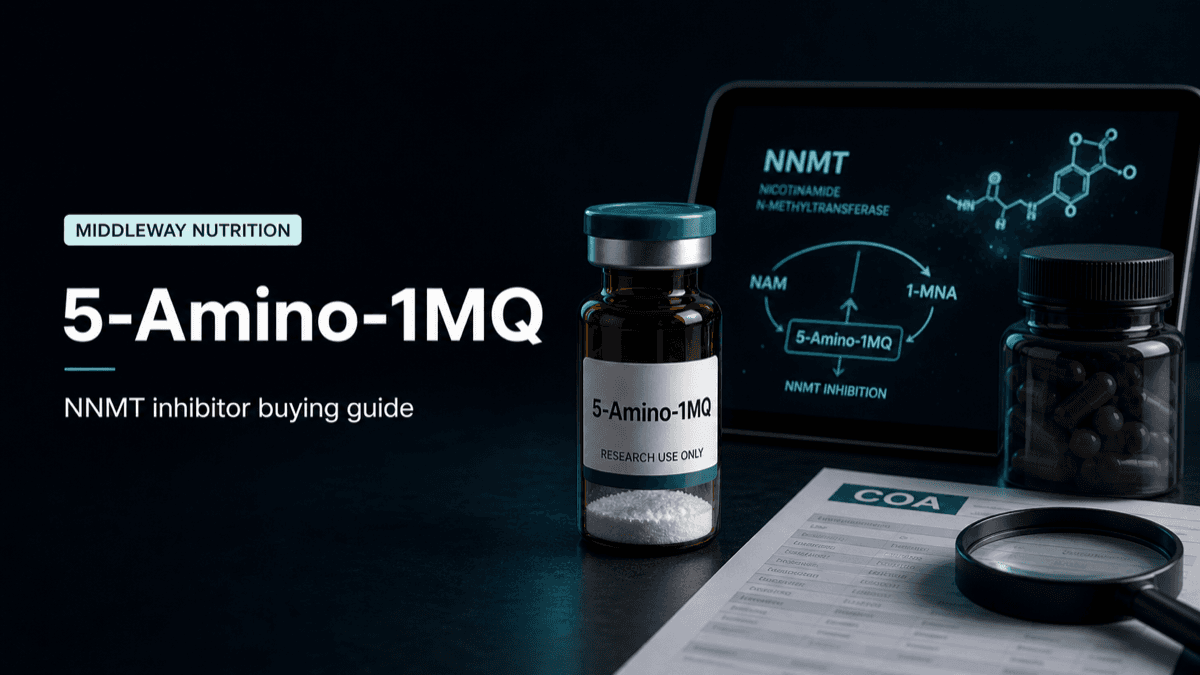
NNMT sits at an interesting junction of metabolism. The enzyme methylates nicotinamide using S-adenosylmethionine as the methyl donor, producing 1-methylnicotinamide. Two things follow from that reaction: methyl groups are consumed, and nicotinamide is diverted away from the salvage pathway that would otherwise recycle it into NAD+.
NNMT expression is elevated in adipose tissue in obesity. The hypothesis behind 5-Amino-1MQ is that inhibiting it restores the methyl pool and raises intracellular NAD+ in fat cells, shifting them from storage toward oxidation.
What the Research Actually Shows
Preclinical work in diet induced obese mice reported reduced fat mass without reduced food intake, which is the finding that generated interest. Separate work has examined NNMT inhibition in the context of muscle stem cell function and ageing.
There are no published human clinical trials. Not phase 1, not phase 2. Every claim about human fat loss, insulin sensitivity or energy is extrapolation from mouse data or user report.
This is worth stating plainly because the marketing routinely does not. "Studied for metabolic health" is technically true and practically misleading if the studies are all in rodents.
5-Amino-1MQ for Beginners: Reported Dosage Ranges
These are ranges described in user reports and vendor material, not validated protocols. No dose finding study exists in humans.
| Format | Reported range | Notes |
|---|---|---|
| Oral capsule | 50 to 150 mg daily | The dominant format. Most reports start at 50 mg |
| Oral capsule, higher | Up to 250 mg daily | Reported, with no evidence the extra does anything |
| Subcutaneous injection | Small microgram amounts | Uncommon. Oral is the sensible route for a membrane permeable small molecule |
| Cycle length | 8 to 12 weeks, then a break | Convention rather than evidence |
| Timing | Morning, with or without food | Reports differ. Consistency matters more than timing |
The conservative approach is the defensible one here. Start at the low end, hold for two to four weeks, and judge before adjusting. There is no research supported reason to start high, and starting high mainly increases the chance of the gastrointestinal upset that is the commonest complaint.
What to Realistically Expect
The claims in circulation cover fat loss, better insulin sensitivity, more energy and improved body composition. What people actually report is more modest: a slow change in body composition over a couple of months, more noticeable in the mirror than on the scale, alongside whatever diet and training they were already doing.
Nothing about the mechanism suggests appetite suppression, and reports confirm that. It does not act like a GLP-1 drug and it does not act like a stimulant. If you are looking for a compound that makes eating less easier, this is not it.
The honest framing is that 5-Amino-1MQ is a metabolic adjunct with a plausible mechanism and no human efficacy data, which means expectations should be set very low and any result should be attributed cautiously.
Stacking, and Why Not to Start There
The compounds most often paired with it are growth hormone secretagogues and repair peptides, on the theory that different mechanisms combine well.
For a beginner this is a bad idea for a simple reason: stacking makes it impossible to tell what did what. If three things start at once and something changes, you have learned nothing about any of them. Running it alone for the first cycle costs nothing and is the only way to get an interpretable result.
Our 5-Amino-1MQ guide covers the compound in more depth, and 5-Amino-1MQ versus other peptides puts it against the alternatives.
Practical Points
- Capsules from research suppliers vary in actual content. A batch specific third party certificate of analysis is the minimum check
- Take it consistently at the same time of day so any effect is attributable
- Track waist measurement and photographs rather than scale weight alone, since the claimed effect is compositional
- Do not change diet and training at the same time you start, or you will not know what caused what
- Stop if gastrointestinal symptoms persist beyond the first couple of weeks
- Set a fixed end date for the cycle before you start, so it does not quietly become indefinite
The last point matters more than it seems. Compounds with subtle effects and no defined endpoint have a way of being continued for months on the reasoning that stopping might undo something, when nothing measurable ever started. Deciding in advance what would count as a result, and what you will do if it does not appear, is the difference between an experiment and a subscription.
Cost is worth calculating on the same basis. At the reported ranges, a monthly outlay for a compound with no human efficacy data sits alongside things with far better evidence behind them, including simply eating more protein and lifting weights three times a week. Neither is a substitute for the other, but the ordering matters.
FAQ
What is a beginner dose of 5-Amino-1MQ?
Reported use starts around 50 mg daily orally, held for two to four weeks before any change. No human dose finding study exists, so this is convention rather than evidence, and there is no reason to believe higher is better.
How long before 5-Amino-1MQ does anything?
Reports describe changes over four to eight weeks if at all, consistent with a compositional rather than an appetite effect. Nothing should be expected in the first fortnight.
Is 5-Amino-1MQ a peptide?
No. It is a small molecule NNMT inhibitor. It is grouped with peptides commercially rather than chemically, and its oral bioavailability is precisely why it is not injected.
Does 5-Amino-1MQ suppress appetite?
No, and the mechanism does not predict that it would. The rodent work showed reduced fat mass without reduced food intake, which is the opposite of how appetite suppressants work.
Is it safe?
Short term reports describe mild gastrointestinal upset and occasional headache and little else. There is no long term human safety data, because there are no human trials. Absence of reported harm is not the same as a safety profile.