
5-Amino-1MQ vs Other Peptides for Fat Loss (Including Retatrutide vs Berberine)
Direct answer: 5-Amino-1MQ inhibits NNMT inside fat cells to raise NAD+ and improve fat oxidation. It does not suppress appetite. GLP-1 agonists like semaglutide, tirzepatide, and retatrutide reduce food intake centrally. Natural compounds like berberine activate AMPK. These mechanisms do not compete — they operate on separate layers of metabolism, and the right choice depends on which layer is limiting your progress.
Where 5-Amino-1MQ Fits in the Weight Loss Peptide Landscape
Most weight loss peptides fall into two camps: appetite regulators and metabolic modifiers. Semaglutide, tirzepatide, and retatrutide are GLP-1 receptor agonists that belong in the first camp. They signal satiety centrally and slow gastric emptying. You eat less because hunger is chemically dialed down.
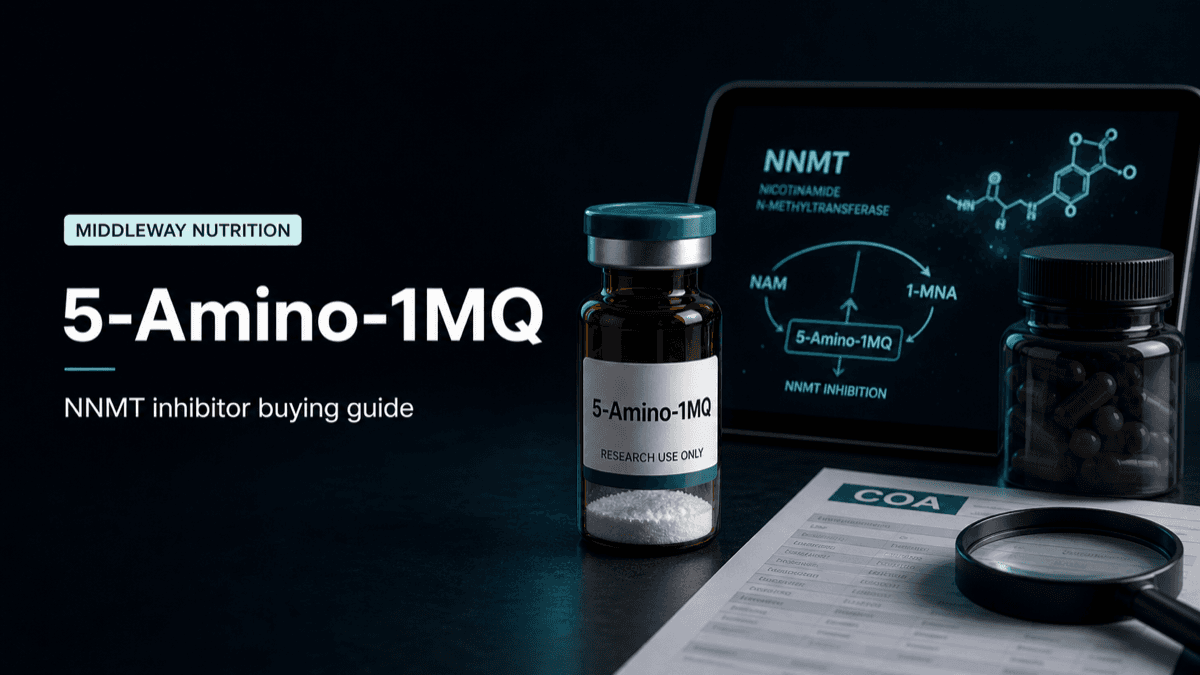
5-Amino-1MQ operates in the second camp. It blocks NNMT — nicotinamide N-methyltransferase — inside adipose tissue. When NNMT is inhibited, the methyl donor SAM is conserved and intracellular NAD+ rises. Higher NAD+ drives mitochondrial activity, meaning fat cells shift toward oxidation rather than storage. No appetite pathway is touched.
The trade-off is evidence quality. GLP-1 agonists have phase 3 human trial data showing 10–22% average body weight reduction. 5-Amino-1MQ has rodent studies and user case reports. That gap matters. It is not a reason to dismiss the compound, but it is a reason to sequence your interventions: proven tools first, experimental refinements second.
5-Amino-1MQ vs GLP-1 Agonists (Semaglutide, Tirzepatide, Retatrutide)
Comparing 5-Amino-1MQ to a GLP-1 agonist frames it as a versus decision. It is not. They address different bottlenecks.
GLP-1 agonists excel when overconsumption is the primary driver of excess weight. If hunger is constant, cravings are difficult to override, or eating behavior is dysregulated, semaglutide and tirzepatide have an unmatched clinical record. Retatrutide, a triple GIP/GLP-1/glucagon agonist in late-stage trials, shows even steeper weight loss numbers. None of these compounds meaningfully alter cellular fat oxidation independent of the caloric deficit they create.
5-Amino-1MQ targets a downstream problem: the metabolic environment inside adipocytes when someone has already reduced intake. Users who plateau on a GLP-1 agonist, lose muscle alongside fat, or find their energy production sluggish at low calorie intake may find NNMT inhibition addresses precisely what GLP-1 therapy cannot.
A common practical stack: GLP-1 agonist for appetite control on injection days, 5-Amino-1MQ on weekdays to maintain cellular fat oxidation. This separates hormonal modulation from metabolic priming without compounding mechanisms that share pathways.
Retatrutide vs Berberine: A Natural Metabolic Comparison
The "retatrutide vs berberine" question puts a cutting-edge pharmaceutical against a well-established plant alkaloid, and the comparison is more instructive than it first appears.
Retatrutide activates three incretin receptors simultaneously (GIP, GLP-1, glucagon), producing pronounced appetite suppression, increased energy expenditure via glucagon signaling, and improved insulin sensitivity. In phase 2 trials, participants lost up to 24% of body weight at 48 weeks. It is injectable, still in trials, and carries GLP-1-class side effects.
Berberine activates AMPK — the same energy-sensing enzyme activated by caloric restriction and exercise. It improves insulin sensitivity, lowers fasting glucose, and has modest but reproducible effects on body weight and lipid panels. It is oral, inexpensive, and has decades of human data.
They are not interchangeable. Retatrutide delivers pharmacological appetite suppression and receptor-level metabolic shifts that berberine cannot replicate. Berberine offers reliable AMPK activation, proven glucose management, and a safety record that retatrutide does not yet have. For someone unwilling or unable to use injectables, berberine combined with 5-Amino-1MQ creates a stacked oral protocol targeting both AMPK (berberine) and NNMT/NAD+ (5-Amino-1MQ) pathways simultaneously. That is a mechanistically sound combination with no known adverse interactions.
5-Amino-1MQ vs BPC-157 (Different Goals, Different Mechanisms)
BPC-157 is a body protection compound derived from gastric juice protein. Its primary documented effects are tissue repair: tendon healing, gut lining restoration, reduced inflammation, and improved vascularization. It does not inhibit NNMT, activate GLP-1 receptors, or directly alter adipocyte metabolism.
Comparing BPC-157 to 5-Amino-1MQ for fat loss misframes the question. BPC-157 supports fat loss only insofar as improved recovery enables more consistent training. If an overuse injury or gut dysfunction is the bottleneck on progress, BPC-157 addresses that bottleneck. 5-Amino-1MQ does not.
Where they complement each other: BPC-157 keeps training capacity high, 5-Amino-1MQ supports the metabolic efficiency of that training. No mechanistic overlap, no known negative interactions, different administration windows. Stack them when both problems are present.
5-Amino-1MQ vs MK-677 (GH Stimulation vs NNMT Inhibition for Body Composition)
MK-677 (ibutamoren) stimulates GH secretion by mimicking ghrelin. More GH raises IGF-1, supporting muscle hypertrophy, recovery quality, and to a degree, lipolysis — particularly in visceral fat. The clinical cost is increased appetite, transient water retention, and potential insulin resistance over longer cycles.
5-Amino-1MQ does not stimulate growth hormone and does not affect appetite. Its mechanism is strictly intracellular in adipose: NNMT inhibition, NAD+ elevation, mitochondrial activation. It does not drive muscle growth.
For someone prioritizing fat loss without muscle gain, MK-677's appetite effect can actively undermine progress unless dietary discipline is high. 5-Amino-1MQ does not create that friction. For recomposition — simultaneous fat loss and muscle gain — MK-677 offers stronger anecdotal and mechanistic support for the muscle side of the equation.
A careful combination: low-dose MK-677 (10–15 mg, 2–3 times weekly rather than daily) for recovery and lean mass preservation, with 5-Amino-1MQ daily for fat oxidation. This approach limits continuous ghrelin receptor activation while preserving the GH pulse benefit.
5-Amino-1MQ vs AOD-9604 (Two Fat-Loss Peptides Compared)
AOD-9604 is a C-terminal fragment of human growth hormone intended to stimulate lipolysis via fat cell GH receptors without the growth-promoting or insulin-affecting properties of full GH. In theory, it tells fat cells to release stored triglycerides without the downstream metabolic costs of HGH.
In practice, AOD-9604 human trial results have been underwhelming. The compound failed to demonstrate meaningful weight loss in its phase 2b/3 trials, which is why it was never approved. User reports are inconsistent — a subset perceive mild effects, but placebo-controlled data does not support reliable fat loss.
5-Amino-1MQ has not been through clinical trials, which is a genuine limitation. However, its mechanism — NNMT inhibition and NAD+ elevation — is built on a more robustly investigated pathway. The rodent data shows consistent fat mass reduction and metabolic improvements across multiple independent research groups. Mechanistically and anecdotally, it edges out AOD-9604.
If budget is limited, prioritize 5-Amino-1MQ over AOD-9604 for fat loss goals. AOD-9604 may warrant curiosity for those specifically exploring GH fragment pharmacology, but it is not a reliable primary fat-loss tool. If you want to compare it on price anyway, our guide to AOD-9604 for sale covers vial sizes and batch verification.
5-Amino-1MQ vs Natural Supplements (Berberine, Creatine, and Foundational Compounds)
Before any peptide, the foundational compounds deserve honest assessment. Creatine monohydrate has 40 years of controlled trial data supporting improved anaerobic output, lean mass preservation, and recovery — all of which indirectly support fat loss by enabling more productive training. The effect is reliable and inexpensive to achieve.
Berberine activates AMPK, the cellular energy sensor, improving insulin sensitivity, lowering fasting glucose, and producing modest but consistent improvements in metabolic markers. Clinical trials show 1–2 kg weight loss versus placebo over 8–12 weeks, with more pronounced effects in metabolically dysregulated populations.
5-Amino-1MQ works on a different cellular layer: NNMT/NAD+ rather than AMPK or contractile performance. It does not replace creatine or berberine. Used alongside them, it adds a third mechanism targeting adipocyte energy metabolism directly.
The hierarchy is clear: diet, training, and foundational supplements first. Berberine and creatine are well-evidenced enough to precede any peptide. 5-Amino-1MQ belongs in the optimization layer, not the foundation.
When to Stack 5-Amino-1MQ with Other Peptides (Practical Stacking Strategies)
Stacking is about matching mechanisms to the specific bottleneck, not combining everything simultaneously.
With GLP-1 agonists (semaglutide, tirzepatide, retatrutide): 5-Amino-1MQ on non-injection days maintains cellular fat oxidation while the hormonal half-life of the GLP-1 agonist carries appetite control through the week. Appetite and metabolic efficiency are addressed on separate pathways without overlap.
With berberine: A fully oral metabolic stack. Berberine handles AMPK and insulin sensitivity; 5-Amino-1MQ handles NNMT inhibition and NAD+ elevation. No known negative interaction. Both are taken with meals.
With BPC-157: Recovery-focused fat loss. BPC-157 supports tissue repair and training continuity; 5-Amino-1MQ supports the metabolic efficiency of that training. No overlapping mechanisms, no known adverse combination.
With low-dose MK-677: 5-Amino-1MQ daily for fat oxidation, MK-677 2–3 times weekly for recovery and lean mass. Limits appetite stimulation from continuous ghrelin agonism while preserving the GH benefit.
Avoid stacking with: Other NNMT inhibitors (theoretical redundancy), or compounds that place heavy demands on SAM methylation pathways in individuals with known methylation sensitivities.
Start with one addition at a time. Track weight, measurements, energy, and strength. Complexity without tracking produces noise, not signal.
Honest Verdict: Who Gets the Most Out of 5-Amino-1MQ vs Who Should Skip It
Worth trying if:
- You have plateaued despite consistent diet and training
- You want to preserve muscle while reducing fat
- You prefer oral over injectable administration
- You are already using a GLP-1 agonist or berberine and want an additional metabolic layer
- You understand and accept the experimental nature of the compound
Skip it if:
- You need significant, predictable weight loss (20+ lbs) — use a clinically validated GLP-1 agonist
- You have type 2 diabetes or serious metabolic disease — start with evidence-based options
- You need appetite suppression — 5-Amino-1MQ provides none
- You require FDA-approved status for peace of mind
- Your nutrition, training, and sleep are not yet optimized
5-Amino-1MQ is a metabolic refinement tool. Its value is highest when the foundation is solid and the bottleneck is cellular rather than behavioral. If that describes where you are, our guide to 5-Amino-1MQ for sale covers current pricing and batch verification.
Dosage and Administration
Most protocols run 50–150 mg daily, split across one or two doses taken with meals. Typical cycles are 8–12 weeks on, 4 weeks off. Start at 50 mg to establish tolerance; some users report mild headaches or transient sleep changes at higher doses.
Oral administration allows flexible timing. Many align dosing with breakfast and lunch to match peak energy demand. Unlike weekly GLP-1 injections, no strict schedule is required — consistency matters more than precise timing.
There is no official dosing guidance, as no human trials have established one. Log your results: weight, body measurements, training performance, and energy. Adjust based on what you observe over a minimum of 6 weeks before drawing conclusions. If you are weighing up sources, our guide on where to buy 5-Amino-1MQ covers vendor checks, certificate red flags and what to expect from a legitimate seller.
Frequently Asked Questions
Is 5-Amino-1MQ legal to buy? Yes, as a research chemical. It is not FDA-approved for human use, not scheduled, and not banned in any major jurisdiction. Purchase from suppliers that publish independent third-party certificates of analysis.
Will 5-Amino-1MQ appear on a drug test? No standard athletic or occupational drug panel tests for it. It is not a controlled substance.
Can women use 5-Amino-1MQ? Yes. The NNMT inhibition mechanism is not sex-specific. No dose adjustment based on sex is supported by current data. Start low and titrate on response.
How long until results are visible? Energy changes may be noticed within 1–2 weeks. Body composition changes typically require 6–12 weeks of consistent use alongside appropriate diet and training.
Should it be taken on an empty stomach? Most protocols recommend taking it with food to minimize potential digestive discomfort, though it is generally well-tolerated.
Can it be combined with other supplements? No known major interactions with common supplements or medications. If taking prescription drugs, space doses where possible and consult a prescribing provider.
Internal Linking Opportunities
- Learn more about 5-Amino-1MQ capsules
- Explore our peptide capsules guide
- Read about tirzepatide for weight loss
Ready to Try 5-Amino-1MQ?
If you've optimized your diet and training but want to see what's possible with metabolic optimization, 5-Amino-1MQ capsules might be worth experimenting with, sourced from a supplier that publishes an independent third-party certificate of analysis for the batch you receive. Remember: peptides complement, they don't replace, the fundamentals.
Note: This article is for informational purposes only. 5-Amino-1MQ is not FDA-approved for weight loss or any medical condition. Consult with a healthcare provider before starting any new supplement regimen.
References
- Jastreboff AM, Aronne LJ, Ahmad NN, et al. Tirzepatide Once Weekly for the Treatment of Obesity (SURMOUNT-1). New England Journal of Medicine. 2022. PubMed 35658024
- Neelakantan H, Vance V, Wetzel MD, et al. Selective and membrane-permeable small molecule inhibitors of nicotinamide N-methyltransferase reverse high fat diet-induced obesity in mice. Biochemical Pharmacology. 2018. PubMed 29155147
- Jastreboff AM, Kaplan LM, Frias JP, et al. Triple-Hormone-Receptor Agonist Retatrutide for Obesity - A Phase 2 Trial. New England Journal of Medicine. 2023. PubMed 37366315