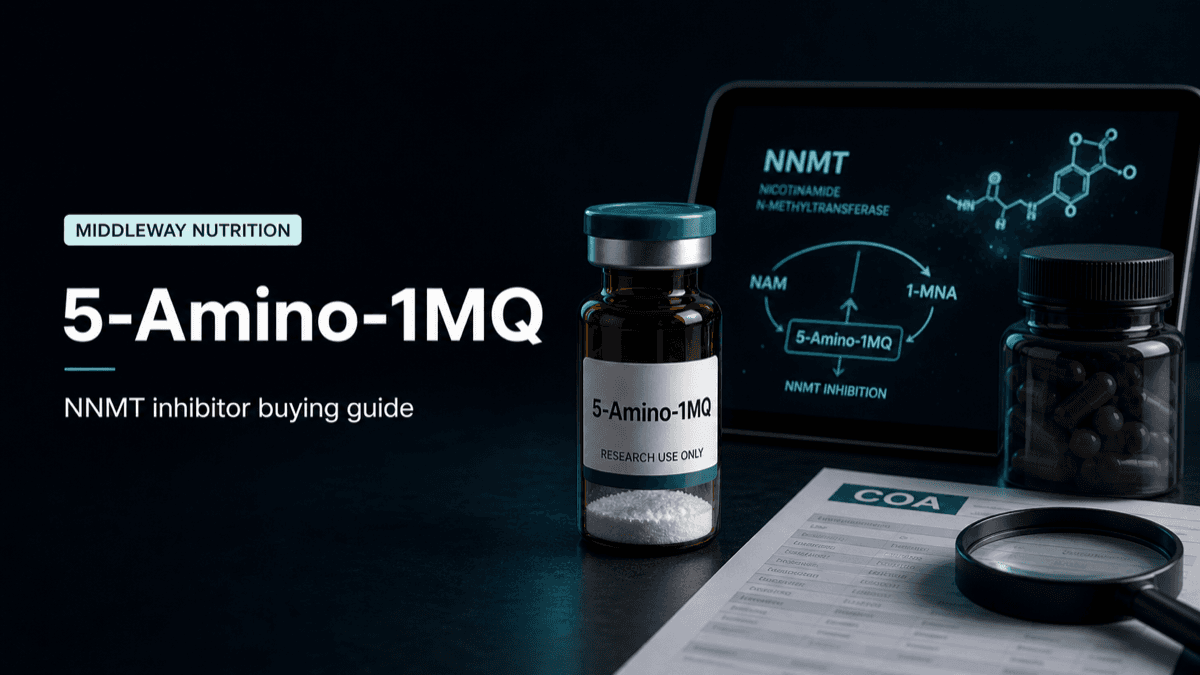
5-Amino-1MQ for sale spans a wide band, from the low tens of dollars for a small vial to the hundreds for bulk gram quantities. That is the easy part. The harder part is proving the vial holds what the label says, because every listing claims high purity and says "COA included," and prices swing tenfold for supposedly the same powder. Below is how to read that price band, then the verification that separates a documented batch from a bag of something.
Key Takeaways
- Small vials sit in the low tens of dollars and bulk grams climb into the hundreds, all sold research-use-only. There is no prescription pathway and no FDA-approved version of this compound
- Ask for per-batch third-party COAs by name, then confirm the report with the issuing lab instead of trusting the PDF
- The most-missed check: most 5-Amino-1MQ is the iodide salt (CAS 42464-96-0, MW 286.11), and only about 56% of that mass is the active cation
- A COA is only evidence if its lot number matches the lot on your container and the issuing lab will confirm the report
- Because this is cheap to synthesize, a low price is a weaker scam signal than with peptides. Missing paperwork is the real red flag
Our pick: Ascension Peptides
Ascension Peptides is where we would buy 5-Amino-1MQ. Their 10mg vial is $52.00 USD, and new customers get 50% off with code PEPTIDEDECK. Quantity discounts also apply: buy 3, 5 or 10 units and save 3%, 5% or 10%.
Every batch is independently tested by a third-party lab. Current batches go to Kovera Labs, whose certificates cover HPLC purity, LC-MS identity, net content (mg per vial), endotoxin, a rapid sterility screen and heavy metals (lead, arsenic, cadmium, mercury), with a pass mark of >98% purity. Older batches were tested by MZ Biolabs in Tucson. The certificates are batch-specific and sit in a public library of 85 certificates, so you can match the lot on your vial to its report. We checked one Kovera report (KVR-2026-410047, for DSIP) against the lab's own records, and it matched.
Two limits worth knowing before you order: Ascension ships within the United States only, with free shipping over $250, and all sales are final, although damaged or incorrect items are replaced if reported quickly. Whatever the certificate shows, still run the salt-form check below and ask whether the 10mg is quoted as the salt or the free-base equivalent.
What a fair price looks like
Listed prices move constantly, so treat any figure as a band. Small vials in the 5-10mg range sit in the low tens of dollars, 50mg vials and capsule bottles run higher, and bulk gram quantities climb into the hundreds.
The band is wide for a reason. Synthesizing a small molecule is far cheaper than assembling a thirty-plus residue peptide, so the cost floor is genuinely low. That flips the usual advice: with retatrutide a rock-bottom price is a strong scam signal because the chemistry cannot be that cheap. Here, cheap can simply be cheap. So price is a poor filter and paperwork is a good one. A cheap vial with a verifiable batch COA beats an expensive bottle carrying a stock certificate and a countdown timer.
For a side-by-side of sellers, see our companion guide on where to buy 5-Amino-1MQ.
What you are actually buying
5-Amino-1MQ is short for 5-amino-1-methylquinolinium. It is not a peptide, which surprises people who find it in peptide catalogs. It is a small heterocyclic molecule acting as a substrate-competitive inhibitor of nicotinamide N-methyltransferase (NNMT), the enzyme that methylates nicotinamide using SAM as the donor. Because NNMT is heavily expressed in adipose tissue and liver, the research interest sits in adipocyte energetics and metabolic rate. That work is preclinical, and any vendor presenting it as a finished fat-loss product is selling past the evidence. Being a small molecule also matters practically: it is orally stable, needs no cold chain, and is verifiable with standard analytical chemistry.
Any listing you find for 5-Amino-1MQ for sale exists in the research chemical market, not the pharmaceutical one. No FDA-registered manufacturer stands behind it and no recall mechanism exists, which transfers the quality burden onto you. Nobody audits the synthesis or verifies the fill weight, and the seller decides which data to publish. Your only leverage is documentation: make the vendor prove things rather than assert them.
How to read the COA
A certificate of analysis describes one specific production lot. A PDF showing a generic product name with no lot number is marketing, not evidence. Work through it in this order:
Compound identity. Should name 5-amino-1-methylquinolinium and specify the salt form. CAS 42464-96-0 is the iodide; some suppliers offer the chloride. Both are legitimate, but you need to know which you bought.
Lot number and analysis date. The lot must match the number on the container you receive, and the analysis must be recent and tied to that lot, not a batch made two years ago. If the vendor cannot produce a COA for your lot, treat that as a no.
HPLC purity. Look for 98% or higher, the floor analytical suppliers specify for reference-grade material. Below 95% is not worth buying. Purity is only half the story though: a vial can be 99% pure by HPLC and still be underfilled, so weight and identity matter alongside the percentage.
Mass spectrometry identity. The check people skip and the one that matters most. HPLC says the sample is one clean thing; mass spec says which thing. The cation weighs near 159.2, the iodide salt near 286.1. Purity without identity leaves the key question open.
Third-party testing: independent or it does not count
An in-house COA on the seller's letterhead is a self-assessment. It might be honest; you have no way to know. Independent testing means a lab with no stake in the sale ran the sample and issued a report you can verify, and that verification step is what almost nobody performs. Take the report number and contact the lab directly. Labs used in this market, including MZ Biolabs, Kovera, and Janoshik Analytical, will confirm whether a report is genuine. Forged COAs circulate freely and a PDF is trivially editable. Two supporting signals: an accredited facility (ISO 17025), and testing published for every lot rather than one flagship batch.
The salt-form arithmetic nobody mentions
Vendor pages routinely list the molecular weight as 159.21. That is the active 5-amino-1-methylquinolinium cation. The powder you receive is almost always the iodide salt, formula mass 286.11, of which iodide is roughly 44%.
So a jar labeled "1 g of 5-Amino-1MQ" as the iodide salt holds closer to 556 mg of active cation. That is not fraud, it is normal chemistry. But two listings quoting the same milligram figure are not comparable, which explains part of the price-per-milligram spread.
Ask one question before ordering: is the quoted quantity the salt or the free base equivalent? A vendor who answers immediately understands their product. One who cannot is reselling something they have never looked at.
What actually arrives
Three formats are common and not interchangeable: crystalline or lyophilized powder in a sealed vial (usually 5-50mg, for reconstitution), bulk powder in gram quantities, and capsules or oral liquid at typically 50mg per unit.
Expect a fine off-white to pale yellow solid, sealed and labeled with compound name and lot number. Vials hold far less visible material than people expect, which triggers a lot of unnecessary "I got scammed" panic. It needs no frozen shipping, so an ambient package is not a warning sign. What should concern you is an unlabeled container or no lot number anywhere.
Red flags to walk away from
- No lot-specific COA on request. The clearest disqualifier there is.
- A COA the issuing lab will not confirm, or a lab with no verifiable presence.
- Salt form unstated and the vendor cannot tell you when asked.
- Basic chemistry errors, most often calling it a NAMPT inhibitor or a peptide. It is neither.
- Human dosing protocols beside "research use only" language. A seller doing both does not take the framing seriously.
- Purity claimed without identity data. Clean and correct are different questions.
- Crypto-only payment from an unknown seller, which removes chargeback recourse.
Legal and safety reality
5-Amino-1MQ is not approved by the FDA for human use, and it is not a legal dietary supplement because it does not meet the definition of a dietary ingredient. It is sold lawfully as a research chemical for laboratory work, and that is the only framing under which these transactions are legitimate. Human safety data is thin to nonexistent: preclinical work is not a safety profile, the long-term effects of sustained NNMT inhibition in people are unknown, and no controlled dosing standard exists.
Quick pre-purchase checklist
- Is there a COA specific to the lot you are being sold, with a matching lot number on the container?
- Does it report HPLC purity of 98% or higher?
- Does it include mass spectrometry identity confirmation?
- Is the salt form stated, and is the quoted mass salt or free base?
- Was the testing done by an independent lab you can contact, recently?
- Does the vendor avoid human-use or dosing claims?
Any "no" is worth a pause. Two or more, shop elsewhere.
FAQ
How much does 5-Amino-1MQ cost?
Prices vary widely between vendors and change often, so check current listings rather than any quoted figure. Small vials in the 5-10mg range sit in the low tens of dollars, while bulk gram quantities run into the hundreds. The spread is wide because synthesis costs are low, which makes price alone a weak quality indicator.
Is 5-Amino-1MQ legal to buy?
It is sold legally in the United States as a research chemical for laboratory use, not as a medicine or supplement. It is not FDA-approved and no prescription route exists. Buying it for personal consumption sits outside the regulated medical system.
How do I know 5-Amino-1MQ is real?
Get a lot-specific COA showing HPLC purity at 98% or above and mass spectrometry identity confirmation, then verify it directly with the issuing lab rather than trusting the PDF. Confirm the salt form too: CAS 42464-96-0 is the iodide, formula mass near 286.1 against a cation mass near 159.2.
Do I need a prescription for 5-Amino-1MQ?
No, and no clinician can write one, because it is not an approved drug. Research vendors sell directly without medical gatekeeping, which is exactly why the verification burden falls on the buyer.
Before you place the order
Whoever you buy from, do not skip the lot-match step. Ask for the COA for your batch, confirm the number on the container, check the salt form. Five minutes of paperwork is the only quality control this market offers you.
Medical disclaimer: 5-Amino-1MQ is sold for laboratory research use only. It is not an FDA-approved drug, not a dietary supplement, and not intended for human or veterinary consumption. This article is informational and is not medical advice or an endorsement of self-administration. Consult a qualified healthcare professional before making any health decision.